University Housing Department announces amended guest policy

News

Kylie McGovern, Editor

On Nov. 2 La Salle University’s department of Housing and Residence Life announced an amended visiting policy via email. The email noted that, in general, students have observed compliance with the public health expectations outlined by the University in La Salle’s health and safety guidelines. 

Beginning Wednesday, Nov. 3, at 5 p.m., La Salle University’s visitation policy will be revised to allow all residential students to accept enrolled non-residential or commuter students as guests at their residences. All guests must continue to be registered online through the established guest registration process. This new policy will be reviewed on an ongoing basis by La Salle’s COVID-19 Response Team, who will be monitoring the number of campus COVID-19 cases, student conduct cases and the impact of contact tracing. 

Each residence hall must abide by different numbers of guests. Including the host or hosts, up to four students can be in a residence hall room, up to six students can be in an apartment and up to 10 students can visit any given townhouse at a time. In addition, face masks are required in residence hall rooms any time guests are visiting. While visiting, the guest must be escorted by their host at all times.

Although the acceptance of commuter guests opens visiting to a new group of people, if students want to host family members or other visitors who are unaffiliated with La Salle University, they may visit campus outside of residential communities and in publicly accessible, open-air spaces.  

Sophomore and commuter Danielle O’Brien says she is ​​“very excited about the new changes concerning the guest policy as a commuter. For a time it felt unfair that commuters — a large percent of La Salle’s student population — were being excluded from visiting dorms. I, like many other computers, have trouble finding things to do in between classes, and visiting friends’ dorms would be a perfect way to accommodate this. 

“Broadening the guest policy to commuter students such as myself is a great opportunity to make connections and friends that you wouldn’t otherwise, and I’m very excited to plan new activities with friends who are dorming and their dorm mates. Not to mention broadening the guest policy to commuters can entice commuters to rethink on-campus housing as it was made clear to me that those dorming at La Salle clearly have a community of their own within their building.”

Dr. Henry A. Reichman presents discussion on the future of academic freedom

News

Elizabeth McLaughlin, Editor

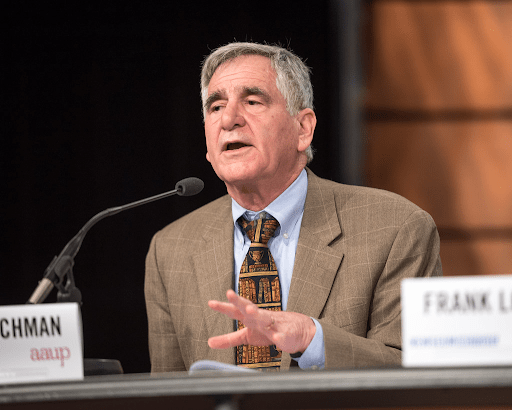
Mike Ferguson, AAUP

Dr. Henry Reichman conducted a virtual discussion on academic freedom in connection with the American Association of University Professors on Tuesday, Oct. 26, 2021.

On Tuesday, Oct. 26, Dr. Henry Reichman presented a Zoom discussion on academic freedom, a topic vital to the integrity of any institution of higher education. Dr. Reichman is the former American Association of University Professors (AAUP) Vice President and president of the AAUP Foundation, as well as the chair of AAUP’s Committee A on Academic Freedom and Tenure from 2012-2015. The event, organized by Dr. Barbara Allen and Dr. Joel Garver, garnered widespread attendance from students, staff and faculty members across all disciplines and from other universities.

In 2019, Dr. Reichman published his book “The Future of Academic Freedom,” which served as the backdrop for this conversation. He explained the terms of academic freedom, making sure to clarify common misconceptions, and offered his perspective on the current biggest threats to academic freedom.

Academic freedom is a concept belonging to the academic profession as a whole that protects the pursuit of inquiry. It guarantees to both faculty members and students the right to engage in debate without fear of censorship. In Dr. Reichman’s words, it “functions ultimately as the collective freedom of the scholarly community to govern itself in the interest of serving the common good in a democratic society.”

It is not, however, a civil liberty akin to freedom of speech; it cannot be classified as simply an employment benefit. Rather, it refers to the collective freedom of the faculty to govern itself as it sees fit, thereby promoting an environment in which academic inquiry is protected. It doesn’t allow a professor to do or say whatever they want without limit or accountability.

It does, however, protect a professor’s comments as a citizen even on topics that have nothing to do with their discipline. Such protection is essential to a healthy institution of higher education. Take, for example, the case of Dr. Arthur Butz, an electrical engineering professor at Northwestern University. In 1975, Dr. Butz published “The Hoax of the Twentieth Century: The Case Against the Presumed Extermination of European Jewry.” Dr. Butz’s Holocaust denial was met with harsh criticism from both his fellow faculty and the public at large. 

Many called for his resignation as a professor, decrying his blatantly anti-Semitic beliefs. Academic freedom, however, protects Dr. Butz’s right to publish this Holocaust denial book insofar as it does not affect his fitness to do research in and teach electrical engineering. Had Dr. Butz been a professor of 19th- and 20th-century history, for example, as Dr. Reichman was, then there would certainly be an argument that his beliefs about the Holocaust could affect his ability to do his job, and therefore academic freedom would not protect him. However, given his stature as a professor in engineering, Dr. Butz was allowed to publish such a book and keep his job.

The example of Dr. Butz is extreme, but nonetheless, academic freedom provides for an open environment for discussion within academic institutions. However, one of the most troubling trends in higher education, according to Dr. Reichman, is the tendency to misunderstand the concept of academic freedom; such a misunderstanding could prove to be dangerous to the liberties that such a concept seeks to protect. As with any debate on freedom, the question of responsibility arises: with great freedom comes great responsibility. Dr. Reichman argues that the responsibility refers not to using academic freedom with trepidation out of concern of backlash or censorship. Rather, there is a responsibility to protect this freedom, lest the integrity and functionality of academic institutions be jeopardized — “in academia, we have a collective responsibility to each other, our students, and the diverse common good in a democratic society.”


Toward the end of Dr. Reichman’s explanation of academic freedom, the floor was opened up to questions from audience members. One faculty member asked a question regarding intellectual property with respect to professor-created content: who owns the content we create for teaching? Dr. Reichman replied by saying that it belongs to the professor. The professor may retain their right to sign the rights of that intellectual property over to a publisher, for example, but since the faculty member is the one who created the material, it ultimately belongs to them. 

In the age of Zoom University, this question has become more relevant than ever; professors were required to move their entire courses online, demanding them to record lectures and develop virtual manipulatives, among other adjustments. The answer to the question of to whom do these materials belong remains unclear, but the AAUP states that they should belong to the faculty member who created them.

There was another question about the rights of the administration of a university to choose and have access to learning management systems (LMS), such as Canvas or Blackboard. According to Dr. Reichman, faculty members should be consulted in all decisions related to the university, especially those which directly impact teaching and learning. Therefore, the faculty should have a say in which LMS are used as well as the terms of access by the administration. Ultimately, faculty members should have the right to actively debate and vote on decisions made by their university that will affect their abilities to carry out their jobs. After all, “where academic freedom is not protected, shared governance will be a scam,” according to Dr. Reichman.

Students’ Government Elections

News

Kylie McGovern, Editor

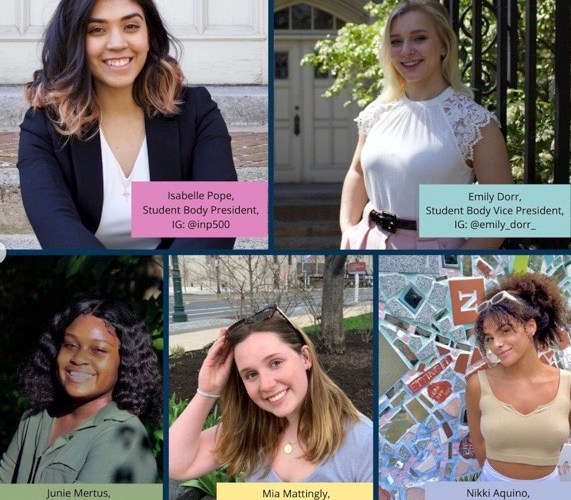
The elected officials and their positions via @lasallesga on Instagram 

Elections for the Students’ Government Association (SGA) for the 2021-2022 academic year election were held from 8 a.m. on Friday, Oct. 22 until 6 p.m. Voting for the student government was conducted using an online survey, which each student received via email. On each screen of the survey, the voter clicked the photo of the student they wanted to represent for the executive board position. The offices up for election were student body president, student body vice-president, secretary of academic affairs, secretary of business affairs and secretary of public affairs. Isabelle Pope, Emily Dorr, Emily Gaboriault, Junie Mertus, Mia Mattingly and Nikki Aquino all ran for the various positions. Candidates made election campaign videos that @lasallesga posted on their Instagram account. 

The results of the election were announced on Oct. 23. The members elected were Isabelle Pope as student body president, Emily Dorr as student body vice-president, Junie Mertus as secretary of academic affairs, Mia Mattingly as secretary of business affairs and Nikki Aquino as secretary of public affairs. 

President Pope said “It was a good race and I am glad that people took the initiative to run for positions after a difficult year with COVID. I am also really excited to see how a group of strong women in SGA leadership positions is going to impact our year this year! We still need to officially appoint a chief of staff and deputy chief of staff, as well as a director of diversity, equity and inclusion and I’m confident that with a full e-board we will be able to accomplish more this year, now that we are on campus.” Mia Mattingly also said she is “super excited to take on this new role in student government as secretary of business affairs because I feel like in this position I can help take initiative within the association and lead it in a direction for more student engagement all while helping with the financial aspects behind the scenes.” The Students’ Government Association will be holding class senator elections on Oct. 29. 

SGA News Brief: Elections

News

News brief provided by Keri Marable on behalf of La Salle Students’ Government Association 

Header Image: La Salle SGA

This October, the Students’ Government Association (SGA) will run elections for the elected representative positions. These positions can vote on issues during SGA meetings. These positions include all senator positions and the executive board.

SGA is the official representative of the student body to the administration. One of three students’ governing bodies on campus, SGA advocates for a better student experience on campus, as well as hosts fundraisers and events. They consider any full-time student at La Salle as a member of SGA and welcome anyone to join them at their general assembly meetings on Tuesdays at 9 p.m.

The e-board positions president and vice president require that a student have been a part of the SGA e-Board for at least one year. The other elected e-board positions are only available to those who have been a member of SGA for a year. The only e-board position open to anyone without experience in SGA is the Director of Diversity Equity and Inclusion, which is appointed via application.

Election voting for the elected e-board positions is Oct. 22 from 8 a.m. to 6 p.m. The e-board positions currently up for election include student body president, vice president, secretary of academic affairs, secretary of public affairs, chief of staff and deputy chief of staff.

SGA considers the Student Body president as the Chair of the Executive Board and appoints senators to committees. The president is also the tie-breaking vote in the senate. They attend University Council and various Board of Trustees meetings as well as stay informed on activities within SGA and on campus. They employ an appointed chief of staff and visual direct line of communication between the president and administration. The president also delegates and supports e-board, senate and members of the student body.

The Student Body vice president works closely with the president. They attend relevant meetings together and the vice president assumes presidential duties when needed. They also prepare a calendar and budget with the secretary of Business affairs. The vice president also employs an appointed deputy chief of staff. They are the chair of general meetings and creator of general meetings PowerPoint slides.

The secretary of academic affairs attends academic curriculum-based meetings and committees to take notes and report back to SGA. They support and collaborate with the College Senators and their initiatives within their prospective colleges. They act as the liaison between the students/SGA and the academic program leadership as well as working directly with the provost.

The secretary of Business Affairs manages the budget with frugality by controlling all incoming and outgoing cash flows. They promote any fundraising ideas/programs approved by the e-board. They also utilize all resources available and gather, secure and re-distributes any funds brought in via these fundraising methods. They create funding proposals for all events that SGA holds that require a cash outlay in any capacity to be sent to the funding board for review as completed. The secretary of Business Affairs also sits on the funding board committee and submits a new budget proposal for SGA at the end of the academic year for SGA 2022-23.

The secretary of public affairs manages all social media platforms, including **Instagram @lasallesga, Twitter @lasallesga and TikTok @lasallestudentgov. They provide a visual display of SGA initiatives on campus and frontline communication online between the student body and SGA. *A demanding role

The chief of staff attends and takes e-board meeting minutes and attends any relevant meetings when asked. They work closely with the president, including on any initiatives they ran on. They also continue in their duties as a senator/representative.

The deputy chief of staff attends executive board meetings and any relevant meetings when asked. They also take general meeting minutes and handle attendance to be sent to the advisor. The deputy chief of staff works closely with the vice president, including any initiatives he/she/they ran on. They also continue in their duties as a senator/representative.

The required qualifications for president and vice president include having a GPA equal to or greater than a 2.75 and must have served on e-board for a year. The required qualifications for the other e-board positions include having a GPA equal to or greater than 2.75 and must have participated in SGA for at least one year. ALL Elected e-board Positions must not be on disciplinary probation, form a petition (50 signatures) due on Oct. 18 and be a full-time student.

For more information on what must be done for elected e-board positions, please contact Isabelle Pope at popei1@lasalle.edu.

Another position students can run for is Class Senator. Any full-time student can run as a class senator. Election Voting for class senators is Oct. 29 from 8 a.m. to 6 p.m.

Class Senators vote on bills, legislation, money allocations and various other items at General Assembly meetings. They represent and advocate for the ideas and needs of their respective class and are chosen by election. The required qualifications for Class Senators include having a GPA equal to or greater than 2.50, must not be on disciplinary probation, form a petition (25 signatures) due Oct. 25 and be a full-time student.

SGA also has two other voting representative positions available by application only. One of these includes the College Senators, who represent each one of the colleges on campus.

Applications will be made active on October 1. The deadline for these applications is Oct. 22 at 6 p.m. The College Senators represent each of the colleges at La Salle (Arts and Sciences, Business and Nursing and Health Sciences) as well as advocate for problems and ideas for certain colleges rather than class. They are voting members chosen by application.

College Senator requirements for qualification include having a GPA equal to or greater than 2.50 and must not be on disciplinary probation. College Senators must submit the application found on SGA’s instagram on Google Forms by Oct. 22 at 6 p.m.

The other position accepted via application is the Executive Board’s Director for Diversity, Equality, and Inclusion who works to make the campus more inclusive for our diverse student population. Applications will be made active on Oct. 1. The deadline for these applications is Oct. 22 at 6 p.m.

The Director of Diversity, Equity, and Inclusion works closely with the heads of the Multicultural center in promoting events and addressing societal microaggressions. They create a small task force of members of the student body to address cultural differences and injustices that need to be brought to attention. They also promote voter engagement amongst eligible students, currently an 85 percent voter registration, highest in Philadelphia. The Director of D.E.I fully utilizes La Salle’s diverse culture and helps to foster a more comforting home for students of ALL races, ethnicities, gender identities and orientations, abilities, religions, socioeconomic status, etc.

The required qualifications include having a GPA equal to or greater than 2.75. *Students of historically marginalized identity are encouraged to apply* Candidates must submit the application found on the SGA’s Instagram on Google Forms by Oct. 22 at 6 p.m.

If you have any additional questions, please contact Kyra Spoto, the Election Committee Chair, at spotok@lasalle.edu or Isabelle Pope, the SGA president, at popei1@lasalle.edu.

Be sure to follow SGA on all social media to keep updated with the election process as well as future events and meetings for SGA.

La Salle University 2021 Honors Convocation

News

Kylie McGovern, Editor 

Timothy O’Shaughnessy at the virtual Honors Convocation 

On Thursday, Oct. 7 nearly 800 La Salle University Students were honored for their academic achievements at the Honors Convocation. Students who achieved a cumulative GPA of 3.50 and above with a minimum of 24 credit hours as of the start of the Fall 2021 semester were celebrated on Thursday. Qualifying students and their families were cordially invited to attend this year’s Virtual Honors Convocation on Thursday, Oct. 7 at 5:30 p.m. via email by the Provost. 

The convocation started with a welcome from the interim provost and vice president of academic affairs Steven Sicnolfi, Ph.D. Next, Father Frank Berna, Ph.D. of the religion and theology department led a prayer and invocation celebrating the accomplishments of the La Salle students during the particularly challenging time of the COVID-19 pandemic. The interim president Timothy O’Shaughnessy made his remarks welcoming friends, families, special guests, and students to the convocation to honor the students. President O’Shaughnessy ‘85 explained that “we are proud to gather today to honor our students who have achieved extraordinary academic success in the Lasallian community.”

 In addition to honoring students this year, La Salle University conferred an honorary degree to a distinguished Lasallian, Nelson J. Perez, Archbishop of Philadelphia. Archbishop Nelson J. Perez explained that he is filled with great joy to be able to celebrate the academic success of the La Salle students. Archbishop Nelson J. Perez also explained how he was inspired by the environment at La Salle in his time teaching theology and psychology here at La Salle. 

Following the presentation of the degree to Archbishop Perez, Steven Siconolfi, Ph.D. presented the distinguished faculty. Mary Wilby, Ph.D., MSN, CRNP, ANP-BC, R.N. of the school of nursing was presented with the 2021 Distinguished Lasallian Educator award. Then, Susan Dixon, Ph.D., an art professor, received the faculty distinguished scholar award. Following that award, Dr. Thomas Blume Ph.D., LMFT, LPC received the faculty distinguished service award. Dr. Catilin Taylor Caitlin Taylor, Ph.D. was then presented with the De LaSalle institute distinguished teaching award for full-time faculty. Following Dr. Taylor’s award, Reg Kim was presented with the De LaSalle institute distinguished teaching award for part-time faculty. Finally, Dr. Jennifer Kleinow Ph.D., CCC-SLP received the 2021 Lindback distinguished teaching award. 

Next, each school and its dean were recognized. First, the School of Arts and Sciences dean Pamela E. Barnett, Ph.D. presented the students in her school being celebrated. Then dean Yusuf Joseph Ugras, Ph.D. presented the School of Business’s recognized students. Lastly, the School of Nursing and Health sciences dean Kathleen Czekanski, PH.D., R.N., CNE those Nursing and Health sciences students being recognized. Dr. Steven Sicnolfi then gave a brief conclusion followed by the alma mater. 

South Philly statue of Christopher Columbus remains covered on Indigenous Peoples Day

News

Rita Offutt, Editor

On Saturday, Oct. 9, the Philadelphia Commonwealth Court decided that the Christopher Columbus statue in Philadelphia’s Marconi Plaza would remain covered, overruling the earlier Common Pleas Court ruling that the plywood box surrounding the statue be removed. The 145-year-old statue was covered by city officials during the summer of 2020, during protests surrounding the death of George Floyd. In July 2020, the Philadelphia Historical Commission voted to take down the statue, but a series of appeals have prevented it from being removed. 

On Friday, Common Pleas Court Judge Paula Patrick issued an emergency order that a contractor could remove the box surrounding the statue. George Bochetto, an attorney acting on behalf of the statue’s supporters, stated the statue would be uncovered by Sunday night. On Saturday afternoon he said the covering would be removed, “if not tonight, first thing tomorrow morning.” South Philadelphia resident Mark Anthony Carlini spoke out in support of the statue to 6abc, saying, “I think it’s a disgrace that they boxed that statue up. This represents the neighborhood. This represents Italian Americans.” Another supporter of the statue, Francis Recchuiti, said, “We are here to honor our heritage, our grandparents who came here…We want to maintain the fact that we have an ethnic identity…there’s no reason to forget your ethnic heritage, and we have. It’s important for our kids and our grandkids to understand there was tremendous discrimination, but we’ve risen above that.” 


The Philadelphia Inquirer
A man dressed as Christopher Columbus drives past the plywood box containing the Christopher Columbus statue.

Following Patrick’s decision, Philadelphia city officials filed an emergency application to vacate her ruling. The Commonwealth Court’s decision to keep the statue covered was released shortly before 11:00 p.m. on Saturday, Oct. 9. According to the Philadelphia Inquirer, “City officials described [Patrick’s decision on Saturday as ‘appalling’], which…came before they had time to respond to the request for permission to uncover the statue.” Representatives spoke out against the removal of the box, including Kevin Lessard, who said uncovering the statue “would pose a serious public safety risk.” Mayor Jim Kenney tweeted, “Grateful that the Commonwealth Court took the time to review this important matter tonight. No action will be taken with respect to the statue at this time.” 

Monday, Oct. 11 marks the first time Philadelphia will celebrate Indigenous People’s Day, replacing the previous Columbus Day holiday after Kenney issued an executive order to change the holiday in January 2021. The annual Columbus Day parade took place on Sunday, Oct. 10 despite the holiday being changed. Throughout both the parade and all of Indigenous People’s Day, the statue remained covered. 

La Salle releases security and fire safety report

News

Alina Snopkowski, Editor

On Friday, Oct. 1, La Salle University’s Department of Public Safety released its annual Security and Fire Safety Report through an email to the university. The entire 2021 report is available here and contains information on a variety of crimes that were reported from 2018-2020, as well as information on policies and procedures relating to reporting crimes.

According to the email sent by Public Safety, “La Salle University is committed to the safety of its students, faculty, staff, and visitors” and the report “contains information regarding campus security, personal and fire safety, crime prevention, crime reporting policies, and other policy matters relating to security on campus.”

If you don’t have time to read the entire 115-page report, here’s a summary of some of the major events, policies and statistics.

The report begins with the university’s mission and core values statements. It then continues with information on the public safety program, how to report criminal offenses or emergencies and how to describe people to public safety or emergency responders. It is also possible to report incidents confidentially through “the  Student Counseling Center; the Student Health Center, ordained priests in Ministry, Service, and Support; a designated Coordinator for Sexual Misconduct Advocacy & Education (Confidential Resource); and a designated Respondent Advocate (Confidential Resource). Reports can also be made via the mylasalle portal (search “Incident Reporting” and choose Standard Incident Report). Report violations of the sexual misconduct policy via the mylasalle portal (search “Incident Reporting” and choose “Report of Sexual Misconduct”).”

There are also sections that define the terms used throughout the report, including explanations of what is classified as a residence hall, who is technically a “University official” and the difference between guests and visitors.

Large portions of the report contain information on university policies relating to topics such as protecting minors, alcohol, drugs and weapons. There is also a section about sexual assault prevention, reporting, investigation, response and resources.

Reported fires for the years 2018 – 2020 and information on fire safety and evacuation procedures and are featured on pages 93 – 95. There were no reported fires in residence halls for the years 2020 and 2018, but four reported fires in 2019 — an electrical fire that took place in St. Basil Court, another electrical fire in the St. Miguel Townhouses, an accidental cooking fire that also took place in St. Miguel, and a stove fire in the La Salle Apartments.

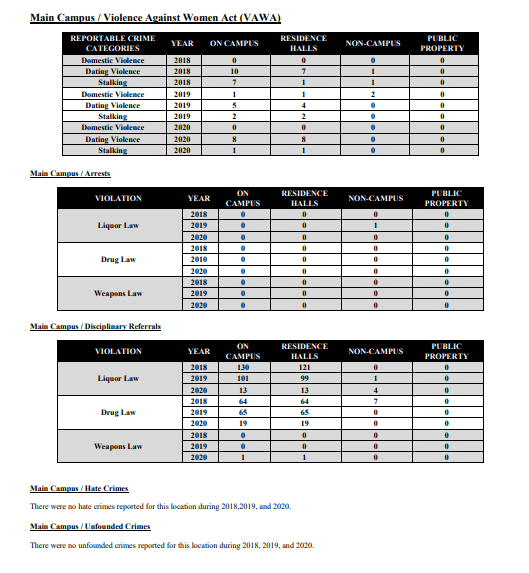
Pages 96 – 101 include tables of reported crimes on Main Campus, Bucks Campus, and Montgomery Campus. For the time period in the report, there were no reported crimes, arrests or disciplinary referrals at the Bucks or Montgomery campuses.

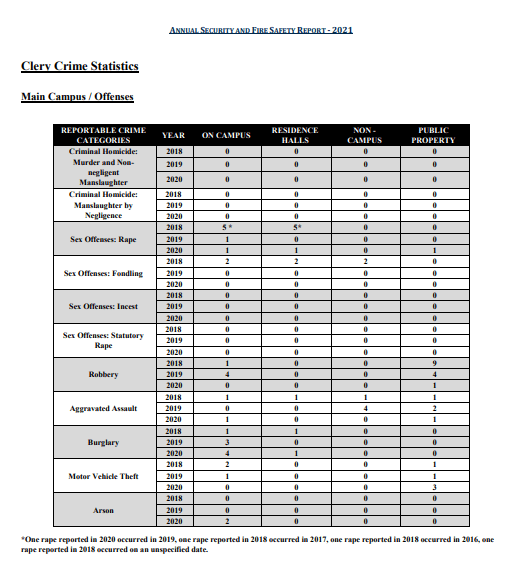
Here is the table of Clery Crime Statistics for 2018 – 2020 at Main Campus.

It is important to understand that the category “Residence Halls” is a subset of “On Campus;” for example, the case of aggravated assault that occurred in 2018 is reported in both the “on campus” and “residence halls” sections, and the one “residence halls” burglary is included in the four “on campus” burglaries, so there were four in 2020, not five.

After these tables, the rest of the report is devoted to student and employee populations, crime rates, more definitions of terms and offenses and concludes with a directory of important phone numbers.

Anyone who has questions about the information in the report is encouraged to contact either Assistant Vice President of Public Safety Amanda Guthorn, D.A., or Eva Howard, Director of Public Safety Compliance and Investigations.

S’mores With Sophomores Event

News
This image has an empty alt attribute; its file name is N45esLCksjkH3w9p7suT3BqsrRPm26TDTPHwIc_AxNqy9J2msnza1L6-iWRVkeruyoILwNIgXvxX6XYNqd4ynypGZXiscpxhUqFm6gGs3LVZy4VMmrJsf2RIHgy36QGwvFG_piVe=s0
Sophomores on the Hasen quad enjoying the S’mores with sophomores event via @ @explorientation on Instagram 

Kylie McGovern, Editor 

On Thursday, Sept. 30 at 7 p.m. the Explorientation team hosted an event for all sophomore students on the Hansen quad called S’mores With Sophomores. On Thursday evening, sophomores were invited to gather around the quad to make s’mores together. This was a special opportunity for the class of 2021 who missed out on some first year engagement activities on campus due to the last school year being primarily online. Therefore, this event gave the current sophomores one of their first chances to safely gather as a collective class amidst the pandemic. This event’s goal was to give students the opportunity to mingle and meet each other in an in-person and on campus environment. 

The Explorientation team set up fire pits to roast marshmallows throughout the quad. La Salle University sophomores participating in the event were provided with everything they needed to make the s’mores including marshmallows, graham characters, chocolate, and sticks to roast marshmallows. Students then made their s’mores and spent time together under the lights of the Hansen quad. One sophomore who particularly enjoyed her experience at the S’mores with Sophomores event is Emily Beals. On Thursday evening, Emily, some other sophomore friends and her roommate set out to make some s’mores and to socialize with some other members of the class of 2024. Upon arriving at the event Emily noticed how nice the quad was set up for the event. She commented on the event saying, “it was super cute and great to both hang out with friends and see all different people I know from my year!”

Emily’s experience at this event was similar to many sophomores who enjoyed the event’s opportunity to meet members of their class and to enjoy a classic campfire snack of s’mores. 

COVID-19 pandemic and social media raise increased concerns about eating disorders

News

Rita Offutt, Editor

On Tuesday, Oct. 5 the United States Subcommittee on Consumer Protection, Product Safety, and Data Security Hearing assembled for a hearing regarding recent allegations against Facebook. The allegations, known as the Facebook Files, were published by The Wall Street Journal in conjunction with whistleblower Frances Haugen. Haugen, who previously worked for Facebook as a data scientist, revealed her identity on the Oct. 2 episode of 60 Minutes. She has produced a body of evidence suggesting that Facebook is harmful for young people and is aware of the harm it is doing, and spoke in accordance with the allegations during the hearing.  

The Facebook Files issue six complaints and have additional articles that support the claims and offer additional information about Haugen. The six complaints are that Facebook has: (1) a secret elite that is exempt from Facebook’s rules; (2) knowledge that Instagram is unhealthy for teenage girls; (3) evidence that Facebook incites anger in its users; (4) weak responses to drug cartels and human traffickers; (5) sown doubt about the effectiveness and safety of COVID-19 vaccines; (6) gradually been recruiting younger audiences. One of the complaints receiving the most attention is Facebook’s knowledge that Instagram is unhealthy for teenage girls. The New York Times reported Senator Richard Blumenthal “recounted to the hearing the real-world impact Instagram has had on a daughter of one of his constituents, who struggled with eating disorders herself.” 

Kathleen Martinez is a Team Leader at The Renfrew Center, a national network of facilities that specialize in the treatment of eating disorders. She described how the social media feeds, such as Facebook and Instagram, are image-based platforms with algorithms that can fuel certain expectations around food, dieting, and body image. Martinez said one of the hallmarks of eating disorders is “a comparison mindset”, and that social media accounts that share unhealthy ideas about dieting or unrealistic body expectations can perpetuate feelings of self-consciousness and damage self-esteem. 

Martinez also shared that eating disorders “thrive in isolation” because of the shame and guilt associated with them. The Renfrew Center has seen a 166% increase in outreach from young adults between the ages of 13-19 since the onset of the COVID-19 pandemic and a 17% increase in prospective college-aged patients. Martinez believes the transition back to campus may also be sparking an increase in unhealthy eating and dieting, since “times of change and transition [can increase] eating disorder behaviors.” New students may struggle with returning to campus, navigating collegiate life, and coping with the lasting effects of the COVID-19 pandemic. Fears about how they will be perceived, a desire for familiarity, and a lacking sense of control can all contribute to unhealthy eating behavior. 

Martinez encourages students to be mindful of their own eating habits and look out for their friends, especially because “eating disorders [fall on] a spectrum, [and while] certain behaviors may not be diagnosable, they are still concerning…a diagnosis is not necessary for treatment.” In other words, students struggling with body image or eating habits don’t need to fall into a specific category. Martinez said, “disordered eating is anything that can be considered problematic or concerning eating, such as food rituals, binging behaviors or an unhealthy relationship with exercise.”

The Renfrew Center offers help to those who may be concerned about their friends or family. Martinez recommends building trust with individuals who may be demonstrating concerning behaviors, and to express concern about general wellbeing as opposed to specific comments about weight and eating. Being empathetic and non-judgemental opens the door for future conversations, especially if worrisome behavior continues. Signs that someone is struggling with an eating disorder or similar issue can include eating alone, using the bathroom frequently after meals, intense exercise, fluctuations in weight, obsessive concerns about body image, swollen salivary glands, restrictive eating, thinning hair, or a complete disinterest in eating. It’s important to monitor changes in eating and exercise habits, as eating disorders don’t always present in a uniform fashion. 

If you are concerned about yourself or someone else, The Renfrew Center has four locations in the Philadelphia area – Radnor, Roxborough, Center City and Mt. Laurel, NJ – and offers assessments to determine if care is needed and if so, what the most appropriate level of care is. They offer resources on their website, www.renfrewcenter.com and can be contacted over the phone at 1-800-RENFREW. The Renfrew Center offers payment options for those who aren’t willing or able to go through insurance, and their website promotes a “full financial support team that interfaces with insurance companies…to negotiate the cost of care covered.” Students struggling with food insecurity are invited to visit The Basket, a free on-campus food pantry open from 12:00 PM-1:30 PM on Wednesdays and Thursday from 11:00 AM-3:00 PM. La Salle’s Student Counseling Center, which is open from 8:30 AM-4:30 PM, also offers support for students struggling with food and body image issues. To schedule an appointment at the Counseling Center, please email studentcounseling@lasalle.edu.

La Salle University updates guest policy 

News

Kylie McGovern, Editor

Header Image: lasalle.edu

On Friday, Sept. 24, La Salle Residence Life sent a notice via email about updates to the residential guest policy. Prior to this update, the policy permitted only students of the same residential areas to visit one another. However, now the visitor policy has been adjusted to allow for residential students to visit any of the residence halls. This policy was updated because the majority of La Salle’s residential students have been properly following the COVID-19 visiting policies designed to keep everyone in the community safe from transmitting the virus.

La Salle’s Residential department stated the amendment to the policy in an email to students, stating, “[The modification to the guest policy is now to] allow all residential students to visit any residence halls. The policy will be reviewed on an ongoing basis, under the advice of our COVID-19 Response Team that will be monitoring the number of campus COVID-19 cases, student conduct cases, and the impact of contact tracing.” The new rules explain that  including the host or hosts up to four students can be in a residence hall room, and up to six students can be in an apartment, and up to ten students can visit any given townhouse at a time. In addition, face masks are required in residence hall rooms any time guests are visiting. While visiting, the guest must be escorted by their host at all times. 

The Visitor Registration Program is conducted on the internet and utilizes email and text. The student will get a Day Visitor Pass that starts at 9:00 a.m. and ends at 11:59 p.m. If a student plans to have guests after 11:59 pm, you will need to request an Overnight Visitor Pass. An overnight visitor pass is active from noon-11:59 a.m. the next morning. However,if a student wants to have family members visit, the visit must take place on the main campus or outside of a student’s residential community “in open-air spaces.”  

La Salle students are excited about this adjustment of policy. For sophomore Ceara Grady, this policy adjustment is a step towards a more normal college experience amidst the COVID-19 pandemic. Grady’s freshmen year was heavily impacted by COVID-19 policies to keep the community safe. Therefore, she was unable to connect with her classmates the way she will now be able to with the adjusted visitation policies. Grady explains that she is “so excited that my friends can come hang out and study in my townhouse now.”