News Brief: Answering the Pope’s call for Synod here at La Salle

News

Emily Dorr , Staff

Header Image: CNBC

It is truly a historic time in the Church as Pope Francis has called for a Synod on just that: Synodality, and in doing so invited all levels of Catholic institutions to begin a two-year process of listening and dialogue. It is the hope of Pope Francis that through this journey together, the Church will be able to learn from and create action in topics of concern identified by its congregation to best live out its continued mission. Now you may be asking yourself, what does this mean and what does this have to do with me? 

Well, whether you are a practicing Catholic or not, a group of faculty, staff, and students are organizing listening sessions just for you. We will listen, document and report issues of concern that you, the student body, presents to us. In doing so, La Salle will join 14 other Catholic institutions of Higher Education in Philadelphia who have answered Pope Francis’ call to Synod. This gathering, listening and discussion is the basis of Synod, a community which comes together and provides feedback for the Church. It is our hope to present what we have documented in April, along with other colleges and universities to the Archbishop, and in turn the Pope. 

If this is something you are interested in, be on the lookout for flyers and information cards as we will be advertising these sessions throughout the following weeks. If you have any questions, please feel free to reach out to Dr. O’Connell oconnellm@lasalle.edu, or Brother Ernest miller95@lasalle.edu. 

Our listening session will take place during the following dates and times:

Sunday Feb. 27 at 7 p.m.
Monday, Feb. 28 at 5 p.m.
Tuesday, March 1 at 12:30 p.m.
Wednesday, March 2 at 5 p.m.
Thursday, March 3 at 12:30 p.m.
Friday, March 4 at 12 p.m.
Sunday, March 6 at 7 p.m.

Listening sessions on Feb.  27, and March 2 and 3 will be held in the Chapel. All sessions other than those immediately following Mass in the Chapel will be held in the McShain Board Room Lounge on the second floor of the Union The Archdiocesan collegiate listening session will be at La Salle on Monday, April 4 from 6 to 9; location to be determined

La Salle’s new menstrual product pilot program

News

Kylie McGovern, Editor 

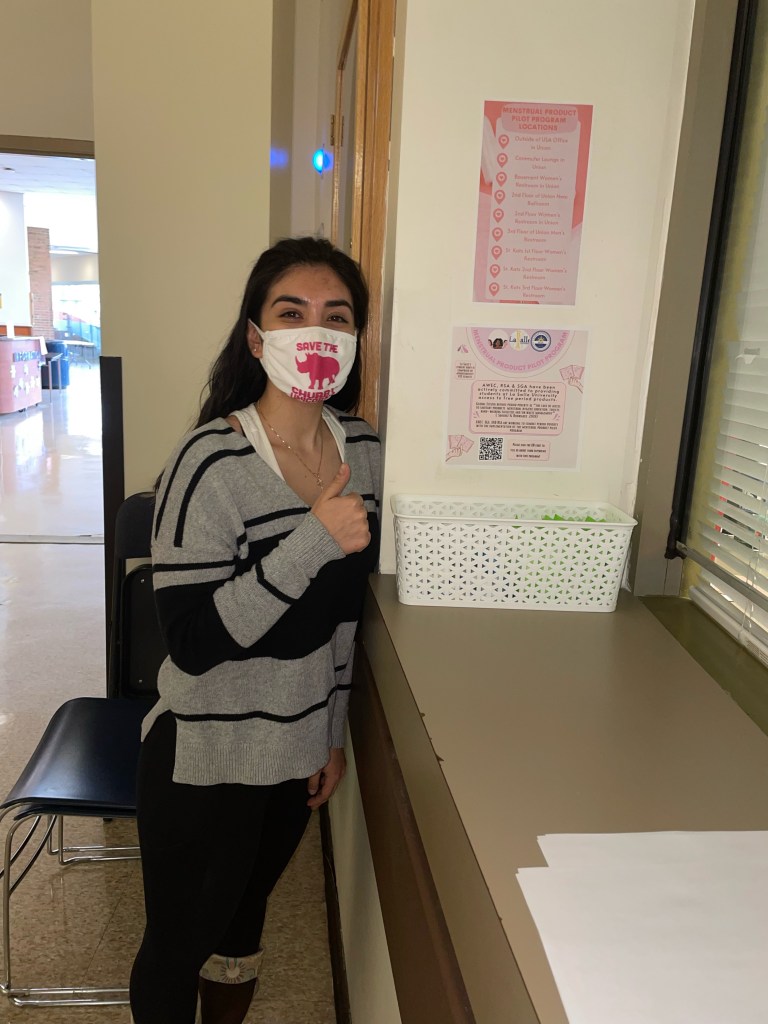
Isabelle Pope poses with the feminine hygiene products in the Union

On Feb. 16 La Salle University’s Students Government Association (SGA), Residence Life Association and All Women Every Color (AWEC) teamed up to announce a feminine hygiene initiative to provide tampons, pads and panty liners to students and faculty at La Salle University funded by the campus activity fund. @Lasallesga posted a video on Instagram to launch the menstrual product pilot program making period products available in St. Kat’s and the Union for women on campus, but also for any student regardless of their gender by having some baskets outside of the restrooms as well. Isabelle Pope, the president of SGA; Jua Brooks, co-founder and co-president of AWEC and Acie Barry, co-founder and co-president of AWEC explained the initiative via this Instagram video. This initiative has been in the works since 2019 and today the three organizations came together to announce their progress. SGA encourages anyone to reach out to them with any question as well as using the QR codes next to the products to provide feedback. This initiative will continue for the rest of the semester and if successful this program will likely continue in the future. 

In 2021, bills related to period equity were introduced in 37 states, according to Women’s Voices For The Earth, a nonprofit advocacy group. However, only five states require schools to provide menstrual products. Recently, California became the latest state to mandate that public schools and colleges stock free pads, tampons and other products in their restrooms. Therefore, this initiative at a private and small school like La Salle is a triumph for adequate menstrual product access. 

Barry explains that AWEC is “an organization founded by myself and Jua that is intended to be a safe space for women of color and allies alike on campus to join together and have important conversations. We are dedicated to creating social bonds within our organization and other organizations on campus all whilst also engaging in philanthropic efforts within the local community. We partnered with La Salle SAVE and hosted a hygiene product drive where we collected various items such as pads, tampons, razors, body wash, etc. and will be donating to a local organization called Women Against Abuse. Since the beginning of last semester, we have been researching period poverty amongst students and working with SGA and RSA to make menstrual products free and accessible to more students on campus. The pilot program started today and will run through the course of the year. Hopefully, if everything goes well, they will be in the majority of bathrooms across campus next year.”

In addition, Pope explained that originally, the proposal was supposed to be to get better dispensers in all of the women’s restrooms. The university explained that this was logistically difficult and expensive because matentience would have to be involved. So, baskets with free products seem easier and faster. The project began primarily with SGA in 2019 and 2020. But, by the end of 2021, the process was tough because of COVID-19 and funding issues. However, things began to look up when Pope joined as a member of AWEC and AWEC discussed access to feminine hygiene products. Pope made a connection between the two projects. The partnership made the entire project much faster, and Pope calls the collaboration a “huge learning experience.” She looks forward to cultivating better relationships with all the clubs on campus. 

President-elect Allen discusses values and concerns

News

Jakob Eiseman, Editor-in-Chief
Nolen Kelly, Editor

Header Image: @LaSalleUniv via Twitter

Dr. Allen came to campus for the first time since the announcement of his presidency to meet with students and faculty.

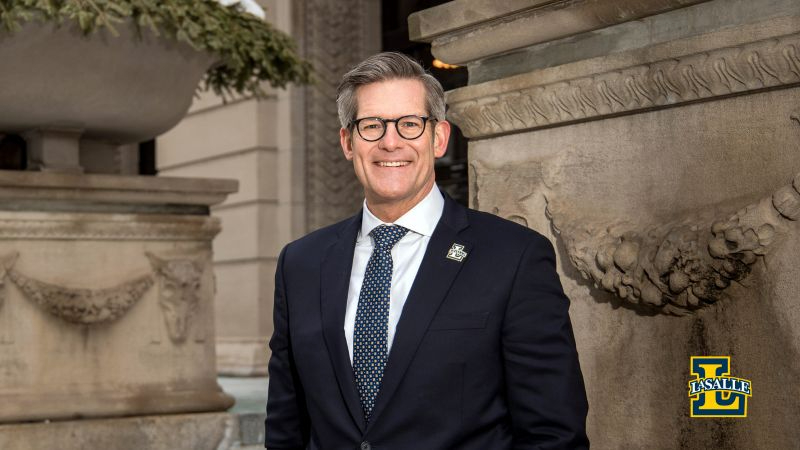
La Salle University held a press conference on Monday, Feb. 14, 2022 during which President-elect Daniel J. Allen was able to give some remarks and share his thoughts about the LaSallian community on its campus. While this conference reaffirmed much of what was already known about Allen, and was certainly a major press beat for the University in local news, Allen appeared comfortable and confident in what he was saying.

Touting a blue and gold tie and “Big L” pin on his lapel, Allen slid into his role as La Salle’s next president during his speech at the conference, using language such as “our students,” “our campus” and other such phrases. Allen appeared comfortable in this new environment, even joking that he felt at home due to the “Chicago weather” Philadelphia was experiencing.

On the subject of his plans for La Salle, Allen said, “We begin by creating an inclusive and equitable environment where all learners regardless of background are welcomed.” During his speech Allen reaffirmed his commitment to underrepresented communities, civic engagement and social justice. Beyond these commitments, Allen also stated that “teaching and learning and our concern for social justice take place in an environment where we are committed to high quality academic programs.”

“Nearly 100 percent of our students at La Salle receive financial aid. That is a commitment that matters to me and that is a commitment that I think is important to post-secondary education in the United States,” said Allen. The president-elect confirmed that he will be working to serve many underserved communities in the La Salle community, not the least of which are students that require financial help to continue their education.

“I have a very ambitious agenda for this University,” said Allen. And while he could not share explicit details just yet, he reminded the community that “42 percent of our students identify as students of color, 37 percent of our students receive Pell grants, 28 percent of our students are the first in their families to attend a college or university” and that these populations are the ones he wants to serve and part of the reason why he was attracted to La Salle.

After the speech, Allen moved to the Union Food Court to meet and chat with students in a comfortable environment. He had lengthy conversions with several students, sitting or standing with them and asking about their ambitions. Allen was even seen returning to students much later in the afternoon to continue previous conversations. Senior communication sciences and disorders student Francesca Spinosi talked to Allen several times on Monday, and said, “He was very nice. He saw that I was working on schoolwork and asked me about it. We had a really good conversation and he was very immersed in it.”

Allen’s commitment to underserved communities, his apparent appreciation and understanding of students and reaffirmations regarding fundraising and university development show that Allen’s first public trip to La Salle was successful for the university’s perception of his plans. 

La Salle’s business school gets its Association to Advance Collegiate Schools of Business accreditation extended

News

Kylie McGovern, Editor

Header Image: Photo courtesy of Kimmel Bogrette

On Feb. 8, La Salle University announced that the Association to Advance Collegiate Schools of Business (AACSB) extended its accreditation of La Salle University’s School of Business through 2027. This accreditation involves a rigorous review process every five years. To achieve accreditation, the school or program must adhere to quality standards like business management and knowledge through faculty scholarship, high-impact teaching and curricula, meaningful interaction between faculty and students and the achievement of specific learning goals. The AACSB accreditation is considered the highest standard of excellence in business education. This accreditation is prestigious because less than five percent of the 13,000 business schools globally earn AACSB accreditation. Therefore, this accreditation makes La Salle’s School of Business one of the leading business schools in the world. 

Yusuf Joseph Ugras, Ph.D,  professor of accounting and the school of business’s  interim dean, explains, “AACSB accreditation is a source of tremendous pride for our faculty, staff, students, and alumni and it serves as the benchmark credential of exemplary business education—one that is reserved for the top tier of business schools globally.” He continues saying, “earning this accreditation extension from AACSB further validates the quality of our teaching, learning, and programmatic offerings at La Salle.” 

According to the AACSB, business schools should familiarize their faculty and administration with the AACSB accreditation guiding principles and standards along with the initial accreditation process. Taking the time to understand the accreditation process and standards before submitting an eligibility application provides a greater understanding of AACSB accreditation, which is typically reflected in a school’s application. To maintain this accreditation, La Salle’s business school must pay an annual fee of $5,950 and maintain the AACSB’s quality standards. This accreditation to last until 2027 is positive news for the business school in particular as well as the posterity of the entire university. 

Member of the business school Nicholas “Nicky” Signoretta, who is studying business systems and analytics (BSA) and finance said that this accreditation is “exciting for me and my classmates in the business school as well. I feel like getting the AACSB accreditation extended only makes my degree more valuable while also congratulating the business school for its prestige that its students already know. I am so proud to be a part of this program and I am excited for what the future holds now that its AACSB accreditation has been extended.” 

Daniel J. Allen will be La Salle’s 30th president 

News

Kylie McGovern, Editor 

Header Image: La Salle University

On Feb. 1, 2022 La Salle’s Board of Trustees Chair William W. Matthews, III, ’90, announced La Salle University’s 30th president. The Board of Trustees voted unanimously to appoint Daniel J. Allen, Ph.D., as La Salle University’s new president. Dr. Allen’s presidency begins April 18. The search for the president was a nine-month long process that concluded with select finalists meeting with stakeholder groups across our broader university community in late January. The board of trustees explains that Dr. Allen emerged as their candidate of choice to lead La Salle University. Matthews explains in his message, “I have every confidence, as does the Board of Trustees, that Dr. Allen will build upon our impressive foundation and elevate La Salle to significant new heights.” In addition, interim president Tim O’Shaughnessy, ’85 will serve on the Executive Cabinet and provide support in the transition for Allen.

Since 2015, Allen has served at DePaul University in a vice presidential capacity, ending his career as Senior Vice President of Advancement and External Relations. Prior to that, he worked in Catholic higher education for over 20 years and received education from Catholic universities as he completed his Ph.D. in education with a concentration in higher education at Loyola University-Chicago and his M.A. and B.A. in English literature from Loras College. 

In his previous role, Allen provided, led and managed all fundraising, alumni relations and advancement communications strategies at DePaul University. In addition to his work at DePaul University, Allen served as the senior associate dean for external relations at the University of Chicago’s Harris School of Public Policy as well as being Vice President of Institutional Advancement at Lewis University in Romeoville, IL, a Lasallian institution. President-elect Allen has expressed interest in the area of postsecondary educational access for low-income students. In addition, he has presented work on improving opportunities for academically qualified, low-income students to the Association for Institutional Research and has had his research published in “Research in Higher Education.” 

In addition to continuing this work at La Salle University, Allen is looking forward to including the voices of students, those in leadership positions and student organizations when planning for changes and goals. In a discussion with the Collegian editorial board, Allen said that one of his goals is for students to think their time at La Salle University “is as robust and as challenging as it can be” so that “students feel it is a vibrant experience.” In addition, Allen plans on being present on campus by attending student activities and sitting down to talk with students to better know and become part of our community at La Salle University. The Collegian staff welcomes President-elect Allen and looks forward to what his presidency has to offer. For more details of Allen’s sit-down with the Collegian, please look to our Editorial section this week.

Campus COVID-19 Update

News

Kylie McGovern, Editor  

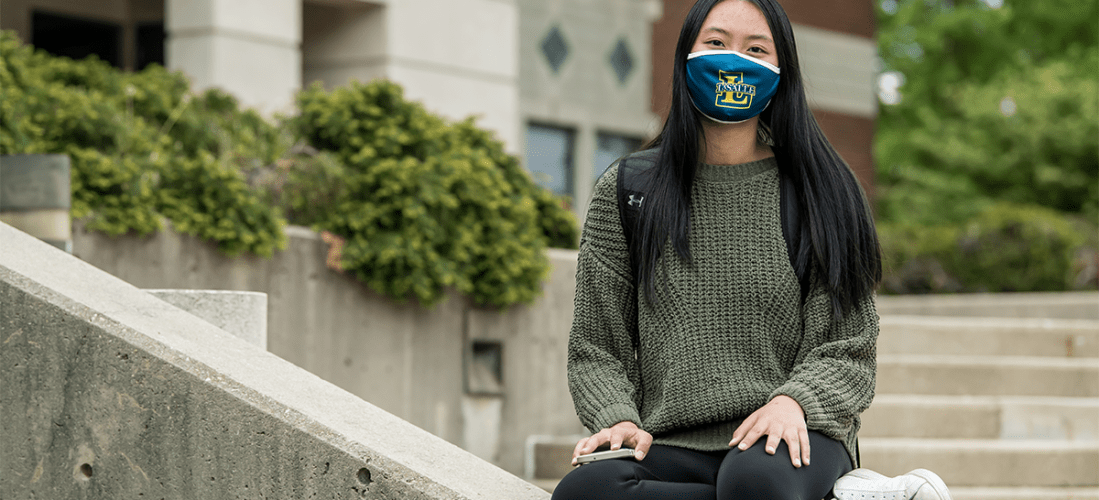
La Salle University student wearing a mask on campus

On Jan. 5, La Salle University released an update on COVID-19 and the spring semester. This notice included information about a booster requirement, updating vaccine information, testing, masking and student programming. Regarding the vaccine, La Salle University is requiring all members of the campus community receive a COVID-19 vaccine booster dose within 30 days of eligibility to minimize the number of community members who may become infected or need to quarantine because of exposure. Those who are vaccinated and boosted against COVID-19 will have more flexibility with quarantine and isolation protocols per newest CDC guidance. Some members of the La Salle community already have an approved exemption on file with the University and will continue to be exempt, but unvaccinated individuals must either double-mask or wear a KN95 mask while indoors per The Philadelphia Department of Public Health. La Salle University has created a deadline and community members must receive a COVID-19 booster shot and submit verification to the University by Tuesday, Feb. 15.

In addition, Once a member of the La Salle community has received the COVID-19 vaccine and/or booster, students and employees must update their vaccination records on file with the University. In addition, for non-residential students and employees, entry testing is available and strongly encouraged. Testing is available at no expense and without an appointment. In addition to residential student entry testing, The Treetops Café testing center has expanded the hours of operation. 

In addition, unvaccinated individuals are required to complete weekly testing. Students who do not comply with testing requirements will face disciplinary action through Student Conduct. Failure to comply with one test will result in a temporary restriction to campus. Failure to comply with two or more tests will result in suspension. Faculty or staff who do not comply with testing requirements will face disciplinary action through HR with action up to termination. However, there was a 95% vaccination rate as of Dec. 15, so only a small percentage of the community needs to adhere to this testing. 

Furthermore, masks continue to be a requirement in all indoor settings on La Salle’s campus. Since the omicron variant is more transmissible than previous variants, La Salle University recommends surgical-grade masks and KN95 masks. The University has a supply of surgical, N95, KN95, and University-branded cloth masks that are available to students and employees. Limited quantities of each supply can be obtained at the on-campus testing center at Treetops Café as well as in each residence hall security desk reception area and Union Information Desk. 

As for in-person extracurricular activities, student Organization Programs and Meetings will need to be virtual through the end of February. Student organizations are encouraged to wait on hosting in-person events until after February, after a review of the institutional positivity rate has been conducted. However, the university has identified some Office-led events to host in-person to provide some limited safe interaction, and student organizations will be permitted to table in the Student Union Lobby. Overall, with the week of in-person classes, La Salle is operating to best facilitate in-person learning while mitigating the risks of COVID-19. 

La Salle ranked #1 in the nation for athlete graduation success rate

News

Kylie McGovern, Editor 

On Dec. 2 La Salle University was ranked among Columbia, Dartmouth, Duke, Harvard, Holy Cross, Lafayette and Yale as number one in the nation for athlete graduation success rate. La Salle earned a near-perfect score of  99 on Graduation Success Rate (GSR) report. 

“La Salle student-athletes have proven year after year that they are fantastic representatives of our institution, both on the fields of play and in the classroom,” Vice President for Athletics and Recreation Brian Baptiste said. “The student-athlete experience at La Salle, to which our department is steadfastly committed, is centered around teaching and learning — two primary tenants of the Lasallian educational mission. We are thrilled that the hard work of our student-athletes has been recognized. This is a significant achievement that all Explorers should be proud of.”

11 La Salle teams received perfect scores of one hundred on the GSR report and the overall department score was first among all Atlantic 10 schools. The men’s basketball, women’s basketball, men’s cross country/track & field, women’s cross country/track & field, men’s golf, field hockey, men’s soccer, women’s soccer, women’s swimming, women’s rowing and men’s rowing all received perfect scores.  

Since the GSR program launched, La Salle University has had 120 teams with a perfect score over the years. The women’s soccer program has been recognized 13 times, the most by a single La Salle program. This year is the women’s basketball team’s tenth consecutive year obtaining a perfect score. Additionally, the men’s basketball team has done so in each of the last seven years.

Presidential search update

News

Kylie McGovern, Editor 

          Via La Salle University  

On Dec. 3 La Salle University students received an email from The Presidential Search Committee regarding an update about the search for La Salle University’s 30th President. The Committee members convened just before Thanksgiving because the application period closed. The committee members reviewed application materials for the robust pool of qualified and intriguing candidates. The committee then assessed the candidates based upon the characteristics outlined in the position profile.

 The position profile is available to the public. It refines the group to those that best match such characteristics of the university’s next president. The position profile includes contact information and then explains the following: “La Salle University celebrates its mission, traditions, and identity as a Lasallian, Catholic, and comprehensive liberal arts institution that promotes excellence in teaching and respect for all people, as it seeks its next President. La Salle offers a remarkable leadership opportunity for its next president. With a mission-driven sense of direction and faithfulness to its values, the Board of Trustees is positioning La Salle and the next president to proactively enhance the university’s reputation for excellence and achieve national prominence. The board’s commitment provides important momentum and opportunity for the next president who will provide innovative thought leadership, create a bold and new strategic plan, build community on campus and in the broader Philadelphia area and achieve long-term growth and financial sustainability.” 

Sophomore Luke Szyszkiewicz explains that he is “frustrated about how long the search is taking,” however, he understands that the process of the presidential source should be done “meticulously and thoroughly.” 

These presidential candidates have been invited to an initial round of interviews with the Search Committee that will occur this month. The committee will provide additional updates as the committee’s important work continues.

La Salle to hold COVID-19 booster clinic in December

News

Jakob Eiseman, Editor-in-Chief

La Salle University

It was announced on Nov. 15, 2021 (after our last issue was already proofed) that La Salle University would be holding a COVID-19 booster vaccine clinic on Wednesday, Dec. 8, 2021 at the COVID testing facility built into TreeTops Cafe on South Campus.

Similar to the clinic held on campus at the end of the spring 2021 semester, Walmart pharmacy is coming in to administer the vaccine and encourage those looking to attend the clinic to complete all necessary prerequisites prior to arrival. While it was not stated which vaccine the clinic will be providing, the CDC has stated that it is safe to receive a booster vaccine that is not of the same type as your initial vaccination. 

In order to receive a vaccine booster from the clinic, members of the La Salle community will first have to confirm that they are, in fact, eligible for the vaccine booster. The CDC recommends that boosters be administered no sooner than six months after the administering of the second dose for the Moderna or Pfizer-BioNTech vaccine or two months after receiving the Johnson and Johnson vaccine. Those who are eligible are those who received their second dose of the Moderna or Pfizer vaccine before June 8 or the Johnson and Johnson vaccine before Oct. 8. If you are unsure you are eligible for a COVID booster, please check the CDC’s website for guidance.

At this time, the clinic is open to “La Salle students, faculty, staff, and Christian Brothers” only, but like the previous clinic, it may open up to the North Philadelphia community if stock of the booster and demand is high enough. Vaccine boosters will be available from 12 p.m. to 3 p.m. at TreeTops, and the University recommends that those interested schedule an appointment rather than walk in. Appointments can be made through this link. Those interested are also encouraged to complete the COVID-19 booster dose attestation form, which can be found here and on La Salle’s website.

While the booster, like the vaccine itself, is free to the general public, those who wish to receive the booster will have to provide proof of health insurance or sign an insurance waiver at the site on the day of the clinic. Those who attend the clinic will have to bring a government-issued photo ID, COVID-19 vaccination record card, and insurance card if applicable. 

As of its most recent update on Nov. 12, the La Salle COVID portal reflects that about 95 percent of the campus community is vaccinated, and the vaccine boosters were approved for everyone above the age of 18 by the CDC on Nov. 19.  The city of Philadelphia is urging its citizens to get the booster to further protect themselves, saying on their website, “Philadelphia has one of the highest rates of routine immunizations in the entire United States. Vaccines for measles and whooping cough and meningitis protect us every day. And many of those vaccines require a booster dose to make sure that we stay protected.”

Philadelphia bans low-level traffic stops

News

Rita Offutt, Editor

On Nov. 3, Philadelphia Mayor Jim Kenney signed the Driving Equality Bill, making Philadelphia the first major city to enact a law against low-level traffic stops. According to the National Public Radio (NPR), the law “bans stops for: driving with a single broken brake light, driving with a single headlight, having a registration plate that’s not clearly displayed, fastened, or visible, driving without an inspection or emissions sticker, bumper issues, minor obstructions (like something hanging from a rearview mirror) [and] driving without vehicle registration within 60 days of the observed infraction.” Instead of being stopped for these offenses, cars will be ticketed. 

Philadelphia’s city council passed the bill in a 14-2 vote on Oct. 14. It will go into effect in February, allowing the Philadelphia Police Department 120 days to retrain officers in accordance with the legislation. According to NPR, “The Philadelphia Police Department was part of a coalition of stakeholders who helped draft the legislation…to [address] racial disparity without compromising public safety.” CNN reported that the Philadelphia Police Department released a statement saying, “We believe this is a fair and balanced approach to addressing racial disparity without compromising public safety. This modified enforcement model for car stops furthers the Department’s priority of addressing the issue of racial disparity in the Department’s investigative stops and complements the Department’s efforts to address these same issues in pedestrian stops.” 

The Driving Equality Bill was initially proposed by city councilmember Isaiah Thomas in October 2020, and cosponsored by Kenyatta Johnson, Katherine Gilmore Richardson, Jamie Gauthier, Kendra Brooks, Maria Quiñones Sánchez, Cherelle Parker and Curtis Jones. According to NPR, Thomas authored the bill after he was stopped for a traffic violation while his son was in the car. Thomas told CNN, “I am humbled by every person who told my office of the humiliation and trauma experienced in some of these traffic stops. To many people who look like me, a traffic stop is a rite of passage — we pick out cars, we determine routes, we plan our social interactions around the fact that it is likely that we will be pulled over by police.”