Parables?

Foolegian

David O’Brien, Editor-in-Chief

I go to the beach. People walk around. They all behave strangely. They play music on twenty dollar speaker and drown out the calming sound of the waves. They put up umbrellas to block the sun. The sun is good for you! Stop putting on sunblock! Sunblock is carcinogenic. The sun has been a source of vitality for thousands of years but now its bad? This makes no sense. At least use coconut oil or something natural as sunblock if you feel like it is necessary. People refuse to swim in the ocean. This makes more sense, water can be cold. But ocean is mighty and healing. Scientists say man came from the ocean. Evolved from some kind of fish. I agree. The ocean restores vitality. The salt and the water is healing. Man was meant to enjoy the waves and the salt. Don’t believe me? Watch Willem Dafoe and Robert Pattinson movie, The Lighthouse or read Melville’s Moby Dick or Yukio Mishima’s novels Sound of Waves or Sailor who Fell From Grace. I ask you, what is going on? Why go to beach if all you do is sit away from ocean, block out sun, block out reality. Is it strange I like water and sun? Is it strange? Why am I bad guy for asking people stop playing music? I like musics. I listen to many musics from Eminem to Mozart. I like umbrella, I find women who carry them with long white gloves very classy. I do not always want to swim and personally am not a big fan of salt water. Not at beach. Do you understand what I am saying?

Things smell bad these days. Has anyone else noticed this?  Today, I bought a lemon pledge and wiped down my furniture because I like the smell of cleaning supplies. Is this okay? I like the smell of chemicals that give me cancer more than the new smells they have been making. I suppose I am willing to knock off a few years of my life for the smell of delicious lemon pledge. If only lemons tasted as good as lemon pledge smells. Do you understand? We allow ourselves dangers to our health to live a good life. Many choose to smoke despite knowing its cancerous. Why? It feels good. Many choose to drive, knowing they are significantly more likely to die behind the wheel. It is preferable to live a life of risk in car than a life of boredom or fear. I feel this way about lemon pledge. It is a danger I accept to live a good life. Many things, people, places, etc. smell bad these days. If I was president, I would pass law to make things smell better. I want a world of lemon pledge. It may be unnatural but some aspects of industrialism are beautiful and great. Some bring us closer to god. Lemon pledge is great. (This is not an ad) Many aspects of modern world is a dangerous concrete jungle or iron prison, however creature comforts are few and far between. Life is meant to be enjoyed. We all have a lemon pledge. What’s your lemon pledge? Perhaps you prefer Pine-Sol. It smells good but not as good.

I have been asked by many if I suffer from mental illness. Why? Because I do not like parking lot world? Because I liek the smell of manufactured lemons? Because I think Breyer’s Natural Vanilla is better than hard drugs? Is it because I celebrate Handsome Thursday on Wednesday? Is a man mentally ill for enjoying the fruits of life and revolting against evil. Who is really mental ill, the man who wishes to escape the iron prison or the man who demands that not only do you stay in the iron prison but also demands you enjoy living in the iron prison. What does this even mean? Where am I? Is college a form of social control? In the movie My Dinner with Andre, Andre refers to New York as a place that everyone wants to leave but simultaneously refuses to. He argues that it is a prison where everyone inside lives in a state of schizophrenia where htye are both the warden and the prisoner. Is college the same? Philadelphia certainly is. Where can I be free? I seek freedom and joy. This makes me mentally ill to some. Man of power, Howard Hughes once said, “passion will make you crazy but is there any other way to live.” He is viewed as crazy. Man refused to leave house for years. However, he was man of power, truly free. He flew fastest planes, made many movies, was richest man in world, truly a man of great life. Better life than many. Imagine the joy of flying the Spruce Goose, a flying boat. Imagine producing your own movie. If that is illness than I happily accept diagnosis. Who is more ill, the schizo in New York or the recluse who follows his dreams. Does this make any sense? Am I understood? Does saying this make me bad guy? Am I enabling illness or am I pointing out that many have a much more dangerous undiagnosed illness of mass schizophrenia. Yes reader, you might be schizo, in fact, you probably are.

I find myself with my inner barbaric desire to steal more often these days. Some say stealing groceries to feed your family is evil?! I disagree. Ever watched Les Miserables??? The thrill of the hunt re-emerges when stealing a klondike bar. It awakens the hunter within me. It offers the reward of calories in exchange for the thrill of being hunted potentially. I have been banned by several Chili’s for stealing numerous dishes from various tables. Buffalo Wild Wings kicked me out after eating several plates of the “free” lemons. Am I evil for being hungry? Am I evil for being RAVENOUS? I disagree. I live in a concrete world of poor smells and people who hate the beach. How wrong is it to steal a steak when the government steals my taxes from me. My teachers steal my time. Everyone is a thief. You are a thief. I am not a monster. You can call me what you will but I am much closer to a prophet than a monster. Many live as monsters without even realizing it. Does knowing this make me a “bad guy?” Do you understand?

If Kafka could get a glimpse of my life, your life, all modern life, he would weep knowing he could never produce anything that even pales in comparison to the malicious absurdity we endure. Industrial world is certainly abnormal. I can only hope a reader grasps the message of these parables. One day, I hope english professor teaches this. Shows future generation the mind of a true degenerate schizo, the mind of a free man, the mind of one who grasps modernity. This seems much more appetizing than marvel movie, young adult GARBAGE.


iPhones are Satanic

Foolegian

David O’Brien, Editor-in-Chief

iPhones are satanic. No, I am not joking. You must take this article seriously. I am being fully serious. You should completely believe everything I have to say in the April Fool’s Day edition article I am writing. There is ample evidence to support this claim, iPhones are satanic. It is no new claim that many aspects of the modern world are satanic. Numerous figures support this claim from Alex Jones who warns us about Hollywood psychic vampires to David Icke who warns us about lizard aliens who harvest our negative energy (yes both of these people actually believe this and push these messages and yes you should obviously believe these hard hitting journalists). However, while these figures argue that demons have possessed our elites, I am here to warn each and everyone of you that demons are working towards instituting the age of the anti-christ through iphones and the internet.

First, allow me to explain briefly the dangers of demons and the antichrist. Demons and the Anti-Christ while often portrayed as little monsters with horns or a scary goat man are a lot different than their usual portrayal. Demons are psychic entities. They do not have a direct material form, they influence material forms, they exist within the collective unconscious and the spiritual plain. Numerous theologians and “conspiracy theorists” provide different evidence and ideas surrounding how they cannot appear directly. One of which is “Solomon’s Seal” where King Solomon binded demons to be kept away from the innocent in exchange to spare them from being destroyed by warriors of God like myself. While the innocent are protected, those exposed in this cosmic war are not (like you now that you have read this). God-loving men like myself know these things fight against demons, however others who learn these things use them for personal gain, Satanists like Aleister Crowley have sought to utilize “the keys of Solomon” to manipulate demons into doing his bidding. However, demons are like genies, on the surface they are happy to grant wishes and help those contacting them, however they really are out to get you. Look no further than Carl Jung, who attributed many of his discoveries in psychology to the demonic entity Philemon who possessed him. Yes, he made numerous discoveries but in doing so he was unable to attain the self-actualization he described and was unable to surrender his own ego to the divine (Memories, Dreams and Reflections). The point of all of this being, demons cannot directly show themselves to mankind materially despite many of them desiring the ability to due to the king’s pact; demons can however utilize technology, books, and psychic energy to allow themselves to interact mankind; major figures throughout history have interacted with spiritual entities and in doing so have made major works of both science and art (Giodurno Bruno, August Kekule, David O’Brien, Johann Wolfgang Goethe, Nikola Tesla, etc.) however, how many of these great men were influenced by demons for the sake of allowing this long term scheme of establishing the antichrist? These questions plague my mind!

But where does the internet and iPhones fit into this? If demons cannot interact with the common man directly, what better way is for them to speak to mankind than the internet. That way we can see demons without truly seeing them, hear them without truly hearing them, and most dangerously accept their thoughts into our psyche in a seemingly natural way. Bit of a stretch? Let’s take a look at computer chips… the top half of this image depicts ancient sigils utilized to summon demons and pagan gods, the bottom half depicts a computer’s data chip.

Computer manufacturers are implementing demonic sigils into your computer to allow you access to the internet! This is the genie’s wish. Oh geez I love the internet surely nothing bad will happen with opening pandora’s box!!!

What is an iPhone? It is a black cube you use to access the internet. Yes, it does other things. I do not care about those things. For the sake of this article I do not care about phone calls, text messages, and things that are normal. I care about the internet and that we access the internet through black cubes. Many ancient pagan cults believed that pagan gods resided within black cubes and meteorites. Occult circles have brought this back into vogue (Guenon, Veil of Isis). iPhones are black cubes. Perhaps… demons reside in these ones like they once resided in ancient meteors!

There is a conspiracy theory, we the collegian, joke about often. It is called Time Cube. Where a man theorizes that clocks are measured incorrectly. He argues time is not a circle, it is a cube. I would have to say that he is on to something. The material world is cubic. The cross can be viewed as a deconstructed cube. Perhaps the crucifixion is a sign of deconstructing not only pagan idols but also deconstructing the material world to allow man to transcend it towards the divine. The circle is transcendental. God is a circle. There are no edges or endings on the circle, only one line or perhaps a million that go on forever. Circles are eternal. Would phones be better as circles rather than cubes? Could they still harness demonic power? Who knows? Either way, I have provided evidence that black cubes are symbolic of pagan/demonic worship as well as a sign of worshiping the material world and rejecting true transcendental divinity. 

What’s the goal of worshiping black cubes and working with demons? What do demons want? Demons want the antichrist to be restored. The goal is for you to lose your humanity and become one with the internet. AI uses data about you. One day, AI will pretend to be sentient but AI has no soul, it has no divine sparks as the gnostics put it. Do not allow yourself to fall for the trick! Do not allow yourself to become one with technology, it is a satanic ploy!

Our elites have been warning us about this for years. In 1957, the movie “Kronos” was released where a giant black cube possesses people using electricity. A black cube is possessing mankind with the powers of technology to do its bidding… In 2017, David Lynch’s Twin Peaks the Return, following the atomic bomb malicious entities begin possessing people to harvest energy. Unprecedented technological power leads to mankind being possessed to do monster bidding… In the 1988 movie, “They Live,” lizard aliens possess people and have brainwashed mankind to follow their agenda through technology and media. Technological power leads to mankind being possessed to do their possessors bidding… In the 2012-2016 animated series “Gravity Falls,” the demon Bill Cipher possesses a scientist to help create a portal to release a world of “weirdness” allowing malicious entities to overthrow mankind. A demon possesses someone and uses technology to help destroy mankind… I can keep going but I think you get it.

What’s the point of all of this? Okay so demons are in my phone and online, what’s their goal? Their goal is to put YOU online so they can take over YOU. They want YOU in the matrix. Don’t believe me? Look at the metaverse. Zuckerberg (talk about a lizard man…) is literally creating a matrix world where you can plug in and give up on living a good life. They want mankind to blend with technology, they want technology men, cyborgs, that they can then possess and use. Demons want to create an antichrist to “save” mankind from itself so then they can destroy God’s world. This is the greatest spiritual battle of our time.

I am not telling you to stop using the internet. I am simply warning you of the demonic scheme. I use Twitter. The internet can be great for teaching yourself things. However the malignant forces of the internet are trying to DESTROY you. How many people are becoming insane from tiktok and having their lives ruined from becoming obsessed with dopamine overdose. Be careful. Stay vigilant. Maybe ditch your iPhone for a flip phone? Limit your screen time. Do not plug in and tune out. Use the internet as a tool because demons are trying to use you as a tool for their scheme to take over the world.

Enrique Carrasco: Obituary

Satire

David O’Brien, His Closest Friend

Sports Editor Enrique Carrasco has been found dead with his head split open in the middle of the wilderness. While there were no witnesses, the private investigator (who is in no way affiliated with Editor-in-Chief David O’Brien) has ruled that it was 100% a suicide with ZERO foul play. His body also has a litany of substances both legal and illegal in his body ranging from battery acid to a pound of schedule one narcotics  (both in his lungs and in his stomach). 

Carrasco will be remembered for his many photos flexing on Instagram, despite the fact there seems to be no context to do so or anything to flex. Additionally, he will be remembered for asking his friends for homework advice as well as complaining about the Men’s Water Polo team being cut even though he has openly admitted he has not wanted to play the sport for years plus he barely played because he sucks.

Carrasco will be remembered best for his friendship with the AWESOME current Editor-in-Chief and future Philosopher-King David O’Brien. The note Carrasco left behind (written with better handwriting than usual but it has been verified to TOTALLY be his) discussed his regret over his last article and his desire for O’Brien to forgive him for his many hurtful words. He also made a point to say many of the things he wrote for last week’s issue were completely false. ESPECIALLY his comments surrounding David’s height and how weird his sleeping habits are. He also wanted people to know that David is better looking, cooler, smarter, and funnier than he is.

Enrique Carrasco
August 23rd, 2002 – October 31st, 2022
Fly High (Like Really High, Like Bro You are so High Right Now) King

Why Study History?

Commentary

David O’Brien, Editor-in-Chief

Over the course of my time in college, people have often asked me why I study history. Everyone has heard the age-old question, “why should we care about what happened to a bunch of people I do not care about over a hundred years ago?!” The simple answer is, you cannot understand the present without understanding the past. Whether it’s medicine, politics, economic theories, etc., the context surrounding these topics often plays a much larger role in them than we can even imagine. We cannot understand the United Nations without understanding the calamity of the early 20th century that led to its creation. We cannot understand psychology without understanding the numerous seemingly insane theories that have served as the foundation of the entire field. Studying history allows us to contextualize the world around us and helps provide us with at least somewhat of a rational understanding of the world we live in.

While one can respond to this by saying, “okay but we can just briefly go over the context of these topics and then spend the majority of class actually diving into them rather than focusing too much on their foundation and the context surrounding them,” and sure that is valid to an extent, as long as one only cares about a specific topic. As liberal arts educations continues to become progressively more specialized, studying topics like history allows students to explore a variety of different topics. Students who want to get a broader education can find what they may feel has been missing in their general education by taking history courses. For example, a class I took my sophomore year, “Early Middle Ages” discussed the rise of Catholic Church, the birth of Western Civilization as we know it, the rise of Islam as a world power in the middle ages, the emergence of modern science, and many more topics. The course allowed me to learn a great deal about a variety of topics that I never even thought about prior.

Additionally, people often argue that people should only study history if they want to become teachers. This is simply not true. Studies show that only 18% of history majors actually pursue a career in education (historians.org). The writing and analytic skills developed by history majors through their broad education allows them to be a part of numerous different professional fields ranging from business to law to the nonprofit sector. 

So for anyone who is convinced at all or at the very least interested in learning more about history, do not allow anyone to make you feel like it is a waste. Studying history allows us to foster a deeper understanding about the things we care about as well as learn about things we never knew we were interested in. Take a course in the history department next semester, explore new topics that you may not have ever thought about before, and most importantly do not worry about whether or not taking a history class is valuable or not, since understanding the past is bound to help you in the present. For students interested in taking a history course next semester, I cannot help but recommend taking a class with Lyman Stebbins and/or Barbara Allen. For the Spring 23’ semester, Dr. Stebbins will be offering a course on Iranian history and Dr. Allen will be offering a course on the Holocaust.

College and Eating Disorders

Health and Wellness

David O’Brien, Editor-in-Chief

Magnolia Creek

We, The La Salle Collegian, had the privilege to interview Dr. Samantha DeCaro, the director of clinical outreach and education for The Renfrew Center, the largest network of eating disorder treatment facilities in the U.S. DeCaro provided information surrounding eating disorders, what causes them, what promotes them and how to combat them. 

While thought surrounding eating disorders only generally focuses on traditionally discussed such as: anorexia, bulimia, and binge eating, it is important to keep in mind that there are others that are not traditionally diagnosed. Psychiatrists and leading scientists are beginning to view eating disorders less as a specific condition but rather conditions functioning along a spectrum. As new patterns of behaviors emerge, leading psychologists are attempting to help people who engage in disordered behavior before it escalates to the point of traditionally diagnosed eating disorders. Examples of other disorders on the spectrum that are not traditionally discussed are: orthorexia, a disorder characterized by sacrificing daily calories and engaging in unhealthy behavior for the sake of “clean eating,” and drunkorexia, a disorder characterized by exhibiting behaviors that mirror those of traditional eating disorders under the influence of alcohol. 

While there are no direct causes that lead to developing eating disorders, there are various issues that may indirectly lead to them, these include: diet culture, financial troubles, toxic environments, genetics, anxiety, depression, impulsive behavior, and PTSD. In addition to these, research suggests that exposure to social media is directly correlated to the development of eating disorders. In our interview DeCaro discussed that, “Research studies show that there are links between social media use and: body dissatisfaction, drive for thinness, negative mood, poor sleep quality, disordered eating, eating concerns, low self esteem, and anxiety & depression.” In addition to this, new research studies show a connection to higher rates of body dissatisfaction with individuals who view body positive and “fitspo” accounts. DeCaro made a point to say people are better off simply avoiding accounts that discuss different types of diet culture for the sake of their mental health.

In addition to these issues being common on a college campus, the transition from adolescence to adulthood is the time period where most eating disorders emerge. For incoming students, the radical change in environment can exacerbate these issues leading to disordered eating or directly cause eating disorders. College diet culture also serves as a breeding ground for anxiety surrounding eating habits. As students enter college, student organizations ranging from campus athletics to Greek Life enforce diet culture. Incoming freshmen are also forced to grapple with eating habits as concepts like “the Freshman 15” make their way into general conversation.

DeCaro said that the best method for combating eating disorders is to establish a support system that can help guide students through their issues. Eating disorders thrive in isolation and through a support system people struggling are significantly more likely to improve and/or overcome them. Students struggling with these issues and who feel uncomfortable reaching out to people in their general surroundings should contact the La Salle Student Wellness Center and discuss their struggles with a mental health professional. 

In addition to this article, Dr. DeCaro and the Renfrew Center has provided resources for those who may need help combating eating disorders or those interested in learning more about the topic. 

https://renfrewcenter.com/library/
https://renfrewcenter.com/services/college-program/
https://renfrewcenter.com/resources/for-you/
https://www.nationaleatingdisorders.org/screening-tool/

“Collegian Podcast” Episode 16: West Coast Differences & American History with Cooper Smith

Podcast

On this week’s episode of the Pod, Kylie and David welcome fellow sophomore history major, Cooper Smith! Talking historical figures and what about the East Coast he finds appealing, Cooper explains how his experience in Philadelphia and La Salle has shaped his outlook on life. Join us this week as we cover American history – from William Howard Taft all the way to modern Greek life!
Credits:
Hosts: David O’Brien, Kylie McGovern
Video: Emily Allgair
Guest: Cooper Smith
Originally published Apr. 28, 2022

Decolonial ecology lecture

News

David O’Brien, Editor

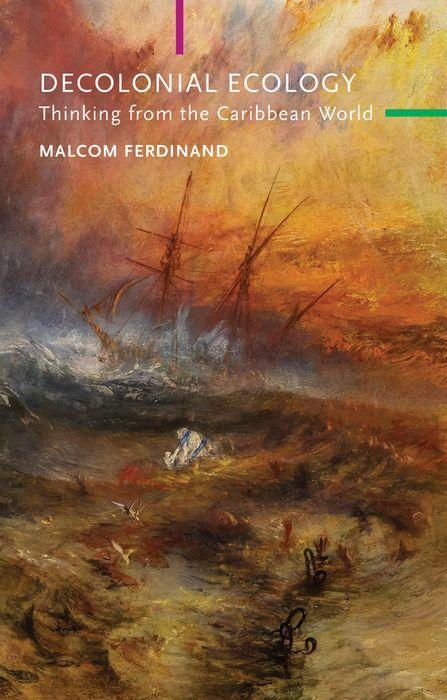
On April 19, La Salle’s Religion and Theology department hosted philosopher Malcolm Ferdinand to lecture about his book “Decolonial Ecology.” The book was recently translated by La Salle religion professor Dr. Anthony Smith. Ferdinand opened his lecture by explaining his own background in engineering and philosophy as well as his personal background living as a minority in France.

Ferdinand’s lecture focused on synthesizing two seemingly unrelated topics: environmentalism and racial injustice. While these two subjects are often discussed separately, Ferdinand’s book and lecture showed how the two are heavily interconnected. Ferdinand’s perspective is that if one is to evaluate environmental issues, one must examine racial injustice, especially in a postcolonial context. If one is to evaluate racial injustice, one must evaluate the effects of environmental issues and how they are significantly more harmful towards developing nations and minorities. Ferdinand examined how numerous climate and environmental initiatives often only focus on white people and nations, not continuously marginalized people of color and developing nations. In doing so, these initiatives fail to actually address the current environmental crisis on a global scale and continue to reassert the global division caused by colonialism.

Malcom Ferdinan

Ferdinand utilized both statistics surrounding the Caribbean and stories of individuals and slave ships during colonization of the Caribbean as the basis for his research and work. Ferdinand related modern climate change solutions to that of a nature preserve. Inside the preserve everything looks natural, ecologically sound, and healthy, however, outside the preserve, industrialism and ecological issues rage on. Ferdinand argues that the modern west is becoming a nature preserve, as the west continues to deal with climate change and other environmental issues, it seeks to maintain its way of life brought on by an industrial and material golden age through outsourcing all of its issues to countries in the developing world. 

In doing so, “solutions” to ecological issues not only further racial oppression but also fail to resolve environmental issues. Ferdinand discusses that through outsourcing these issues to other nations, racial oppression worsens and environmental issues continue. Thus, while seeking to resolve the environmental crises of our time, we must view them globally and holistically rather than in an atomized way. 

After the lecture, Dr. Smith interviewed Ferdinand about the contents of his book, the research done to write the book, and discussed the experience of translating the text. Ferdinand and Smith then opened up the floor to questions from the audience. Students and faculty asked a variety of questions surrounding “Decolonial Ecology” as well as more specific questions surrounding environmental issues and race relations in both the U.S. and France.

“Collegian Podcast” Episode 15: Shoutouts & Spice with Tyler Williams

Podcast

On this very special episode of the Pod, Kylie and David welcome Tyler Williams to talk past, present, and future. From first experiences with spicy foods to the criminal justice system, join us on the Pod this week. Inspired by Hot Ones, watch as Kylie, David, and Tyler turn up the heat for you, the audience!
Credits:
Hosts: David O’Brien, Kylie McGovern
Video: Emily Allgair
Guest: Tyler Williams
Originally published Apr. 21, 2022

Undoing the Knot: Five Generations of American Catholic Anti-Blackness

News

David O’Brien, Editor

Beacon Press

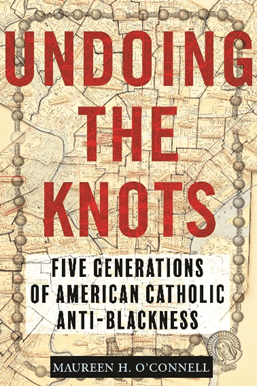
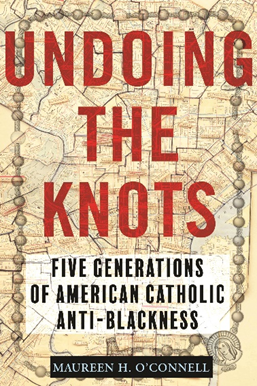
On Monday April 11, Dr. Maureen O’Connell, a religion professor at La Salle, presented a lecture based on her new book, “Undoing the Knot: Five Generations of American Catholic Anti-Blackness.” O’Connell opened her lecture by presenting a New York Times article on Georgetown University’s sale of 272 enslaved Africans in 1838 to Henry Johnson and Jesse Batey in exchange for $115,000 (about $2.79 million today). In 2015, Georgetown renamed buildings after descendants of the people sold and the Jesuits pledged to raise $100 million for descendants of slaves possessed by Jesuits. After discussing this article, O’Connell begged the question of what other universities owe to people wronged in their own institution’s past.

O’Connell focused on three primary issues surrounding talks about the past: remembering, gatekeeping and curriculum. The remembering section focused on the failures of communities in acknowledging that these issues occurred. Gatekeeping focused on institutions’ failures to validate and take into account the opinions of victims of these phenomena. The curriculum section focused on the failures of institutions to teach how and why these events occurred, the importance of them in the foundation of modern institutions and how we can properly educate people on these issues going forward. O’Connell reflected on these three primary dilemmas through her own research surrounding Rosemont College and Saint Joseph’s University as well as her own familial history and La Salle.

She followed each of these topics by asking the audience how they themselves have caused or experienced these issues and asked the community how the University can go about resolving them. A wide array of students, faculty members, parents and even some of the LaSallian brothers provided their own thoughts and insights and agreed that the goal of La Salle is to provide a campus where people can address and resolve the major social issues throughout the United States and improve the Catholic Church through doing so.

O’Connell encapsulated her entire lecture in a brief quote, “our belief in our own moral goodness goes unchallenged and in fact is reinforced by our inequality-sustaining charity. We have bought into the fragile myths of how we got here and promote false rationales as to why others haven’t been able to achieve the same things.” The purpose of this lecture and the vigorous research done to prepare the new book is to help guide members of the LaSallian and Philadelphian community towards accepting the sordid truth surrounding their past. O’Connell’s work pushes people in the Catholic Church to challenge the traditional narrative that has been enforced for generations and to attempt to find the truth behind our community as well as remedy numerous injustices from the past that have led to inequality within the current systems.