From April 1 to April 8, La Salle’s Student Government Association (SGA) ran elections and promoted campaigns by students running for the positions of student body president, vice president, secretary of academic affairs, secretary of business and senators for each class. SGA ran elections for their executive board from 8 a.m. to 6 p.m. on April 1, allowing members of the student body to vote on the four open positions. Although each position’s winner ran uncontested, the voting process was upheld for write-in purposes. The winners of the elections and representatives filling the positions are as follows:
Student Body President- Michaela Craner, Communication Sciences & Disorders 5-year
Student Body Vice President- Nikki Aquino, Biochemistry
Secretary of Academic Affairs- Junie Mertus, Biology
Secretary of Business Affairs- Will Goydan, Finance
Elections for class senators were held from 8 a.m. to 6 p.m. on April 8, allowing students to vote for multiple candidates for each class senator position. The freshman class of 22-23 will have a chance to elect senators at the beginning of next semester after they have had time to live on campus for a period. The winners of each class senator position are as follows:
We had a chance to catch up with some of the newly elected members of SGA, and this is what they had to say: Goydan was to the book and simply said, “As Secretary of Business Affairs I will be in charge of managing proposals for different events and ensuring that SGA continues to make use of its budget in a way that best supports our community.” Meanwhile, the new student body president, Craner, said “I am so honored to be serving as your SGA president. Looking toward the coming year, I will be focusing on improving communication between the student body and SGA through various means as well as within SGA itself. Next year, I want to grow SGA’s presence on campus through surveys and outreach to other organizations, while strengthening the bonds between our members. Make sure to keep an eye out for our surveys and initiatives in the future.”
On Tuesday, April 22 at 6 p.m. an induction ceremony was held in the La Salle Union Compass Club, and all officials listed above are now officially sworn in as representatives of the student body. We at the Collegian look forward to working closely with SGA to communicate to and from the student body, and wish the new officials the best of luck in their representative and academic endeavors.
Traditionally, SGA has been governed by first collecting data and polling the student body on suggestions and desired changes before communicating those suggestions to the university’s governing bodies, and it looks like Craner will be upholding this tradition. SGA works with several university committees including those related to public safety, dining, campus life and curriculum.
La Salle’s annual Foreign Language Awareness Week began on Monday, March 28. The week is full of presentations, activities and fun and informative opportunities to learn about different cultures, countries and languages.
The organizations running the event will be handing out passports for students and faculty to collect and learn more about the events. This passport includes a list of all the events of the week as well as where and when they will be taking place. When you attend an event, you’ll get a mark on your passport. Some professors are offering extra credit for attending certain events or presentations, and a gift card raffle will be held at the end of the week. The more events you go to, the more chances you have to win. Turn in your passport to Hayman 241 by Wednesday, April 6 to be entered into the raffle.
Tuesday
On Tuesday, March 29, the main event of the day is the food fair in the Hayman lobby. From 12:30 p.m. to 2:00 p.m. come enjoy food from all over the world, including curry, hummus, empanadas, pastries and Polish chrusciki from my own grandmother’s recipe (I can’t make them as good as she can, but I’m trying my best).
You are invited to wear your cultural attire any day of the week, but especially on Tuesday.
Elements of Celtic Spirituality presented by Dr. O’Connell 3:30 – 4:00 in Hayman 217
Wednesday
Wednesday, March 30 is full of cultural presentations. The presentations for that day, as well as for Tuesday and Thursday, are all listed at the end of this article. Come hear professors, student organizations and other experts present on a variety of topics.
Presentations:
Auguste Rodin: Founder of Modern Sculpture; A Walk presented by Brother Leonard – 10:00 | 10:30 in Hayman 211
French Movie – 11:00 | 12:00 in Hayman 207
Kiss, Bow, Shake Hands presented by Dr. Thomas | 10:45 – 11:00 in Hayman 211
Pysanky: The Art of Ukrainian Easter Eggs presented by Chrystyna Prokopovych | 12:30 – 2:30 in Hayman 214
Scholarships to Travel Abroad presented by Dr. Ketz | 2:00 – 2:30 in Hayman 211
Quinceanera presented by OLAS | 3:30 – 4:00 in Hayman 211
Mexican Movie sent by the Mexican Consulate | 5:00 – 6:00 in Hayman 217
Thursday
We close out the week on Thursday, March 31, with all sorts of fun and entertainment. From 12:30 p.m. to 2:00 p.m. we’ll have board games and card games from all over the world to play in the Hayman lobby, as well as some good old fashioned Kahoot games about languages. The last hurrah is OLAS’s Latin Night in the Union from 6:00 p.m. to 8:00 p.m., where there will be food, drinks, music and an overall great time.
Presentations:
Race and Culture around the World presented by political science classes | 12:30 – 2:00 in Hayman Lobby
Pierogi Making presented by Professor Chubok | 2:00 – 3:00 in Hayman 117
We hope you will attend some of these events this week!
Foreign Language Awareness Week Collegian articles
We collected testimonies from members of the La Salle community far and wide this week to share what makes us unique through our use of multiple languages. Thank you to all who participated.
Read our story about the benefits of multilingual communication here.
And read our story about the best foreign language films and television series here.
On March 2, Interim President Tim O’Shaughnessy responded to the recently revised city mask guidelines explaining that, although the Philadelphia Department of Public Health issued an adjustment to its indoor masking policy, La Salle’s COVID-19 response team reviewed these revised public health guidelines and waited to update the campus community regarding any potential policy changes. Until that new update, the current indoor masking policy remained in effect. O’Shaughnessy continued to encourage COVID-19 boosters and vaccines because they remain the greatest tools for reducing severe illness in our community and returning to a more active campus life.
On March 4, just days after the original update, O’Shaughnessy wrote to the La Salle community again to announce that “beginning Monday, March 7, La Salle University will transition to recommending, but not requiring, that masks be worn indoors. Everyone must continue to carry an appropriate mask with them at all times.” This changing mask policy follows the guidance of federal and local health agencies and was decided with the counsel of La Salle’s COVID-19 response team.
There are still circumstances where masks will be required like on the University shuttle, in clinical healthcare settings and in the COVID-19 testing center. In addition, masks are required to be held in the event that an individual asks others to be masked in their presence. If asked to mask up, it is recommended students follow the request.
During the upcoming spring break (March 12–20), La Salle will likely see a significant portion of our community travel away from campus. Therefore, masks will be required for the five-day period immediately following the University’s spring break, the week of March 21–25, as a preventative strategy. O’Shaughnessy does, however, explain that “masks have helped limit the spread of COVID-19. If necessary, we will not hesitate to reinstitute a mask mandate in the event that we experience significantly increased case counts on campus or in the region.”
As for other universities in the area and their mask mandates, many of these schools are on spring break. But, Temple University’s Senior Director of Health Services, Mark Denys, explained that “out of an abundance of caution, the university will still require the use of masks inside buildings when we return to campus next week.” Furthermore, Saint Joseph’s University’s president Mark C. Reed, Ed.D., explained on March 2 that “Given declining numbers regionally and nationally, our very high community vaccination rate and updated guidance from the CDC, City of Philadelphia and Montgomery County, the University will no longer require masks be worn indoors in all shared or common spaces at all times. Beginning tomorrow, March 3, masks will be optional on campus.” Drexel University decided that “despite loosened local mask ordinances, Drexel’s indoor mask requirement will continue at least through the end of winter term (through March 19, 2022) while we assess community needs moving forward. Masks are also still required on public transit throughout Philadelphia.”
In speaking to a few students about the new mask guidelines, the Collegian’s Managing Editor David O’Brien kept his response simple, saying, “I’m glad we don’t have to wear them anymore,” but junior biology student Luke Szyszkiewicz explained that he “doesn’t like how confusing the different rules are between different professors and the university.”The Collegian’s Editor-in-Chief Jake Eiseman says, “I think dropping the mask guidelines on campus is a positive move. It’s in accordance with the CDC’s and the city’s recommendations and cases have been low on campus for months now. Giving people the option to take the mask off should be seen as a good thing overall, but there are bound to be a few bad apples. Many people will continue to wear the mask regardless, and some will remove them when they feel it is safe, but some will never wear a mask again even when expressing symptoms, and that is my main concern.”
Editor’s Note: Although I am personally excited that we no longer have to wear masks because our cases are quite low, I think that these conditions should only prevail with high vaccination rates and requirements. I think that taking away the masks is a good decision for now and likely the remainder of the semester, but I hope the university continues to closely moderate cases and surges so that the campus’s health remains a top priority.
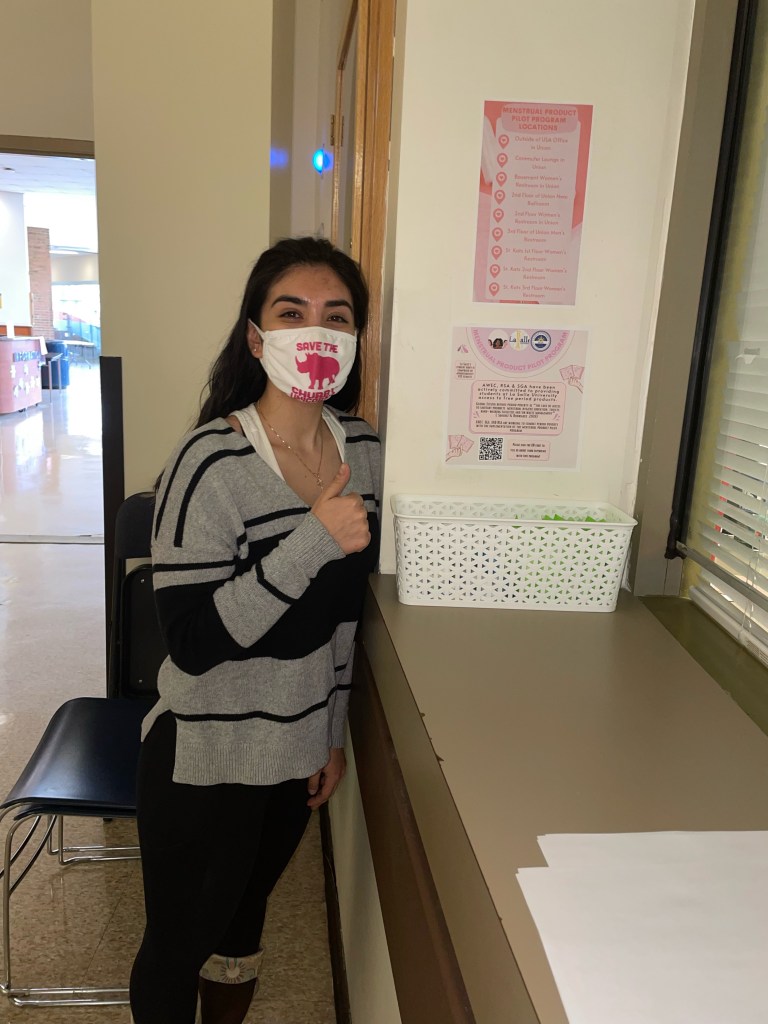
Isabelle Pope poses with the feminine hygiene products in the Union
On Feb. 16 La Salle University’s Students Government Association (SGA), Residence Life Association and All Women Every Color (AWEC) teamed up to announce a feminine hygiene initiative to provide tampons, pads and panty liners to students and faculty at La Salle University funded by the campus activity fund. @Lasallesga posted a video on Instagram to launch the menstrual product pilot program making period products available in St. Kat’s and the Union for women on campus, but also for any student regardless of their gender by having some baskets outside of the restrooms as well. Isabelle Pope, the president of SGA; Jua Brooks, co-founder and co-president of AWEC and Acie Barry, co-founder and co-president of AWEC explained the initiative via this Instagram video. This initiative has been in the works since 2019 and today the three organizations came together to announce their progress. SGA encourages anyone to reach out to them with any question as well as using the QR codes next to the products to provide feedback. This initiative will continue for the rest of the semester and if successful this program will likely continue in the future.
In 2021, bills related to period equity were introduced in 37 states, according to Women’s Voices For The Earth, a nonprofit advocacy group. However, only five states require schools to provide menstrual products. Recently, California became the latest state to mandate that public schools and colleges stock free pads, tampons and other products in their restrooms. Therefore, this initiative at a private and small school like La Salle is a triumph for adequate menstrual product access.
Barry explains that AWEC is “an organization founded by myself and Jua that is intended to be a safe space for women of color and allies alike on campus to join together and have important conversations. We are dedicated to creating social bonds within our organization and other organizations on campus all whilst also engaging in philanthropic efforts within the local community. We partnered with La Salle SAVE and hosted a hygiene product drive where we collected various items such as pads, tampons, razors, body wash, etc. and will be donating to a local organization called Women Against Abuse. Since the beginning of last semester, we have been researching period poverty amongst students and working with SGA and RSA to make menstrual products free and accessible to more students on campus. The pilot program started today and will run through the course of the year. Hopefully, if everything goes well, they will be in the majority of bathrooms across campus next year.”
In addition, Pope explained that originally, the proposal was supposed to be to get better dispensers in all of the women’s restrooms. The university explained that this was logistically difficult and expensive because matentience would have to be involved. So, baskets with free products seem easier and faster. The project began primarily with SGA in 2019 and 2020. But, by the end of 2021, the process was tough because of COVID-19 and funding issues. However, things began to look up when Pope joined as a member of AWEC and AWEC discussed access to feminine hygiene products. Pope made a connection between the two projects. The partnership made the entire project much faster, and Pope calls the collaboration a “huge learning experience.” She looks forward to cultivating better relationships with all the clubs on campus.
La Salle’s highest-paid employee doesn’t even work here anymore. In the spring of 2018, La Salle fired Dr. John Giannini, the former head coach of the men’s basketball team. Still, thanks to the fine print in his contract, La Salle has been paying his salary each year since his dismissal. According to the university’s IRS 990 form from 2020, he was paid at least $603,217, not including “other compensation.”
And on Jan. 7 of this year, La Salle charged a late fee to my account, clocking in at $150. And, of course, they had to charge me interest on that late fee, to the tune of $10.88. Fast forward to Feb. 7 — I was charged yet another late fee (+ interest). Dear La Salle: if I wasn’t able to make the base payment without any late fees back in January, what makes you think I’m suddenly in the financial position to shell out an additional (and I believe arbitrarily-determined) $321.76?
For brevity and simplicity, let’s round that out to $300. $300 in my pocket goes toward groceries and bills and occasionally funding my small business. But my two main concerns as a college student right now are food and shelter. And La Salle’s biggest expense is… paying someone they fired four years ago? It doesn’t match up.
At this point, perhaps you’re thinking, “Liz, do you have a job?” Yes, I did, in admissions. And then the university laid me off at the start of my senior year. Something about “not having it in the budget.” I’m glad Giannini is in the budget, though! Especially given La Salle’s dwindling admissions numbers, it is of the utmost importance that we lay off our student recruiters, right? Wrong. It’s no secret that La Salle is struggling, from both a financial perspective as well as an admissions perspective. So this is my question to the university: how do you justify laying off your budget workers — all of whom are very effective recruiters — while still wasting money elsewhere? I’m not a lawyer, I can’t pretend that I know the terms of Giannini’s contract — but has the university even explored getting out of it somehow? Or, did the university maybe consider not firing him back in 2018…at least get some labor out of him if you’re going to have to pay him regardless? Or was the performance of the basketball team the most important criteria in their decision-making?
I don’t know how the university makes its decisions, but I can say that after nearly four years here, I do know that they prioritize two key areas: its men’s basketball team and its business school. Everything else, I’ve learned, isn’t nearly as important as those two stalwarts. This isn’t an article interested in slandering the business school. Given the high job placement rates that come out of Founders’ Hall, La Salle is getting a really high return on investment on that front. My qualms lie with the team whose record is 40-65 (.381) since coach Ashley Howard was brought on.
My motivation for writing this article didn’t grow out of my personal, unique frustration with the university’s financial decisions; it grew out of the collective. All of my peers are beyond frustrated with the manners in which La Salle goes about squeezing money out of its students, only to turn around and spend it in foolish ways. If the basketball program was better, maybe this would be a different article, or maybe it wouldn’t even be written at all.
But, the fact of the matter is this: Giannini gets $600k while La Salle’s own students struggle to make ends meet. A man who hasn’t worked here for four years gets a yearly salary while student workers get laid off. La Salle’s admission numbers continue to drop to alarmingly low levels while the university focuses its efforts on a team with a bad record. Perhaps the worst part? My peers reading this article lose more and more faith each day in their university to make sound financial decisions. I love La Salle; I always have and always will. But allowing students to lose confidence in the very institution to which they entrust not only their education but also the trajectories of their careers is bad policy. And it doesn’t take a finance major to know that paying Giannini without receiving any services from him is bad practice; it’s bad for the financial statements and even worse for student morale.
Luckily, Financial Aid was able to waive one of my two late fees. I’m still trying to come up with the extra $160 that would otherwise go toward PECO, PGW or rent. I’ll figure it out. I just hope La Salle does, too.
Two weeks ago, we published the first in what will (hopefully) be a series of anonymous surveys for the La Salle Collegian community to share their opinions on a variety of topics. For the inaugural survey, what better topic than something we haven’t stopped hearing about and thinking about for the past couple of years — online classes, COVID-19 and La Salle’s reaction to it all?
The survey was available on the homepage of the Collegian website and was taken by about 70 people. Around 40 were current students who had taken at least one semester of completely online classes and at least one semester of completely (or mostly completely) online classes. The rest were professors, staff, alumni, friends and family of students or students who had only taken online or only in-person classes. This number of responses is just a small collection of Collegian readers and students and is not necessarily representative of the entire University. However, there are still some interesting insights and patterns shown through the responses.
The majority of the topics in the survey, which were only shown to students who had taken at least a semester of online classes as well as a semester of in-person classes, compared online and in-person learning in a variety of ways. Statements were presented with a Likert scale with the responses “strongly agree,” “somewhat agree,” “neither agree nor disagree,” “somewhat disagree,” “strongly disagree” and “I don’t know/this doesn’t apply to me.” At the end of the survey, all respondents could also share whatever other information on these topics that they wanted the Collegian to know.
To try to reduce possible bias from the ways the questions were phrased, for each topic, half of the respondents received a statement asking about online learning compared to in-person learning, while the other half of the respondents received the same statement but reversed, so it asked about in-person learning compared to online learning. For example, a statement about mental health was phrased as “my mental health is better during online classes than it is during in-person classes” for half of the people who took the survey and “my mental health is better during in-person classes than it is during online classes” for the other half. Since the comparison was between just those two choices, a response of “strongly agree” to one ‘version’ of the question means that, at least logically, that same person would have answered “strongly disagree” if they had been asked to respond to the reversed statement. For that reason (and to cut down on the number of charts in this article), all results will be presented in terms of in-person vs online versions of the statements, with all responses to both versions of the question combined.
Here are the results.
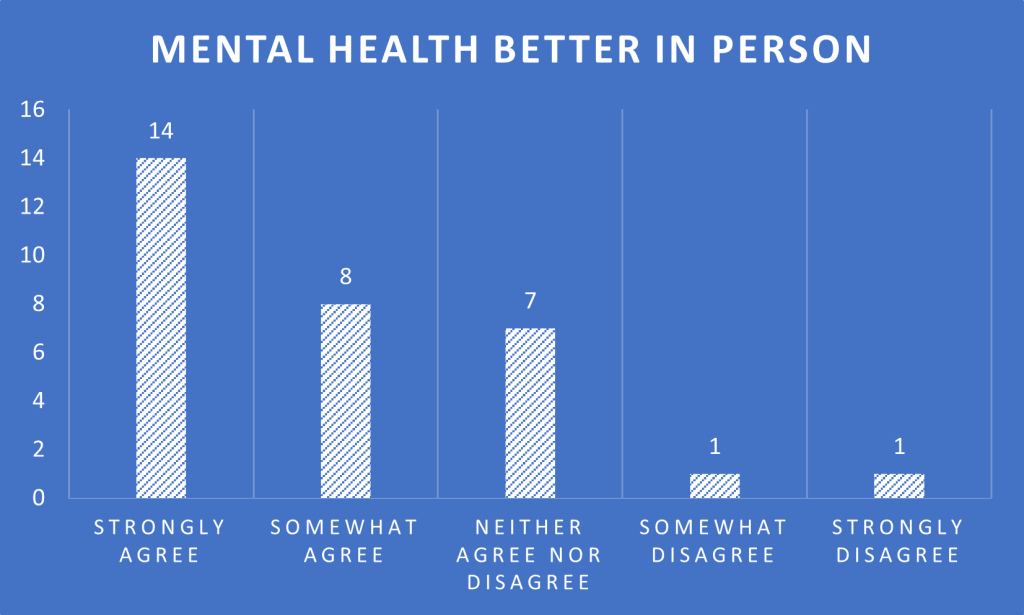
“My mental health is better during in-person classes than it is during online classes.”
The majority of students who responded to this question thought that their mental health is better during in-person classes than it is during online classes.
“My professors’ office hours are more convenient in-person than online.”
The highest number of students were neutral on this statement. However, more students thought that online office hours were more convenient than in-person office hours.
“My professors’ office hours are more helpful in-person than online.”
While a high number of students, again, found this statement neutral, many more students found that office hours were more helpful in-person instead of online.
“It is easier for me to work on schoolwork when classes are in-person instead of online.”
The majority of students found it easier to work on schoolwork when classes are in-person.
“It is easier for me to work (at a job) when classes are in-person instead of online.”
The responses to this statement were more varied, but most students thought that working at a job was easier when classes were online.
“It is easier for me to join clubs and extracurriculars when classes are in-person instead of online.”
Again, the majority of students who answered this question find it easier to get involved with clubs and extracurriculars in-person (although, during online classes, many groups, including the Collegian, did meet and organize online).
“My grades, overall, are better when classes are in-person than when they are online.”
This statement had an even split of agreement and disagreement — while eight respondents were neutral, 11 agreed and 11 disagreed in some capacity.
“It is easier for me to connect with my classmates when classes are in-person instead of online.”
Just one respondent disagreed with this statement.
“In-person classes are more interactive than online classes.”
This topic was shown to both students and professors who took the survey, and both groups overall agree that in-person classes are more interactive than online classes. One respondent at the end of the survey made a note that “online classes can be very interactive if the professor knows how to set them up that way.”
All people who took the survey, regardless of if they are students or not, were able to answer questions about La Salle’s distribution of COVID-19 information, contact tracing and COVID-19 testing policies and if they knew who to contact if they had questions on any of those topics.
“La Salle’s distribution of information about online classes, COVID-19 policies and other related topics has overall been up-to-date.”
A majority of respondents thought that this information has been distributed in a timely manner.
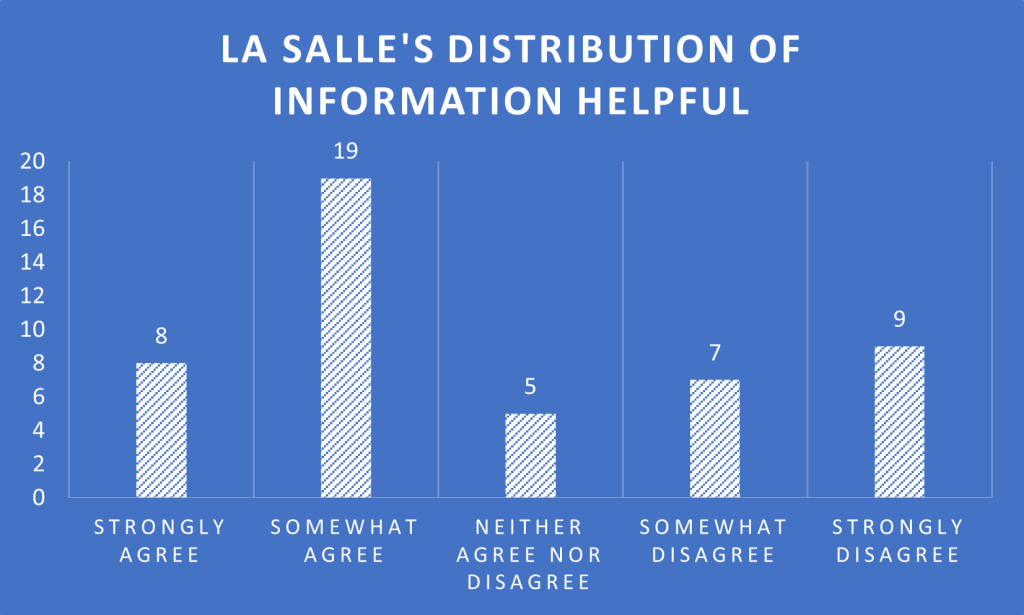
“La Salle’s distribution of information about online classes, COVID-19 policies and other related topics has overall been helpful.”
While more people agreed than disagreed with this statement, there was still a fair number of respondents who did not think the University’s information about these topics has been helpful.
“If I have a question about La Salle’s COVID-19 policies, I know who to contact or where to find the information.”
Most respondents seemed to know where they could have their questions answered, although several were also confused and unsure. For current information on La Salle’s COVID-19 policies, check this page.
The last statement students were shown asked them to choose between all online or all in-person classes for the current semester.
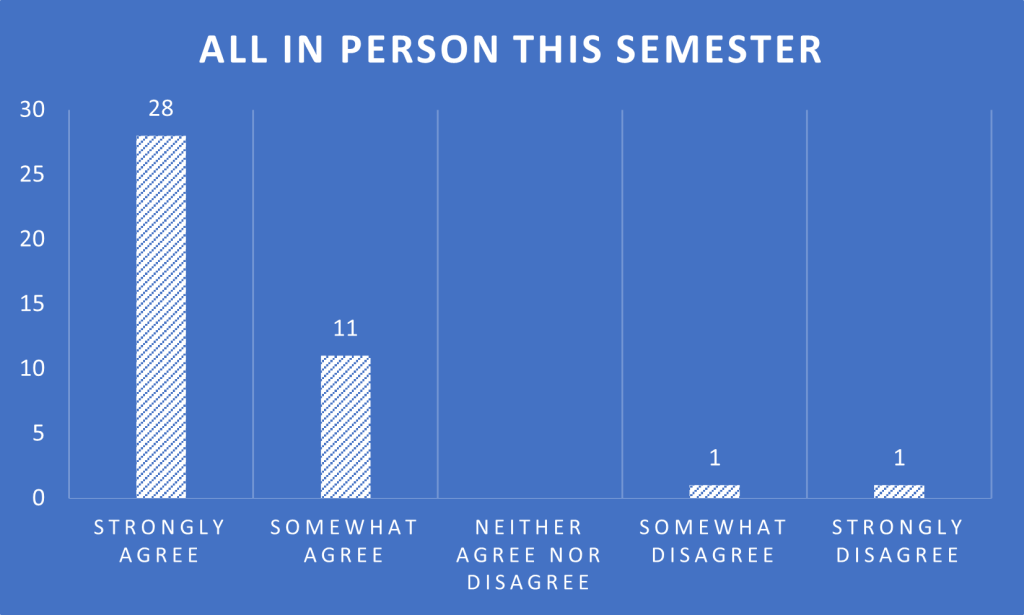
“All things considered, if I had to choose between either all in-person classes or all online classes for this semester, I would choose in-person.”
A large majority of respondents prefer in-person classes over online ones for this semester.
“I think that online classes don’t work,” explained one respondent at the end of the survey. “My experiences with online classes have been well,” wrote another. Someone else thinks it is necessary to “keep online classes and accommodations accessible for disabled students and those at highest risk,” and another wrote that it is important to remember that “there is inherent risk to everyone once a person walks outside their home or dorm.”
Although the sample size of this survey is certainly not large enough to represent the campus community as a whole, the results and patterns in the responses are still interesting. Here are my main takeaways.
Overall, the Collegian community, or at least those tuned in enough to respond to this survey, seems to think the University is doing a pretty good job distributing up-to-date and helpful information. Most students who took this survey reported that, in in-person classes, their mental health was better, joining clubs and extracurriculars and connecting with classmates was easier and it was easier to work on schoolwork. However, while classes were online, most respondents found it easier to work at jobs, and many found that online office hours are more convenient than in-person ones. Whether classes were online or in-person didn’t seem to have a consistent effect on students’ grades and, all things considered, the vast majority of students who took this survey would prefer completely in-person classes over totally online ones for this semester.
Many factors have influenced La Salle’s decisions about online classes and COVID-19 policies over the past two years, and some of those factors were certainly not covered in this survey. However, I think it is important to see what students, professors and others in the La Salle community think about changes and policies. We regularly receive surveys from the University about topics like Residence Life and dining options on campus, so why not something including some of the topics and themes in this article? These as well as other subjects could provide important insight to administration about what students think about their decisions and changes — because, after all, shouldn’t they be a little bit interested?
If you have any ideas for topics for future surveys, feel free to contact me at the email linked above!
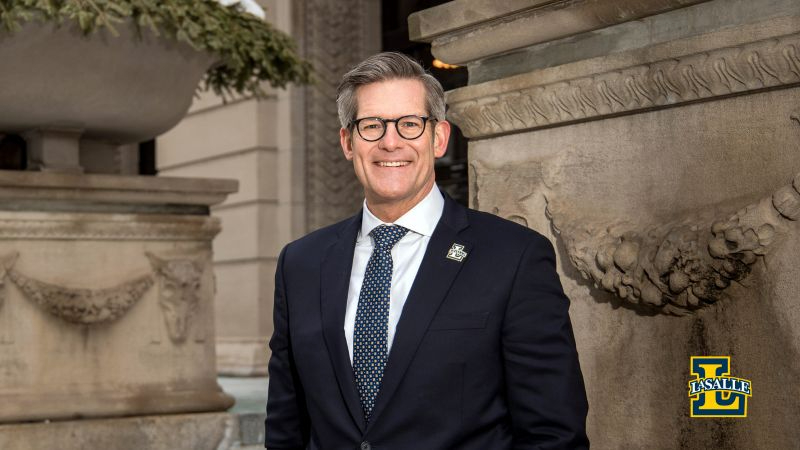
On Feb. 1, 2022 La Salle’s Board of Trustees Chair William W. Matthews, III, ’90, announced La Salle University’s 30th president. The Board of Trustees voted unanimously to appoint Daniel J. Allen, Ph.D., as La Salle University’s new president. Dr. Allen’s presidency begins April 18. The search for the president was a nine-month long process that concluded with select finalists meeting with stakeholder groups across our broader university community in late January. The board of trustees explains that Dr. Allen emerged as their candidate of choice to lead La Salle University. Matthews explains in his message, “I have every confidence, as does the Board of Trustees, that Dr. Allen will build upon our impressive foundation and elevate La Salle to significant new heights.” In addition, interim president Tim O’Shaughnessy, ’85 will serve on the Executive Cabinet and provide support in the transition for Allen.
Since 2015, Allen has served at DePaul University in a vice presidential capacity, ending his career as Senior Vice President of Advancement and External Relations. Prior to that, he worked in Catholic higher education for over 20 years and received education from Catholic universities as he completed his Ph.D. in education with a concentration in higher education at Loyola University-Chicago and his M.A. and B.A. in English literature from Loras College.
In his previous role, Allen provided, led and managed all fundraising, alumni relations and advancement communications strategies at DePaul University. In addition to his work at DePaul University, Allen served as the senior associate dean for external relations at the University of Chicago’s Harris School of Public Policy as well as being Vice President of Institutional Advancement at Lewis University in Romeoville, IL, a Lasallian institution. President-elect Allen has expressed interest in the area of postsecondary educational access for low-income students. In addition, he has presented work on improving opportunities for academically qualified, low-income students to the Association for Institutional Research and has had his research published in “Research in Higher Education.”
In addition to continuing this work at La Salle University, Allen is looking forward to including the voices of students, those in leadership positions and student organizations when planning for changes and goals. In a discussion with the Collegian editorial board, Allen said that one of his goals is for students to think their time at La Salle University “is as robust and as challenging as it can be” so that “students feel it is a vibrant experience.” In addition, Allen plans on being present on campus by attending student activities and sitting down to talk with students to better know and become part of our community at La Salle University. The Collegian staff welcomes President-elect Allen and looks forward to what his presidency has to offer. For more details of Allen’s sit-down with the Collegian, please look to our Editorial section this week.
Last semester, I experienced issues with La Salle’s shuttle system and wrote an article expressing my concerns about the lack of proper communication regarding the shuttle hours. I had explained that my friends and I went downtown and had followed the shuttle service hours posted on La Salle’s page, which stated that the shuttle would be running until 3 a.m. Unbeknownst to us, the shuttle hours were changed, and they were no longer running at the time that we were hoping to get a ride. Had the updated hours been posted, and the shuttle tracking app wasn’t removed, we wouldn’t have been left waiting in the dark on the corner of an unsafe street for a shuttle that was not going to arrive.
Following the article, the updated hours were posted online and the shuttle tracker app was made available again, which I am happy about. However, not long after that, my friends and I had walked to the station, as it was still bright out, but were followed on our walk by an older man that we do not know. Luckily, a shuttle driver noticed and pulled over to pick us up. We were happy to have been given a ride, but were uncomfortable with the fact that we had been followed, so we have felt a bit unnerved at the idea of walking to and from the Septa station on our own since then.
On a recent Friday afternoon we wanted to go downtown, so we tracked the shuttle on the La Salle app to take us to the Septa station. We were waiting on campus when the app said the shuttle had arrived nearby, although it had not. We called public safety and asked to be picked up. When we got on the shuttle, we asked how late they would be running later that night to make sure that we could get back in time so that we would not have to walk home in the dark, just in case we got there later than the posted times. We were told that at any time during the day or night we could call 215-951-1300 and that a shuttle would be sent out to us.
When we got back to the Olney station later that night we used the shuttle tracking app, and, again, it said that the shuttle arrived at the station even though it had not. It was only 7 p.m. at that point, and the shuttle is supposed to run normally until 9 p.m., so we assumed there would be no issue getting a ride if we called the number we were given earlier.
We called and were told that unless we had a medical emergency, a shuttle could not be sent out to us. I explained that we were given that number earlier in the day and were told to call at any point for a ride and was again told that a shuttle would not be sent unless there was a medical emergency. We walked back in the dark in 20-degree weather, still uncomfortable about the fact that we had previously been followed and were in an unsafe neighborhood to be walking around in at night.
I have had no problems with the shuttle drivers themselves as they have consistently expressed how much they value La Salle students’ safety, but I am extremely disappointed in La Salle for their lack of communication and their irresponsibility. My primary purpose in writing this article is to make it known that there needs to be more consistency, communication and emphasis on student safety. La Salle may claim that student safety and well-being is a top priority, but they have continuously proved otherwise. There is consistently better communication regarding the beloved basketball team than about something as crucial as public safety — or anything else, for that matter.
“For when two or three gather together in My name, there I am with them.” Matthew, 18:20
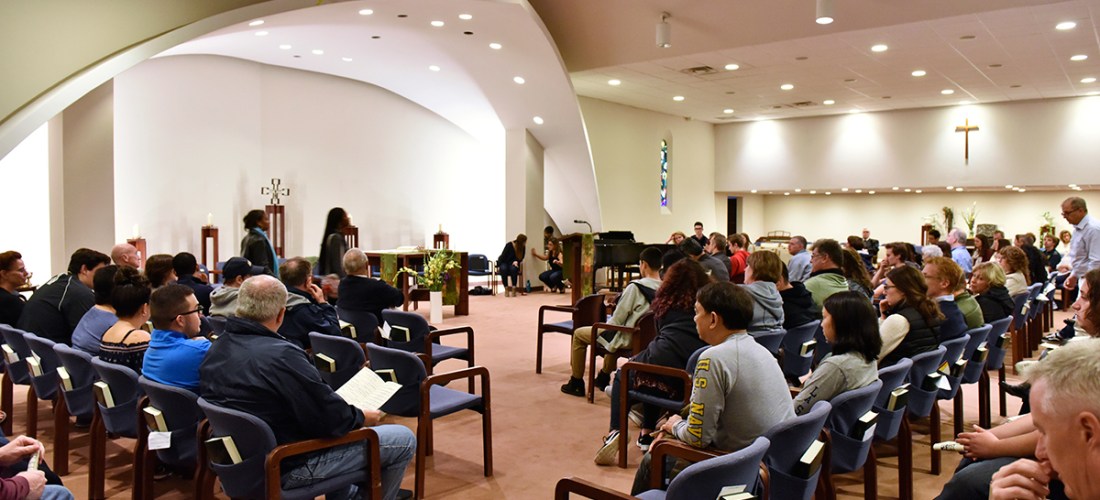
As a Catholic University, we are blessed to be able to celebrate Mass every day, Monday through Thursday, in our beautiful Chapel. Daily Mass is at 1 p.m. and it takes only about 20-25 minutes. As your fellow Lasallian, I invite you — students, faculty and staff — to make a habit of going to daily Mass at our Chapel, even if just once a week.
Mass has always been an important part of my life since I was a young boy. I am originally from Tanzania, East Africa. Faith is what held people in my village together. When I was in my last two years of elementary school, my best friend, Alphonce Marandu, and I went to Mass every morning. Our mothers would wake us up at 5 a.m. and we would walk (past our school) for an hour to get to our church which was four miles away. After Mass, we would walk back two miles to our school. Alphonce was praying that he would be a priest and I was praying that I would be admitted into secondary school. Less than five percent of students who finished elementary school at the time were selected to go to secondary school. The national exam I took at the end of my elementary school education is the most important exam I ever took in my life. Our prayers were answered a millionfold!
Every time I walk from Hayman Hall to the Chapel, I marvel at God’s goodness and generosity. Now, a three-minute walk gets me from my office to Mass. I find this quite amazing.
Mass is a wonderful opportunity to worship and pray together. We all need prayers — all the time — both as individuals and also as a community. Surely, Mass is not the only way one can pray, but as a Catholic, I don’t know a more powerful form of prayer.
Usually, if someone asks me about last fall semester, I will just groan about how much I hated Zoom. Although I despised an entirely online format last year, I loved the expedited semester that finished before Thanksgiving. I wish that this year we could have come to school two weeks earlier in August and began the semester two weeks sooner so that we could have finished classes and finals before Thanksgiving break, because my motivation at the end of this semester is at approximately zero.
A longer winter break that includes both Thanksgiving and the normally scheduled winter break would also give students the opportunity to perhaps work an internship, make some money, or just have uninterrupted rest.
In complaining to my friends about my lack of focus after the break, we can conclude that Thanksgiving break is a tease. The nice restful time spent with family to the jump to the end of semester assignments and finals has been brutal.
If anyone has seen me attempt to do homework, my motivation is certainly sub-par. The other day I was writing a paper and had to listen to Cardi B’s “Money” to hopefully regain some focus to complete my work. If we had an expedited semester, the format would prevent Thanksgiving break from interrupting our motivation. In terms of other breaks, we already have fall break, which is a shorter and necessary break midway through the semester.
In conclusion, I support bringing back the expedited semester from last year. I would be happy to come to school two weeks early if that meant finishing two weeks early as well.








 The La Salle Collegian