The difference between $300 and $600k

Commentary

Elizabeth McLaughlin, Editor

Header image: collegeconsensus.com

La Salle’s highest-paid employee doesn’t even work here anymore. In the spring of 2018, La Salle fired Dr. John Giannini, the former head coach of the men’s basketball team. Still, thanks to the fine print in his contract, La Salle has been paying his salary each year since his dismissal. According to the university’s IRS 990 form from 2020, he was paid at least $603,217, not including “other compensation.”

And on Jan. 7 of this year, La Salle charged a late fee to my account, clocking in at $150. And, of course, they had to charge me interest on that late fee, to the tune of $10.88. Fast forward to Feb. 7 — I was charged yet another late fee (+ interest). Dear La Salle: if I wasn’t able to make the base payment without any late fees back in January, what makes you think I’m suddenly in the financial position to shell out an additional (and I believe arbitrarily-determined) $321.76?

For brevity and simplicity, let’s round that out to $300. $300 in my pocket goes toward groceries and bills and occasionally funding my small business. But my two main concerns as a college student right now are food and shelter. And La Salle’s biggest expense is… paying someone they fired four years ago? It doesn’t match up.

At this point, perhaps you’re thinking, “Liz, do you have a job?” Yes, I did, in admissions. And then the university laid me off at the start of my senior year. Something about “not having it in the budget.” I’m glad Giannini is in the budget, though! Especially given La Salle’s dwindling admissions numbers, it is of the utmost importance that we lay off our student recruiters, right? Wrong. It’s no secret that La Salle is struggling, from both a financial perspective as well as an admissions perspective. So this is my question to the university: how do you justify laying off your budget workers — all of whom are very effective recruiters — while still wasting money elsewhere? I’m not a lawyer, I can’t pretend that I know the terms of Giannini’s contract — but has the university even explored getting out of it somehow? Or, did the university maybe consider not firing him back in 2018…at least get some labor out of him if you’re going to have to pay him regardless? Or was the performance of the basketball team the most important criteria in their decision-making?

I don’t know how the university makes its decisions, but I can say that after nearly four years here, I do know that they prioritize two key areas: its men’s basketball team and its business school. Everything else, I’ve learned, isn’t nearly as important as those two stalwarts. This isn’t an article interested in slandering the business school. Given the high job placement rates that come out of Founders’ Hall, La Salle is getting a really high return on investment on that front. My qualms lie with the team whose record is 40-65 (.381) since coach Ashley Howard was brought on.

My motivation for writing this article didn’t grow out of my personal, unique frustration with the university’s financial decisions; it grew out of the collective. All of my peers are beyond frustrated with the manners in which La Salle goes about squeezing money out of its students, only to turn around and spend it in foolish ways. If the basketball program was better, maybe this would be a different article, or maybe it wouldn’t even be written at all.

But, the fact of the matter is this: Giannini gets $600k while La Salle’s own students struggle to make ends meet. A man who hasn’t worked here for four years gets a yearly salary while student workers get laid off. La Salle’s admission numbers continue to drop to alarmingly low levels while the university focuses its efforts on a team with a bad record. Perhaps the worst part? My peers reading this article lose more and more faith each day in their university to make sound financial decisions. I love La Salle; I always have and always will. But allowing students to lose confidence in the very institution to which they entrust not only their education but also the trajectories of their careers is bad policy. And it doesn’t take a finance major to know that paying Giannini without receiving any services from him is bad practice; it’s bad for the financial statements and even worse for student morale.

Luckily, Financial Aid was able to waive one of my two late fees. I’m still trying to come up with the extra $160 that would otherwise go toward PECO, PGW or rent. I’ll figure it out. I just hope La Salle does, too.
The results are in — responses to our first Collegian community survey

Commentary

Alina Snopkowski, Editor

Header image: lasalle.edu

Two weeks ago, we published the first in what will (hopefully) be a series of anonymous surveys for the La Salle Collegian community to share their opinions on a variety of topics. For the inaugural survey, what better topic than something we haven’t stopped hearing about and thinking about for the past couple of years — online classes, COVID-19 and La Salle’s reaction to it all?

The survey was available on the homepage of the Collegian website and was taken by about 70 people. Around 40 were current students who had taken at least one semester of completely online classes and at least one semester of completely (or mostly completely) online classes. The rest were professors, staff, alumni, friends and family of students or students who had only taken online or only in-person classes. This number of responses is just a small collection of Collegian readers and students and is not necessarily representative of the entire University. However, there are still some interesting insights and patterns shown through the responses.

The majority of the topics in the survey, which were only shown to students who had taken at least a semester of online classes as well as a semester of in-person classes, compared online and in-person learning in a variety of ways. Statements were presented with a Likert scale with the responses “strongly agree,” “somewhat agree,” “neither agree nor disagree,” “somewhat disagree,” “strongly disagree” and “I don’t know/this doesn’t apply to me.” At the end of the survey, all respondents could also share whatever other information on these topics that they wanted the Collegian to know.

To try to reduce possible bias from the ways the questions were phrased, for each topic, half of the respondents received a statement asking about online learning compared to in-person learning, while the other half of the respondents received the same statement but reversed, so it asked about in-person learning compared to online learning. For example, a statement about mental health was phrased as “my mental health is better during online classes than it is during in-person classes” for half of the people who took the survey and “my mental health is better during in-person classes than it is during online classes” for the other half. Since the comparison was between just those two choices, a response of “strongly agree” to one ‘version’ of the question means that, at least logically, that same person would have answered “strongly disagree” if they had been asked to respond to the reversed statement. For that reason (and to cut down on the number of charts in this article), all results will be presented in terms of in-person vs online versions of the statements, with all responses to both versions of the question combined.

Here are the results.

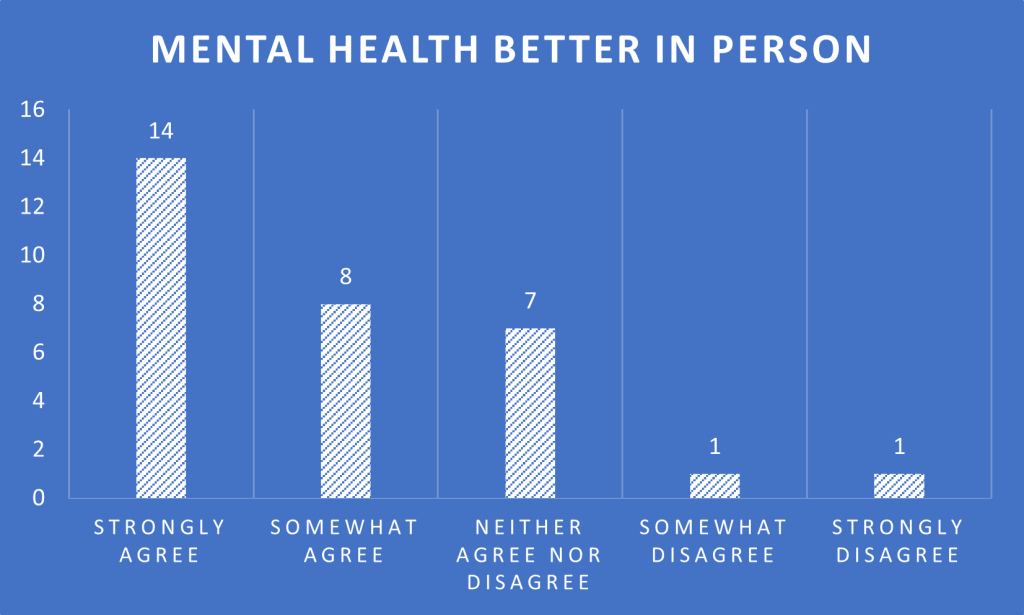
“My mental health is better during in-person classes than it is during online classes.”

The majority of students who responded to this question thought that their mental health is better during in-person classes than it is during online classes.

“My professors’ office hours are more convenient in-person than online.”

The highest number of students were neutral on this statement. However, more students thought that online office hours were more convenient than in-person office hours.

“My professors’ office hours are more helpful in-person than online.”

While a high number of students, again, found this statement neutral, many more students found that office hours were more helpful in-person instead of online.

“It is easier for me to work on schoolwork when classes are in-person instead of online.”

The majority of students found it easier to work on schoolwork when classes are in-person.

It is easier for me to work (at a job) when classes are in-person instead of online.”

The responses to this statement were more varied, but most students thought that working at a job was easier when classes were online.

“It is easier for me to join clubs and extracurriculars when classes are in-person instead of online.”

Again, the majority of students who answered this question find it easier to get involved with clubs and extracurriculars in-person (although, during online classes, many groups, including the Collegian, did meet and organize online).

“My grades, overall, are better when classes are in-person than when they are online.”

This statement had an even split of agreement and disagreement — while eight respondents were neutral, 11 agreed and 11 disagreed in some capacity.

“It is easier for me to connect with my classmates when classes are in-person instead of online.”

Just one respondent disagreed with this statement.

“In-person classes are more interactive than online classes.”

This topic was shown to both students and professors who took the survey, and both groups overall agree that in-person classes are more interactive than online classes. One respondent at the end of the survey made a note that “online classes can be very interactive if the professor knows how to set them up that way.”

All people who took the survey, regardless of if they are students or not, were able to answer questions about La Salle’s distribution of COVID-19 information, contact tracing and COVID-19 testing policies and if they knew who to contact if they had questions on any of those topics.

“La Salle’s distribution of information about online classes, COVID-19 policies and other related topics has overall been up-to-date.”

A majority of respondents thought that this information has been distributed in a timely manner.

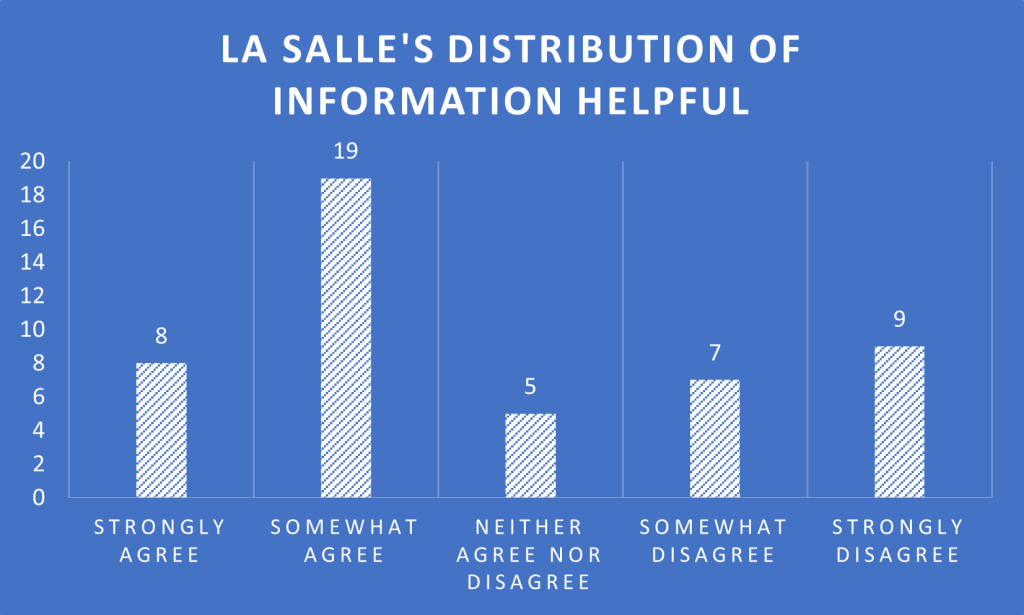
“La Salle’s distribution of information about online classes, COVID-19 policies and other related topics has overall been helpful.”

While more people agreed than disagreed with this statement, there was still a fair number of respondents who did not think the University’s information about these topics has been helpful.

“If I have a question about La Salle’s COVID-19 policies, I know who to contact or where to find the information.”

Most respondents seemed to know where they could have their questions answered, although several were also confused and unsure. For current information on La Salle’s COVID-19 policies, check this page.

The last statement students were shown asked them to choose between all online or all in-person classes for the current semester.

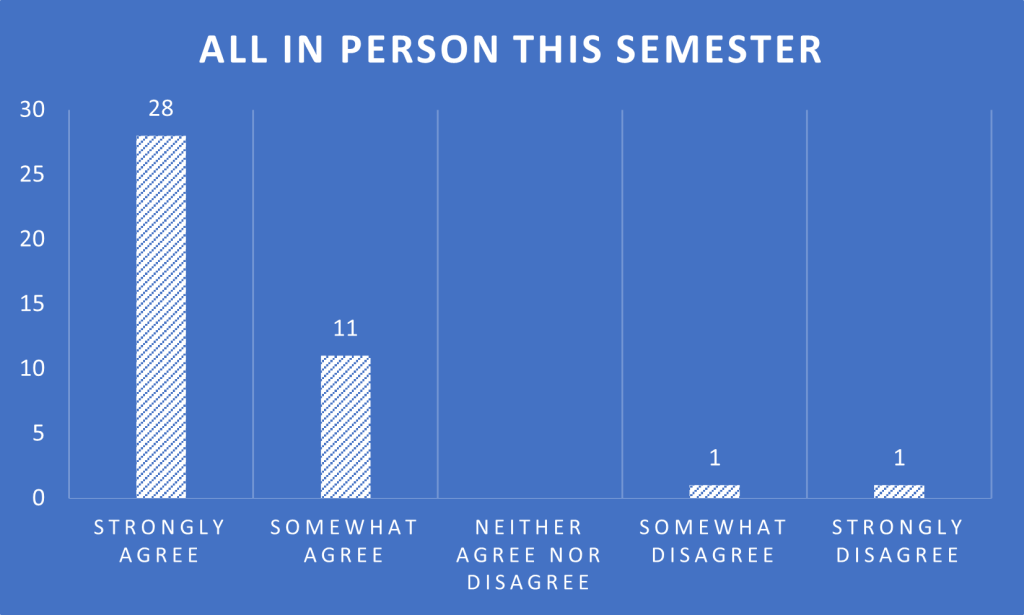
“All things considered, if I had to choose between either all in-person classes or all online classes for this semester, I would choose in-person.”

A large majority of respondents prefer in-person classes over online ones for this semester.

“I think that online classes don’t work,” explained one respondent at the end of the survey. “My experiences with online classes have been well,” wrote another. Someone else thinks it is necessary to “keep online classes and accommodations accessible for disabled students and those at highest risk,” and another wrote that it is important to remember that “there is inherent risk to everyone once a person walks outside their home or dorm.”

Although the sample size of this survey is certainly not large enough to represent the campus community as a whole, the results and patterns in the responses are still interesting. Here are my main takeaways.

Overall, the Collegian community, or at least those tuned in enough to respond to this survey, seems to think the University is doing a pretty good job distributing up-to-date and helpful information. Most students who took this survey reported that, in in-person classes, their mental health was better, joining clubs and extracurriculars and connecting with classmates was easier and it was easier to work on schoolwork. However, while classes were online, most respondents found it easier to work at jobs, and many found that online office hours are more convenient than in-person ones. Whether classes were online or in-person didn’t seem to have a consistent effect on students’ grades and, all things considered, the vast majority of students who took this survey would prefer completely in-person classes over totally online ones for this semester.

Many factors have influenced La Salle’s decisions about online classes and COVID-19 policies over the past two years, and some of those factors were certainly not covered in this survey. However, I think it is important to see what students, professors and others in the La Salle community think about changes and policies. We regularly receive surveys from the University about topics like Residence Life and dining options on campus, so why not something including some of the topics and themes in this article? These as well as other subjects could provide important insight to administration about what students think about their decisions and changes — because, after all, shouldn’t they be a little bit interested?

If you have any ideas for topics for future surveys, feel free to contact me at the email linked above!

La Salle needs to start recycling

Commentary

Kylie McGovern, Editor

Header image: lasalle.edu

Can La Salle please start recycling? I will get into research and logistics in a moment, but I am genuinely embarrassed and upset that I am writing this article in 2022 amid a literal climate crisis. Why would an institution of higher learning and research refuse to invest in recycling? I will never understand. 

There are recycling cans on main campus (which I personally think are probably just dumped into a dumpster with the regular trash) and the university claims on this website that the Grounds Division at La Salle University consists of technicians who are very knowledgeable in their profession. They are dedicated to keeping the La Salle Community looking exceptional and free of debris. Their tasks include the following: lawn maintenance, landscaping, removal of trash, recycling and snow removal, as well as the Custodial Division at La Salle University, who are responsible for trash/recycling pickup. However, there aren’t recycling bins in any of the residence halls. 

Living close to campus, I take a bag of recycling home every now and then because my conscience literally cannot bear throwing away single-use plastic just because I don’t have access to recycling at my apartment. 

There are many benefits to recycling: according to Eco-Cycle,  many items that are recycled can be repurposed into different things rather than sitting in landfill for the next 100+ years. For example, steel products can be recycled over and over again. In addition, plastic can be recycled into so many different things like carpet, clothing, auto parts and new bottles. Similarly, paper is recycled into new paper. Some types of paper can be recycled up to seven times. Just by recycling about 30 percent of waste every year, Americans could save the equivalent of 11.9 billion gallons of gasoline and reduce the greenhouse gas equivalent of taking 25 million cars off the road. In addition, the process of recycling can also create jobs as for every one job at a landfill, there are ten jobs in recycling processing and 25 jobs in recycling-based manufacturing.

This lack of proper and adequate recycling at La Salle is not the only issue — the University is being wasteful in other ways. The lights in the business building are kept on 24 hours a day, seven days a week! Also, can we talk about the straws and plastic utensils in the dining hall? This article is my call to action for La Salle University — both the administration and the student body — to put time and perhaps even money into making the university more sustainable. I learn about climate change in my classes and then exit the classroom to see vending machines full of plastic bottles that we do not have the resources to recycle, which seems a little backwards to me.

I think there are various solutions to La Salle’s recycling and sustainability issues, starting with turning off the lights in Founders Hall, providing recycling in residence halls and using more reusable materials in our dining halls. This is just a list of options I thought of in about 13 seconds. 

I know that there are perhaps logistical and financial barriers to these solutions on the front end, but in the future  if the university puts some funds into these things, the effects will certainly pay off both financially and environmentally. To both the higher ups at La Salle and its student body: let’s get better, because I do not want my grandchild to die from climate change or to be living the same non-recycled plastic in 50 years. If this enrages you also and you have answers regarding sustainability at La Salle, feel free to email me.

Still disappointed in La Salle’s public safety communication

Commentary

Meghan Cain, Staff

Last semester, I experienced issues with La Salle’s shuttle system and wrote an article expressing my concerns about the lack of proper communication regarding the shuttle hours. I had explained that my friends and I went downtown and had followed the shuttle service hours posted on La Salle’s page, which stated that the shuttle would be running until 3 a.m. Unbeknownst to us, the shuttle hours were changed, and they were no longer running at the time that we were hoping to get a ride. Had the updated hours been posted, and the shuttle tracking app wasn’t removed, we wouldn’t have been left waiting in the dark on the corner of an unsafe street for a shuttle that was not going to arrive.

Following the article, the updated hours were posted online and the shuttle tracker app was made available again, which I am happy about. However, not long after that, my friends and I had walked to the station, as it was still bright out, but were followed on our walk by an older man that we do not know. Luckily, a shuttle driver noticed and pulled over to pick us up. We were happy to have been given a ride, but were uncomfortable with the fact that we had been followed, so we have felt a bit unnerved at the idea of walking to and from the Septa station on our own since then.

On a recent Friday afternoon we wanted to go downtown, so we tracked the shuttle on the La Salle app to take us to the Septa station. We were waiting on campus when the app said the shuttle had arrived nearby, although it had not. We called public safety and asked to be picked up. When we got on the shuttle, we asked how late they would be running later that night to make sure that we could get back in time so that we would not have to walk home in the dark, just in case we got there later than the posted times. We were told that at any time during the day or night we could call 215-951-1300 and that a shuttle would be sent out to us.

When we got back to the Olney station later that night we used the shuttle tracking app, and, again, it said that the shuttle arrived at the station even though it had not. It was only 7 p.m. at that point, and the shuttle is supposed to run normally until 9 p.m., so we assumed there would be no issue getting a ride if we called the number we were given earlier.

We called and were told that unless we had a medical emergency, a shuttle could not be sent out to us. I explained that we were given that number earlier in the day and were told to call at any point for a ride and was again told that a shuttle would not be sent unless there was a medical emergency. We walked back in the dark in 20-degree weather, still uncomfortable about the fact that we had previously been followed and were in an unsafe neighborhood to be walking around in at night.

I have had no problems with the shuttle drivers themselves as they have consistently expressed how much they value La Salle students’ safety, but I am extremely disappointed in La Salle for their lack of communication and their irresponsibility. My primary purpose in writing this article is to make it known that there needs to be more consistency, communication and emphasis on student safety. La Salle may claim that student safety and well-being is a top priority, but they have continuously proved otherwise. There is consistently better communication regarding the beloved basketball team than about something as crucial as public safety — or anything else, for that matter.

An invitation to daily Mass

Commentary

Richard Mshomba, professor of economics

“For when two or three gather together in My name, there I am with them.” Matthew, 18:20

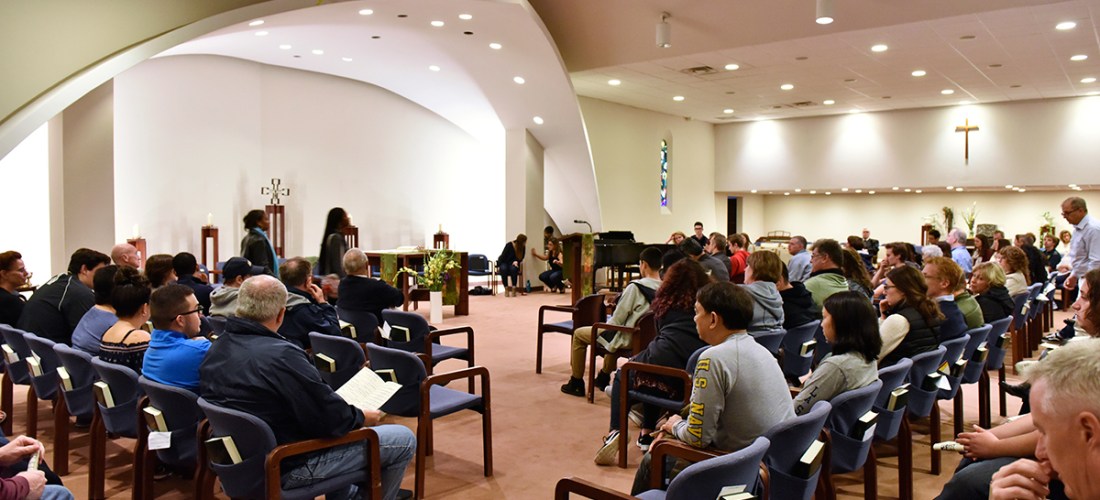
As a Catholic University, we are blessed to be able to celebrate Mass every day, Monday through Thursday, in our beautiful Chapel. Daily Mass is at 1 p.m. and it takes only about 20-25 minutes. As your fellow Lasallian, I invite you — students, faculty and staff — to make a habit of going to daily Mass at our Chapel, even if just once a week.

Mass has always been an important part of my life since I was a young boy. I am originally from Tanzania, East Africa. Faith is what held people in my village together. When I was in my last two years of elementary school, my best friend, Alphonce Marandu, and I went to Mass every morning. Our mothers would wake us up at 5 a.m. and we would walk (past our school) for an hour to get to our church which was four miles away. After Mass, we would walk back two miles to our school. Alphonce was praying that he would be a priest and I was praying that I would be admitted into secondary school. Less than five percent of students who finished elementary school at the time were selected to go to secondary school. The national exam I took at the end of my elementary school education is the most important exam I ever took in my life. Our prayers were answered a millionfold!

Every time I walk from Hayman Hall to the Chapel, I marvel at God’s goodness and generosity. Now, a three-minute walk gets me from my office to Mass. I find this quite amazing.

Mass is a wonderful opportunity to worship and pray together. We all need prayers — all the time — both as individuals and also as a community. Surely, Mass is not the only way one can pray, but as a Catholic, I don’t know a more powerful form of prayer.

Following up on 9/29 article: Why you shouldn’t sleep in the same room as your phone

Commentary

Elizabeth McLaughlin, Editor

Synced

Attention is a powerful tool: one that enhances our human experiences, and one that is highly prized and captured by technology and media.

It has been nearly four months since I wrote the article entitled “Why you shouldn’t sleep in the same room as your phone.” After re-reading it this afternoon, I couldn’t help but notice ways in which I could improve upon it. I also noticed that my relationship with my phone has changed a bit since Sept. 29, the day that article was published. So without further ado, here’s the follow-up that no one asked for.

Full disclosure: I sleep with my phone in my room again. One night, as we were all wrapping up whatever conversation filled our living room that evening, my roommate Mia made a comment to my other roommate, Ren, that perhaps leaving her laptop downstairs overnight wasn’t the best idea in the event of a home invasion. It sucks that we have to think that way, but this advice was coming off the heels of a string of home invasions on our block committed by a man who lives just three doors down from us. Safeguarding ourselves and our belongings was a priority situated at the front of our minds. I plugged my phone into its usual spot next to our TV and went upstairs, not thinking much of Mia’s comment… until I started perseverating on it.

“If someone breaks in and steals my phone, they wouldn’t be stealing just my phone — I keep all of my cards in a wallet attached to my phone case. My debit card, my other debit card, my other debit card, my expired debit card, my credit card, my ID, my school ID, my expired ID. They would have it all. And I would have to re-obtain all those elements of my identity.” Talk about a headache! This was the opposite of my intention when I decided to sleep in a phone-less room, so needless to say, that night was the last night I heeded my own advice.

But that night launched a series of moments with myself in which I began to evaluate exactly how much of my identity is tethered to a device. My copious amount of cards aside, my phone is also a portal into the various versions of myself that I choose to share with others. I try to limit my social media to just Instagram these days, but even there, I have two accounts: a personal one and an art one. To me, there is not much delineation between what I might share on the former versus the latter; they represent the same person, just with different photos and captions. But my personal lack of boundaries between the two doesn’t matter much; by making both accounts, I chose to fragment my identity, creating two canalized versions of the one person I know myself to be. And that’s a little unnerving.

I fell down a rabbit hole of making a mental note of all the online avatars I’ve created for myself over my 21 years of life. It all started in late elementary school, early middle school when I created way too many One Direction fan accounts. And in 2012, I created my Facebook account to connect with relatives who lived in other states and also to play Farmville. Somewhere around then, I made multiple Tumblr accounts: for writing and One Direction, mainly. Thanks to the strong community that Directioners so famously fostered, I made virtual friends all over; I even inherited a meme account from one of those friends, who disposed of it and all of its ten thousand followers as easily as one would dispose of a used tissue.

I was very present online, because that’s what you do when you’re a teenager in the 21st century. Even now, I can remember with great detail the types of environments I was exposed to from platform to platform. My One Direction fan accounts are where I was first exposed to digital art; I remember becoming good friends with a Brazilian girl named Paula whose digital paintings of Niall Horan still impress me to this day. On my meme page, I exchanged units of cultural ideas and symbols with tens of thousands of people across the world (after all, that’s what the word “meme” literally means: a unit of cultural information spread by imitation, as defined by Richard Dawkins in his 1976 book “The Selfish Gene”). On my Tumblr accounts, I had access to a range of writers; the ones I found most interesting were the other 16-year-old girls who just so happened to be situated somewhere else on the planet. On a darker note, I was exposed to the nasty eating disorder environment that was all too familiar to girls like me in that era.

I had seen and experienced so much thanks to the Internet. And looking back on it, I can’t help but feel protective of my younger self; of young girls now who are experiencing their own digital renaissance as I type these words. And my concern isn’t reserved for teenage girls; it extends to all of us who regularly interact with the Internet. I’m realizing more and more with each passing day how much of who we are, individually and collectively, is informed by the ways technology captures our attention. Four months out from my initial article and almost two years into a global pandemic, I’m constantly taking note of how precious our attention is — and how sophisticated, calculated and well-funded the various attacks so often made on it are.

The word “attention” comes from Latin ad + tendere, meaning “to stretch toward.” I think it’s important to make the distinction that when we pay attention to something, the word itself does not describe a “bringing forth,” but instead a “stretching toward.” It’s as if we meet the object of our attention where it is, perceive it and then move onto the next object once we’ve had our fill. If it were the case that the act of paying attention is a bringing forth of sorts, then wouldn’t there be a loss in understanding by moving the object away from its original space in time? I like to think of an analogy of seeing the Eiffel Tower in pictures on our phone as compared to going to Paris and seeing it with our own eyes; the former eliminates much of the richness and enjoyment found in “stretching toward” in favor of the ease of “bringing forth.” Attention is a beautiful thing, I’m learning, precisely because it invites us to stretch ourselves toward something else; to step outside the perceived boundaries of the self to attempt to meet something (or someone else) where it is.

I’m also learning that the way media is presented to us is sometimes more compatible with a “bringing forth” model than a “stretching toward” model. We don’t have to go digging to find something that will capture our attention. In fact, we often do the opposite of digging: we just peruse the surface until we’ve had our fill. (If you don’t believe me, just consider the way a Twitter homepage is designed. The man who invented the “pull to refresh” mechanism, Loren Brichter, has since expressed great remorse for designing something that is so adept at holding our attention prisoner.) I’m afraid that we engage too often with too much surface-level attention that fails to satiate our curiosity. In other words, it’s easier to let ourselves be presented with information than it is to actively seek out what we want to know. I’ve realized that this whole critique I’ve just made is why I’m so against Tik Tok. The idea that an algorithm brings forth content for us which we then find worthy of our attention — to a frighteningly accurate degree, I might add — feels more than defeating; it feels uncreative.

It feels like the tools that enable us to fully experience what it means to be human are becoming dull. We have too many apps and instances where we can let others (people, algorithms) bring forth objects worthy of our attention; too infrequently do we actually stretch ourselves toward something else. I can’t blame us; actively shifting our attention toward x is harder than being passively presented with x, and it’s far too easy to dismiss x with a simple flick of our fingers. This is all to say, I prefer to spend time on the Internet actively seeking out things that interest me than spend time being a receptacle for whatever the algorithms have identified as worthy of my attention at that moment. In other words, I’d rather be (more) in charge of what I pay attention to than let my attention be channeled and canalized by external forces.

Harry Frankfurt is a philosopher who was born in 1929 in Langhorne, PA. I mention his birthplace because when I discovered it via a quick Wikipedia search, I was delighted to learn that he grew up just 30 minutes from me. I think it’s important that we supplement our interests with context; the context that this philosopher and I share in a geographic locale has made his impact on me all the more potent. I definitely need to dive deeper into his work on free will and the concept of a person, but there is one idea that I want to work into this article before I sign off: the idea of wanting to want what we want.

Say it’s Sunday morning and what I want is to scroll on social media, and I know that I want to do that because I wake up and reach for my phone. Is that what I want to be doing? Sometimes, yes. More often, no. So when I don’t want to want to do that, I don’t do it. At the risk of typing “want” way too many times, I’ll leave off with this: I want to enjoy what I do as I do it; I want what I do to add to the fullness of being human. So I have conversations like these with myself and others, consciously considering attention, both at the individual and collective levels. After all, what we pay attention to is what we make our lives out of; I don’t know about you, but I want to make a life I love.

For more on the topic of attention, and to find out where I learned a lot of the facts I used in this article, check out Jenny Odell’s book, “How to do Nothing: Resisting the Attention Economy.”

The semester should end before Thanksgiving

Commentary

Kylie McGovern, Editor 

Usually, if someone asks me about last fall semester, I will just groan about how much I hated Zoom. Although I despised an entirely online format last year, I loved the expedited semester that finished before Thanksgiving. I wish that this year we could have come to school two weeks earlier in August and began the semester two weeks sooner so that we could have finished classes and finals before Thanksgiving break, because my motivation at the end of this semester is at approximately zero.

A longer winter break that includes both Thanksgiving and the normally scheduled winter break would also give students the opportunity to perhaps work an internship, make some money, or just have uninterrupted rest.

In complaining to my friends about my lack of focus after the break, we can conclude that Thanksgiving break is a tease. The nice restful time spent with family to the jump to the end of semester assignments and finals has been brutal.

 If anyone has seen me attempt to do homework, my motivation is certainly sub-par. The other day I was writing a paper and had to listen to Cardi B’s “Money” to hopefully regain some focus to complete my work. If we had an expedited semester, the format would prevent Thanksgiving break from interrupting our motivation. In terms of other breaks, we already have fall break, which is a shorter and necessary break midway through the semester.

In conclusion, I support bringing back the expedited semester from last year. I would be happy to come to school two weeks early if that meant finishing two weeks early as well.

Homecoming and parents’ weekend should not be at the same time

Commentary

Enrique Carrasco, Editor

It happens too often: you’re hanging out in an alleyway with a drink in your hand when you look over and see two parents looking at you… judging you. It happened to several of my roommates, and several of my friends, and if I had drank this weekend, it definitely would have happened to me.  Homecoming is a time full of mistakes, bad decisions, and way too much alcohol for our upperclassmen. Parents’ weekend is all about family, being in communion with them, and enjoying their presence. As you can imagine, these two events do not go hand in hand. Yet for whatever reason, the school thinks it’s a really good idea to host both events at the same exact time. I am a strong advocate for the idea that parents’ weekend should not only be on a different weekend, but it should also be earlier in the semester.

I had been planning for this homecoming ever since I first heard of it, and my drunken plans should not be interrupted by some freshmen parents who have not seen their kid in a month. It happened to my friend, we’ll call him James, on homecoming. James had consumed copious amounts of alcohol before 2 p.m., and James was looking to continue the party before the basketball game started. Yet, while we were hanging out at our friend’s townhouse, their parents arrived. Not only did James have to stop drinking, but he had to sober up enough to talk to these very religious parents. As you can imagine, James did not leave a good impression on the parents, who were constantly giving him dirty looks just for being intoxicated. I believe it is not fair for James, who is a college student, to have to change his plans because some parents are here. Not only that, but James had plans to visit the countryside of Pennsylvania with this friend and their parents in the upcoming week, and the impression that drunk James made is less than ideal.

To fix this problem, I propose the school changes parents’ weekend to earlier in the semester (before Halloweekend would be ideal), to allow parents to visit their kids and see campus when 90 percent of the student body is not intoxicated in one way or another. The earlier the school pushes parents’ weekend, the better, as this change is sure to leave a better impression on the parents, who pay for their kids to be here. This, in turn, is likely to increase the number of students enrolling in the school, as parents’ impression of La Salle would be what La Salle normally is (a beautiful tranquil campus, with students frolicking around the quad) rather than intoxicated college students making a mess in an alleyway.  I know for a fact that I am not the only person on campus who believes that parents’ weekend should not be intertwined with homecoming, and various students (including James) agree with me on this one. 

I have an unhealthy relationship with Black Friday

Commentary

Jakob Eiseman, Editor-in-Chief

Header Image: CNBC

I’ve never loved and hated something so equally in my life as Black Friday. I am so internally conflicted about my feelings that existential dread already set in during the first week of November. Black Friday is magical, it is unethical; it’s a great value, but horrible for the environment; it’s a way to plan financially, but also extremely predatory. 

I should start off by saying that I have gone out Black Friday shopping in some capacity every year since I was 13 years old, with the exception of 2020, as I was not risking my life for a $10 copy of “Speed” on Blu-Ray… although maybe it would have been worth it…  I digress. I was raised as a deal hunter — I clip coupons, I follow Amazon wishlists, I have Twitter notifications turned on and get dozens of messages a day letting me know when anything from a Bowflex, to a Nintendo Switch OLED, to a subscribe-and-save pack of Double Stuf Oreos goes on sale. Naturally, this means Black Friday was always a big deal for me.

Around three or four years ago, though, I realized that I was spending money for the sake of spending money, rather than for the sake of getting products I actually needed or wanted. Sure, I’ve used that mood lamp shaped like a gemstone a few times, but did I really need to buy it just because it was at a Black Friday sale? I started to get buyers remorse even on good purchases like a mechanical keyboard for $100 off or Senheiser headphones that I use every day that I got for 50 percent off. For the last two years, I saw REI’s #OptOutside campaign trending on Twitter, and actually felt pretty inspired to spend some time outside with friends and family, but that didn’t stop me from checking my phone to see what I wanted to buy online.

Beyond my personal conflict with spending too much money, though, I also started to realize how draining Black Friday is for retail workers after working two myself in a retail position. Stores stay open to please mobs of deal hunters like myself, and workers miss out on time with their family around the Thanksgiving holiday. I always found consonance knowing that it was a choice they made, but in some cases it really isn’t a matter of choice. Beyond this, companies have begun opening their doors Thursday night, even pushing into Thursday morning in some cases, which plants that seed in people’s head that they are missing out on savings by spending time with their family. It feels wrong.

Now, the whole structure has fallen under its own weight, with some companies starting their deals as early as this week, and some lasting until after the holiday season itself. What’s worse is that as Black Friday participation has gone down, organizations are encouraged to compete using increasingly shady and predatory methods in order to hold on to what was once the biggest retail shopping day of the year. Most doorbuster deals are the same ones offered year round, especially on big ticket items like TVs, game consoles and appliances. They are literally the same deals that are offered every few months, but they are presented as once-a-year opportunities that can’t be passed up. Even more egregious than that, many products are driven up in price prior to Black Friday and then are put on discount to equal the actual MSRP, but are presented as a good deal. 
I don’t know. I’m sure I will still fall into some purchases this year, but I am going to try to stay out of the stores. I want to avoid COVID firstly, but it’s also a small way that I can protest the unethical practices big stores have been taking. I wasn’t writing this piece to corral the Collegian community into hating stores and boycotting Black Friday, but hopefully to find some others who are in a similar situation as me. Feel free to reply in the comments or reach out to me at my email with your thoughts on Black Friday and what we might be able to do as a society to move past it or improve it.

Can women safely exist in our society?

Commentary

Kylie McGovern, Editor

Header image: Philly Voice

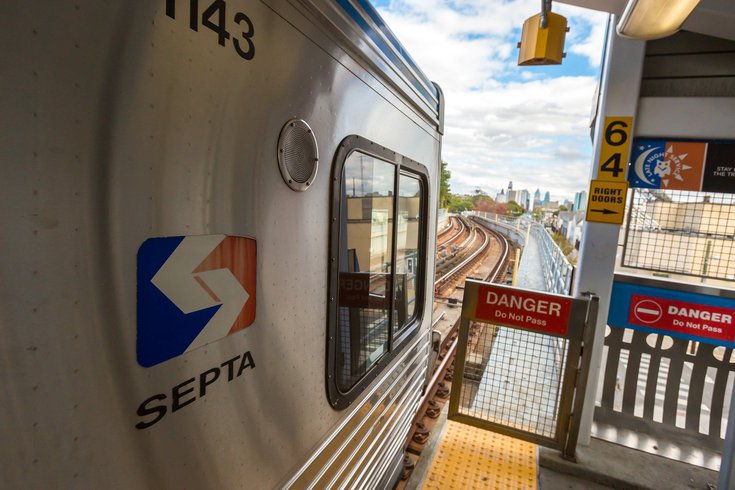
A few weeks ago I began to ponder the different newsworthy things I had heard about in recent days both at La Salle and the greater area of Philadelphia. What came to mind made me sick: the news about a woman who was raped while riding on a SEPTA Market-Frankford train at the 69th Street Terminal in Upper Darby. There is immense controversy about whether there were bystanders who took cell phone videos without calling the police or physically intervening but, frankly, my greater concern is the fact that a woman cannot ride public transportation without fear of literally being sexually assaulted. 

I know that I, among other La Salle students, use SEPTA frequently. This injustice that occurred to this woman shakes me to my core. I am frankly disgusted that we live in a world where women cannot even travel on or use resources like SEPTA without being endangered. I fear for my female classmates, my friends, my sisters, my aunts, my mother and my grandmothers who all use SEPTA. I am disgusted that females cannot even exist without being hurt.

This issue is bigger than just SEPTA. The world does not protect its women. According to the World Health Organisation (WHO), “most cases of femicide are committed by partners or ex-partners, and involve ongoing abuse in the home, threats or intimidation, sexual violence or situations where women have less power or fewer resources than their partner.” Furthermore, in a survey reported by the BBC, a third of respondents thought it was acceptable for men to hit their partners. These facts further emphasize the vulnerability women face today based on their gender.

A woman should not have to fear taking the train home from work. A woman should not have to fear walking home at night. A woman should not have to fear being talked down to by her coworkers or classmates. A woman should not have to fear seeing her perpetrators walk away unscathed. Women should not fear living, but they do — I walk across 20th street alone fearing being catcalled out of someone’s window and as they drive away laughing, I feel uncomfortable and ashamed.

Now I have to fear taking the train. I am terrified for the women around me and myself. Simply terrified. I am afraid for every woman I either know or do not know. I hope and I pray that this disgusting act of femicide, among the other situations myself and the women I know face every day, will one day disappear.