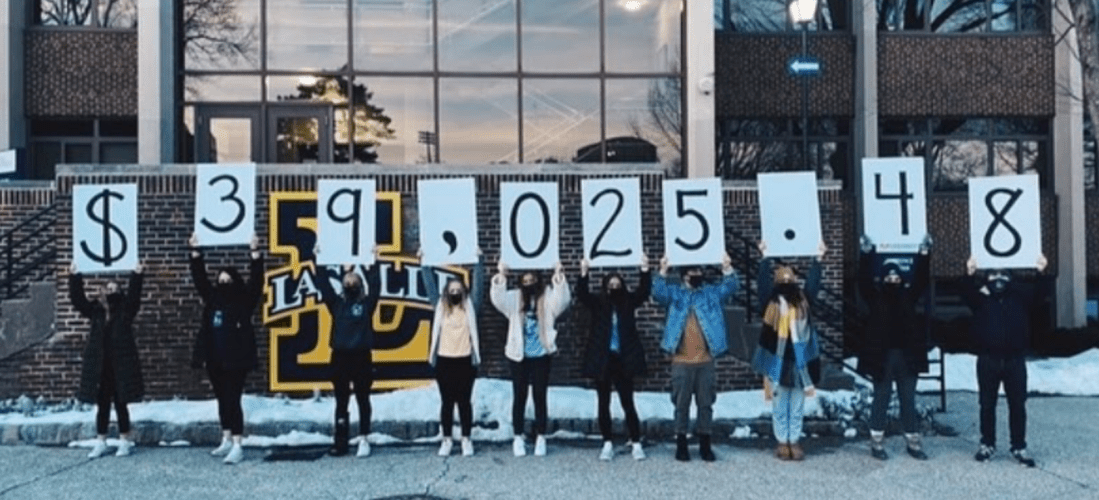
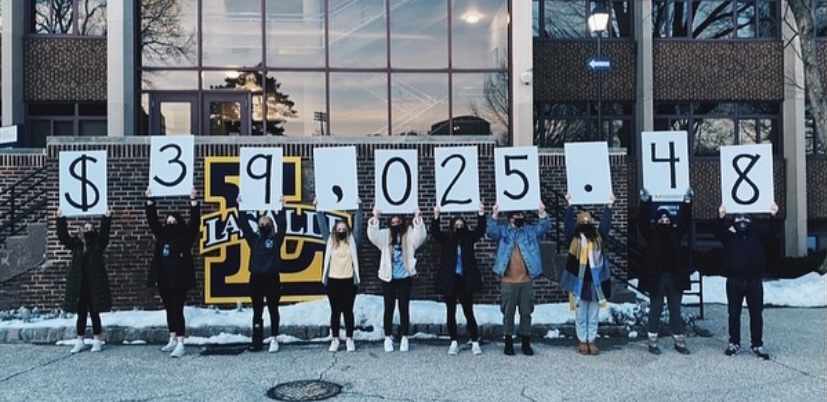
La Salle Students reveal Explorathon total Instagram, @lasalleexplorathon
On Feb. 22, La Salle hosted a virtual Explorathon event and raised over $39 thousand for the B+ Foundation. The event began with a Zoom meeting at noon and events on Instagram from @lasalleexplorathon. These events included a lip sync battle, raffle baskets, a social media fundraising challenge, dares in exchange for donations, musical performances, a performance by the La Salle dance team and stories from B+ families. The total was revealed at 5 p.m. via Instagram live. Freshman Emily Beals, dance team member, says, “it was super fun to get to dance with my team after all the time we spent practicing on Zoom and even better to be associated with a great organization like Explorathon!” These events on Instagram involved the student body and B+ families virtually in fun and COVID-19 safe ways. The Student Government Association, Honors Council and other clubs participated in the event as well.
Sophomore Mel Olimpio says, “This year obviously presented a lot of challenges and something we never could have anticipated. This year’s Explorathon started coming together during the start of the pandemic last Spring — and we weren’t sure if we would be able to navigate a dance marathon virtually. We also were not sure whether or not we could motivate the community to fundraise to the point of being able to surpass last year’s total. Although this year’s event couldn’t be in person, the La Salle community adapted well and continued to fight hard against childhood cancer. We were able to raise 70 percent more than we did last year — and reach a total of $39,025.48 that will all go towards families impacted by childhood cancer and childhood cancer research.”
Gamma Phi Beta was the highest fundraising team; the women in Gamma Phi Beta raised $8,819 for B+ families. Alyssa Goodson was the top fundraising individual who says she is drawn to the cause “because you get to see a direct impact it has on the families and the kids. You hear their stories and it really is amazing knowing that you can make a lasting impact on them. Especially during this pandemic and many families losing their jobs, this is more crucial than ever. Also seeing the community of La Salle come together for one cause is really breathtaking as well.” Alpha Phi Delta was the highest fundraising fraternity. More fundraising winners are featured on Instagram. La Salle students are excited for next year’s event.
On Saturday, Feb. 13, the United States Senate voted against the impeachment of former President Donald Trump for the Jan. 6 attacks on the Capitol. Trump was on trial for inciting insurrection, or encouraging an act of rebellion. According to the National Public Radio (NPR), “The Democratic House impeachment managers argued that the former president, who addressed a rally outside the White House ahead of the insurrection, was ‘singularly responsible’ for the violence on Jan. 6.”
One of the representatives who served as a House impeachment manager was Madeleine Dean, a La Salle alumna who has been working in the House of Representatives since 2019. Dean completed her undergraduate degree at La Salle and went on to pursue a law degree at the Delaware Law Firm of Widener University. For 10 years, from 2001-2011, Dean came back to La Salle as an English professor. Based on her teaching career, Dean earned a score of 3.9 out of 5 on Rate My Professor, where users described her as a “great teacher” and someone who will “improve your writing skills.”
During the impeachment trial, Dean gave an impactful address as she detailed the events of Jan. 6. According to CBS Philly, she said, “At 1:45, the president’s followers surged past Capitol Police shouting, ‘This is a revolution.’ Just after 2:10, an hour after President Trump ended his speech, the insurrectionist mob overwhelmed Capitol security and made it inside the halls of Congress…Because the truth is, this attack never would have happened, but for Donald Trump. And so they came, draped in Trump’s flag and used our flag, the American flag, to batter and to bludgeon.” The Jan. 6 attack killed five people, and two police officers took their own lives following the event.
Dean was joined in her efforts by the lead manager from Maryland, Jamie Raskin, Joaquin Castro (Texas), David Cicilline (Rhode Island), Diana DeGette (Colorado), Ted Lieu (California), Joe Neguse (Colorado), Stacey Plaskett (Virgin Islands) and Eric Swalwell (California). Nancy Pelosi, the Speaker of the House, selected the nine impeachment managers, all of whom have backgrounds in constitutional law, law enforcement and civil rights. According to the New York Times (NYT), Pelosi said, “It is their constitutional and patriotic duty to present the case for the president’s impeachment and removal. They will do so guided by their great love of country, determination to protect our democracy and loyalty to our oath to the Constitution.” A related NYT article about Dean describes her commitment both to the Constitution and her faith, quoting her as saying, “I carry [a pocket constitution and a copy of the Beatitudes] with me because one is a guide to life — a high standard to strive for — and the other is the law of the land. One is how to live as a human being, and how to live as a citizen.”
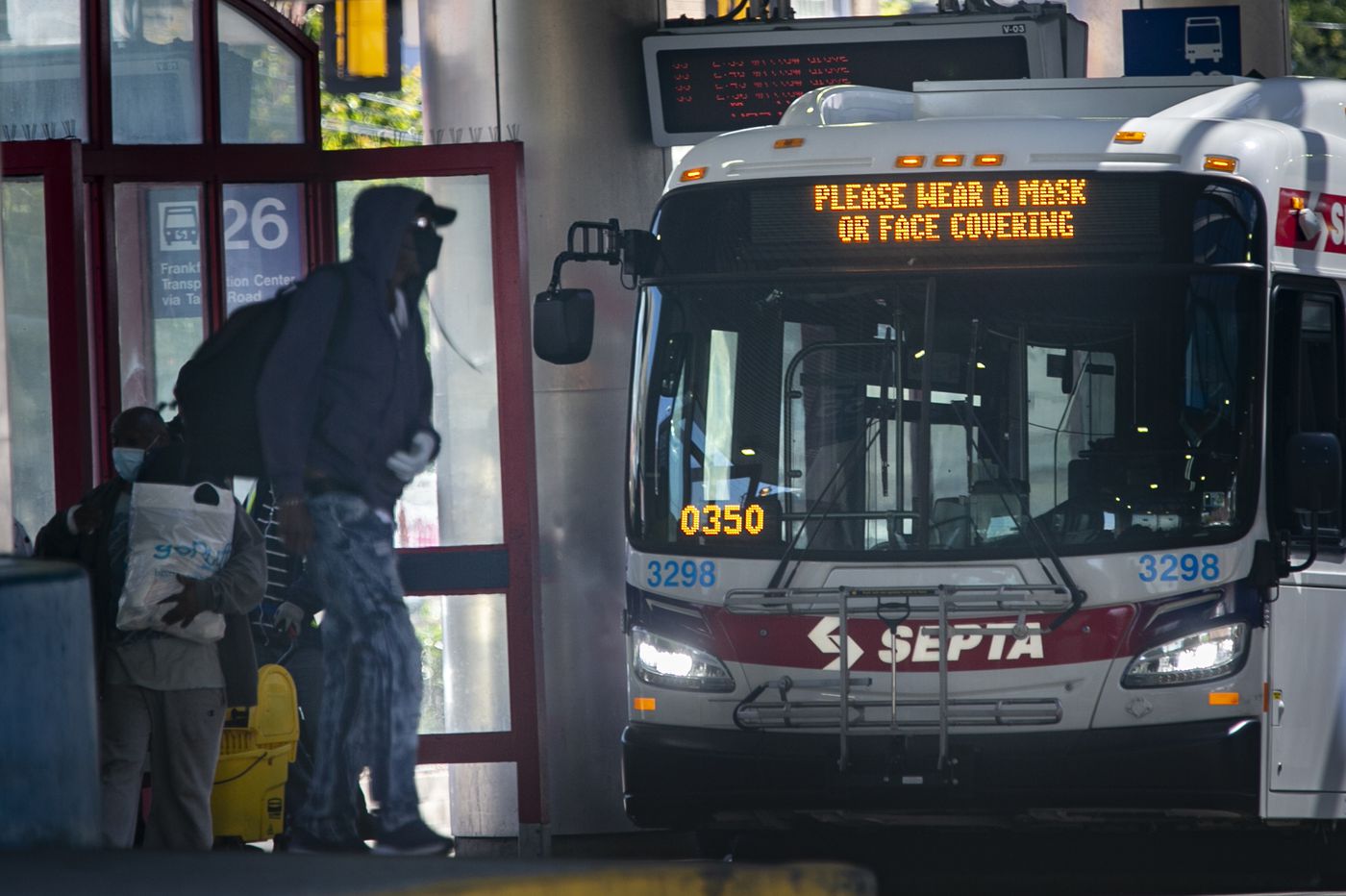
SEPTA bus with request to wear a mask Philadelphia Inquirer
The Southeastern Pennsylvania Transportation Authority (SEPTA) is planning to reopen five Regional Rail Ticket Offices in Feb. 2021 following their closures on Dec. 14, 2020. Despite these COVID-19 related closures, La Salle University students and Philadelphians alike have used other SEPTA transportation to commute to campus, run errands and explore the city. To ensure employee and rider safety SEPTA has precautions in place to slow the spread of COVID-19. These policies have been in place since June 4, 2020.
SEPTA’s policy for COVID-19 is in accordance with the governor Tom Wolf’s guidelines and guidelines from the Center for Disease Control (CDC). Those riding SEPTA are required to wear a mask and social distance. Vehicles also have capacity limits to further encourage social distancing. In addition, SEPTA has an app available on Android and iOS where customers can access route information. Operators comply with the limits by not stopping for additional passengers when capacities have been reached. In addition, SEPTA has recently offered a $100 incentive to their employees who receive the COVID-19 vaccine. Over the past months of the COVID-19 pandemic, several SEPTA employees have been exposed and infected with COVID-19. This effort to get employees vaccinated will keep SEPTA running and adequately staffed to ensure timely and frequent travel.
Freshman Nick Radley used the subway system to travel from La Salle’s campus to Center City. When asked about his experience on the subway during the ongoing virus, Radley explained, “I didn’t see anybody not wearing masks and they had signs on every other seat encouraging people to social distance. None of the trains were overcrowded.” However, Radley also explained that he had not seen any “hard enforcement” of these rules.
Senior Christian Camacho has similar experiences to Radley. Camacho said, “I feel as though SEPTA is doing the correct measures to keep students and people safe. No seats are authorized for two people to sit next to each other, each person has their own seat for their bag and themselves.” Camacho did notice that SEPTA employees seldom sanitize surfaces on the vehicles and when they do the cleaning is not thorough. However, Camacho was impressed by bus drivers only accepting a certain amount of people who are wearing masks on the bus before closing the doors. Like Radley, Camacho says he has not seen an overpacked bus. “Everyone wears their masks except for the homeless population, but even some buses have masks available for people,” Camacho observed.
Overall, riding SEPTA has been a safe experience for La Salle students despite COVID-19. The precautions taken by SEPTA allow for students to travel comfortably throughout the area and commute to campus for class.
St. Joseph’s University and the University of Science announced a possible merge between the two institutions on Feb.10. Both institutes view this merger as a way of growing and thriving together. USciences would become one with St. Joseph’s University. According to the Philadelphia Inquirer, “Even before the pandemic, many colleges, private and public, had been struggling with falling enrollment and tight finances, with trends showing even fewer available high school students later this decade.” Mark Reed, President of St. Joe’s, is attempting to take initiative with this strategy to turn his campus around. Reed states that, “From my vantage point, you can take two entities, and if you put them together, you get a whole that is greater than the individual parts.” The U.S. Department of Education shows that in the “2010 and 2019 academic years, enrollment and nonprofit colleges and university have fallen 4.1 percent In the last 12 months, we saw a 4 percent decrease in enrollment rates. Reed sees this merger as a benefit for both institutes involved. He hopes to add on new programs with the help of USciences.
Though there is talk of a potential merger with USciences and St. Joseph’s, they insist that their name remains the same. Reed says, “The hawk will never die.” Mark Reed and Paul Katz (President of USciences) already signed the non-binding agreement. “They have signed a nonbinding letter of intent to evaluate the impact of a merger and develop an agreement.” However, Reed made it clear that the decision to merge with USciences is not final, and St. Joe’s is open to the idea of merging with another institution. All institutes will be allowed to keep their names and their sports teams as if they were not merged. Reed sees this as a chance of getting ahead of the COVID-19 impact on universities. While increasing enrollment rates, he hopes that this merger will also allow the institutes to expand on their programs they offer. St. Joes already had to make a few adjustments starting with decreasing the number of freshman students who attended in the Fall semester, with hopes that a smaller enrollment would increase the quality of academics. Due to COVID-19, Reed has not only lost students, but saw a decline in staff and faculty. Reed remains hopeful — “I am confident we will weather this storm and manage through as well as we possibly can.”
On Feb. 4, 2021, La Salle announced the decision to revise their visitation policy for students. As part of the “Return-to-Campus” plan, the University banned off-campus visitors and wrote regulations to prohibit students from gathering in residence halls. The revised policy, which went into effect on Monday, Feb. 8, provides slightly more lenient guidelines for gathering.
The updated policy permits visitors within student residences, but only if those visitors are living on-campus in the same area. In other words, students can gather with people who live in the same building as them or within the same complex, but cannot have visitors from other residence halls. All resident students must abide by these guidelines, but the number of visitors allowed in each area differs depending on the location. A list of the specific guidelines from the official university communication on the matter are below:
St. Katharine: One residential student from St. Katharine may visit another residential student from this area at one time.
St. Albert, St. Bernard, St. Cassian, St. Denis, St. George, St. Hilary, St. Jerome: All remaining buildings in North Dorms will be treated as one residential area. One residential student from this combined residential area may visit another residential student from this area at any one time.
La Salle Apartments: A one-to-one ratio for each occupant within a unit will be maintained. Only La Salle Apartments residents are permitted as guests within this residential area.
St. Teresa Court: A one-to-one occupant-to-guest ratio for each occupant within a unit will be maintained. Only St. Teresa Court residents are permitted as guests within this residential area.
St. Miguel Townhouses: A maximum of three total guests per townhouse, in addition to occupants, will be permitted. Only St. Miguel Townhouses residents are permitted as guests within this residential area
An email, written by Dawn Soufleris, the Vice President of Student Affairs and Enrollment Management, highlighted student compliance with COVID-19 guidelines in her email regarding the policy revision. Soufleris wrote, “[the administration] has observed compliance with the public health expectations outlined by the University in La Salle’s plan. The majority of our residential students have maintained adherence to these policies — like mask-wearing, physical distancing, handwashing, and more.”
Nonetheless, the revised visitation policy will be reviewed on a weekly basis, and the no-guest policy can be reenacted at any time. Students who do not comply with the revised guidelines may have their guest privileges or housing privileges revoked, depending on the frequency and severity of the situation. While visiting or having visitors, face masks and physical distancing are required.
Students hosting other residents are encouraged to keep detailed records of who is in their space and when they are there in order to assist in La Salle’s contact tracing process.
As of January 2021, there have been two known cases of the U.K. strain of COVID-19 in Pennsylvania. Health departments are working with other cities in Pennsylvania to create a plan that monitors, identifies and tracks citizens exposed to the new strain. According to the Center for Disease Control and Prevention (CDC), “The U.K. variant may have an increased risk of causing death. The U.K. variant is known to spread faster and more easily than others.” The CDC works with different public health agencies to monitor the spread of the U.K. strain, but there are still parts of the new variants that are leaving scientists unsure. The CDC stated, “Scientists are working to learn more about these variants, and more studies are needed to understand; How widely these new variants have spread, How the disease caused by these new variants differs from the disease caused by other variants that are currently circulating and how these variants may affect existing therapies, vaccines, and tests.” The CDC continues to try and encourage wearing a mask, maintaining six feet of distance and avoiding large gatherings. They are unsure whether or not the same measures will protect people from the new U.K. variant.
U.S. News & World Report Officials go door-to-door in the UK to test for the new COVID-19 variant.
Communities in London have begun testing house-by-house for the new variants of COVID-19. According to AP News, “Public health officials are concerned about the variant first identified in South Africa because it contains a mutation of the virus’ characteristic spike protein that existing vaccines target. The mutation may mean the vaccines offer less protection against the variant.” Public Health officials in England have created a door-to-door strategy of testing and insist that people remain home unless absolutely necessary. Health care officials are handing out home testing kits and setting up many testing sights as a way of reaching all members of the communities. The U.K. aims to shut down their borders and require quarantining for 14 days for everyone that enters their country. A professor from University College London, Andrew Hayward, stated in an AP News article, “You can think about completely shutting the borders or having quarantine, [but] what’s the endgame in that? Is that something that you’re going to do forever, because it looks like these strains may continue to arise in the long term? So we need some sort of sustainable strategy, and I think that’s very difficult for politicians to think about that.” While it’s unknown whether or not the U.K. variant is more infectious, scientists and health care officials suggest wearing your mask, social distancing and getting the COVID-19 vaccine as soon as it becomes available to you. Cases are spreading to individuals who have never left the country or had contact with anyone who traveled to London. The House of Commons was told by Health Secretary Matt Hancock that, “Our mission must be to stop its spread altogether and break chains of transmission.”
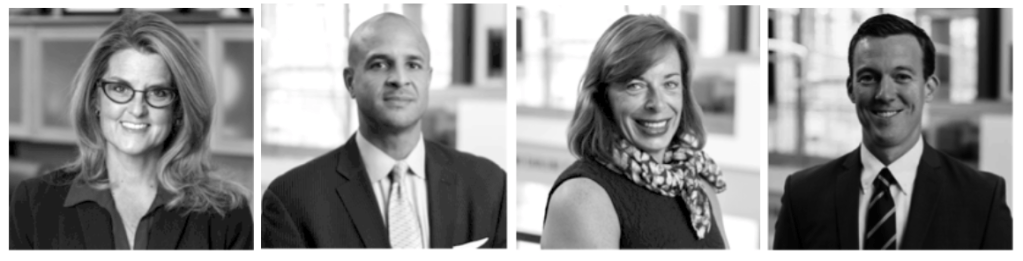
La Salle University From Left to Right: Colleen Hanycz, Joe Meade, Dawn Soufleris, Kevin E. Dolan. Four administrators are leaving the University; meanwhile, the Board has created an executive vice president role.
Bianca Abbate, Editor-in-Chief
This story is developing.
The recent announcement that La Salle President Colleen Hanycz would leave La Salle University for Xavier University left many in the community with questions; now, one source has revealed that departing with Hanycz are Chief of Staff Joe Meade, Vice President of Strategy and General Counsel Kevin E. Dolan and Vice President of Student Affairs and Enrollment Dawn Soufleris.
During an opening meeting Jan. 14, it was announced to faculty that the three administrators would be leaving the University for new roles. Dolan and Meade are to leave in February; Soufleris is to leave in April.
Chief of Staff and Executive Director of Government and Community Affairs Joe Meade is set to assume the role of vice president of community relations and government affairs at Comcast Spectator. Meade will begin his new role leading the company’s strategy and program development efforts Feb. 22; according to the Philadelphia Tribune, his main objective at Comcast Spectator will be to grow the game of hockey within the greater Philadelphia area. In his current position at the University, Meade’s responsibilities include personnel operations, financial management and coordination with senior leadership, as well as lobbying for public funding opportunities for the University. In 2018, Meade was named to Philadelphia Business Journal’s “40 Under 40,” after which he told University Communications, “I am appreciative in being given the opportunity to serve in such a significant capacity under the leadership of President Hanycz. Momentum is upon us, and I am thrilled to be a part of the remarkable La Salle community.” Meade’s position at La Salle will not be filled at this time.
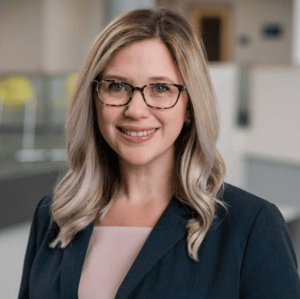
Vice President of Student Affairs and Enrollment Dawn Soufleris will assume a new role in New Jersey at Montclair State University April 5, 2021. In her new role, she will oversee 22 departments with nearly 300 employees and some 700 student workers. Soufleris joined La Salle in 2016 after serving at Rochester Institute of Technology (RIT) as associate vice president for student affairs. Since 2016, Soufleris has re-envisioned Public Safety and Career Services and developed a week-long student orientation program for incoming freshmen. She is also the institution’s deputy Title IX director. Soufleris told Montclair State University, “Providing students with support, positive engagement, and ample opportunities to find their niche and to shine have been my central tenets throughout my career in higher education…To be able to continue this work as a member of the Red Hawk family is such an honor…I look forward to meeting students, the SDCL staff and the campus community and to learning more about the exceptional educational experience Montclair provides to its students.” To date, the University has appointed former Assistant Vice President of Strategic Communications and Marketing Angela Polec to the role of vice president of enrollment, marketing and communications, effective Feb. 8.
La Salle University Pictured above is new Vice President of Enrollment, Marketing and Communications Angela Polec.
Vice President of Strategy and General Counsel Kevin Dolan is set to leave in February for a role as partner of a law firm, Mullen Coughlin, in which he will handle data privacy. In his current role at La Salle, Dolan oversees legal issues and strategic initiatives at the University. He also serves as secretary to the Board of Trustees. Before joining La Salle in 2015, Dolan worked in the private law sector as partner at the Lewis Brisbois Bisgaard & Smith firm in its Data Privacy and Network Security practice group. Effective Feb. 8, former Associate General Counsel Sean Corgan will oversee both of Dolan’s current roles.
La Salle University Pictured above is Sean Corgan.
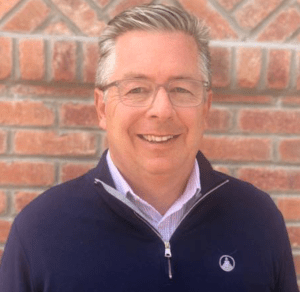
Also coming to La Salle under the role of executive vice president is Tim O’Shaughnessy, ‘85, who is a graduate of the business school. Before joining La Salle, O’Shaughnessy served as the chief financial officer for the Archdiocese of Philadelphia from 2012-2019. According to one source, O’Shaughnessy was hired in October without the faculty’s knowledge or consultation. The Faculty Senate heard about the appointment on Feb. 1 and were not familiar with the appointee. The executive vice presidency did not exist prior to O’Shaughnessy’s appointment.
La Salle University Pictured above is Tim O’Shaughnessy, ’85.
With the President and three of her executive cabinet members on their way out, the task to find new employees, including the chief of staff, may be difficult, given the University’s financial struggles. Over the summer, the University laid off 53 employees (nearly 7 percent of the full-time workforce) and cut salaries or hours for 48 others. Another 51 vacant staff positions were eliminated. Hanycz told the Philadelphia Inquirer in June that, amid the pandemic, La Salle faced millions in losses and additional expenses. Hanycz added that institutions like La Salle (“lightly endowed” and “highly dependent on tuition, room and board”) would face “a dire financial outlook” if students would not return to school in the fall. Following these statements, students would carry out the fall semester remotely and some, but not all, would return to campus for the spring semester.
While the news was announced to faculty Jan. 14, the University has not yet notified the student body of these departures; one source claimed that the University is to send students an email detailing the departures in the near future. The University did publicly welcome those filling new roles on its website Feb. 2.
La Salle’s Resident Student Association (RSA) hosted a community debriefing event on Feb. 2, 2021 to discuss the hate symbol found in St. George on Jan. 18, 2021. The debrief covered details about the incident and focused on how the La Salle community can overcome acts of hate. The meeting was hosted and led by RSA president Elizabeth Hallinan and other executive board members. It was attended by La Salle’s Director of Public Safety Compliance and Investigation Eva Howard, the Assistant Vice President of Student Engagement Anna Allen, the Director of Multicultural Affairs Cherylyn Rush, the Director of Residence Life TiRease Holmes and the Vice President of Student Affairs and Enrollment Dr. Dawn Soufleris.
Howard opened the meeting by explaining the incident. On Jan. 18, Public Safety received a request for an investigation after several etchings of racist speech were found written in a restroom stall. The incident was investigated, and included interviews of all of St. George’s residents. Ultimately, Public Safety was unable to determine when the etchings appeared and if they were written by a current resident. The bathroom stalls where the writings have been sanded down, painted over and repaired. Residents have been instructed to contact Public Safety immediately if they notice further damage.
Soufleris explained how Public Safety’s process overlaps with La Salle’s proceedings. Following the report of the incident, La Salle’s Biased Incident Response Team (BIRT) met and determined how to proceed. BIRT comprises a number of administrators from various departments and was formed to handle incidents of intolerance with consistency. Due to the location of the etchings, and the reasonable expectation of privacy associated with bathrooms and residence halls, Soufleris reported the University will not be installing video cameras. Instead, the administration is working with student organizations to develop a space for discussion and opportunities to build tolerance on campus.
Students at the debrief reported feeling shocked and disappointed by the incident, and many attendees noted their difficulty with the situation given the protests that took place this summer. Allen said, “I think La Salle has the capacity to be actively anti-racist…I want to hope the etchings are old. I tend to be an optimist when it comes to our student community.” Soufleris added that she is “confident in the community we have here.” Rush applauded RSA for responding to the incident, saying that similar efforts are normally led by marginalized students. She commended RSA’s demonstration of allyship and ownership of the community. The debrief was the first time RSA has hosted a debriefing event and led a discussion following an instance of hate.
Everyone in attendance was encouraged to reflect on the ways hate speech in La Salle’s community impacts them. Many administrators, including Allen and Rush, invited students to reach out to them. Soufleris said she “would really like to listen, to hear [students] thoughts.” More information about future initiatives to address hate and intolerance can be found by contacting RSA at rsa@lasalle.edu.
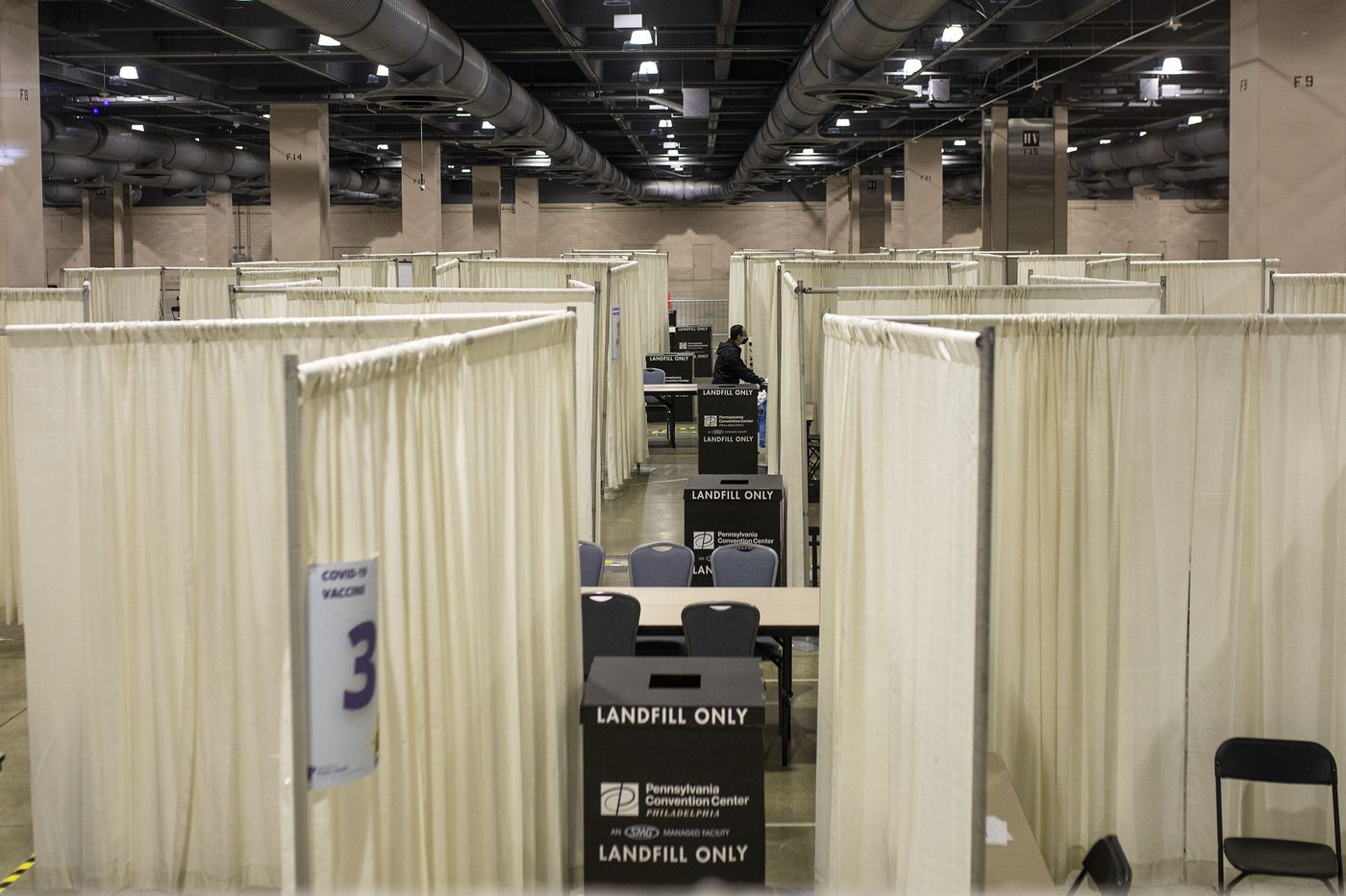
At the beginning of January 2021, Andrei Doroshin, a recent Drexel University graduate, began pioneering a vaccine center in Philadelphia and called it Philly Fighting COVID (PFC). Its website reads, “PFC opened the first mass community vaccination clinic in Philadelphia and is now the preeminent blueprint for mass clinic design and operations because it maximizes safety, efficiency, and patient privacy while administering more than 50x the daily vaccines that we administered during the H1N1 pandemic. Philly Fighting Covid (PFC) was founded in 2020 at the beginning of the COVID-19 Pandemic by a group of forward-thinking engineers and scientists who refused to stand idle…” However, this non-profit soon became a city-wide controversy.
Doroshin sent a photo via Snapchat of him taking home vaccine doses despite patients being turned away that same day. This photo circulated around to a near dozen people.
Later, Doroshin admitted to taking home four vaccine doses for his friend and girlfriend. Soon, Doroshin was also demanding for Health Commissioner Dr. Thomas Farley to resign, but Mayor Jim Kenney is standing behind Farley.
The City of Philadelphia has since severed its ties with PFC and is planning a hearing. Council President Darrell Clarke wants to require the city to sign written contracts with vaccine partners from now on. The city’s office of inspector general is meanwhile examining whether Dr. Caroline Johnson, an acting deputy in the health department, unfairly gave Doroshin’s group, and another potential applicant, budget information that was not made public. As of now, it is unclear if Doroshin will face any criminal charges, Philadelphia District Attorney Larry Kraner and Pennsylvania Attorney General Josh Shapiro are looking into the investigation. Shapiro said the allegations “are serious and any consumers who believe they have been misled should file a complaint with our office.” He continued, “Taking advantage of people and their privacy under the guise of serving as a nonprofit is not only unethical — it can also be against Pennsylvania law.” In addition to Doroshin taking vaccines, PFC started billing insurance companies for the vaccines, despite receiving them for free. Doroshin defended that decision as well, claiming that the donations the group was receiving were not enough to cover the costs of running the vaccination clinics. Despite the controversy, nearly 7,000 Philadelphians were vaccinated by PFC. mcgovernk8@lasalle.edu
On Aug. 14, 2020, La Salle students received communication from the University encouraging them to take the Explorer Promise. Members of the community who took the oath not only promised to wear a mask, follow the physical distance guidelines and wash/sanitize regularly, they promised to take others’ health into consideration every morning prior to coming to campus. Students who are living on campus and experience any COVID-19 symptoms (including fever, cough and shortness of breath) are directed to self-quarantine. La Salle’s administration team recommends letting faculty know when classes are being missed due to symptoms related to COVID-19. Administrators expect to continue to make decisions that will keep our community safe during the remainder of the pandemic.
In an effort to keep the community safe, President Hanycz advised students to stay home if they feel ill, follow capacity limits indoors and avoid large gatherings. However, not only students play a role in keeping our community safe. The return-to-campus plan includes new protocols the University administration is implementing to keep students safe, such as guidelines for testing and identifying positive cases, increased cleaning protocols and instructions for living and dining on campus. In following these protocols, all students were tested before moving in or beginning classes on campus. Areas that are used often, like restrooms, classrooms, residential buildings, dining rooms, entranceways and elevators are cleaned multiple times a day. Over the course of the spring 2021 semester, part of the return-to-campus plan mentions an “Entry and Surveillance” plan, detailing how students will be randomly selected for testing throughout the spring 2021 semester. Since entry testing is complete, La Salle is shifting into the surveillance testing part of the plan. At random, students that are living, working or learning on campus will be selected for testing. La Salle administrators also made the decision to implement a “No Guest Policy” which prevents resident students from having outside individuals in their dormitories. For La Salle to remain open for the entire spring 2021 semester, La Salle’s administration must ensure all COVID-19 protocols are being followed. In addition to the previously listed protocols, community members must wear masks above the nose, keep a minimum six-foot distance between students and sanitize their hands regularly.
The Assistant Vice President of Campus Life Anna Allen created a project that aims to help students better adapt to the changes the administration is enacting. Allen created the “Caught in the Act” project to ensure that Explorers follow the new guidelines. Allen stated, “This project hopes to ‘catch’ students wearing face masks properly, practicing good social distancing and using the hand sanitizer stations.” Everyday there will be student leaders walking the campus to reward students following protocols. If students are comfortable with participating, their picture will be taken and they will be given a coupon that can be used at Starbucks, Union Market or the Outpost. The Caught in the Act project was created to ensure that the La Salle community is not only following the new mandates, but encouraging other members to take part in keeping our community safe. Allen hopes that this project will remind students about the #ExplorersCare slogan that the entire community all have a part in.
Allen mentioned, “Our community is only as strong as what we do when no one is watching.” She recommends giving tips, such as, “Hi, could you put your mask over your nose,” or “Hi could you step back just a little so that we can be properly socially distanced?” If students become noncompliant with the regulations, they could be written up, or La Salle may have to shut down.