
Senate approves railroad labor agreement before strike deadline

Business

Jorden McVeagh, Editor 

A group of people standing in front of a white building

Description automatically generated with medium confidencehttps://vaisaagro.com/fehopabe/2022/12/01/schumer-senate-cannot-leave-until-rail-strike-bill-is-passed/

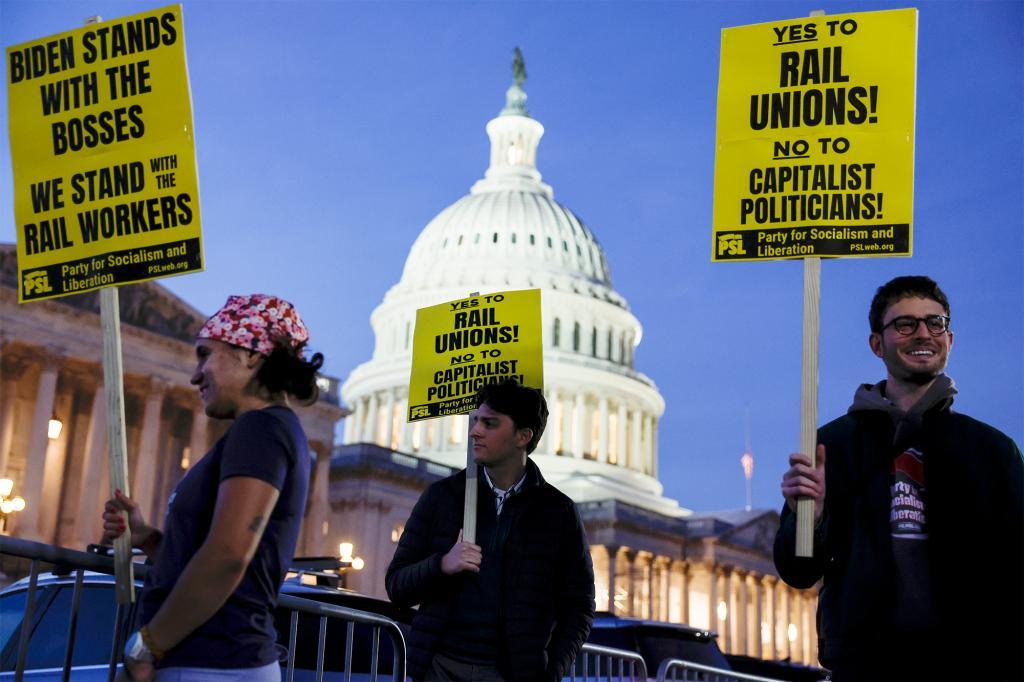
In a follow-up to my recent article regarding railroad union strikes, I bring you the news that the US Senate has approved an agreement that will pass on to President Joe Biden. This agreement is major as it prevents the rail unions from going on strike. At the final act there was an effort to include seven days of paid sick leave that didn’t end up making the final draft. This was an important bill for the US economy as any strike would hinder the transportation of goods raising their market prices, and the importance of this was reflected in the Senate’s voting. The bill passed through with 80 in favor and a mere 15 against. President Biden has already stated that he will sign the bill if it were to make it across his desk. Now, as for what the final bill looks like, it is similar to what was discussed in my previous article. Railroad workers will see a pay increase of 24% over the next five years with the dates of this arrangement going from 2020 to 2024, payouts will average $11,000, and an extra paid day off. The passing of this bill was accepted by the union. They even went as far as to release a statement saying, “our members are forced to work more hours, have less stability, suffer more stress, and receive less rest… No American worker should ever have to face the decision of going to work sick, fatigued or mentally unwell versus getting fired by their employer.” While no worker should go to work sick in any way, I get what they are saying. Hopefully, the terms of the agreement will be sufficient for long term stability in terms of pay and worker treatment on the railroads. Now how does this benefit the average consumer? It will mean that we won’t have to pay higher prices as the Christmas and New Year’s holidays roll around the corner. Products will be imported and exported easily and without delay which won’t create a shortage of the products on the market. While this is big for the current time of year the more important figure is that gas and the chemicals used in making it will be easily transported. This means gas prices will hover around the same prices that they sit at currently instead of potentially jumping up. This will save the consumer money on gas from traveling all over the place for their shopping. Overall, the union coming to an agreement is good for both parties. Workers get a pay structure and work environment they feel safe and happy in, and the consumer’s wallet doesn’t have to suffer because of the shortage that would have come from the strike.

Rail Union disputes may lead to an increase in consumer spending

Business

Jorden McVeagh, Editor

\

https://www.ibtimes.com/nationwide-rail-strike-imminent-after-union-rejects-labor-proposal-3638645

This past week in Omaha, Nebraska, a major deal was offered that could determine consumer spending for the foreseeable future. This deal was offered to railroad engineers that saw an offer of a 24% raise to conductor salaries that was ultimately rejected. The rejection of the offer has raised many concerns regarding whether the dispute will be settled before next month’s deadline. Before Monday three of the smaller unions had already rejected the offer with a split vote on Monday between the two largest unions which led to the result of the offer. However, seven smaller unions were able to accept and approve a deal with the terms of a 24% raise with an additional $5,000 in bonuses. The unions will go back to the drawing board and will renegotiate the terms of the agreement. This time they will look at adding paid sick time to their contracts. Much to the disliking of the railroads resulting in the negotiations going into deadlock between the two parties. All 12 of the unions need to approve of the offer to prevent a strike. This is where this issue would really hurt the general economy and the American consumer. It would further tighten the supply chains and as I mentioned before, increase stress in a post pandemic economy both in the US and globally. If this were to continue it is likely that Congress would step in at some point in order to impose a contract between the railroads and the unions assuming they cannot come to an agreement. The main problem that workers have with the railroads is the lack of consideration for quality-of-life. Many feel as if the demanding schedules hinder their ability to live life away from the rails, something that is supposed to be improved in the negotiations. So, why does this matter to the typical consumer? Because we will experience supply chain issues like those seen during the pandemic due to 30% of the nation’s freight being moved via the railroad. Gas prices could again increase as a result of oil refineries having trouble producing the current gas volumes they are. Recently harvested crops took longer to move and fertilizers for upcoming plants will not reach their destination in time. Finally, consumer goods will be impacted due to the inability to import goods. This comes at the worst time of the year with the holiday season upon us. Consumers may see a severe shortage in their favorite goods resulting in the prices to increase. As the Thanksgiving and Christmas holidays come closer, it will be interesting to see how this dispute ends. Hopefully for consumers both in the US and globally they settle, and people can move forward without having to worry about higher costs during the biggest spending period of the year.

Global Stocks all over the place due to Inflation and Virus Concerns

Business

Jorden McVeagh, Editor

https://www.medicaleconomics.com/view/positioning-in-a-chaotic-stock-market-with-key-sectors

Stocks on the Asian market have declined as of Mon., November 14, 2022, while European and American stocks open higher due to the optimistic views on inflation in the US and virus cases spanning over China. Last week, US inflation reported at a lower rate than in the prior weeks which caught the attention of investors all over the world. They hope that this hints that the FED will rethink its plan to continue to raise interest rates to help fight rising inflation. However, industry workers such as Venkateswaran Lavanya of the Mizuho Bank believe this is not an accurate measure as to what is coming. In an article published by US News, Lavanya said, “It is far too hasty to declare a decisive conclusion to inflation risks.” Meaning, that reports can come in on a daily, but we cannot assess these as true indicators as to what the FED will do with interest rates in the future. This still did not stop the various markets from around the world from responding to this news. Exchanges such as the FTSE in London saw a 0.8% gain, the DAX in Frankfurt just behind them at a positive 0.7% gain, and Paris’s CAC 40 jumping 0.5%. However, not all markets responded in a way that would reflect this optimism. In the US, the S&P 500 dropped 0.2%, with the Dow Jones dropping 0.1%. These numbers still should not be looked at as a representative value for the entire US stock market. While the markets did see a slight drop, the S&P jumped 5.5% on Friday alone. This ends a great week for the US markets, which saw all three exchanges ending in the green. Last week was also a big week for the US political economy with the congressional elections being held, which found Republicans likely to take control of the House of Representatives, and the Democrats taking the Senate. In Asia, concerns of COVID are still high. The Nikkei 225 out of Tokyo dropped by 1.1% while the Hang Seng in Hong Kong went up 1.7%. With the news of the Chinese government making the decision to reduce the economic cost of their Zero COVID policy are primarily the reason behind the major shift of the markets. Finally, in Seoul, the Kospi dropped 0.3% with the S&P-ASX 200 following with a 0.2% drop. The FED will meet again in December once again to discuss interest rates. Investors expect another rate hike however this time only by half a percent in comparison to three fourths of a percent that was seen with the last four hikes. It will be interesting to see what the markets continue to do in the coming weeks leading up to the meeting. As talks of recession creep into the conversations in America more often, it may get worse before it gets better, but we will not know until more plays out in the coming weeks.

Elon Musk looks to rehire some of the staff he booted last week.

Business

Jason Ryan, Staff

Twitter Inc. is heading into its second full workweek under Elon Musk with half its workforce, mounting losses and a couple of expected reversals to its plans\

The social-media company, Twitter Inc. laid off close to 3,700 people on Friday, only to reach out soon thereafter to dozens of employees where it was decided they were either fired in error or are just too essential to the changes the billionaire businessman, Elon Musk, wanted to make. 

The layoffs hit across many divisions, including the engineering and machine learning units, the teams that manage content moderation and the sales and advertising departments.

These stroke events, as described by people familiar with the situation or in an internal company memo posted on Slack, follow Musk’s own acknowledgment in a tweet that the company he and wealthy partners bought for $44 billion is losing $4 million a day.

Twitter Inc. decided to go after its workforce  to trim costs following Musk’s acquisition, which finally closed in late October. Many employees learned they lost their job after their access to companywide systems, like email and Slack, were suddenly suspended. The sudden requests for employees to return to office demonstrate how rushed and disorganized the process was.

Some regions were hit harder than others. For example, the company fired more than 90% of its staff in India over the weekend, severely depleting its engineering and product staff. The job cuts left the company with a little over a dozen staff in the growth market.

That being said, Twitter is rolling out new features such as its Twitter Blue subscription plan. To elaborate, Twitter will issue the new blue verification check marks to users who pay $7.99 a month for the service starting on Nov. 9. The company had previously planned to roll out the subscription feature Nov. 7, the day before the election; however, one of Musk’s early goals for the company is  delayed until Wednesday to avoid potential chaos during the U.S. midterm elections.

The company received internal and external feedback that the verification process for its Twitter Blue subscription program could be prepared for abuse. This has raised concerns that candidates and other political figures might be impersonated on site in the days before the US election. 

Late Sunday, Musk said Twitter would ban accounts that impersonate others, after several high-profile users changed their names and pictures to match the billionaire. Any name change at all will cause a temporary loss of a verified check mark.

Though the company needs some technical staff to return, the platform is not likely to be forgotten about. They surely need to figure out a way to get out of this mess and control Musk’s short temper.

  ryanj21@lasalle.edu

The United States vs China in a war for Technological Superiority

Business

Jorden McVeagh, Editor

A picture containing text, circuit, electronics

Description automatically generated

China has been a global superpower for many years now, and they are wanting to increase their global standing in a war of technology with the US. On Oct. 7t, President Biden released a new set of regulations on China hindering their ability to purchase advanced microchips and the equipment necessary to make those chips without the proper licensing. The new set of regulations also restricts the US civilian from helping certain chip manufacturing facilities located in China in order to develop the chip. This has created a tech war between the United States and China, a war that Chinese leader Xi Jinping is eager and wanting to win. He believes that by doing so China will have officially arrived as a tech superpower on the global scale, and he believes that the new regulations are unfair and prevent China from taking the necessary steps in propelling their country to the next level. The United States has become a hub for chip manufacturing, and the rest of the world is almost dependent on the US and other countries in order to design, make, and fabricate the chips. The new regulations are hitting China in both the short- and long-term. While it restricts their ability to produce and gain access to chips as of now, the country will also be affected in the long run. Mark Williams and Zichun Huang, both analysts at Capital Economics, stated, “Chinese firms will lose access not only to advanced chips, but to technology and inputs that might over time have allowed domestic chipmakers to climb the ladder and compete at the cutting edge.” This goes to show how much the regulations placed by the Biden Administration will hurt the Chinese economy and tech industry in the future. There is little chance for true tech advancement, and they believe it will extremely hurt China’s chance at becoming the leading tech superpower in the world. The chips in question are an important component in the making of smartphones, self-driving cars and arms manufacturing. With this in mind, the US has made it public that the reasoning behind the regulations was to protect national security interests. As of 2025, Beijing has targeted for China to become a, if not the, global leader in a multitude of different industries, and the tech sector was not one left off the list. Pair this with leader Xi Jinping coming back for an unprecedented third term, and China may be on their way to achieving that benchmark. With the shipping industry struggling to get shipments across the oceans it will be interesting to see how this plays out for China. China will focus on achieving this domestically by creating a talent pool large enough that all their technological goals will be completed by their set deadlines. China has been a country threatening the US in terms of global supremacy for years now, and with the world shifting to a more technologically based world by the day, it will be interesting to see where the scales shift in the coming months and years.

Trump Organization Tax Fraud Trial to Begin on Monday

Business

Ian Krysztofiak, Staff

The Trump Organization is to begin trial on Monday, Oct. 24, involving tax fraud regarding compensation for the company’s Chief Financial Officer. Jury selection begins as the prosecutor argues that executives were paid in cars, private school tuition, apartments and cash. While the Trump Organization has been the subject of legal scrutiny, this is one of the first criminal trials that the company has faced. The Trump Organization faces criminal counts of conspiracy, criminal tax fraud and falsifying business records. The company could face fines of $1.6 million under New York state law if convicted. 

The Manhattan district attorney’s office says that the Trump Organization kept two sets of books, internal records review that chief financial officer Allen Weisselberg received compensation through Mercedes-Benz cars and private school tuition for his grandchild. Weisselberg argues that the company didn’t report these benefits to tax authorities.  The Trump Organization is expected to say that the incident was an isolated practice of Mr. Weisselberg and another employee. Mr. Weisselberg is expected to take a plea deal to fully testify against the Trump Organization. 

Along with Mr. Weisselberg, Donald Bender, a partner at accounting firm Mazars USA LLP, will be another witness who prepares the company’s tax returns. Mazars said earlier this year that it would drop the Trump Organization as one of its clients and that it does not stand by its prior financial statements. 

Even though Mr. Trump and his family were not charged, the indictment says that the former president signed checks for private-school tuition. This trial follows a multiyear investigation by Manhattan’s district attorney’s office into the Trump Organization’s unethical conduct involving hush money payments to adult film actress Stormy Daniels among their many other civil lawsuits. The New York Attorney General, Letitia James, brought a civil suit against Mr. Trump, his three children, and his company last month for the misrepresentation of the company’s assets to its lenders and insurers. However, this trial is only regarding the company’s payroll practices. 

EV Company Rivian to recall Vehicles due to loose fastener concerns

Business

Jorden McVeagh, Editor

Image: Rivian R1T seen at the New York International Auto Show athttps://www.nbcnews.com/news/us-news/rivian-recalling-nearly-vehicles-loose-fastener-concerns-rcna51319

On Oct. 7th, 2022, Electric truck and SUV company Rivian Automotive announced that they would be recalling  all their vehicle lines as a result of a loose fastener. The recall will tighten said fastener in order for drivers to steer the vehicle without issue. Rivian, founded in 2009, will be recalling over 13,000 of their vehicles. The cause of the problem is a result of the front upper-control arm and steering knuckle not having enough torque. The company based out of Irvine, California, believes that it would only take a few minutes to make the fix and that all repairs should be completed within 30 days, assuming customers collaborate willingly. Rivian is trying to jump on the EV buzz and fix their problems now with the hopes the emerging consumers within the EV market will start to purchase their vehicles and grab a hold of the overall market share currently dominated by Tesla. The company has been public for little over a year and has already surpassed Ford and GM in market value making it the second most valuable automaker from the US behind Tesla. However, with the current economic conditions, the stock price does not reflect their prosperous first year being publicly traded as it has dropped 67% on the year thus far. Big news for the company came last month as they announced a partnership with Mercedes-Benz. The two companies will be building a factory in Europe that will produce electric vans for both companies to sell to the public. Even though Rivian has experienced success as of late, it has not come without its hardships. It started in March when the company announced price hikes on all vehicles which resulted in huge backlash from angry customers. Then in April, the company laid off over 800 workers after reporting a $1.6 billion net loss in the first quarter of 2022 alone.  Followed up by another poor second quarter where they posted a $1.7 billion net loss. Then as the old saying goes, “when it rains it pours.” Rivian has not been able to escape the global supply chain issues that have plagued the global economic environment. As a result, their factory stationed in Illinois can produce 150,000 vehicles per year on average. This year, the factory will be happy to produce 25,000. 

Ocean freights rates are dropping; ships being canceled amid low demand inflation concerns

Business

Jason Ryan, Staff

Cargo companies are canceling some sailings amid low demand for imported products due to rising inflation.

A significant consumer pullback is showing up in ocean shipping, with logistics managers and specialists stating they have seen a 20% drop in ocean freight orders for the months of September and October. The decline in demand cuts across products, including machinery, housing, industrial and some apparel. 

Ocean carriers have been canceling dozens of sailings on the busiest routes during their peak season, the most recent sign of the economic whiplash touching firms as inflation weighs on global trade and consumer spending.

For the first two weeks of October, a total of about forty scheduled sailings to the U.S. West Coast from Asia and 21 sailings to the East Coast from Asia have already been scrapped. Typically, during this time of the year, an average of two to four sailings in a week are blanked, the industrial term for canceled sailings.

The cancellations in October 2022 are a sharp reversal from months back when the scarce shipping space pushed the freight rates higher, and the carriers’ profits touched record levels. In October 2021, firms like Walmart and Home Depot were chartering their ships to get around the bottlenecks at major ports to satisfy a surge in demand for imports, this is just not the case now. 

Moreover, Trans-Pacific shipping rates have plummeted about 75% from levels seen a year ago. The transportation industry has been grappling with weaker demands as giant retailers cancel orders with vendors and step up their efforts to cut inventories.

The impact of Hurricane Ian can also be a reason for the cancellations. For example, this CNBC Supply Chain Heat Map demonstrates how vessel congestion on the east coast continues and how the impact of Hurricane Ian will delay the clearing out of vessel congestion.

To elaborate, during the period of Sept. 12-18, the Port of Savannah, a major U.S. seaport, reached the highest number of weekly average days waiting at anchor and cancellations since April 2022. Because of Hurricane Ian, zero vessel calls have been recorded at the Port of Savannah since Sept. 29. There is no question this new disruption by Ian will increase the existing congestion even more. 

  ryanj21@lasalle.edu

The Pound Tumbles as Britain Announces New Tax Cuts to Fight Inflation

Business

Ian Krysztofiak, Staff

https://www.bloomberg.com/opinion/articles/2022-08-17/hsbc-citigroup-and-the-end-of-global-banking

The British pound hit a record low of $1.0349 when compared to the dollar during Asian trading hours on Monday, surpassing 1985’s previous record low. This comes after the British government unveiled tax cut programs on Friday. These plans include canceling the proposed plan of a 25% corporate tax hike, and a reduction on income and bonus taxes. These tax cuts come after a rise in energy prices from Russia’s cut in energy exports. The tax cuts will hopefully shield businesses and households from surging energy prices. It has been 50 years since Britain has seen tax cuts of this scale. 

Resulting in a low pound against the dollar, imports, oil and gas, and other commodities priced in dollars will now be more costly, which puts more economic stress on England. A low pound also affects yields on ten-year UK government bonds, which ultimately makes government borrowing more expensive. The ten-year UK government bond yield is currently at 4.12%. 

Recently, currency exchange markets have been hit hard; the Turkish Lira has also hit a record low against the dollar. And China has recently announced that it will make it harder to bet against the Yuan by introducing a 20% risk-reserve ratio for any financial institutions that sell foreign exchange forward contracts. This will make it costlier for banks and their clients to sell Yuan to buy Dollars in the derivatives market. The Euro has also fallen to a 20-year-low against the dollar. 

Critics see the falling pound as a potential debt problem for the U.K., as they recently borrowed 11.8 billion pounds in August, a 5.3 billion difference from what they borrowed in 2019. These tax cuts by the U.K. are a gamble, using the cuts to both fight inflation, and high energy prices are accelerating worries of a recession. With inflation at a 40-year high of 9.9 percent, this is a bold strategy from Kwasi Kwarteng, the Chancellor of the Exchequer. Unfortunately, these tax cuts will most likely only benefit the wealthy more than the middle class.

Interest Rates. On the Rise Again?

Business

Jorden McVeagh, Editor

rising interest rates

What do Rising Interest Rates Mean for Your Money? | Access Wealth 

This upcoming Wednesday Sept. 21, The Federal Reserve will meet to discuss the topic of raising interest rates once again. The past two meetings have resulted in two interest rate hikes which is significant since they haven’t raised rates since 2018. However, since March alone, the Fed’s benchmark policy rate has risen 2.25% and it stands to go up again after Wednesday’s meeting. After the meeting concludes interest rates once again will receive a bump of three quarters of a point which would bring rates to 3%. In addition, they also could raise rates by as much as an entire percentage point which would bring rates to 3.25%. All around Wall Street it is a back-and-forth discussion between whether or not people think the Fed will continue raising interest rates until November or if inflation will slow down so the central banks can relax for a little. 

Forecasts for the last quarter show that interest rates could rise to as high as 3.5-4% by November and jump up to 3.75-4.5% in December. When it comes to answering the question “do you think this will slow down anytime soon?” economists believe that there is still more to come in the future. Inflation is still rather high in comparison but has gone down over the past year. Before August, the national inflation rate sat at 8.52% with it now sitting at 8.26%. This is certainly moving in the right direction, but still up from last year’s closing rate of 5.25%.

Even though interest rates are still high, this still doesn’t mean the economy is struggling all around. The job market is sitting in an amazing position right now with an unemployment rate of 3.7% equaling 6 million people across the US without work. To put it into perspective, it is generally accepted that an unemployment rate between 4-5% is full employment. Full employment refers to the economic system where anyone who wants to and is able to work is employed. In addition, consumer spending is also still going strong. We are seeing consumer spending numbers at a higher level than it was during the COVID-19 pandemic period, it is still strong with consumers spending $1.392 trillion (USD) in the second quarter of 2022. This is up slightly from the $1.388 trillion that was spent in the first quarter of 2022. 

Finally, the housing market is still high even with the spike in interest rates in the past months. These rate hikes could prove to be costly in the long run though, as too many hikes could result in sending the US economy into a mild recession according to Chief Investment Officer at Girard Timothy Chubb. These hikes could also shift the stock market substantially in terms of market volatility. With interest rates still rather unpredictable, investors have no idea what forecasts for later in the year could look like. July 2023 forecasts have rates anywhere between 3.25-5% which would result in other central banks, such as the European Central Bank, to increase rates as well to keep the market in some sense of balance. If this were to happen it would make the markets that much more volatile making it harder to predict whether a stock price will go up or down based on other market occurrences.

While it is unknown what will happen this week and in the coming months, it will be interesting to see what happens and how it continues to impact the global economic environment.