New UK COVID-19 strand spreads widely

News

Jessica Conk, Staff

As of January 2021, there have been two known cases of the U.K. strain of COVID-19 in Pennsylvania. Health departments are working with other cities in Pennsylvania to create a plan that monitors, identifies and tracks citizens exposed to the new strain. According to the Center for Disease Control and Prevention (CDC), “The U.K. variant may have an increased risk of causing death. The U.K. variant is known to spread faster and more easily than others.” The CDC works with different public health agencies to monitor the spread of the U.K. strain, but there are still parts of the new variants that are leaving scientists unsure. The CDC stated, “Scientists are working to learn more about these variants, and more studies are needed to understand; How widely these new variants have spread, How the disease caused by these new variants differs from the disease caused by other variants that are currently circulating and how these variants may affect existing therapies, vaccines, and tests.” The CDC continues to try and encourage wearing a mask, maintaining six feet of distance and avoiding large gatherings. They are unsure whether or not the same measures will protect people from the new U.K. variant. 

U.S. News & World Report
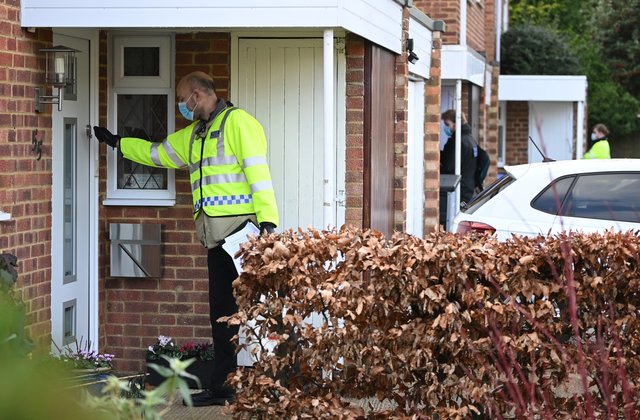
Officials go door-to-door in the UK to test for the new COVID-19 variant.

Communities in London have begun testing house-by-house for the new variants of COVID-19. According to AP News, “Public health officials are concerned about the variant first identified in South Africa because it contains a mutation of the virus’ characteristic spike protein that existing vaccines target. The mutation may mean the vaccines offer less protection against the variant.”  Public Health officials in England have created a door-to-door strategy of testing and insist that people remain home unless absolutely necessary. Health care officials are handing out home testing kits and setting up many testing sights as a way of reaching all members of the communities. The U.K. aims to shut down their borders and require quarantining for 14 days for everyone that enters their country. A professor from University College London, Andrew Hayward, stated in an AP News article, “You can think about completely shutting the borders or having quarantine, [but] what’s the endgame in that? Is that something that you’re going to do forever, because it looks like these strains may continue to arise in the long term? So we need some sort of sustainable strategy, and I think that’s very difficult for politicians to think about that.” While it’s unknown whether or not the U.K. variant is more infectious, scientists and health care officials suggest wearing your mask, social distancing and getting the COVID-19 vaccine as soon as it becomes available to you. Cases are spreading to individuals who have never left the country or had contact with anyone who traveled to London. The House of Commons was told by Health Secretary Matt Hancock that, “Our mission must be to stop its spread altogether and break chains of transmission.”

conkj1@lasalle.edu

Caught in the Act project launches at La Salle

News

Caught in the Act project launches at La Salle

Jessica Conk, Staff

On Aug. 14, 2020, La Salle students received communication from the University encouraging them to take the Explorer Promise. Members of the community who took the oath not only promised to wear a mask, follow the physical distance guidelines and wash/sanitize regularly, they promised to take others’ health into consideration every morning prior to coming to campus. Students who are living on campus and experience any COVID-19 symptoms (including fever, cough and shortness of breath) are directed to self-quarantine. La Salle’s administration team recommends letting faculty know when classes are being missed due to symptoms related to COVID-19. Administrators expect to continue to make decisions that will keep our community safe during the remainder of the pandemic. 

In an effort to keep the community safe, President Hanycz advised students to stay home if they feel ill, follow capacity limits indoors and avoid large gatherings. However, not only students play a role in keeping our community safe. The return-to-campus plan includes new protocols the University administration is implementing to keep students safe, such as guidelines for testing and identifying positive cases, increased cleaning protocols and instructions for living and dining on campus. In following these protocols, all students were tested before moving in or beginning classes on campus. Areas that are used often, like restrooms, classrooms, residential buildings, dining rooms, entranceways and elevators are cleaned multiple times a day. Over the course of the spring 2021 semester, part of the return-to-campus plan mentions an “Entry and Surveillance” plan, detailing how students will be randomly selected for testing throughout the spring 2021 semester. Since entry testing is complete, La Salle is shifting into the surveillance testing part of the plan. At random, students that are living, working or learning on campus will be selected for testing. La Salle administrators also made the decision to implement a “No Guest Policy” which prevents resident students from having outside individuals in their dormitories. For La Salle to remain open for the entire spring 2021 semester, La Salle’s administration must ensure all COVID-19 protocols are being followed. In addition to the previously listed protocols, community members must wear masks above the nose, keep a minimum six-foot distance between students and sanitize their hands regularly. 

The Assistant Vice President of Campus Life Anna Allen created a project that aims to help students better adapt to the changes the administration is enacting. Allen created the  “Caught in the Act” project to ensure that Explorers follow the new guidelines. Allen stated, “This project hopes to ‘catch’ students wearing face masks properly, practicing good social distancing and using the hand sanitizer stations.” Everyday there will be student leaders walking the campus to reward students following protocols. If students are comfortable with participating, their picture will be taken and they will be given a coupon that can be used at Starbucks, Union Market or the Outpost. The Caught in the Act project was created to ensure that the La Salle community is not only following the new mandates, but encouraging other members to take part in keeping our community safe. Allen hopes that this project will remind students about the #ExplorersCare slogan that the entire community all have a part in.

Allen mentioned, “Our community is only as strong as what we do when no one is watching.” She recommends giving tips, such as, “Hi, could you put your mask over your nose,” or “Hi could you step back just a little so that we can be properly socially distanced?” If students become noncompliant with the regulations, they could be written up, or La Salle may have to shut down. 

conkj1@lasalle.edu