Facing both chaotic financial markets and raging inflation, the Federal Reserve indicated it could soon raise interest rates for the first time in more than three years as part of a broader tightening of historically easy monetary policy.
In a move that came as little surprise, the Fed’s policymaking group said a .25 percentage point increase to its benchmark short-term borrowing rate is likely coming. It would be the first increase since December 2018.
Chairman Jerome Powell added that the Fed could move towards a more aggressive path, stating, “I think there’s quite a bit of room to raise interest rates without threatening the labor market… sooner…and perhaps faster.” These comments were made at his post-meeting news conference.
Source: Globe Echo
This was not the message investors were hoping for. That being said, the major stock market averages turned quite negative shortly following Powell’s statement. Investors have ineffectively been trying to guess what is going on with the Fed for weeks. Still, Powell said the Fed and investors were on the same page.
The Dow turned negative, falling 70 points. The index had been up as many as 500 points earlier Wednesday. The S&P 500 and Nasdaq gave up some of their gains as well. The S&P 500 was up just .01 percent and the Nasdaq rose 0.6 percent. In addition, bond yields rose following the Fed’s statement. The yield on the 10-year Treasury rose to 1.8 percent from 1.78 percent from late Tuesday.
Pressure from inflation on businesses and consumers is what is driving the Fed to raise interest rates this year. There is some concern on Wall Street that the central bank will raise interest rates this year more than the four times that which most economists currently expect.
Since the COVID-19 pandemic erupted in 2020, investors have poured money into stocks, confident that the central bank would help keep share prices upright. With that support going away, markets have been hit with a spell of volatility. The S&P 500 is down 7.3 percent so far this year, while the Dow is off 6 percent. The Nasdaq Composite has also fallen 11 percent. The Federal Reserve’s announcement for its soon hike in interest rates has been attributed to an unstable market seen last week. With this news, it is interesting to see what is to happen in the coming weeks.
Attention is a powerful tool: one that enhances our human experiences, and one that is highly prized and captured by technology and media.
It has been nearly four months since I wrote the article entitled “Why you shouldn’t sleep in the same room as your phone.” After re-reading it this afternoon, I couldn’t help but notice ways in which I could improve upon it. I also noticed that my relationship with my phone has changed a bit since Sept. 29, the day that article was published. So without further ado, here’s the follow-up that no one asked for.
Full disclosure: I sleep with my phone in my room again. One night, as we were all wrapping up whatever conversation filled our living room that evening, my roommate Mia made a comment to my other roommate, Ren, that perhaps leaving her laptop downstairs overnight wasn’t the best idea in the event of a home invasion. It sucks that we have to think that way, but this advice was coming off the heels of a string of home invasions on our block committed by a man who lives just three doors down from us. Safeguarding ourselves and our belongings was a priority situated at the front of our minds. I plugged my phone into its usual spot next to our TV and went upstairs, not thinking much of Mia’s comment… until I started perseverating on it.
“If someone breaks in and steals my phone, they wouldn’t be stealing just my phone — I keep all of my cards in a wallet attached to my phone case. My debit card, my other debit card, my other debit card, my expired debit card, my credit card, my ID, my school ID, my expired ID. They would have it all. And I would have to re-obtain all those elements of my identity.” Talk about a headache! This was the opposite of my intention when I decided to sleep in a phone-less room, so needless to say, that night was the last night I heeded my own advice.
But that night launched a series of moments with myself in which I began to evaluate exactly how much of my identity is tethered to a device. My copious amount of cards aside, my phone is also a portal into the various versions of myself that I choose to share with others. I try to limit my social media to just Instagram these days, but even there, I have two accounts: a personal one and an art one. To me, there is not much delineation between what I might share on the former versus the latter; they represent the same person, just with different photos and captions. But my personal lack of boundaries between the two doesn’t matter much; by making both accounts, I chose to fragment my identity, creating two canalized versions of the one person I know myself to be. And that’s a little unnerving.
I fell down a rabbit hole of making a mental note of all the online avatars I’ve created for myself over my 21 years of life. It all started in late elementary school, early middle school when I created way too many One Direction fan accounts. And in 2012, I created my Facebook account to connect with relatives who lived in other states and also to play Farmville. Somewhere around then, I made multiple Tumblr accounts: for writing and One Direction, mainly. Thanks to the strong community that Directioners so famously fostered, I made virtual friends all over; I even inherited a meme account from one of those friends, who disposed of it and all of its ten thousand followers as easily as one would dispose of a used tissue.
I was very present online, because that’s what you do when you’re a teenager in the 21st century. Even now, I can remember with great detail the types of environments I was exposed to from platform to platform. My One Direction fan accounts are where I was first exposed to digital art; I remember becoming good friends with a Brazilian girl named Paula whose digital paintings of Niall Horan still impress me to this day. On my meme page, I exchanged units of cultural ideas and symbols with tens of thousands of people across the world (after all, that’s what the word “meme” literally means: a unit of cultural information spread by imitation, as defined by Richard Dawkins in his 1976 book “The Selfish Gene”). On my Tumblr accounts, I had access to a range of writers; the ones I found most interesting were the other 16-year-old girls who just so happened to be situated somewhere else on the planet. On a darker note, I was exposed to the nasty eating disorder environment that was all too familiar to girls like me in that era.
I had seen and experienced so much thanks to the Internet. And looking back on it, I can’t help but feel protective of my younger self; of young girls now who are experiencing their own digital renaissance as I type these words. And my concern isn’t reserved for teenage girls; it extends to all of us who regularly interact with the Internet. I’m realizing more and more with each passing day how much of who we are, individually and collectively, is informed by the ways technology captures our attention. Four months out from my initial article and almost two years into a global pandemic, I’m constantly taking note of how precious our attention is — and how sophisticated, calculated and well-funded the various attacks so often made on it are.
The word “attention” comes from Latin ad + tendere, meaning “to stretch toward.” I think it’s important to make the distinction that when we pay attention to something, the word itself does not describe a “bringing forth,” but instead a “stretching toward.” It’s as if we meet the object of our attention where it is, perceive it and then move onto the next object once we’ve had our fill. If it were the case that the act of paying attention is a bringing forth of sorts, then wouldn’t there be a loss in understanding by moving the object away from its original space in time? I like to think of an analogy of seeing the Eiffel Tower in pictures on our phone as compared to going to Paris and seeing it with our own eyes; the former eliminates much of the richness and enjoyment found in “stretching toward” in favor of the ease of “bringing forth.” Attention is a beautiful thing, I’m learning, precisely because it invites us to stretch ourselves toward something else; to step outside the perceived boundaries of the self to attempt to meet something (or someone else) where it is.
I’m also learning that the way media is presented to us is sometimes more compatible with a “bringing forth” model than a “stretching toward” model. We don’t have to go digging to find something that will capture our attention. In fact, we often do the opposite of digging: we just peruse the surface until we’ve had our fill. (If you don’t believe me, just consider the way a Twitter homepage is designed. The man who invented the “pull to refresh” mechanism, Loren Brichter, has since expressed great remorse for designing something that is so adept at holding our attention prisoner.) I’m afraid that we engage too often with too much surface-level attention that fails to satiate our curiosity. In other words, it’s easier to let ourselves be presented with information than it is to actively seek out what we want to know. I’ve realized that this whole critique I’ve just made is why I’m so against Tik Tok. The idea that an algorithm brings forth content for us which we then find worthy of our attention — to a frighteningly accurate degree, I might add — feels more than defeating; it feels uncreative.
It feels like the tools that enable us to fully experience what it means to be human are becoming dull. We have too many apps and instances where we can let others (people, algorithms) bring forth objects worthy of our attention; too infrequently do we actually stretch ourselves toward something else. I can’t blame us; actively shifting our attention toward x is harder than being passively presented with x, and it’s far too easy to dismiss x with a simple flick of our fingers. This is all to say, I prefer to spend time on the Internet actively seeking out things that interest me than spend time being a receptacle for whatever the algorithms have identified as worthy of my attention at that moment. In other words, I’d rather be (more) in charge of what I pay attention to than let my attention be channeled and canalized by external forces.
Harry Frankfurt is a philosopher who was born in 1929 in Langhorne, PA. I mention his birthplace because when I discovered it via a quick Wikipedia search, I was delighted to learn that he grew up just 30 minutes from me. I think it’s important that we supplement our interests with context; the context that this philosopher and I share in a geographic locale has made his impact on me all the more potent. I definitely need to dive deeper into his work on free will and the concept of a person, but there is one idea that I want to work into this article before I sign off: the idea of wanting to want what we want.
Say it’s Sunday morning and what I want is to scroll on social media, and I know that I want to do that because I wake up and reach for my phone. Is that what I want to be doing? Sometimes, yes. More often, no. So when I don’t want to want to do that, I don’t do it. At the risk of typing “want” way too many times, I’ll leave off with this: I want to enjoy what I do as I do it; I want what I do to add to the fullness of being human. So I have conversations like these with myself and others, consciously considering attention, both at the individual and collective levels. After all, what we pay attention to is what we make our lives out of; I don’t know about you, but I want to make a life I love.
For more on the topic of attention, and to find out where I learned a lot of the facts I used in this article, check out Jenny Odell’s book, “How to do Nothing: Resisting the Attention Economy.”
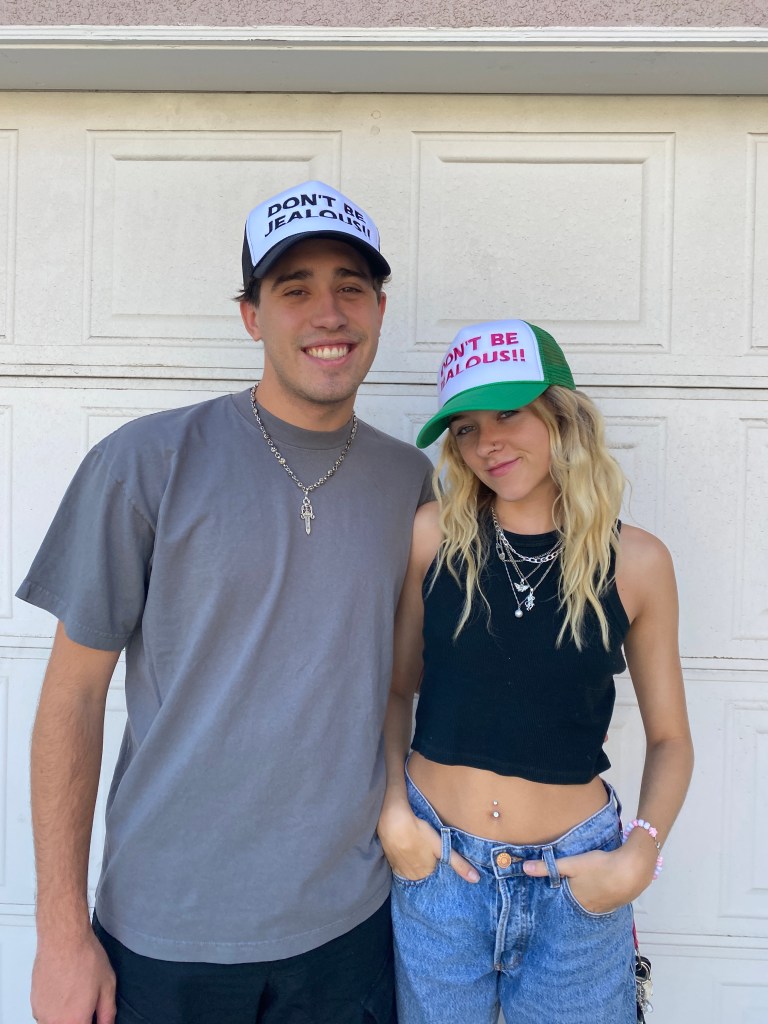
Sasha Tarnovsky and Andrew Burror, creators behind HoesForClothes, wearing their “don’t be jealous” trucker hats. June 2021. Source: Sasha Tarnovsky
Their latest clothing drop sold out in mere seconds. It was a completely custom-designed and manufactured hoodie, with the text, “Does it look like I care?! Because I do” written on the front and back. And for Sasha Tarnovsky and Andrew Burror, creators and owners of HoesForClothes, they care a whole lot about making the hottest, most fun clothes you’ve ever seen. Tarnovsky cites Dec. 30, 2019 as the official start date of her business, HoesForClothes, but her and Burror’s story goes back much further than that.
Tarnovsky got her first sewing machine in fourth grade for Christmas and from that point on, she was set on becoming a fashion designer. Throughout the years, her interests expanded and she enrolled at University of California, Santa Barbara to study political science. She graduated with her degree in political science as well as a minor in poverty and inequality in March of 2021. So if you start putting together a timeline of Tarnovsky’s life, you’d see that she was running her clothing business while completing her degree — talk about a multi-talented, hardworking girl! Not to mention, Tarnovsky turned 21 last June, so she graduated college early and is a successful business owner. Tarnovsky and Burror have been dating for four years, and their relationship forms the bedrock of their clothing brand: both individuals offer their creativity and business skills to H4C, and the brand wouldn’t be where it is today without their sincere dedication to the brand itself and each other.
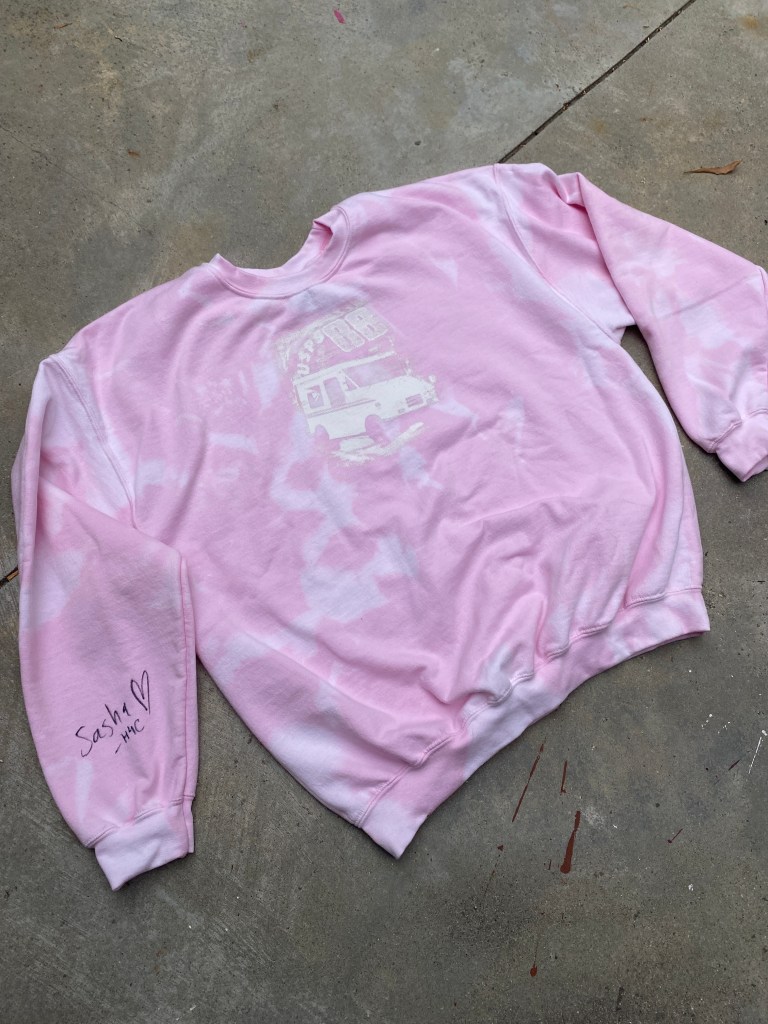
“USPS crew,” one of H4C’s oldest designs that a customer asked Sasha to sign. August 2021. Source: Sasha Tarnovsky
But Tarnovsky and Burror didn’t just stumble upon the idea for H4C one fortuitous day. Tarnovsky started her first brand that eventually became H4C in January of 2019, while she was a freshman at UC Santa Barbara. At that point, she was selling clothes from her closet, mostly to her friends. She curated an Instagram account called GrinchyVintage where she sold her clothes and posted content related to her taste in fashion. Over time, she moved on to selling upcycled thrifted and vintage clothing, and rebranded the name to Cherubs and Cherries. Tarnovksy recalls how this rebrand didn’t last very long because she didn’t feel like the name and vibe truly fit her personality. From there, she rebranded into HoesForClothes and has since built upon her amazingly successful company. If you visit hoesforclothes.com, which I strongly suggest you do, you’ll see the results of years of hard work and creativity. And if you’re anything like me, I bet you will find a bunch of clothes that would make the cutest additions to your wardrobe!
One of my personal favorites from the HoesForClothes catalog is the “fast fashion killed the small and independent designer” print. Tarnovsky mentioned how the song Video Killed the Radio Star by The Buggles was stuck in her head, and that’s how she got the inspiration for this print. As someone who is vehemently opposed to fast fashion, this print complements my interests while reminding me that there are still so many inspiring small, independent designers out there — like Tarnovsky and Burror, to name a couple. For Tarnovsky, her personal favorite designs are the “BE A HOE” trucker hat, her Y2K graphic sweatpants and her “wear what you want” hoodie (which is “100% his [Burror’s] work”). Speaking of the trucker hat — Tana Mongeau, a reality star and influencer, wore a “DUMP HIM” trucker from H4C on an episode of the TV show Reality House. Tarnovsky cites this instance as one of the craziest things to happen to her brand in 2021. Another surreal moment for her was running into a complete stranger in public who was wearing one of her designs — an accomplishment every small designer dreams of one day experiencing.
Becoming a fashion designer has been a goal of hers ever since she was little, so it goes without saying that Tarnovsky is living her dream. But that doesn’t mean that it comes without challenges. On days when her clothes are selling out in a matter of minutes, she sometimes feels stressed that something will go wrong, or she won’t get the orders filled in time or that her customers are growing irritated or impatient. On days when she doesn’t have tons of orders, she worries that her business is failing, or that no one likes her clothes anymore or that she won’t have enough money to continue growing and expanding. “I feel like there are a lot of ups and downs,” Tarnovsky says, “but I would not trade it for the world!”
Sasha celebrated after reaching 10k followers. July 2020. Source: Sasha Tarnovsky
There are some other elements of running a business that, at times, feel more taxing than rewarding. She cites Tik Tok as one of her least favorite parts about her job. She mentions that she doesn’t feel entirely comfortable or adept at video creation, so having to create Tik Toks to promote her brand often feels like a chore. If you’ll allow me to have a brief aside for a moment, I remember having a conversation with my friends about how I could grow my own clothing brand. My friend Angela said something along the lines of, “Liz, you’re not going to like hearing this, but you have to get on Tik Tok.” She was right, on both accounts: I did not like hearing that, but Tik Tok would certainly help grow my brand, a piece of advice offered by Tarnovsky, as well. Despite her dislike for the app, Tarnovsky has grown a considerable following of almost 40k on Tik Tok, and by the looks of it, her following is only going up from here.
One more thing that Tarnovsky mentions as challenging is the lack of social interaction that running a small business while fulfilling a high volume of orders entails. Pandemic aside, Tarnovsky recalls how she used to meet new people and hang out with friends often. Now that she’s behind a successful brand, her weeks can feel really lonely. She’s hoping that this changes when her brand gets bigger as she’s able to hire more employees and outsource certain tasks (perhaps Tik Tok content creation?) to others. In the meantime, Tarnovsky is absolutely crushing the game, and if it wasn’t clear enough already, she’s definitely a huge inspiration to me.
Throughout all of it — the good days and the bad — Tarnovsky has a strong support system that enables H4C to be all that it is: a successful, unique and inspiring brand that creates high-quality and appealing designs. When asked to shout out a couple of people who helped her and H4C get to where they are today, she says the list is endless. Her mom, her boyfriend, her friend Maddi who was her very first buyer, her sister who does her shipping and her grandparents who help with packaging and printing are all essential parts of the H4C company. She is also a great supporter of fellow clothing businesses run by creatives like herself. See the list at the end of this article for links to some of Tarnovsky’s current favorite brands.
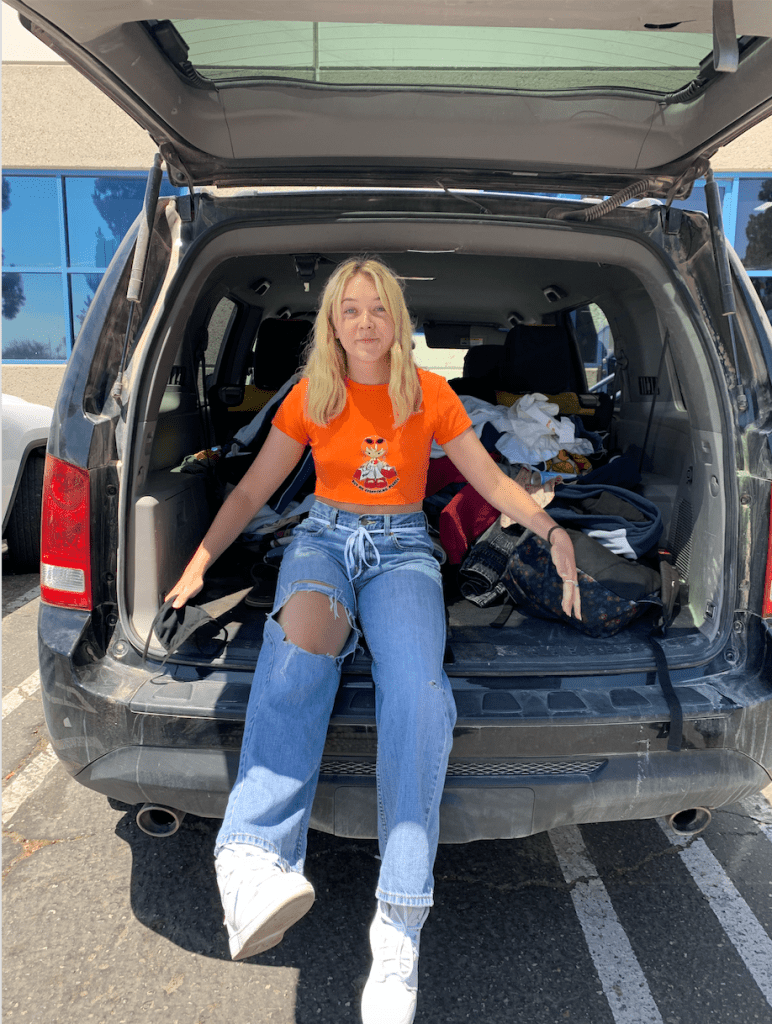
Sasha after a thrift haul for one-of-a-kind items and re-works. August 2020. Source: Sasha Tarnovsky
I am so excited to see what amazing designs and products HoesForClothes continues to put out in the future. Not only is their business extremely efficient and impressive, Tarnovsky is also such a sweet, inspiring and creative person who I was lucky enough to interview for this article. One core principle that Tarnovsky holds herself to — and encourages other creatives to do the same — is to stay true to herself and be original. She says, “Everything that I release that is not very ‘me’ where I’m just trying to appeal to someone else always flops. Copying other creators or being inspired by trends will never last. If you keep posting and creating items that are YOU and unique to your brand, you will develop an audience that is committed to the same aesthetic and you will see growth.” Tarnovsky and Burror are living proof that this advice works, given the success and integrity of their brand, HoesForClothes.
Another piece of advice imparted by Tarnovsky is to make yourself known as a human being, rather than just promoting your products as the work of some faceless, unsympathetic creature. At the core of this advice is the idea that we crave interaction; we sustain ourselves through real, meaningful relationships. That’s why small businesses like H4C are as successful as they are — because they refuse the practice of constantly churning out meaningless designs that lack any sort of personal touch. Rather, H4C and other small clothing brands like it favor a model that incorporates — and doesn’t alienate — humanity and business. The designs from H4C aren’t simply cute and jealousy-inducing; they’re created with love by two people who love each other and love what they do.
Keep an eye out for HoesForClothes, because Tarnovsky and Burror aren’t going anywhere — if anything, they’re only just getting started.
Sasha’s Current Favorite Small Businesses
Penelope Gazin’s Fashion Brand Company. “I am addicted.”
@fearhall’s (Instagram) Get Some Sleep. “They are currently the reason I canNOT STOP spending money. The owner is awesome, I met him in person at a pop up of theirs this year!”
Snapchat launches 523, a content accelerator program for minority-owned small businesses..
Do you know of any small, minority-owned businesses? Snapchat is looking for underprivileged entrepreneurs to be part of their 523 program, which will provide successful applicants with $10,000 each month to create content for Snapchat’s Discover section.
The name “523” pays homage to the original office location of Snapchat, Inc. at 523 Ocean Front Walk in Venice Beach, California. The goal is to provide platforms to small businesses run by people from underrepresented groups, defined by Snapchat as BIPOC, LGBTQ+, veterans, those with disabilities, and/or women. On top of that, the business cannot have netted more than $5 million in gross revenue for FY 2021 or during the last 12 months. The last qualifier is that any hopeful business cannot have more than 20 full-time employees.
Snapchat’s goal is to help “these creative minds… see the equitable benefits from their impact” by providing them with ample resources, both financial and social. On top of the $10k/month stipends, select business owners will also work with the company’s media and content partnership team; they will also have access to workshops and networking events with 523’s sponsors, which include AT&T, Nissan, Target, State Farm, Unilever, Uber Eats and McDonalds. “We’ll double down on our efforts to make sure that everyone feels that they belong on our platform… creating diverse, accurate content that reflects a rich variety of views across our global community,” Snapchat stated in their 2021 Citizen Report.
On one hand, this effort is aimed at the goal of supporting underprivileged businesses and creators who have lacked the resources and platforms to grow their businesses. On the other hand, this effort promotes Snap’s Discover service, a feature that contends with the likes of TikTok and Instagram Reels. Snapchat describes Discover as “the fastest way for our Snapchatters to be informed, entertained, and learn about the world around them.” Moreover, it “is a monetizable environment that supports our partners as they build their business.
Snapchat isn’t the only company with a program like this. In November, TikTok announced plans to offer $50,000 grants to 10 black creators. They are partnering with a company called MACRO “to ensure Black creatives and artists have the resources they need to reach new heights in their careers and spearhead innovation in their respective industries,” according to TikTok’s director of creator community, Kudzi Chikumbu. YouTube, Facebook, and Triller have launched similar programs. Applications are open from now until February 1, 2022. Selected small businesses will be announced on March 1. If you know of any small businesses who might benefit from partnering up with Snapchat, send them this article and they may be in the running for a $10k/month stipend.
Please don’t partner with Boohoo. On Tuesday, Oct. 19, Boohoo released their biggest ever celebrity collaboration to date. This time around, Megan Fox’s line aims to “celebrate female sensuality,” according to Boohoo’s website. If I were Megan Fox, I would’ve preferred to craft a celebration of womanhood with another brand — one whose garments don’t fall apart almost as soon as they’re purchased; one that seeks to fix rather than destroy the environment; and one that doesn’t have slavery allegations.
Felisha Tolentino
Megan Fox and Boohoo teamed up to create the brand’s largest celebrity collaboration to date.
Every now and then, I search for news related to Boohoo. I’m currently doing my capstone on fast fashion and Buddhism and I’m using Boohoo as a case study. Recently, I discovered this collaboration with Megan Fox and immediately wished I had gotten the chance to talk her out of this despicable deal. Unfortunately, she wouldn’t return my calls, so here we are.
I worked for fashion week this past summer and spent most of my week working directly with Boohoo for their big debut. The Boohoo team arrived in Miami from LA with suitcases of garments for fittings before the show. I remember one influencer, Cindy Prado, came in to try on her swimsuit. I handed her the suit, she put it on, they took some photos, and Prado handed it back to us for safekeeping. It sat in a bag for a couple of days, and when it came time to dress the influencer for the runway, the garment was somehow already broken. Literally all it did was sit in a plastic bag, untouched — yet it was somehow unwearable. That’s because Boohoo deals in fast fashion, which is mutually exclusive to quality fashion. After all, there was once a time when fashion designers were responsible for crafting collections four times a year, in line with the seasons: winter, spring, summer and fall.
Now? There are 52 seasons. That’s not an exaggeration. Companies like Boohoo churn out new collections, on average, every single week, all year round. No wonder that garment was broken before it even got to the runway — it was built to fall apart. Once again, that is not a euphemism or exaggeration; fast fashion garments are literally built to fall apart so that you are forced to shop again, sooner rather than later.
How do brands like Boohoo accomplish such efficient capitalist modes of production? By slave labor, of course. I say that not to make light of the situation, but rather to elucidate the almost unfathomable allegation that slavery still exists today. Unfortunately, it’s not unfathomable — it’s reality. According to Livia Firth, 1 in 6 people work in the global fashion industry, making it the most labor-dependent industry on earth. There have been multiple investigations into Jaswal Fashions, a factory in Leicester, United Kingdom, which supplies up to 80 percent of its production to Boohoo alone. Some sources say that workers are paid as little as £3.50 an hour, according to an investigation from the Sunday Times. Other sources say that workers were forced to come in during COVID-19 lockdowns to keep pace with the increased demand for clothing as people stayed home and shopped online. It is unclear whether all workers at this factory are paid at all for their labor, and Boohoo has done little to redress the situation since it came to light.
I remember reading somewhere that Fox sends her kids to a “vegan school” (whatever that means). Thank you for caring at least a little about the environment and the meat industry’s impact on it, Ms. Fox. But has she thought about how many of her garments, manufactured by Boohoo, will end up in landfills? According to the Ellen MacArthur Foundation, the equivalent of one garbage truck of clothes are burned or landfilled every second. Our environment can’t sustain this rate of waste, so if we want to be able to celebrate female sensuality and send our kids to vegan schools, we should make sure that we have a planet where we can do those things first.
This article isn’t to shame anyone who shops fast fashion, especially because it is (unfortunately) all most of us can afford. It is, however, meant to raise eyebrows at celebrities like Fox who continue to validate and support such harmful business practices. Ms. Fox, if you’re reading this, it’s not too late — ditch Boohoo in favor of sustainability.
Dr. Henry Reichman conducted a virtual discussion on academic freedom in connection with the American Association of University Professors on Tuesday, Oct. 26, 2021.
On Tuesday, Oct. 26, Dr. Henry Reichman presented a Zoom discussion on academic freedom, a topic vital to the integrity of any institution of higher education. Dr. Reichman is the former American Association of University Professors (AAUP) Vice President and president of the AAUP Foundation, as well as the chair of AAUP’s Committee A on Academic Freedom and Tenure from 2012-2015. The event, organized by Dr. Barbara Allen and Dr. Joel Garver, garnered widespread attendance from students, staff and faculty members across all disciplines and from other universities.
In 2019, Dr. Reichman published his book “The Future of Academic Freedom,” which served as the backdrop for this conversation. He explained the terms of academic freedom, making sure to clarify common misconceptions, and offered his perspective on the current biggest threats to academic freedom.
Academic freedom is a concept belonging to the academic profession as a whole that protects the pursuit of inquiry. It guarantees to both faculty members and students the right to engage in debate without fear of censorship. In Dr. Reichman’s words, it “functions ultimately as the collective freedom of the scholarly community to govern itself in the interest of serving the common good in a democratic society.”
It is not, however, a civil liberty akin to freedom of speech; it cannot be classified as simply an employment benefit. Rather, it refers to the collective freedom of the faculty to govern itself as it sees fit, thereby promoting an environment in which academic inquiry is protected. It doesn’t allow a professor to do or say whatever they want without limit or accountability.
It does, however, protect a professor’s comments as a citizen even on topics that have nothing to do with their discipline. Such protection is essential to a healthy institution of higher education. Take, for example, the case of Dr. Arthur Butz, an electrical engineering professor at Northwestern University. In 1975, Dr. Butz published “The Hoax of the Twentieth Century: The Case Against the Presumed Extermination of European Jewry.” Dr. Butz’s Holocaust denial was met with harsh criticism from both his fellow faculty and the public at large.
Many called for his resignation as a professor, decrying his blatantly anti-Semitic beliefs. Academic freedom, however, protects Dr. Butz’s right to publish this Holocaust denial book insofar as it does not affect his fitness to do research in and teach electrical engineering. Had Dr. Butz been a professor of 19th- and 20th-century history, for example, as Dr. Reichman was, then there would certainly be an argument that his beliefs about the Holocaust could affect his ability to do his job, and therefore academic freedom would not protect him. However, given his stature as a professor in engineering, Dr. Butz was allowed to publish such a book and keep his job.
The example of Dr. Butz is extreme, but nonetheless, academic freedom provides for an open environment for discussion within academic institutions. However, one of the most troubling trends in higher education, according to Dr. Reichman, is the tendency to misunderstand the concept of academic freedom; such a misunderstanding could prove to be dangerous to the liberties that such a concept seeks to protect. As with any debate on freedom, the question of responsibility arises: with great freedom comes great responsibility. Dr. Reichman argues that the responsibility refers not to using academic freedom with trepidation out of concern of backlash or censorship. Rather, there is a responsibility to protect this freedom, lest the integrity and functionality of academic institutions be jeopardized — “in academia, we have a collective responsibility to each other, our students, and the diverse common good in a democratic society.”
Toward the end of Dr. Reichman’s explanation of academic freedom, the floor was opened up to questions from audience members. One faculty member asked a question regarding intellectual property with respect to professor-created content: who owns the content we create for teaching? Dr. Reichman replied by saying that it belongs to the professor. The professor may retain their right to sign the rights of that intellectual property over to a publisher, for example, but since the faculty member is the one who created the material, it ultimately belongs to them.
In the age of Zoom University, this question has become more relevant than ever; professors were required to move their entire courses online, demanding them to record lectures and develop virtual manipulatives, among other adjustments. The answer to the question of to whom do these materials belong remains unclear, but the AAUP states that they should belong to the faculty member who created them.
There was another question about the rights of the administration of a university to choose and have access to learning management systems (LMS), such as Canvas or Blackboard. According to Dr. Reichman, faculty members should be consulted in all decisions related to the university, especially those which directly impact teaching and learning. Therefore, the faculty should have a say in which LMS are used as well as the terms of access by the administration. Ultimately, faculty members should have the right to actively debate and vote on decisions made by their university that will affect their abilities to carry out their jobs. After all, “where academic freedom is not protected, shared governance will be a scam,” according to Dr. Reichman.
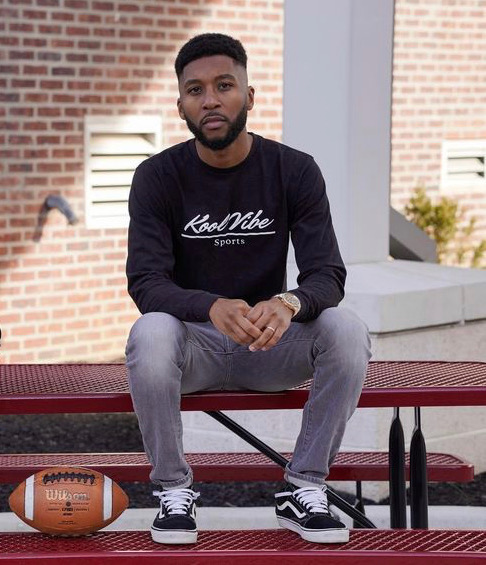
Malik Mitchell, ‘17 started his own sports marketing agency earlier this year and prides himself on providing high quality services to every one of his clients.
Jan. 8, 2021 was an important day for La Salle alumni Malik Mitchell: it was the day he officially started his business, Kool Vibe Sports (KVS). In nine months, Mitchell and his associates at KVS have grown to offer top-of-the-line sports marketing services to clients such as Zech McPhearson and Milton Williams of the Philadelphia Eagles and Sandro Platzgummer of the New York Giants, to name a few. Mitchell prides himself on being attuned to his clients’ needs, offering services such as contract negotiations, endorsement deals, media relations and more. He even recently helped one of his clients move to another apartment — a testament to how much he cares. Mitchell states that he and his team at KVS tirelessly work toward “maximizing client earnings and empowering athletes to own their talent on and off the field. He does all of this while working full time for South Jersey Gas in their marketing department.
Mitchell graduated from La Salle in 2017 with a degree in marketing. After graduation, Mitchell often communicated with one of his high school friends, Eli Apple, a cornerback for the Cincinnati Bengals. Apple and Mitchell would often discuss marketing opportunities for Apple to continue to build his brand. Mitchell realized: he was this football player’s go-to man for marketing advice, so he put those skills to use in the professional field. Fast forward a few years, and Mitchell founded Kool Vibe Sports, where he handles all off-field marketing and advises his clients, just as he did for his old friend, Eli.
He does this with the help of two crucial elements: passion and a dedicated team. Mitchell played football for more than ten years and brings that passion for the sport to his business, day-in and day-out. After graduation, Mitchell went on to create his own social media marketing company, “Malik Mitchell Marketing,” with clients ranging from a pharmaceutical firm to a barber shop. His Lasallian education coupled with his on-the-job training in social media marketing allow him to deliver an unparalleled experience to his clients throughout their career. His passion for sports combined with his know-how of marketing make him a valuable player within the field of sports marketing.
Mitchell isn’t the only La Salle alumni with a passion for sports marketing. Adam (A.C.) Bartley, ‘15, Brandon Rowe, ‘17, Jauwan Marant, ‘17, and Kathlyn Martin, ‘17, are also alumni of the La Salle marketing and communication programs, and all currently work alongside their good friend Mitchell at KVS. Mitchell, Rowe, Bartley and Marant all met within their first few weeks as La Salle students and immediately bonded over their shared interests and ambitions. Mitchell and Martin are college sweethearts and got married right after college. Mitchell had a vision for his business and his team helps him make this vision a reality by bringing their unique skills to the table.
After graduation, Bartley worked as a financial analyst and continually brings his go-getter mentality to every business venture at KVS. Rowe’s photography skills help him provide creative direction to their clients. Overall, all the employees at KVS share Mitchell’s vision of providing high quality sports marketing services to each and every one of their clients.
One of the greatest things about starting your own business is that “you could work for yourself for the rest of your life,” said Mitchell. But being your own boss comes with hours of hard work, planning and perseverance, according to Mitchell. When he’s not working full time at South Jersey Gas, Mitchell is thinking about ways he can enhance the quality of service he provides to his clients.
His advice to those interested in starting their own business? Create a plan. Set goals for yourself and outline the objectives that will ensure you accomplish those goals. It’s also important to measure your success along the way. Mitchell only officially started KVS in January of this year, but his diligence with measuring his success every step along the way is part of the reason why KVS has grown so much in such a short period of time. Working for yourself and with your friends is a great thing, and it comes with lots of planning and hard work.
Channeling your passion, building a great team and spending time to develop a comprehensive business plan are just three key elements of starting your own business. For Mitchell, it is also important to remember where he came from. He cites his parents as his mentors; as shining examples of the power of hard work, dedication and love. He also recalls his time spent in LA with his good friend Eli Apple, who showed him that he has a knack for sports marketing. He maintains close relationships with his friends and colleagues he met during his time at La Salle. With all this in mind, Malik Mitchell is dedicated to growing his business and providing top quality services to his clients.
This Lasallian alumnus is making a name for himself in the field of sports management and marketing, and he encourages readers interested in what he does to reach out at malik@koolvibesports.com. If you are interested in sports marketing, don’t hesitate to connect with Mitchell — he would love to help out his fellow Lasallians, and his insight is truly invaluable.
How do you feel when you leave something unfinished? Some may say just a little anxious, others may experience downright despair. A lucky few of us simply feel neutral: “I’ll get to it tomorrow, no need to fret.” But most of us probably don’t feel good when we go to bed knowing that we didn’t finish all that we needed to do.
What’s worse than that feeling? Seeing it manifested in tiny, red, numbered bubbles plastered all over our phone screens. You have: 3 unread emails, 65 unread texts, 18 Snapchats, 7 Canvas announcements, and a whole lot of dread…or at least I do at the moment. Never has there been a time in human history in which we have been more consciously made aware of our unfinished business. That fact alone is anxiety inducing, even for those of us who are quick to clean up our inboxes at the earliest opportunity. Many of us have an obsessive relationship with clearing our notifications; I have an unwritten rule for myself that my Outlook inbox has to be attended to as quickly as possible, at any hour of the day. The other day, I found myself performing the mundane, rote ritual of clearing out my Gmail of all the quotidian branded messages I get from various companies. I took a moment to recognize the anxiety attached to my habits, and took an oath to change for the better.
Office Sign Company
It is worthwhile to establish a cell phone-free zone in your daily life.
In a sense, we are slaves to our notifications. They demand our attention and remain in the corners of our minds, begging to be resolved, ad nauseam. I can’t think of anything more tiring than going to bed with the knowledge that I have so many unfinished tasks; tasks which await my attention as soon as I wake up. That is why I no longer sleep with my phone in my room. By eliminating the opportunity to be reminded of messages which require my attention, I’ve created a more peaceful space for myself.
In fact, I’ve modified my relationship with my phone in more ways than one. I don’t bring my phone with me to the dinner table (I never did, shoutout to mom and dad for that one), but I also don’t bring it to my desk when I’m doing work, or sometimes when I’m hanging with friends. I prefer to maintain a much bigger distance from my phone than I had in the past and it has served me well. These days, I wake up and begin to lean into my day alone, without the presence of pesky notifications or posts from others. Then, I make the choice to go downstairs and check my phone when I’m ready. If, overnight, a friend or family member texted me, I’m much more eager to respond than I would have been had I been consciously aware of their message for hours on end.
By cutting the leash between my phone and me, I’ve significantly reduced my anxiety. I no longer feel like I need to lug around this hunk of junk with me wherever I go. When I do decide to take my phone out, it’s for a purpose that serves me and enhances my day. By breaking up with listless scrolling, I’ve crafted a more meaningful life. By leaving my phone downstairs when I go to bed, I can blissfully pretend, at least for a few hours, that I exist in an era untouched by smart-phone-induced anxiety. By choosing when to use my phone and when to leave it at home, I’m choosing a more enjoyable life.
So tonight, I invite you to leave your phone alone; be alone with your thoughts. There is no rule that you have to check every notification, every app, all the time. A smartphone is only smart after you examine your relationship with it; after you unlearn codependence in favor of balance. I promise, those little red bubbles (unfortunately) aren’t going anywhere.
Between November and January, retail sales are expected to rise by eight percent from last year, according to the professional service network Deloitte’s holiday retail forecast. On top of that, Deloitte also said that e-commerce sales are expected to rise by up to 15 percent. Given the growing labor shortage, holiday shopping might be a much bigger headache this season, for both the consumer and the retail suppliers.
According to Melissa Hassett of the staffing agency ManpowerGroup Talent Solutions, “Hiring intention in the upcoming quarter is higher than ever.” Potential employees can anticipate benefits such as debt-free bachelors degrees, higher wages, quadruple-digit sign-on bonuses and more. Walmart is even offering ACT and SAT prep courses for free to high school employees. Last week NBC’s Leticia Miranda said, “Amazon announced that it will hire 125,000 employees at an average starting wage of $18 per hour with a $3,000 sign-on bonus.” In a move that is very telling of the times, Best Buy is hosting a virtual job fair, seeking to fill more than 5,000 positions.
Over the summer, restaurant chain Denny’s equipped a 53-foot kitchen truck to travel the country in a nationwide hiring effort. McDonald’s introduced a child care program to attract potential employees with kids. Additionally, McDonald’s announced a 10 percent increase in wages for hourly workers in May. The following month, the fast food chain had its “largest month of hires in the last couple of years,” according to McDonald’s U.S. Chief People Officer Tiffanie Boyd. Employers are desperate for workers; in recent months, “the bargaining power and the labor market has shifted toward job seekers,” according to Nick Bunker, economic research director for North America at the Indeed Hiring Lab.
For months, federal pandemic unemployment benefits offered people a more attractive alternative to working in a retail environment; they could make more by filing for unemployment than most companies were willing to pay them. Last week, most of these benefits expired. Despite this, retailers are still having a difficult time filling positions. On average, it takes 40 days to fill a retail position, a 21 percent increase from April this year, according to talent cloud company iCIMS. Another factor that makes people hesitant to go back to work is the concern regarding contracting COVID-19. Companies have introduced extremely attractive benefits in order to combat pandemic-induced unemployment, but it seems that health remains the main concern, a concern that will undoubtedly change the way we shop this holiday season.














 The La Salle Collegian