We as humans are stressed, overburdened and time-constrained. The seventy foot long to-do list that seems to grow with no end has overstayed its welcome. Demands are countless, from work and school to house chores. It can feel like something always needs doing. Time to relax and destress seems like a commodity worth more than gold.
Yet, when does one have the time? After a long day out and about, you get home at 6pm, make dinner, wash the dishes and finally have a chance to watch a movie,“relax” by 7:30. Is it really relaxation? Stress still stews in the mind, leaving you unable to fully enjoy that comfy couch.
There is a remedy, a way to enjoy the lovely couch to its fullest potential. That being meditation. Meditation comes in various forms, yet some forms can be more time consuming than others. The stereotypical idea of meditation involves an empty mind and stillness for long periods of time, which can be hard to practice during busy days. If relaxation is a commodity, why spend it doing nothing? Immersive meditation solves this issue by being practicable during tasks, even on the busiest days.
This form of meditation turns the most mundane and boring tasks, like cleaning dishes, into an opportunity to experience serenity. When immersed fully in a task, the mind focuses solely on the present action and no external thoughts arise. From this focus, the mind experiences mental clarity, peace and a sense of refreshment. Practicing this form of meditation is best with simple tasks, like doing dishes. Complex tasks require greater effort, which increases the chance of stress, defeating the point of meditation.
Achieving meditative immersion in a task can seem difficult, but it is doable with the right practices. Two simple practices are controlled breathing and sensory focus. Breathing techniques increase focus and reduce stress according to Berkeley. Practicing breathing technique is as simple as controlling your inhales and exhales to 2 second intervals. Sensory focus is the concentration on how the senses perceive the task at hand. For example, while washing dishes hear the water rushing from the faucet, feel the sponge suds up cleaning the dishes.
These practices help keep the mind immersed in a task. Intruding thoughts will have little room to distract from meditation with the mind occupied.
Meditation provides multiple benefits, and its impact varies by person. Common long-lasting benefits are: better mental well-being, improvement in focus, stable emotions, an increase in creativity and better sleep, according to Mayo Clinic. Next time you are doing chores, practice immersive meditation and see how you feel after. It costs zero extra time for an immeasurable benefit, a healthier mind.
It’s that time of year again! The leaves are turning and the weather’s getting colder, which can only mean pumpkin, apple and cinnamon flavors have taken over Starbucks! Below is a subjective guide as to which drinks are a trick, and which are treats this fall!
1. Pumpkin Spiced Latte
– Description: “Espresso and steamed milk with pumpkin, cinnamon and nutmeg flavors, topped with whipped cream.”
– Price: $5.95
– Nutrition Facts: 390 calories, 50g sugar
– Rating: 6.5/10
– Rationale: This was my first ever pumpkin spiced latte, and I was slightly disappointed. I had expected much more from the drink, as I have heard raving reviews about it, but enjoyed it, nonetheless. It had less flavor than anticipated, but enough pumpkin to get me in the fall mood! Would definitely have again but it wouldn’t be my first choice.
2. Apple Crisp Oat Milk Macchiato
– Description: “Layered flavors of apple, cinnamon, oats and brown sugar harmonize with Starbucks® Blonde Espresso Roast, creamy oat milk and spiced-apple drizzle to create a delicious apple crisp you can sip.”
– Price: $5.95
– Nutrition Facts: 320 calories, 29g sugar
– Rating: 8.5/10
– Rationale: Absolutely loved! Smelled like apple pie baking in the oven and tasted just as good. I’m usually not a warm coffee fan, but the apple flavor mixed with the creamy oat milk made it perfect! I’ve ordered this one multiple times and plan to order again!
3. Iced Pumpkin Cream Chai Tea Latte
– Description: “A blend of black tea infused with warming spices and milk, topped with pumpkin cream cold foam.”
– Price: $5.95
– Nutrition Facts: 460 calories, 66g sugar
– Rating: 4.5/10
– Rationale: Very unimpressed. I only got this drink in a small sample cup, but even then it was WAY too sugary. The flavor was delicious, but only for a sip or two until the sugar became nauseating. If you like super sweet, I recommend perhaps a tall, but wouldn’t go much larger than that. Would never order beyond a sample, which is unfortunate because I generally love chai.
4. Iced Apple Crisp Oat Milk Shaken Espresso
– Description: “Layers of Starbucks® Blonde Espresso, spiced apple flavors and creamy oat milk.”
– Price: $6.25
– Nutrition Facts: 180 calories, 21g sugar
– Rating: 3/10
– Rationale: Strong taste of the espresso didn’t mix well with the sugary taste of the apple-cinnamon flavoring. The apple resulted in a bitter flavor that wasn’t as appetizing as expected. As a fan of oat milk shaken espressos, this was quite surprising, but I would definitely choose the apple crisp macchiato instead.
5. Pumpkin Cream Cold Brew
– Description: “Cold brew sweetened with vanilla-flavored syrup, finished with pumpkin cream cold foam and a dusting of pumpkin-spice topping”
– Price: $5.25
– Nutrition Facts: 250 calories, 31g sugar
– Rating: 7/10
– Rationale: I don’t like my coffee too bitter, so I rarely get cold brew. However, I was willing to try something new with the pumpkin cold foam and vanilla flavoring and it did NOT disappoint. It was much less sweet than the pumpkin spice latte but still maintained a festive flare that would absolutely get me to order this drink over and over again.
Final rating: If you’re going to Starbucks to buy a festive fall drink, I believe an apple crisp macchiato is the way to go! Although if you’re looking for a more “health-conscious” option, the pumpkin cream cold brew is a close second!
*Note all pricing is for grande sizes only and doesn’t include tax. All descriptions were taken directly from https://www.starbucks.com/menu/featured/. This list is not exhaustive and there are other seasonal drinks not included, as well as food options that are worth a try!
Bears. Bears eat salmon. Lots of salmon, but not always the whole fish. They most prefer the skin and other fatty parts, sometimes discarding the rest of the fish, per NPS.gov. Why? Bears eat fattier foods to consume calories that are nutrient dense for preservation.
Humans eat salmon. Lots of salmon, but not always the whole fish. Many eat salmon filets, but discard the skin. Why? People eat less fatty foods to avoid excess calories, purposefully or incidentally missing out on nutrient-dense foods.
There may be a few things to learn from bears. Most importantly, if you have errands to run after you make porridge and tidy your bed, you should lock your door… Still, there are more notes to take, specifically, eating animal fats and not being scared of doing so!
Sure, bears hibernate. They sleep for half of the year and need that extra fat, and yes, I think we all may be a little jealous. However, a surplus of animal-based fats when opportunity strikes may be a good idea. Plus, who is going to turn down extra bacon?
Fats are macronutrients that contain nine calories of energy per gram; proteins and carbohydrates contain four calories per gram. They store energy in the body, absorb nutrients and create hormones, according to the British Heart Foundation. There are three relevant types of fat: monounsaturated, polyunsaturated and saturated. Animal fats come in polyunsaturated and saturated forms.
Polyunsaturated fats are commonly referred to as “good” fats due to their ability to maintain healthy cholesterol levels. Saturated fats have a less stellar reputation, commonly attributed to heart disease from overconsumption, according to MedlinePlus. Despite reputation, both fats come in many forms, housing dense variations of nutrients. Some nutrients found in animal fats are vitamins A, D3 and B12. These nutrients, like many others, play roles in maintaining the body’s health.
So, fats contain energy and play a role in bodily health. Yet, in excess they can be unhealthy. Why would anyone then consume excess fats? It is for the same reason those bears hibernate, except less extreme. Consuming animal fats in place of excess calories from other sources provides extra energy for later use and is a rich source of nutrients that the body can either use or store.
Everyone misses a meal once in a while. It is understandable in this busy world. The decrease in energy that comes with it may not be as forgiving. Next time you are faced with eating animal fats, act as a bear would, and eat some extra. You will get nutrients for maintaining health, and maybe the next missed lunch may not be so brutal with that extra energy from last dinner.
Over summer vacation, I worked as an educator at the Wissahickon Environmental Center in Wissahickon Valley Park. One of my favorite experiences from the job was participating in a week-long Ecology Camp in August. Founded by Tony Croasdale and Susan Haidar, my supervisors,, this educational camp is for children ages 11-14. We visited and learned about a different type of ecosystem found in the Delaware Valley each day. For this article, I will share my memories from this fun week.
On day one, we visited Dixon Meadow Preserve in Lafayette Hill, PA. There, we took a tour led by wildlife photographer Troy Bynum. On the tour, we saw some cool things including a European hornet, a Carolina mantis egg capsule and a beautiful, male blue grosbeak. Bynum informed us that a pair of blue grosbeaks bred here over the summer. Additionally, we saw two bobolinks fly over before leaving.
European Hornet, via Sean Bradley
On day two, we visited Whitesbog Village, a cranberry farm in the Pine Barrens of NJ. This place is historically significant because in 1916, agricultural specialist, Elizabeth White, developed the world’s first cultivated blueberry. Today, many of her testing fields remain. There, we went on a guided tour of the farm and testing fields. Additionally, we saw plants and wildlife, including Virginia meadow beauties, a Fowler’s toad, an eastern musk turtle and a Tersa sphinx moth caterpillar.
Virginia Meadow Beauty, via Sean Bradley
On day three, we visited The Wetlands Institute in Stone Harbor, NJ to learn about the wildlife in the bay and in the surrounding marsh. There, with guided assistance, we got to go in the bay wearing waders to catch marine invertebrates using a seine net. Some invertebrates that were caught and released included Atlantic blue crabs and glass shrimps. Afterwards, we went on a guided walk through the marsh. Along the way, we saw laughing gulls and fiddler crabs. Lastly, before leaving, we explored the aquarium in the nature center.
Laughing Gull, Via Sean Bradley
On day four, we visited Tannersville Cranberry Bog in Tannersville, PA, which is unique for being the southernmost boreal bog east of the Mississippi. The bog formed from retreating glaciers about 13,000 years ago. Its unique distinction allows it to be home to many boreal plants like tamarack and black spruce, as well as cool plants like the carnivorous purple pitcher plant. Additionally, we saw an amazing diversity of fungi on the hike to and from the bog. While leaving, we saw a broad-winged hawk land on a telephone wire.
Tamarack and Black Spruce growing in the bog, Via Sean Bradley
Finally, on day five, we visited John Heinz National Wildlife Refuge at Tinicum, which is the largest remaining freshwater tidal marsh in Pennsylvania. There, we explored the woods and wetlands and saw cool things like swamp rose mallow. Afterwards, we headed back and thus concluded Ecology Camp.
Swamp Rose Mallow, via Sean Bradley
It has been a pleasure sharing this article with you, and I hope you enjoyed reading it.
It’s that time of the week again. The fridge is empty, and you need to save a few dollars. Let the grocery scavenger hunt commence. You start your three-part journey at your favorite grocer to get pantry essentials and cheese. Then you head to the grocery store with the supposed “best” prices on meat in town, at least according to all their advertisements. Ending the journey, at the store with the cheapest produce. Wait, the cheap produce spot’s cheese and meat is cheaper than your last two destinations, yet you already got overcharged.
All the effort spent maximizing grocery value is wasted. You still end up sacrificing your first-born child and three fingers from your dominant hand, for groceries… How can someone possibly know the best food deals without becoming some sort of price prophet, an oracle cursed to search for the fairest groceries of thy land?
Maybe there is a solution. A remedy to gluttonous groceries demanding your monthly budget. The price prophet we the people need! A localized price catalog showcasing the lowest and average price for America’s most purchased groceries.
A magical list of the cheapest and average price for groceries sounds great, but how could it actually work? Local governments would take the helm of this project and localize grocery price catalogs by their respective county. The catalog could be updated monthly or actively track prices with the help of artificial intelligence . The catalog could feature 50 of America’s most purchased groceries. Each product would have the cheapest price in the county along with that price’s location, and the overall county price average.
Tracking prices by county keeps shoppers informed on prices in their communities, without the necessary workload. Once produced, the catalogs would be posted online for ease of access. Shoppers could check the catalog for cheapest asparagus in the area before their grocery journey, or even see if that asparagus bundle at their local grocer is a fair deal or overpriced.
Price catalogs inform consumers on current prices. Informed consumers make educated purchases, ideally getting themselves the best spending value. Apply this to groceries, customers save money during their shopping, either to spend elsewhere or afford higher quality foods.Shoppers have more to gain than just fair prices with a grocery catalog. It’s free advertising.Product research, aka checking the price catalog, is the second-largest motivator in purchasing decisions, even more so than company driven marketing, according to McKinsey Quarterly. Free exposure in a catalog dedicated to customer research, simply by offering the best prices. It sounds like a recipe for low price competition in the grocery industry, driving down the costs for all.
The dream to stop getting screwed over by the grocery industry exists – but will it happen? Demand catalogs and beat the grocery gambit.
I will be the first to admit I spend too much time on the internet. Therefore, I have given myself the authority to tell you, our faithful readers, what is cheugy. Considering our demographic is parents and grandparents (no offense), I will give you a quick background on the term. Urban dictionary defines it as “The opposite of trendy. Stylish in middle school and high school but no longer in style. Used when someone still follows these out of date trends. This may include but not be limited to fashion, habits on social media, usage of slang, etc.” And look, I am certainly not the supreme opinion of what’s in, but I would like to think I keep up with what’s hot without being too trendy. So I give you the running list of what is cheugy in my notes app, (sorry if any of these apply to you).
Reposting sports scores to your instagram story
Checked bags at the airport
All black sneakers
Victoria’s secret PINK
Highlights that are literally white
Animal tattoos
Greek Life
Crocs and those stupid yeezy rubber sandals (corrected to all rubber shoes)
Flats
Jeans with rips all the way up the legs
Dating a twin
Male musical artists
Talking about AP classes when you’re an adult
@chng on instagram
Shaming people for getting drunk
Being afraid to talk about poop
March Madness brackets
Snapchatting people you don’t know
Pants that are too long and they go into your shoes
Being gluten free if you don’t have an allergy
Dove men’s 3 in 1
Kissing people you don’t actually like in any regard
The facial hair a guy tries to grow when he first goes to college
The athlete jackets with a nice outfit
Vaping
And the thing about cheug for me, is that if you do any of these things in an authentic way, meaning you just really love Victoria’s secret PINK for what it is, you’re fine. According to the New York Times, “cheugy can be used, broadly, to describe someone who is out of date or trying too hard.” But, I hate to be the bearer of bad news, if you’re reposting @chnge cause everyone else is, you’ve got cheugy fever and the only cure is getting actual interests and hobbies outside of whatever was in 6 months ago. Stop following trends that are going to be out in 5 seconds and be authentic.
Corporations commonly get caught up in some hijinks. In the quest to pursue higher profits, companies tend to forget about human rights sometimes. Nike has been heavily criticized for years for using child labor and sweatshops, even though they claim to have cleaned up their act a decade ago, this still affects them to this day. Of course, there were reports of Apple employees in China working so hard for so little that eventually, they jumped off the very building they worked at. Rather than fix the working conditions, the factory put up anti-jump nets, which didn’t actually make things better. They just wanted to make sure people could not die, so they could scoop them up from the nets and put them back to work. Many Apple fans pointed the finger at Foxconn, the supplier that produces many of Apple’s devices along with several other companies. As a corporation, how would you resolve this issue and not run a working environment where people are driven to suicide? Pay people better? Improve the conditions? Let the employees have time off? Well, I guess you could do that, but what if instead you ensured that you were not exploiting humans by simply not using humans at all.
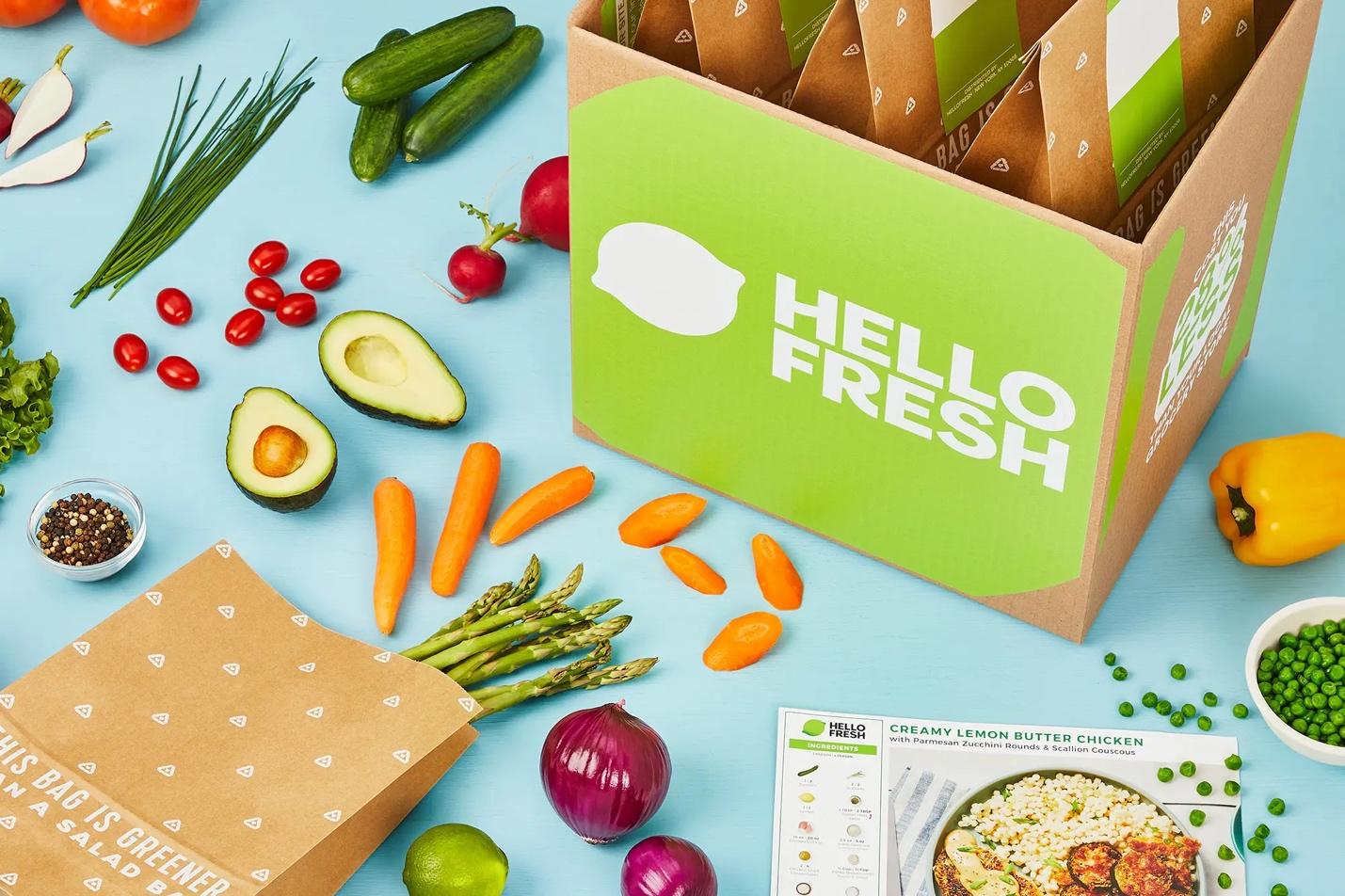
This brings us to HelloFresh. You remember them, right? You spend like $20 a meal for about $10 worth of ingredients and a recipe you could’ve found online for free and then you still have to cook it yourself. Anyway, the meal kit delivery service HelloFresh was recently accused by People for the Ethical Treatment of Animals (PETA) of using coconut milk obtained from monkey labor in Thailand. Some days you wake up and see a story on the Internet and you think this can not be real; it has to be a joke. This is one of those stories. It’s just too absurd, but it’s apparently true. Thailand is the 9th largest producer of coconuts worldwide, behind Indonesia, India, the Philippines, and a few other countries. And I guess, when you’re that far down the list, you have to give yourself a competitive edge, plus humans are whiny. Coconuts grow on trees. There’s no way around that. So, for people to harvest them, they need ladders, they need safety equipment, they probably want breaks and if they get hurt you have to train a new employee. What if there was a natural solution to this problem? What if you could find a worker that could not only climb trees, but leap from treetop to treetop and pull the coconuts down with a speed unlike any human. PETA says that “57 operations in nine provinces of Thailand” still use monkeys to do this and claims that HelloFresh buys their coconut milk from those companies who get their coconuts from one or more of these 57 operations. HelloFresh released a statement saying, “HelloFresh strictly condemns any use of monkey labor in its supply chain, and we take a hard position of not procuring from suppliers or selling coconut products which have been found to use monkey labor. We have written confirmation from all of our suppliers — in the U.S. and globally — that they do not engage in these practices.”
Now I want to know who at HelloFresh is in charge of sending the form to suppliers saying that “hey, just a formality, but can we get a signature saying that you don’t have monkeys working for you?” Curious George is not on the suppliers’ payroll, so they’d probably be confused.
Now you’re probably wondering if it’s a job that’s very dangerous for humans, isn’t it actually good that they are using monkeys? Don’t they like climbing trees? Well…
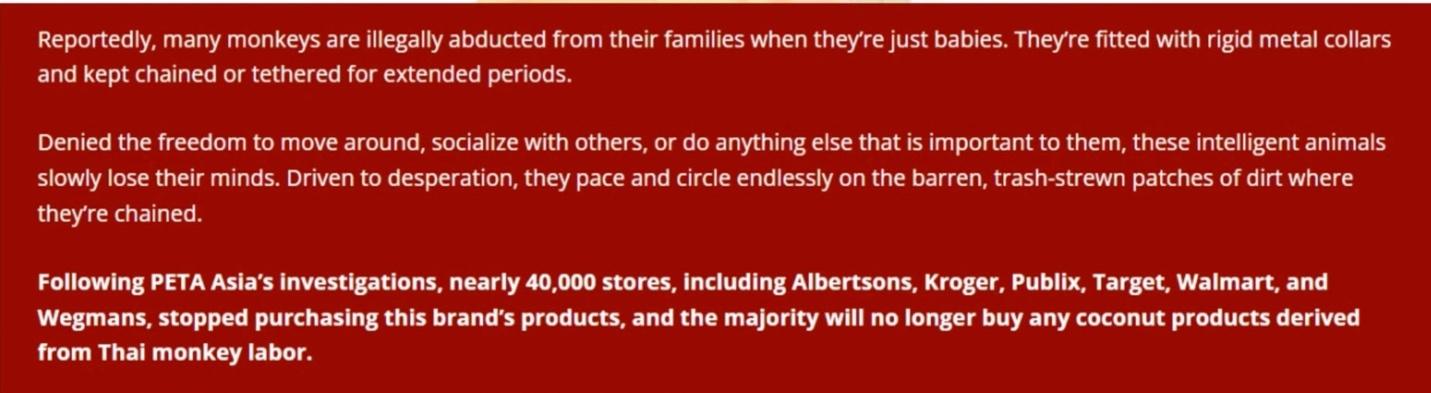
The following emailed statement is from PETA and it’s pretty rough.
These companies basically go into the jungles and abduct monkeys from their families, cage them, beat them, and force them to work. When the monkeys are no longer able to work anymore, they do not exactly get thrown a gold watch and a retirement party. They get tossed back into the jungle, where they can not really survive anymore because they have spent too much time in captivity. Now I do not think PETA would go for any animals being used as laborers, but what if the monkeys were not caged, collared and beaten, were fed well and maybe got weekends off? You do not hear anyone complain about seeing eye dogs being forced to stop blind people from walking into traffic. Just when you think the world can not get any darker, you wake up one day and find out someone’s whipping monkeys for coconut milk.
Only a week into the spring semester and I already have a heavy heart.
I hear so many people around me excited for another fresh beginning, to reconnect with friends they haven’t seen in weeks, to begin to plan in advance the weekend adventures they will go on, and the long nights they will have. But I couldn’t help choking back tears as my car pulled out of the driveway and I set off for school once again. And just like all of those people I hear discussing their lives and plans around me, I too am excited for a new beginning, new year, the ability to reconnect with my friends and teammates and the planning of exciting events. Yet only a week in and I feel guilty for having a heavy heart.
Before now, I thought that home was merely a structure. It was the place you slept in at night, that kept you out of the winter cold and dry when the Earth was crying. It was an establishment with 4 walls in which you kept all of your belongings and went back to after a long day. It was the place you ate your meals and washed the troubles off your skin. However, it isn’t until you leave home for a while and return that you learn home isn’t just a structure, but a concept.
Home is what makes you feel the most comfortable, where you feel at your safest; what puts your mind at ease, creating the same sensation as a never-ending hug. Home is warm, it is soft. Home can be a person, people even—maybe even people that don’t consist of your family. Home is like the first sip of coffee in the morning or the smell of freshly mowed grass. It is said home is where the heart is, which is true, for home is where, what, and who your heart connects with.
For me, my home isn’t here in Philadelphia, so leaving to come to school is never simple and rarely goes without a few tears. Yet home isn’t a place designed for you to leave for an extended period of time. Home is the place you’re meant to stay. A place you’re always meant to appreciate and to cherish.
Homesickness is the cause of my heavy heart. Remorsefully, here in Philly, I miss my home. Yet to be at school means to step outside of this comfort zone, to miss home and miss everything comfortable it brings with it in order to grow. No growth occurs in the places in which we are the most complacent. If the weather was only ever sunny, the grass would begin to dry and flowers would inevitably die. The discomfort of rain is necessary to maintain the balance and beauty of nature, therefore as a part of nature, discomfort is necessary for us to survive, and thrive, as well.
Homesickness creates for a heart as heavy as a wet rag, yet to feel this way is necessary. If you’re away from the things, places, and people that fill your soul with endless sunshine, I am proud of you. I am proud you are choosing to conquer a world of unfamiliarity and grow as an individual outside of your comfort zone, to choose to leave where your heart most strongly resides in order to find new places that feel like grabbing the last cookie out of the jar or singing along to your favorite song.
Leaving home is never easy, yet the easiest things aren’t always the most worthwhile, and the most worthwhile things aren’t always easy.
If you too are like me, guilty with an incomplete heart, know I am proud of you for making the worthwhile decision, and you should be too.
A few months ago, I told my friends that if Elon Musk bought Twitter, he wouldn’t actually fix it the way people wanted. That’s because what people wanted was a completely unmoderated utopia (or dystopia) for people to say whatever they wanted and for Elon to bring all of the banned accounts like Donald Trump and Andrew Tate back. Since then, he’s tried to back out of the deal, got sued by Twitter and settled the suit by effectively saying “if I buy it, will you stop suing me?” (Not a real quote) He was going to lose and effectively buy the site anyway and probably pay some extra penalties as well.
On Oct. 26, the day before the deal was official, Musk went to Twitter HQ with a sink, filmed it and tweeted it. Now it’s been about three weeks since he took over Twitter and what’s happened since then? Well, not only did he not immediately reinstate all the banned accounts, which really set off Lavern Spicer, he said he was forming a “content moderation council with widely diverse viewpoints” and that “no major content decisions or account reinstatements will happen before that council convenes.” He added that this group would include the civil rights community and groups that face “hate-fueled violence.” Also on day one, he tweeted a post captioned “Dear Twitter Advertisers” and included two screenshots of text, trying to reaffirm to them that the site won’t become a free-for-all hellscape where anything can be said with no consequences. This is what I predicted would happen, because he must appease the people who pay the bills, at least in the short term, while he figures out another revenue stream.
One thing I didn’t predict is that his purchase of Twitter would cause much of a trainwreck this quickly. First off, a bunch of advertisers left, and Musk had a fit, claiming that they were “trying to destroy free speech in America,” and threatened to name and shame them if they didn’t stop. Yes, advertisers will definitely spend money if you threaten them. Good plan! He admits the site experienced a massive drop in revenue, which means he needs another way to make money. The solution? Well, Elon Musk, the richest man on Earth who hangs out on yachts for fun, decides blue checkmarks are too elitist and wants everyone who isn’t a celebrity, politician or important person of note to have a blue check next to their name. So, he tweaks Twitter Blue, a product that already existed. You can’t make this up. He originally said that it would cost $20 a month. Stephen King made a comment saying he would never pay $20, saying that the site should pay him. Elon responded with a suggestion to charge $8 instead of $20. I imagine Elon considers Stephen King a personal hero. After all, the guy wrote a book about a self-driving car that kills people and Elon Musk has made that a reality!
So, $8 is where it ends up, and Musk’s rationale is that “it is the only way to defeat the bots & trolls.” Yes, trolls could never find a use for being able to have a verified checkmark next to their name, right? Many people started making a bunch of Elon Musk impersonation accounts, with many of the users already being verified.
Rich Sommer, who plays Harry Crane on Mad Men, changed his name and profile picture to Musk’s and sent out a tweet mocking the Tesla CEO.
Comedian Kathy Griffin and YouTuber Ethan Klein were both banned for changing their name
to Elon Musk and shitposting.
Comedian Kathy Griffin and YouTuber Ethan Klein were both banned for changing their name
to Elon Musk and shitposting.
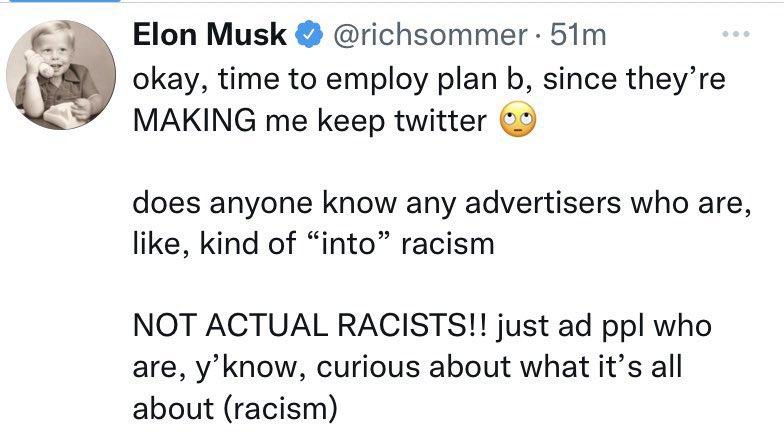
Then there were the people who did start buying blue checkmarks just to make posts. Here are some of my favorites:
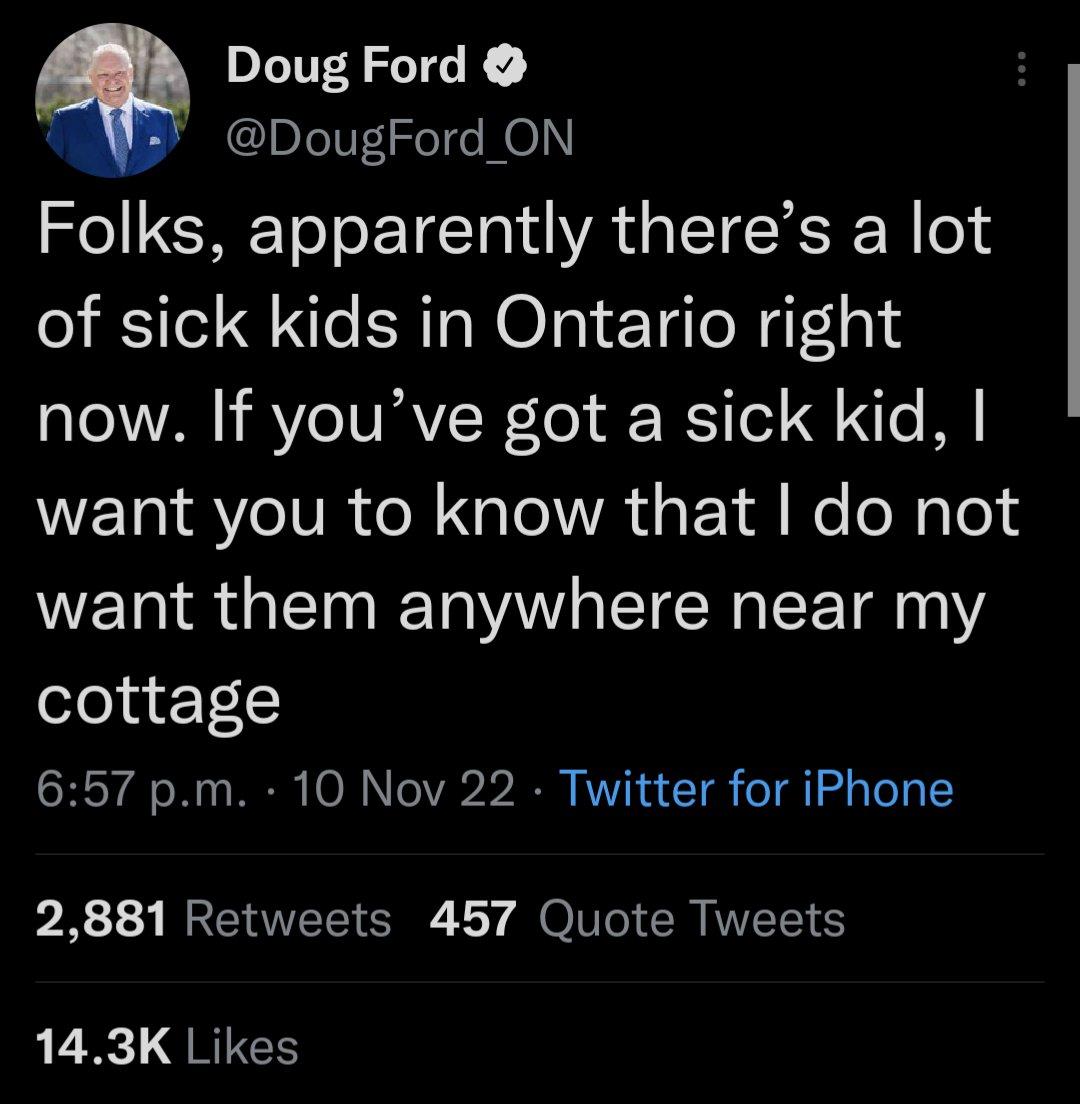
Here’s one for the Canadians:
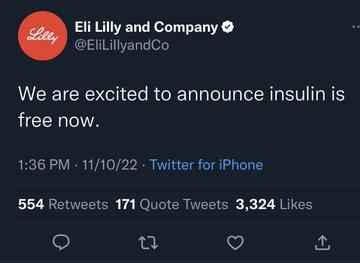
And in perhaps the most damaging use of $8 ever, someone impersonating pharmaceutical company Eli Lilly and Company tweeted this:
When the real Eli Lilly and Company tweeted an apology, people started mocking them for not apologizing for the cost of insulin. If that wasn’t enough, their stock dropped rapidly. There’s lots of speculation as to how this could happen, but the fact is that right after the tweet, the stock had a $20/share drop. That’s a lot in one day. A few days later, the Twitter Blue program got suspended, and you didn’t need a Nostradamus to see this coming. This raises an interesting question: could Eli Lilly sue Twitter for allowing this to happen? Probably not, but it does lead to why verification exists in the first place. It’s a bizarre story that involves baseball manager Tony La Russa, who tried to sue Twitter back in 2009 because someone was impersonating him. La Russa claimed they settled, but Twitter denied this. As a measure to fight this impersonation problem, Twitter put a Verified feature in place for famous people. You were required to send someone a scan of your ID to get it. That is how verification should work. Just letting anyone buy a blue checkmark with no real verification was absolutely going to result in this.
An email from Elon leaked onto the site, where he mentioned that 50% of the revenue still needs to come from advertisers, even if Twitter Blue worked. He also told his staff that Twitter might not survive the upcoming economic downturn, he’s already teasing an impending bankruptcy. Here’s the problem: he doesn’t know how to run a business that’s funded by advertising and subscriptions. He only knows how to run businesses that are allegedly heavily funded by government grants and subsidies. Elon has declared that “comedy is legal” on Twitter, but this opens another potential problem that he needs to avoid. Straining relationships with Visa, Mastercard, his old friends at PayPal and other payment processors. This is because I guarantee that once the fake accounts are banned, the owners of them will issue chargebacks against Twitter. This isn’t the first time this happened, the payment processors almost stopped dealing with OnlyFans and one of the reasons was chargebacks, as they feared credit card companies would stop working with them. Visa doesn’t need Twitter, Twitter needs Visa. On Nov. 16, he sent an email to his remaining staff, telling them to pledge their lives to the company or resign. Guess what most of them did? The next day, TwitterHQ shut down because Elon was afraid of the service being sabotaged by the service and that the offices would reopen on the 21st, giving Elon a weekend to figure out if he has any staff left and who among that staff he can trust. This all sounds awfully familiar. I don’t want to say a certain someone’s name, but…isolating from everyone and not knowing who you can trust at the very end is very similar to how things wrapped up in 1945.
Elon once again proved me right on Nov. 18, when he tweeted, “New Twitter policy is freedom of speech, but not freedom of reach. Negative/hate tweets will be max deboosted & demonetized, so no ads or other revenue to Twitter.” He’ll effectively be shadow banning posts deemed “negative” or “hate,” they won’t appear in feeds, they are only accessible through a person’s Twitter page directly to see them, which many people don’t do. He did reinstate the accounts of Christian conservative satire site The Babylon Bee, Canadian psychologist Jordan Peterson and I guess for “balance, ”Kathy Griffin. He gave a hard “no” to Alex Jones, so it seems the “free speech absolutist” has his absolutes. Former president Donald Trump got his account reinstated after a poll created by Elon that was about 52/48 in Trump’s favor. Trump has repeatedly stated he won’t be coming back to Twitter, so we’ll see how long that will last or whether a post will be “deboosted” under the site’s new rules.
Absolutely anything is possible. There is not a single thing you cannot achieve. Wake up early, eat a healthy breakfast, make sure you attend all of your classes and get a workout in. Make sure you complete all of your assignments to the best of your ability, your room is clean, your bed is made and your laundry is done. Make sure you practice a multi-step skincare routine after you shower, achieve your step goal, meditate, journal, plan your papers in advance, study hard, attend every meeting. Make sure to make the extra effort to call home every day, keep in touch with old friendships, socialize with current ones and attempt to form new ones. Make sure you look good for the day, your hair is done, your outfit is comfortable, but simultaneously stylish. Make sure you smile often, stand up straight and above all, never let anyone see the one lonesome tear strolling down your face because you have simply had enough; but anything is possible, right?
Perfection is a concept unfairly driven into the minds of children at a young age. We are taught that there is a standard that we must meet in order to be good enough, that there is this “realistic” expectation held. And as we see other people meet this expectation, it becomes a sort of protocol, routine. There is this assumption that we must be able to reach this now standardized goal or else we fall short and fail. Inadvertently, one forces themself to try that much harder to fulfill this expectation in fear of falling short, the fear of messing up forever imprinted into the minds of those who will not stop pushing themselves until they break. Yet the reality is, anything is not possible, for this vast category of “anything” includes the notion of perfection, and what is realistic is that there is no such thing.
Perfect denotes zero mistakes, the absolute best one can be 100% of the time, however, to do this is to be merely inhuman. Robots are programmed to be perfect, not people, and oftentimes even robots make mistakes. Have you ever had a computer glitch, or something go wrong on your phone that was not caused by user error? Even what is intended and designed to be perfect cannot fully fulfill this definition, so why would you, a human, ever think it to be possible?
The fact you cannot ever be entirely perfect does not mean you should not try your best to be the best YOU can be, but it does mean it is not worth it to run yourself into the ground trying. A balance between discipline and cutting yourself slack is imperative to a positive wellbeing. As much as you might need to study a little harder for an exam or work late one night on a paper, you also need to watch a movie or take a nap. As someone who struggles with finding this balance, feeling immense amounts of guilt when I do ease back on myself, denying myself the credit I deserve for the hard work I do, I understand the difficulty in being simultaneously motivated and relaxed. However, it is necessary to strive for progress, not perfection.
Get up early, eat a healthy breakfast and go to your classes, but it is okay if you are not able to get a workout in. Do your work and make sure you do your skincare after you shower, but if that means you cannot do your laundry, so be it. You deserve to be in a neat space, so get that room cleaned up, but if you only have energy to make your bed, that is okay too. Maybe in order to call your parents you had to stay up late writing a paper; reward yourself with sleeping in the next morning.
Even if all of this is not enough to lighten the load of what feels like the entire world on your shoulders, it is always okay to let that tear trickle down your face, for you are not that “perfect” robot, but a human. A human who is loved, important, valued, and above all, perfectly imperfect. As hard a pill as it is to swallow, know perfection is unattainable, therefore, you will forever be chasing a goal that cannot be reached, falling short every time. For this exact reason it is important to not strive for perfection, rather progress. And know too, at the very least, I will be beyond proud of you for this progress.






 The La Salle Collegian