As the world continues to adjust to life in a pandemic, Mother Nature has other plans and is throwing historic amounts of snow our way. While heavy snowfalls are normal in countries, such as Russia and certain parts of North America, in the last month, some areas have seen record-breaking snowstorms, some the heaviest seen in decades. Listed below are several of the heaviest and most shocking snow falls from around the world over the last few weeks.
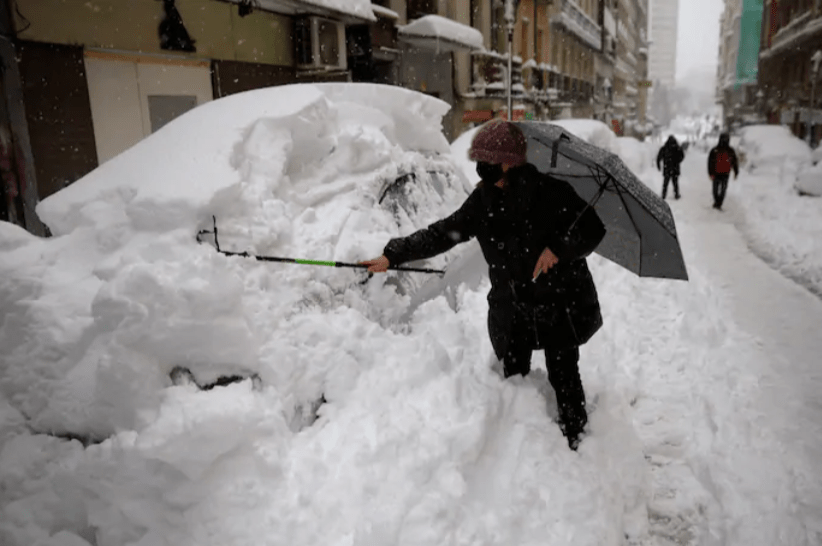
Madrid
Courtesy of the Washington Post
When you think of Spain, you often picture the bright sunny city of Madrid, its intricate parks and elegant architecture. You may not always picture it being covered in snow, even during a normal winter season. This year, Madrid received a little over 12 inches of snow, the most since 1971 — bringing the city to a complete halt.
Moscow
Courtesy of Moscow Times
While you can expect that a country such as Russia typically receives several feet of snow a year, this year was a bit more than usual. It turns out last year, Moscow received a very mild snowfall and within the first two days of its recent snowfall, Moscow was sitting under 22 inches of snow. There were 60,000 city crew members who joined in efforts to clean up the snow.
Athens
Courtesy of Euro News
Greece is no stranger to snow, however, this year the country has received an unprecedented amount as opposed to years prior. Heavy snow totaling several inches covered Athens during their recent snowstorm, just as the country was beginning to distribute COVID-19 vaccinations across the capital city. While snow is common among the mountainous regions in Greece, it is far more rare to see it in the capital city.
Texas
Courtesy of People Magazine
The recent snowstorm to hit the U.S. impacted several states, including Texas. While it does not snow often in Houston, one of Texas’ largest cities, it snowed a record-breaking 22 inches this month. This is one of the 94 times it has snowed in Texas since 1981. The last time it snowed as bad as this year was in 1985, on Valentine’s Day.
New York
Courtesy of New York Times
New York is no stranger to snow, but the recent storm has hit NYC with one of the biggest snowfalls in its recent history. Since their last blizzard in 2016, this year’s highest counted snow within the last few years totaling in 17.4 inches.
Philadelphia
Courtesy of Philadelphia Inquirer
We had to mention our lovely city on this list, as we saw a sizable 17.5 inches of snow this winter. Philadelphia had also recorded 4 consecutive days of snowfall, which is only the 4th time this has happened in our history.
On June 2, 2020, 28 million people posted pictures of black squares on social media to show their support for the #BlackLivesMatter movement and the Black lives lost to police violence. While the intention of this day, known as Blackout Tuesday, was to show solidarity and call attention to racism, in reality, these blank posts clogged up feeds and hashtags for weeks while simultaneously gaining no progress towards justice for Black people.
The pinnacle of anti-racism efforts should not be spontaneous declarations of “allyship” and “wokeness” on social media. These posts can be considered virtue signaling, as they serve primarily to show that the user is moral and falls on the “right side of history,” or performative activism, as the user is speaking out on social justice issues simply to appeal to their audience and peers. Ultimately, these posts redirect attention away from the community the user is claiming to support, and right back towards the, typically white and privileged, user.
However, social media can still be a useful tool for social justice activism if proper preparation and thought goes into the post or repost. We must always be asking ourselves both our intentions for posting and what impact it will have. Am I posting this to show something about myself, or about the community I am advocating for? Does this post have substance; what is it that my audience is learning? Does it motivate readers to do something beyond reading and learning? Especially helpful posts are those which serve as a resource for information and have a call to action.
Truly fighting against white supremacy and racism requires a commitment to work beyond the posts. Don’t get me wrong — awareness and education are very important, but they get Black people no closer to actual, tangible liberation. Reposts can make people more knowledgeable of the work to be done, but they do not break down the social norms and overarching institutions that serve white people while simultaneously harming Black, Indigenous and People of Color (BIPOC).
There are other steps we can take from our phones that have more of an impact than just a like and a share. We can sign petitions — more than just the few that are trending. We can call and email federal, state and local representatives to demand their support for certain movements or pieces of legislation. Oftentimes, there are even pre-written scripts that we can access and use for direction and convenience. We can do our research and choose not to spend our money at companies that promote white supremacy, discredit the Black Lives Matter movement, exploit the working class and benefit from prison labor, instead opting for ethical and Black-owned small businesses.
One of the best ways to liberate Black people is to eliminate the racial wealth gap. White people have 8 times the median net worth as Black people, and Black people are twice as likely to be in poverty. So, the best way to get Black people more money is to, well, give them more money. The rise of digital activism makes mutual aid easier to participate in than ever. Mutual aid differs from charity in the sense that it does not require a third-party organization to transfer funds and the recipient retains their independence with ability to spend the funds however they see fit according to their needs and situation. I know most of us could spare one morning of Starbucks coffee; why not try redistributing that wealth instead?
There are actions we can take beyond the phone screens, too. White people can self-reflect on ways we continue to benefit from white privilege, even though we may be against it morally. We can attend classes, workshops, and online events that teach us to put our social justice passion into action. We can physically attend protests to make sure that demands are not silenced and ignored. Perhaps most importantly, we can address racism every time we encounter it at home, school, work, or elsewhere. Microaggressions, contrary to the term, are, in fact, incredibly discriminatory, violent, and harmful. Tolerating racism and remaining silent in the face of racism makes us part of the problem, not the solution.
There are hundreds of other actions I could recommend, but as a white person, my last suggestion to you is to diversify your feed. As white people, we cannot possibly comprehend the lived realities of our BIPOC friends and neighbors. We must listen to Black voices, support them, and amplify them. Some of my favorite people on Instagram are Avery Francis (@averyfrancis), Mithsuca Berry (@mythsooka), Michelle Nicole (@passionandpower), and Monique Melton (@moemotivate). Check out their accounts, give them some follows, and send them a few dollars too, while you’re at it. Some of their content may be free, but that doesn’t mean that their labor should be.
White people possess white privilege, therefore the power and responsibility to destroy racism is in our hands. This article is a call to action for every single white person reading this and every single white person you know. The bottom-line is we need to do more — all of us, not just some of us. Significant and sustainable change is only forced through consistent and persistent effort. If 28 million people called on their governments to defund the police, donated their extra income and called out racism every time they witnessed it, we would probably accomplish a lot more than painting a social media platform black for one day.
On Friday, Feb. 5, the Washington Post’s “Made by History” section published a piece by Dr. Jamie Goodall (a historian at the U.S Army Center of Military History and expert on the history of piracy) about the Super Bowl and the Tampa Bay Buccaneers. The main topic of her piece was the problem of romanticization of outlaw figures who, in their heyday, were not revered and heroic as we portray. She did not write about how Tampa should change its name; she did not condemn the city (though given what I saw of the stadium crowding, I might). She merely wished to point out that sometimes the figures we romanticized were not regarded as romantic heroes in their time and that we should remember that. The topic of this article is the threats of violence directed at Dr. Goodall since her op-ed was published and the issue of threats and violence directed at professional women who share their opinion, even an expert opinion.
Dr. Goodall’s piece went viral in the days since its publication. The headline has been tweeted about and retweeted on social media, most notably by former President Trump’s press secretary Kayleigh McEnany and a vlogger named Matt Walsh who in his bio calls himself a “theocratic fascist, tyrant and beekeeper” (why anyone would admit that about themselves, I do not know). Even the Daily Mail wrote a piece on her and took the time to go through her Instagram and find photos of her wearing a facemask with Jolly Rogers and one professional pic of her where you can see her tattoo of a female pirate, using these as examples that she is a hypocrite. The reactions have ranged from calling her a hypocrite, to attacks towards her former colleagues at Stevenson University, to threats of rape and other forms of violence against her. She has not left social media but she has blocked many of these online trolls and has locked down her account, showing a tremendous amount of strength and courage while being mobbed by a group of people who get upset by a piece saying that not everyone in the past was a romantic swashbuckling hero.
Dr. Goodall’s case is not a one-time phenomenon. Sadly, it is part of a pattern of women who in various industries become the target of online harassment and threats of sexual violence simply because they wrote or said something in their field.. This whole situation brings up memories of both gamergate and comicsgate and how internet figures make it their mission to attack women.
Gamergate was an online harassment campaign directed at women involved in the video game industry. Zoe Quinn, an independent video game developer who created a video about dealing with depression, was targeted with threats of violence and exposing of personal information. In 2014, she did an interview for The Guardian where she said she was afraid to go home and was living on her friends’ couches because of threats against her person. She and several other women connected to video games were bombarded with attacks from anonymous online individuals. These threats included attacks on their professional careers to gruesome images of dead animals sent to their inbox. Comicsgate was a similar harassment campaign but was targeted at professionals in the comics industry, arguing that diversity in writing rooms and the creation of characters who were either female or people of color were ruining the industry. Members of comics forums even created a blacklist of comics creators they argued were destroying the industry (many on the list were women, people of color and LGBT creators). Much like with gamergate, they used online harassment to target women in the industry. An example of this would be the case of Heather Antos and the milkshake photo.
In 2017, Heather Antos was an editor at Marvel Comics and had posted a photo of herself and some of her female colleagues going out for milkshakes after the work week. The spectacularly apolitical photo was quickly bombarded with online trolls connected to comicsgate attacking Antos and her colleagues and arguing that they were the reason the comic book industry was seeing a decline in sales.
These online harassment mobs are a byproduct of a culture war that has been brewing in the United States for decades. The people attacking these women do not really care about history, comics or video games. Rather, they desire to silence individuals and control these industries that they have no real connection to. It is more about making women and people of color in these industries more submissive to their wills and thus unable to speak or voice an opinion. We can see this in all these cases. The desire is not about the financial health of these fields or the quality of content being created. It is about dominating and making the victims of these harassment campaigns submissive. If this all sounds incredibly rapey, that is because it is. Let us speak plainly on this.
In my professional, academic and personal life I have had the opportunity to work with and know numerous women who are quite brilliant and frankly I have no qualms admitting that I am mediocre compared to a lot of them. They all have brilliant knowledge on subjects and opinions but are often silenced or forced to hide their views.. If they don’t, the troll army will come after them and spend weeks threatening their wellbeing. I could honestly write 20 pages on the issues women face in the workplace and online. However, I am not sure I am the right person to write that piece. Instead, all I will say is that in society we must be more alert to these kinds of hate campaigns and realize that they are a threat to the rights and safety of our colleagues, friends, family and fellow human beings. The absence of those voices at the table because of a bunch of angry bloggers would be nothing short of a tragedy for these industries but also for society as a whole and will result in a stifled unenlightened mess.
Britney Spears has been an icon in the music industry for numerous years, inspiring endless individuals with her music, style and personality. But with fame also comes torture, especially in the perspective of the Spears family. Spears was the girl-next-door in the early 2000s — everywhere you turned, you would see her face somewhere. But Spears was always receiving backlash in the tabloids everywhere she went. At a certain point, the tabloids were getting the best of her and her mental state was declining at a steady rate. It is at this point, in 2007, that Spears reached her breaking point. She suffered from a psychiatric breakdown, shaving her head and chasing paparazzi with an umbrella. No one took her mental illness seriously and just belittled her to the point of a breakdown, which is horrendous. After the breakdown, it got to the point in which Spears’ father took conservatorship of her finances since she was found to be unable to do it herself. It is this concept of conservatorship that her father took from her that still weighs heavy in today’s press. From the years after the conservatorship, Spears had many obstacles throughout her career that influence much of her music. She was not allowed to make her own decisions at all and it played a major role in her mental health. Years after the conservatorship, Spears has cleaned up her act, but still for some reason her father, Jamie Spears, still holds this conservatorship. Britney Spears is a profound celebrity with much recognition through the years of the music industry, but her father does not see it that way at all and refuses to give up the conservatorship. Many fans have witnessed her unfamiliar behavior on videos that have surfaced on TikTok, which is a reason why the #FreeBritney movement has gained such a following.
Laura Newberry, Los Angeles Times
Supporters of Britney Spears want an end to the conservatorship her father, Jamie Spears, has over her finances.
There has also been an increase in conspiracy theories about the #FreeBritney movement. Many fans would comment asking if she was okay, and to wear yellow in her next video if she was not. And you better believe that in her next video, Britney Spears wore yellow, making fans hysterical, believing she was truly in trouble. Many fans believe that she has been trapped and cannot control her own life because of her father and believe it to be taking a serious toll on her mental health. These reasons have fans believing that Spears is being held against her will and being forced to do things. Many fans believe if she has the ability to uphold a successful music career and be a loving mother, she is more than capable of handling her personal affairs and does not have to have her father in charge of everything.
After all these years with this icon, there has been so much talk about her in recent days, especially with a new documentary coming out about her and the struggles she faces in her career. There also has been much talk revolving around the conservatorship of Spears following the trial on Thurs., Feb. 11. There was no clear conclusion of the trial, but the conservatorship still is held in favor of her father, leaving room for trials to come later on in the future.
Spears has been such a role model for individuals facing mental illness and everything in between that the best we can do for her is stand up and fight against this conservatorship against her. Because at the end of the day, all the fans want the same — we want the best for Spears, which is the whole idea behind the #FreeBritney movement. If you agree with #FreeBritney then spread the word or tweet something and look out for petitions to remove conservatorship from her father and hand it over to her; it’s what she deserves.
Our phones can serve as a bottomless pit of distractions, leaving us drained and dissatisfied. Meditation can help.
Do you have trouble focusing in class? Do you find that you can’t muster up the courage to do that assigned reading? Do you ever find yourself exhausting your Twitter feed, closing out of the app, only to reopen it seconds later, expecting something different? Do you find yourself in a constant negative feedback loop of ennui? First, we’ve all been there. Second, you should try meditation.
To be clear, the central purpose of this article is not to claim that you should meditate, but rather to illuminate the struggles we face, especially in a post-Zoom world, while offering an empirical prescription to those ailments. This prescription has served me well, but in no way do I want to act as a meditation evangelist. Simply put, you can take it or leave it.
Let’s briefly discuss some of the struggles of being human. Listlessness is characterized as a lack of interest or energy; I believe that we are engaging in an attack on our energy levels every time we unlock our phones. The adult brain can store between five and nine items in short term memory. You can open Twitter, and by the time you see your tenth tweet, it is very likely that you can’t remember the first. More importantly, when presented with much more than five to nine pieces of information at a time, it’s easy for our brains to get overwhelmed. It’s a shame that social media, by design, presents you with an infinite amount of information at once, so long as you enable it. It’s a shame because our prefrontal cortex — which evolved millions of years ago to mediate the functions of goal articulation, goal retention, and self-discipline — is no match for computers. When you put it that way, it’s no wonder that we are turning our thumbs arthritic in the name of scrolling.
But it doesn’t need to be so bleak. Sure, we’ve designed a computer that can accurately anticipate our needs and desires and use that information to present us with our own virtual reality. Big deal. Still, the quest to manage stress isn’t completely hopeless. I was surprised to learn that the term “stressed out” was invented sometime in the last century. Before we had a name for it, did people feel stressed out? Of course they did, but their stress was informed by extremely different circumstances, and they just didn’t identify that overwhelmedness like we do. Nonetheless, holding all circumstances equal, there is one timeless practice that, if done correctly, is almost guaranteed to reduce stress. You guessed it: meditation.
You’ve probably heard that before; that meditation is worth trying, whether it was from a friend, a fellow netizen, or a public figure. Neuroscientist Sam Harris says meditation is “the practice of learning to break the spell and wake up;” I concur with Mr. Harris here. There are many unique forms of meditation and the practice itself has evolved from myriad different branches of philosophy and religion. In Zen Buddhism, there is zazen, or sitting meditation. This is the form I espouse, although there are other forms that provide their own benefits. Bodhicitta is a Sanskrit word which is interpreted to mean Beginner’s Mind or Awakening Heart. A key element of experiencing bodhicitta is attentiveness to each moment, in each moment. Thich Nhat Hanh once said something along the lines of, “if you miss the moment, you miss your life.”
Meditation is about being present in each moment. You’ve definitely heard that kitsch phrase before, but I find it a lot easier said than done. Try it. Find a comfortable seat and settle in. Aim your eyes downward, or completely close them at the risk of accidentally falling asleep (I can’t say that hasn’t happened to me once or twice). Then, notice. Notice any sounds that might arise around you; let them come and let them go. Notice how your body feels, if you’re needlessly tense in certain areas (you probably are, and that’s okay). Notice the temperature of the room, if you can. Just notice things, letting them come and go. Don’t hurry them or ignore them. Focus on your breath. I’ll admit, it’s harder than you might think. But if you get off track, if your mind begins to wander, that’s okay. Just redirect your attention to your breath. Keep on doing that, and you’re strengthening your ability to concentrate.
Right concentration is one of the steps in the Eightfold Path, which is what the Buddha proposes as the path to end suffering. Right concentration involves the concept of samadhi, meaning oneness with the object of meditation. Samadhi is not hyper-focusing on one thing, feeling, or sensation. Samadhi is regarded in Hinduism as the final stage of meditation, so don’t feel frustrated if you fail to comprehend it or realize it in your practice. Rather, I offer this information in hopes to inspire you to look into right concentration, the Eightfold Path and meditation.
If you do, you might find yourself more present in each moment. You might find that you are better at redirecting your attention to the task at hand, to the present. You might find that the prospect of endlessly scrolling through social media loses its appeal; that you feel less drained by technology and more in control of your digital footprint. You might find yourself more self aware. And in the end, I hope you find wisdom and compassion in each moment.
When I was growing up, my parents did not keep any alcohol in the house. There was no beer in the fridge for my father to drink while he watched Sunday football, my mother would not sip wine with friends. They never went to beer distributors or liquor stores. In fact, I can only recall maybe one or two times that I ever saw them drink alcohol at a party. There were few things my parents were admittingly strict about as far rules went. Alcohol was one of them and they made it clear that I wasn’t allowed to drink until I turned 21. All of this has led me to have a weird relationship with alcohol. I don’t drink during the semester and only at night with food. I’m sure some reading this will not believe me when it comes to my impressive control of alcohol. Drinking always made me feel ashamed, as though I was doing something amoral and, worried about my mental health during this hellish year, I decided to give up drinking entirely.
My weird relationship with alcohol and my parent’s abstinence from it has always been a curiosity. Why did my parents dislike alcohol so much? My parents gave me and my brother plenty of freedom as we were growing up. So why was alcohol the big issue? I got my answer recently when talking to a distant cousin after the death of my grandfather. She informed me about my great-grandfather and his marriage to my great-grandmother was an unhappy one (from all accounts my great-grandmother was a borderline psychopath and I am not exaggerating that). He hated his wife and used alcohol to numb the pain of being married to her. In one drunken stupor, he decided to run away from his family in Philadelphia and went on a bender all the way to New York. His brother had to track him down up there and bring him back. His brother once again had to rescue him when one night he got drunk and punched a hole in a wall and he had to come over and make sure he didn’t kill my great-grandmother. I never knew my great-grandfather, he died before my father was born. However, his difficult marriage and the drinking created a ripple effect through time — my parents raising me in a dry house and my own awkward feelings toward alcohol today.
Whether we like it or not, we all feel the effects of the past on our lives. Every part of our environment (physical, political, cultural, economic) is the product of the actions of people who made decisions that we still feel even though many of them have passed and their names are not active in our public memory. In that regard, they act as ghosts haunting and whispering to us from beyond the grave. If the past is such a powerful force on us, then does that mean we should study history?
In all my years of studying history, I have come across dozens of reasons for the past. So many, in fact, that if I were to try and list them, I fear that I would lose your attention and push the word limit (which I do often). So, I will make this piece the first in what I hope will be a series of pieces advocating for my fellow explorers to take courses with our wonderful history faculty and even possibly dual major or major in history. My argument here is that events do not just happen in a vacuum. They have consequences and those consequences can transcend the distance of decades and affect us today. In the story above, I mention my great-grandfather and the hardship he endured and how that has led to my parent’s strictness when it came to drinking and to my own decision to abstain from alcohol. Learning my own family’s history showed me that there was a reason for our weirdness towards drinking. Professional historians, of course, do this as well, but on a more societal level — they find ways to show that the worlds they study are speaking to us now.
After the September 11 attacks, historians of ancients Greece and Rome felt their work had become relevant and that the conflicts between the United States and the Middle East were part of a pattern stretching back to the wars between the Persian Empire and the states of Athens and Sparta and how the Greek historian Herodotus framed these conflicts in his work. Or, to use an example from this decade, scholars have been making many connections between modern problems of police brutality and racial injustice and the racist policies and hierarchies that were put in place during the Antebellum and Jim Crow eras of American History to prevent Black Americans from achieving true equality in the United States.
Studying history allows us to better understand how the actions of those from yesterday are still affecting us now, allowing us to perhaps even one day break the chains of conflict and oppression and build something better. Or, at the very least, it will help us steer us into a better direction. Regardless, if you want to better understand this phenomenon, I strongly recommend that you take some history courses here at La Salle during your academic careers. If nothing else, you’ll see that we are just one link in a chain that has been forged long before any of us living now were born.
Combating climate change is something that the Biden administration has put to the forefront. President Biden talked about adding aspects of the proposed Green New Deal into his agenda and has appointed John Kerry to head the newly formed United States Presidential Envoy for Climate. These measures are a good start, but it is not enough; solar panels and wind turbines have long been hailed as the leaders of renewable energy, but what if instead of trying to use nature to stop climate change, we work with nature?
This is where permaculture comes in. Permaculture is the idea of building self-sufficient communities which only use the resources given by nature. The idea of it might seem very outdated for modern society, however, when you break down permaculture, you start to realize how a simple idea can result in massive change.
One of the most important ideas of permaculture is keeping everything in a closed loop system; permaculture communities grow their own food, get their fertilizer from waste produced by the livestock they own and feed said livestock with feed grown by the community. You don’t have to rely on stores or chains to provide food for the community or livestock; you are your own store.
The second most important idea of permaculture is rain conservation. According to the Environmental Protection Agency (EPA), Americans lose about 50% of their outdoor water due to poor irrigation systems. Faulty irrigation results in the annual loss of 25,000 gallons of water yearly. Permaculture attempts to fix this problem by going back to our roots. One idea is building canals on swampy land and raising the land around it. This idea was inspired by the Aztecs, who famously had some of the best irrigation systems in pre-colonial North America. This water can then be used to grow crops and farm fish, without causing much destruction to the land.
Shain Rievley
Water collected in rain barrels can be used to water plants; HGTV offers a tutorial on how to build a system for your own home.
The final big idea of permaculture is working with nature, not against it. This can be done in several ways. One way is using animals to get rid of invasive insects instead of pesticides. It is becoming clear that chemicals sprayed on food are not only harmful for the people who eat the food, but also harmful for the person spraying the chemicals. Permaculture uses alternative sources of pest control, such as using chickens to eat the bugs off the food.
Working with nature also comes into play when building structures. Instead of just having a rain barrel, people in a permaculture society will use the rain barrel to store water and grow aquatic food or build a fence that will keep animals in and catch wind at the same time.
Obviously, not everyone will want to move to a permaculture society. However, that doesn’t mean we all can’t use the ideas of permaculture to make our own homes a little greener. If it is possible, I highly recommend growing some of your own food. Find different ways to store rainwater and come up with ideas to reuse old waste products. It might seem small, but every big change started with small ideas.
Professors should implement open-note exams whether the class is virtual or in-person. Even though many individuals see open-note exams as easier or a way not to study for the class, I see it as a learning opportunity. While taking in-person exams where notes were not allowed I found myself memorizing and studying material simply to regurgitate the information on an exam. However, while taking virtual exams where my notes were available for me to use, I found myself trying to learn to apply the material rather than memorize it. Plus, I ended up retaining more of the material from my virtual exams compared to material from tests where I had to memorize the content.
I think allowing students to take tests with their notes is more beneficial for them in the real world. Allowing notes encourages students to learn to apply material, and being able to use information is a skill we need in the professional world. When students go on to get real jobs all the information is available to them, so they don’t have to memorize anything, however, they do need to figure out how to use that information to complete their tasks. Memorization, to a certain extent, is simply not needed in the real world. Application is far better than recalling facts. Additionally, open-note exams encourage students to take better notes since they have the opportunity to refer back to them. This situation encourages individuals to be more organized, develop neater handwriting and form a note taking system that works specifically for them. Personally, they made me learn better and refer to my notes far more often than I would have. Although I understand that open-note exams are not very common, I strongly believe that they should be the norm.
The month of January has been one of the roughest times for the Republican Party in its history. With its members blamed for the attack on the Capitol, loss of donations from big business, divisions throughout the party and its flag bearer Donald Trump’s uncertain future, it can be easily assumed that the GOP is in ruins and on the cusp of a collapse. However, the Republican Party has a history of rising from the ashes of its self-inflicted wounds and returning to power. In the aftermath of Watergate and Nixon’s resignation, Republicans believed themselves relegated to a permanent minority status in Congress. However, a mixture of the Reagan revolution and the work of Newt Gingrich and his new generation of Firestarter Republicans helped the GOP gain control of both chambers of Congress in 1994. Calamity hit the Republican Party again in the late 2000’s when a mix of the Great Recession brought on by deregulation and frustration over then-President George W. Bush’s handling of the war in Iraq cost them both chambers of Congress in 2006 and boosted Barack Obama to the White House. Yet by 2014, a more hardline Republican Party, transformed by the Tea Party Movement, had regained both chambers of Congress and would, in some ways, set the stage for Donald Trump’s surprise victory in 2016. Perhaps the best example of Republican defeat and return comes from analyzing the party from 1932 through 1952 and how the GOP changed after what was one of its worst hours.
The 1920’s saw the Republican party put three men in the White House consecutively (Harding, Coolidge and Hoover) and maintain control of both chambers of Congress. With total power, the GOP set out to enact their platform agenda of lowering the taxes on the wealthy that were implemented by the Wilson administration to fight World War I and deregulation of the private sector. At the same time, they also raised tariffs on foreign goods and encouraged the world to buy American. The Republican Party of the 1920’s believed that the government that did the least did best. We regard the 1920’s as a roaring decade of extravagant wealth because it appeared that everything was going well, and the American economy appeared to be thriving. By 1929, however, the good times were over as the Depression ravaged the world and forced people out of work. The Hoover administration’s response to the Depression was essentially a doubling down on the same policies of lower taxes and deregulation. They had hoped that the free market would eventually correct itself. In the meantime, they told the American people to fend for themselves. The American people did not respond well to this call for personal responsibility when suffering during a catastrophe, a feeling many can relate to today. In response to the apparent lack of response from their leaders, the American people decided to give Hoover and the Republicans in Congress the boot and decided to give Franklin Delano Roosevelt, along with his New Deal, a try, thus putting the Republican Party into a state of political exile for two decades.
Historian Heather Cox Richardson does an excellent job of documenting the Republican Party’s time in the political wilderness in her book “To Make Men Free: A History of the Republican Party,” which presents the entire history of the GOP from its founding before the Civil War to the Bush years. She describes the Republican Party, after their attempt to beat Roosevelt in 1936, as essentially being split into factions with two very distinct visions for both the United States and the party: the Taft wing and the Dewey wing.
Encyclopædia Britannica
Robert Taft disagreed with Roosevelt’s economic policies.
Led by its namesake Senator Robert Taft (the son of former president and chief justice, William Howard Taft) of Ohio, the Taft wing believed that the economic policies enacted in the 1920’s were fine and that FDR and the Democrats’ agenda would lead the nation toward socialism. According to Richardson, their hatred of the New Deal was so fierce that they were even willing to align themselves with the Southern Democrats, who were not keen on it because of the New Deal’s aid to African Americans. The Taft wing saw themselves as defenders of the American way of life, the Constitution and as the only true Republicans in the United States, unlike their rivals over in the Dewey wing of the party.
Opposite of the Taft wing were the Dewey Republicans, led by New York District Attorney, Thomas Dewey. This group believed that the government had a role in regulating business and were more open-minded about the New Deal. Dewey Republicans threw their support behind the establishment of a minimum wage, the Wagner Act and an end to child labor. They also differed from the Taft wing with their support for intervention into World War II, believing that such intervention would boost American production.
Encyclopædia Britannica
Thomas Dewey lead his namesake wing of the Republican Party.
Over the course of two decades, these two factions would duke it out over which side would be in control of the Republican Party, and each wing had their chance to prove their case to the American people. However, neither side was able to defeat FDR or his successor Harry Truman. There was one change, though. In 1952, when former allied General Dwight D. Eisenhower decided to enter the Republican primary as a Dewey Republican against Robert Taft. The Taft Wing could not hope to defeat the popular general who led the allied forces in Europe. As a consolation, Senator Richard Nixon of California was chosen as Eisenhower’s running mate to gain their support and unite the party. Together, the two won the 1952 presidential election. Eisenhower then set out to enact a fiscal policy of balanced budgets and reduction of the national debt while also advocating for labor rights and social services. Richardson says that the Republicans had been transformed through decades of exile and strife and came back a more egalitarian party akin to their forebears: Abraham Lincoln and Thaddeus Stevens.
The GOP has been down and beaten before and always finds its way back. The questions now are just how long will it be in the wilderness and what it will stand for. Will it dump Trump and attempt to cleanse itself of his legacy and most devoted supporters in Congress? Will it look to the examples of Thomas Dewey and embrace the more egalitarian vision his wing had or continue to channel the spirit of Robert Taft? Ultimately, the decision will fall upon Republicans to answer what it means to be a member of their party.