
Claire Herquet, Editor-In-Chief
Three years at La Salle so far have taught me many valuable lessons. I’ve learned how to write on a deadline week-to-week, survive an 8 a.m. class commuting from New Jersey, juggle work-life balance as a student-athlete, and so much more. But above all else, I have learned one undeniable truth: the squirrels run this campus.
I understand the seriousness of this allegation. I did not arrive at this conclusion lightly. This is the result of years of observation, tons of serious conversations with my colleagues, and dozens of suspicious encounters (one particularly intimidating squirrel outside Hayman Hall that looked at me like it knew my GPA).
The evidence is overwhelming. At the very least, they are not operating under the same rules as normal squirrels.
According to wildlife experts, squirrels are supposed to have a natural fear of humans and avoid potential threats. However, urban squirrels often become habituated to people, meaning they learn that humans are not particularly dangerous and begin acting more boldly.
That explains some things.
It does not explain what is happening at La Salle.
Most squirrels, when approached, will make a reasonable life decision. They will run away, climb a tree, and/or create distance.
Squirrels at 20th and Olney do none of these things.
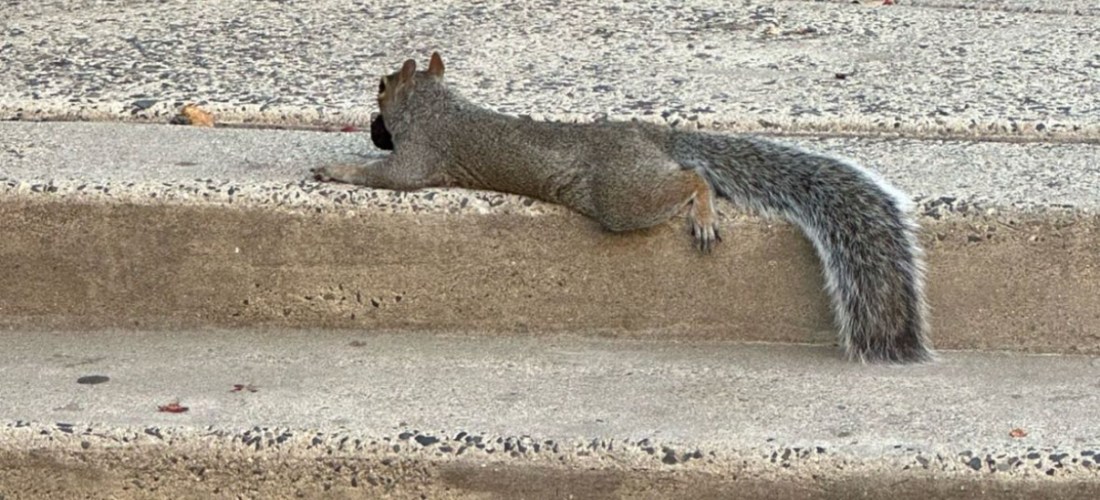
Instead, they stare. You know the stare. They’re conducting performance reviews.
You’re walking to class, already late because you convinced yourself five more minutes of sleep would improve your morning (it barely ever does), and suddenly there is a brown, fuzzy fella standing directly in your path.
Not near your path.
Not adjacent to your path.
They post-up directly in it.
I’ve watched innocent students completely alter their walking pathway because a squirrel was standing in the middle of the sidewalk with an attitude problem. They weren’t attacking or chasing anyone – just existing aggressively.
It remains exactly where it is because it knows you will be the one to go around.
And you do.
Every single time.
At this point, the squirrels definitely view the students here as the lesser species. Scientists have found that squirrels living around people often become more tolerant of human activity and allow humans to get much closer than their counterparts. This explains tolerance, but not arrogance.
I regularly see squirrels positioned throughout campus as if they’re working shifts. During the day, there are usually a few by the Student Union, always a couple around Connelly Library, and near the benches outside John E. Glaser Arena. I’ve seen all of them in the same place at once, which suggests an organizational structure. One can never assume, but these locations might be part of a whole coordinated surveillance operation.
I don’t think we should call them wildlife anymore—they’re getting too advanced. In reality, La Salle University might be a squirrel-controlled municipality, and we’ve been just passing through it this whole time. Frankly, we should stop pretending otherwise.
The squirrels don’t need your meal swipes or your tuition money. They don’t even need your respect anymore; they already have it.
If you don’t believe me, try staring at one for longer than five seconds. You’ll be the first to look away. If you’ve ever altered your route because a squirrel looked too confident, you’re already living under their rule.
I know I am.
If this article suddenly disappears soon, please understand that I probably said too much. The squirrels have ears and eyes everywhere—you know how administrators can get.

