
Elizabeth McLaughlin, Editor

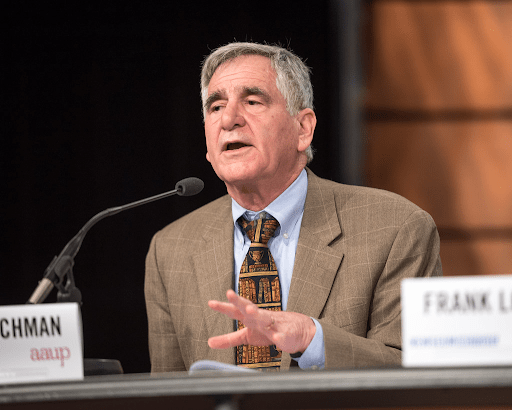
Dr. Henry Reichman conducted a virtual discussion on academic freedom in connection with the American Association of University Professors on Tuesday, Oct. 26, 2021.
On Tuesday, Oct. 26, Dr. Henry Reichman presented a Zoom discussion on academic freedom, a topic vital to the integrity of any institution of higher education. Dr. Reichman is the former American Association of University Professors (AAUP) Vice President and president of the AAUP Foundation, as well as the chair of AAUP’s Committee A on Academic Freedom and Tenure from 2012-2015. The event, organized by Dr. Barbara Allen and Dr. Joel Garver, garnered widespread attendance from students, staff and faculty members across all disciplines and from other universities.
In 2019, Dr. Reichman published his book “The Future of Academic Freedom,” which served as the backdrop for this conversation. He explained the terms of academic freedom, making sure to clarify common misconceptions, and offered his perspective on the current biggest threats to academic freedom.
Academic freedom is a concept belonging to the academic profession as a whole that protects the pursuit of inquiry. It guarantees to both faculty members and students the right to engage in debate without fear of censorship. In Dr. Reichman’s words, it “functions ultimately as the collective freedom of the scholarly community to govern itself in the interest of serving the common good in a democratic society.”
It is not, however, a civil liberty akin to freedom of speech; it cannot be classified as simply an employment benefit. Rather, it refers to the collective freedom of the faculty to govern itself as it sees fit, thereby promoting an environment in which academic inquiry is protected. It doesn’t allow a professor to do or say whatever they want without limit or accountability.
It does, however, protect a professor’s comments as a citizen even on topics that have nothing to do with their discipline. Such protection is essential to a healthy institution of higher education. Take, for example, the case of Dr. Arthur Butz, an electrical engineering professor at Northwestern University. In 1975, Dr. Butz published “The Hoax of the Twentieth Century: The Case Against the Presumed Extermination of European Jewry.” Dr. Butz’s Holocaust denial was met with harsh criticism from both his fellow faculty and the public at large.
Many called for his resignation as a professor, decrying his blatantly anti-Semitic beliefs. Academic freedom, however, protects Dr. Butz’s right to publish this Holocaust denial book insofar as it does not affect his fitness to do research in and teach electrical engineering. Had Dr. Butz been a professor of 19th- and 20th-century history, for example, as Dr. Reichman was, then there would certainly be an argument that his beliefs about the Holocaust could affect his ability to do his job, and therefore academic freedom would not protect him. However, given his stature as a professor in engineering, Dr. Butz was allowed to publish such a book and keep his job.
The example of Dr. Butz is extreme, but nonetheless, academic freedom provides for an open environment for discussion within academic institutions. However, one of the most troubling trends in higher education, according to Dr. Reichman, is the tendency to misunderstand the concept of academic freedom; such a misunderstanding could prove to be dangerous to the liberties that such a concept seeks to protect. As with any debate on freedom, the question of responsibility arises: with great freedom comes great responsibility. Dr. Reichman argues that the responsibility refers not to using academic freedom with trepidation out of concern of backlash or censorship. Rather, there is a responsibility to protect this freedom, lest the integrity and functionality of academic institutions be jeopardized — “in academia, we have a collective responsibility to each other, our students, and the diverse common good in a democratic society.”
Toward the end of Dr. Reichman’s explanation of academic freedom, the floor was opened up to questions from audience members. One faculty member asked a question regarding intellectual property with respect to professor-created content: who owns the content we create for teaching? Dr. Reichman replied by saying that it belongs to the professor. The professor may retain their right to sign the rights of that intellectual property over to a publisher, for example, but since the faculty member is the one who created the material, it ultimately belongs to them.
In the age of Zoom University, this question has become more relevant than ever; professors were required to move their entire courses online, demanding them to record lectures and develop virtual manipulatives, among other adjustments. The answer to the question of to whom do these materials belong remains unclear, but the AAUP states that they should belong to the faculty member who created them.
There was another question about the rights of the administration of a university to choose and have access to learning management systems (LMS), such as Canvas or Blackboard. According to Dr. Reichman, faculty members should be consulted in all decisions related to the university, especially those which directly impact teaching and learning. Therefore, the faculty should have a say in which LMS are used as well as the terms of access by the administration. Ultimately, faculty members should have the right to actively debate and vote on decisions made by their university that will affect their abilities to carry out their jobs. After all, “where academic freedom is not protected, shared governance will be a scam,” according to Dr. Reichman.
 The La Salle Collegian