Why neither party is supporting a candidate for the 2022 PA senate race

Politics, state politics

Aidan Tyksinski, staff

Header Image: Generals International

Why neither party is supporting a candidate for the 2022 PA senate race

While the 2022 Pennsylvania Senate race is one of the most discussed midterm races in the nation, it seems that two major players in the race are willing to stay uninvolved for the time being. Both the Pennsylvania Republicans and Democrats are unwilling at this point to throw their support behind any candidate fighting for soon-to-be-former Senator Pat Toomey’s seat. While both parties have a good reason not to do so at the moment, some candidates need these nominations more than others. 

For the Democratic party, there are a couple of reasons that no candidate has support, the biggest being that the pool of candidates is currently too big. For any Democratic candidate to get a nomination, they need at least two-thirds support from the committee. When the committee held this vote over a week ago, there were four frontrunners: John Fetterman, Val Arkoosh, Connor Lamb and Malcolm Kenyatta. The number of frontrunners recently shrunk by one due to Arkoosh dropping out of the race late last week. 

Out of the three leading candidates, it seems that most of the Democratic Committee is torn between Fetterman and Lamb. Fetterman, the more progressive of the two, has gotten more donations than any other candidate in the party. However, it seems that many members of the committee feel that Fetterman’s message might not create a lot of turnouts in the very purple state, and view Lamb as a moderate whose message could swing the seat back under Democrats’ control. During the voting for the nomination, 159 members endorsed Lamb, 64 members endorsed Fetterman and Kenyatta got 49. A candidate must get 176 votes for the nomination.

For the Republicans, the reason for not picking a nomination is much simpler: there is currently no clear front-runner in the race. The two current front-runners, Dr. Mehmet Öz and David McCormick, both joined the race very recently and have no experience running a political campaign. With this seat as valuable as it is, the Pennsylvania Republican Committee seems to be playing it safe until after the primary, when there will be a clear candidate for the November election.As it stands, either McCormick or Öz could win the primary in May. Using their deep pockets, both candidates have created attack ads against each other and the Democratic party. Both have also accused each other of having ties to foreign countries, with McCormick also throwing around the idea that Öz’s ties in Hollywood will not make a good senator for Pennsylvania. The party is not the only main player staying silent on the race. Former President Trump, whose advisors say is paying close attention to the open seat, has been silent on the race ever since the candidate he supported, Sean Parnell, dropped out in November of last year. In the coming weeks and months, it will be interesting to see if more candidates fall out of the race, and which party will back a candidate first.

Pennsylvania joins at least twenty-five other states in raising the minimum wage by 2024

Politics, state politics

Jada Urbaez, Staff

Pennsylvania joins at least twenty-five other states as they all raise the minimum wage for state workers this year. Effective last Monday, Jan. 31, 2022, the minimum wage for Pennsylvania state workers increased to $15 per hour. 

Back in 2018, Pennsylvania Governor Tom Wolf proposed that the minimum wage would increase annually by $.50, which would have been on track to pay workers $15 per hour by the year 2024. Pennsylvania has sped up the process and is two years early, considering it is only 2022 and the wage has increased tremendously. 

State workers will exclusively receive these benefits for the time being, not the general public. State workers include any individual that is employed by the Pennsylvania government such as workers at the Department of Motor Vehicles or other government services. 

The minimum wage for other workers remains at $7.25, which has not changed in 13 years. The last notable increase took place in 2008, when it raised from $6.25 per hour to $7.15 per hour. Then, in 2010, it went up by .$10, to where it is now at $7.25 per hour. Governor Wolf says that the standstill in the hourly pay rate is “an embarrassment” and plans to increase it drastically to $12 by July 1, following a $.50 raise annually. That is… if the majority Republican Pennsylvania General Assembly follows through with the governor’s goals for the state’s citizens. 

Pennsylvania currently sits at the 30th state in the United States in terms of the highest offered minimum wage. The federal minimum wage sits at $7.25 per hour, which is the current minimum wage not only in Pennsylvania but in other states including Oklahoma, Kansas and Idaho. Two adults with no children’s poverty wage is $8.29 an hour, by comparison.

The recent discussions around the nation regarding the pros and cons of raising wages have caused much disagreement and back and forth amongst people. Many express that increasing pay rates would result in higher prices of goods and services, which could possibly lead to hyperinflation. Others think this is untrue, and providing workers with a liveable wage could mean raising income for workers so they could afford day-to-day expenses, be financially stable and stress-free, which, in their opinion, far outweighs the possibility of rapid inflation.

Tensions and preparations increase in the Russia-Ukraine situation

international politics, Politics

Elizabeth Boyle, Staff

The movement of troops and rising tensions between Russia and Ukraine have recently gained a broad global audience. Currently, there are 100,000 Russian troops sitting outside the Ukrainian border, and President Joe Biden has raised concerns about an invasion in the near future. 

The United Nations Security Council had a meeting on Jan. 31 to discuss the security concerns. During the meeting, the U.S. and Russia went back and forth with each country accusing the other of provoking violence and raising tensions. President Biden spoke in full support of the meeting, saying, “[the meeting] was a critical step in rallying the world to speak out in one voice.” Putin was not supportive of the meeting and described it as a “PR stunt.”

Russian Ambassador to the United Nations Vasily Nebenzya argued that, by the U.S. speaking out about and preparing for Russia to invade Ukraine, the U.S. caused the situation to escalate. He believed it was the U.S.’s goal to provoke Russia. Nebenzya said, “our Western colleagues are talking about the need for de-escalation. However, first and foremost, they themselves are whipping up tensions and rhetoric and are provoking escalation. The discussions about a threat of war are provocative in and of themselves.” 

The U.S. Ambassador to the U.N., Linda Thomas-Greenfield, then accused Russia of providing false information with the goal of portraying Ukraine and the West as a threat to Russia. Thomas-Greenfield accused Russia of “attempting, without any factual basis, to paint Ukraine and Western countries as the aggressors to fabricate a pretext for attack.” She then mentioned the 100,000 troops currently positioned at Ukraine’s border.

President Biden has met with Tamim Bin Hamas Al Thani, the ruling Sheikh of Qatar. They discussed global energy supplies in case Europe needs energy if supplies are damaged by a Russian attack on Ukraine and the use of natural gas as a blackmail tool against Western Europe. Russia provides 40 percent of the natural gas used in Europe. The gas is currently transported from Russia through Ukraine to the rest of the continent, and, with a potential invasion, these lines could be disrupted. This disruption could also cause the prices of energy to rise globally.

Poland has been communicating with Ukraine and trying to help Ukraine as much as possible. Polish President Andrzej Duda met with Ukrainian President Volodymyr Zelenskyy and President Biden to talk about potential options in the situation. Duda offered thousands of rounds of ammunition to Ukraine for use in its defense. Ukraine has not yet replied to the offer.

Ukrainian citizens are also concerned about the potential of a Russian attack. Civilians have begun any type of training they can get in order to prepare themselves for self-defense. Many citizens are working on guerilla-style fighting techniques. The far-right group known as Azov worked with the National Corps to give military training to volunteers teaching them self-defense. The group has adopted the slogan “Do not panic, get ready!”

The commander of the Azov Battalion, Maxim Zhorn, said in an interview, “today, we are talking about the Russian Federation’s plan for a new attack against Ukrainian territories, and at the same time we are talking about the absolute ineffective actions of the [Ukrainian] government and that is why we took it upon ourselves to start training the civilian population.”

Hundreds of people showed up hoping to receive training. A similar group, run by Svetlana Putilina, trains women, predominantly Muslim women, in Kharkiv, on proper handling and use of military equipment. The women work on aiming, loading and firing various types of weapons including automatic rifles. The city of Kharkiv is only 25 miles from the border with Russia and the citizens there are concerned they could be one of the first targets. 

Biden prepares to make history by appointing the first Black woman to the U.S. Supreme Court

national politics, Politics

Rachel Phillips, Staff

After 28 years on the Supreme Court, Justice Breyer has announced his retirement and will officially step down at the end of the current term, occurring in late June or July of 2022. Over the years, Breyer has been known as a moderate on the Court, with his history of voting only indicating a slightly more conservative outlook than his Democratic peers. However, following the death of Ruth Bader Ginsberg, Breyer became the Court’s senior liberal, and his soon-to-be-vacant seat presents an opportunity for the Biden administration to introduce a potentially more progressive candidate. While the new Justice will not change the current 6 to 3 ratio of conservative to liberal judges in the Supreme Court, it does ensure that the seat will be filled by a Democratic preferred candidate who could potentially serve for decades. The timing of Breyer’s retirement also confirms that the seat will not be vacated during a future, potentially Republican, administration, where their chosen candidate could further sway an already conservative court majority. President Biden has yet to decide on his nominee, but the predicted timeline indicates the name could be announced as quickly as the end of February 2022. Democrats have adamantly stated they expect an efficient search and transition, hoping to parallel the speed of Republicans during the Amy Coney Barrett nomination in October of 2020.

The President is also hoping to deliver on a promise he made during his 2020 presidential campaign. Like the pledges of both Ronald Reagan and Donald Trump,  who vowed to nominate women, President Biden is planning to nominate the first Black woman to the U.S. Supreme Court. Currently, the front runners include Judge Ketanji Brown Jackson of the U.S. Court of Appeals for the D.C. Circuit, California Supreme Court Justice Leondra Kruger, Judge Candace Rae Jackson-Akiwumi who serves on the U.S. Court of Appeals for the Seventh Circuit and Judge J. Michelle of the U.S. District Court for the District of South Carolina. This list, however, is likely to expand in the coming weeks, as President Biden has stated that he is preparing to meet with an increasing number of nominees, as well as consult with lawyers, scholars and Vice President Kamala Harris throughout the decision process. In addition, Biden is also willing to hear suggestions from senators of either party regarding potential candidates. While the response to President Biden’s search criteria has drawn the criticism of many Republican leaders and accusations of “identity politics,” it is unlikely his position will change. Jen Psaki, Biden’s press secretary, confirmed during a White House briefing that “the President has stated and reiterated his commitment to nominating a Black woman to the Supreme Court and certainly stands by that.”

Canadian vehicle protest, “Freedom Convoy,” blocks essential U.S.-Canadian port over Canadian vaccine mandates

international politics, Politics

Ceara Grady, Staff

Header Image: Rebel News

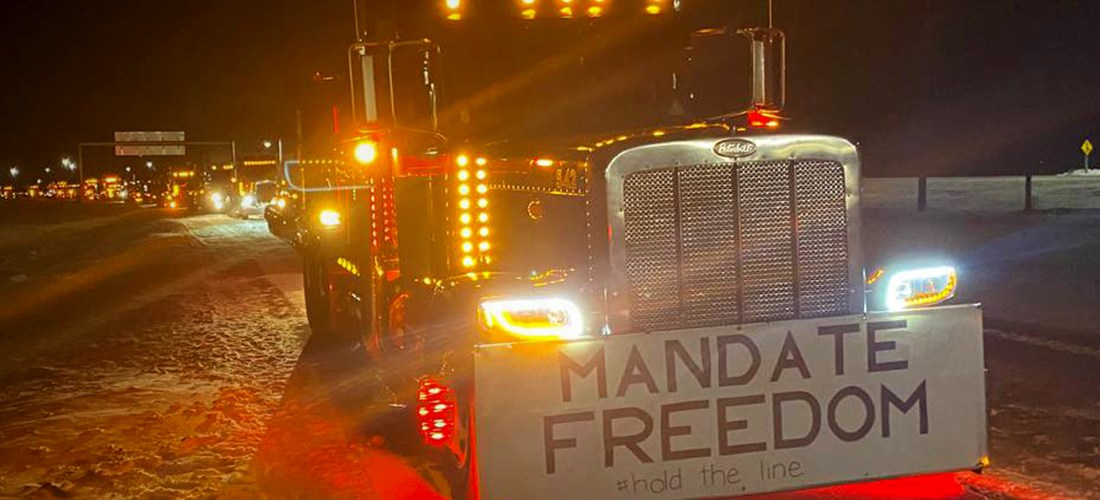
A vehicle blockade has been built at one of the busiest ports of entry between the United States and Canada in support of what has come to be known as the Freedom Convoy.  The Freedom Convoy started as an assembly of Canadian truckers protesting a new Canadian COVID-19 mandate that requires unvaccinated truckers to quarantine and be tested after returning from any trips to the United States.

Since then, the movement has evolved to protest all of Canada’s vaccine mandates and other COVID-related restrictions. Prime Minister Justin Trudeau has said that he has no plans to engage or comply with the Freedom Convoy and their demands, saying, “my focus is standing with Canadians and getting through this pandemic”.

Additionally, a change in Canadian policy wouldn’t resolve the protestors’ objections, because the United States made vaccinations mandatory for Canadian truckers entering the United States at the end of January. Meanwhile, the blockade extends for miles from the entry port along the main highway, even extending into surrounding neighborhoods. The disruption of the line-up of trucks in these neighborhoods has blocked residents’ access to necessities like the grocery store and has even impacted services like postal delivery and school bus routes. 

On the United States’ side of the port in Montana, officials have started to turn away people trying to cross into Canada. The Freedom Convoy also protested outside of Canada’s Parliament in a massive but relatively peaceful demonstration. Despite this, there are concerns that the protests could turn violent and become more invasive. Such fears have caused Prime Minister Trudeau and his family to leave their official residence out of an abundance of caution, though he has and continues to emphasize that this coalition of truckers represents a small minority, as 90 percent of Canadian truckers are vaccinated. 

The Freedom Convoy has raised over $7 million through its GoFundMe campaign, which officials are taking as a sign that the protesters don’t plan to disband soon. Additionally, influential United States public figures like former President Donald Trump and Elon Musk have come out in support of the Freedom Convoy and its mission. There have also been reports that a similar group of protestors could make a cross-country trip, from California to Washington D.C., to protest similar COVID-19 vaccination rules for American truckers. 

Among safety and public health concerns, officials are also worried about the impact this blockade will have on both the Canadian and American economies, particularly as both are still working to recover from the height of the pandemic. Supply chain issues have been plaguing both economies due to complications in starting industries back up after reduced COVID-19 restrictions, but this blockade at the border and strike of truckers will continue to exacerbate those issues. 

Breakdown of the Pennsylvania Senate race

Politics, state politics

Aidan Tyksinski, Staff

In less than 10 months’ time, the Pennsylvania state midterm elections will be upon us, and while this election may not be the most important election to some, it certainly will be the most symbolic of where Americans stand today politically at this time. The frontrunners to take former Senator Pat Toomey’s seat are a progressive from Reading, a physician from Montgomery County, a former Marine from Pittsburgh, a former TV-host-turned-politician and a politician-turned-billionaire hedge fund owner. On that note, let’s put a face to these candidates.

Democratic Candidates  


FT

John Fetterman

As the frontrunner for the 2022 Pennsylvania senate seat, Fetterman’s 6’9 size makes him seem more like a basketball player than a politician. He got his start in politics by becoming the mayor of Braddock, a small town outside of Pittsburgh. He then became Lieutenant Governor of PA, where his political status blossomed. During his time in this role, Fetterman pushed hard for LGBTQ+ equality and the legalization of marijuana. At one point in 2019, Fetterman went around to all the state’s 67 counties and created a survey that asked people their thoughts on marijuana’s legalization. According to his campaign website, Fetterman also supports a $15 minimum wage, a single-payer healthcare plan, clean energy and the Black Lives Matter movement.

TheDP

Val Arkoosh

Arkoosh has gotten the third-most donations for Democratic Candidates ($2.1 million) in this race. A physician and chair of the Montgomery County Board of Commissioners, Arkoosh has campaigned to fix problems using a scientific approach. In her campaign message, Arkoosh specifically says she will fight climate change, help push for COVID-19 safety measures and support upholding Roe v. Wade. Specifically, Arkoosh wants to codify Roe v. Wade, which would let Congress protect a women’s right to choose instead of the Supreme Court. In fighting climate change, Arkoosh promises to end fracking and push more companies to use renewable energy. Arkoosh also wants to reform immigration into the United States, create a fairer justice system and pass what she refers to as common sense gun laws.

U.S. House of Representatives

Conor Lamb

Lamb, who has been labeled as a moderate by the national media, got the second-most donations thus far ($2.6 million). Lamb, a former marine, federal prosecutor and vice-chair of the Veterans’ Affairs Committee while in Congress, has talked about several key issues on his agenda if elected to the position. Lamb, like Fetterman, is a supporter of a $15 minimum wage and a supporter of LGBTQ+ rights. He also, like Arkoosh, is running on a pro-choice platform. Lamb also wants to reform or eliminate the filibuster if he is elected and has taken a hard stance for Israel to defend itself from attacks by enemies.   

Republican Candidates


The Guardian

Dr. Oz

Mehmet Öz is known by most Americans as Dr. Oz, the former daytime television host turned politician. Oz, a heart surgeon who graduated from the local University of Pennsylvania, announced late last year that he was running for PA Senate, the first political campaign he has ever run. Oz’s main focus is on COVID-19 reform. On his website and in his campaign ads, Oz has stated that politicians got COVID-19 wrong and has been adamant that schools should not close due to the pandemic. Oz, like Conor Lamb, made it clear he supports Israel and has pushed for healthcare reform through the private sector. He is also against energy regulations, is pro-life and has stated on his website that he will protect the constitutional rights of law-abiding gun owners.

Pa. Senate GOP primary fight over candidate's business record
NYPost

David McCormick

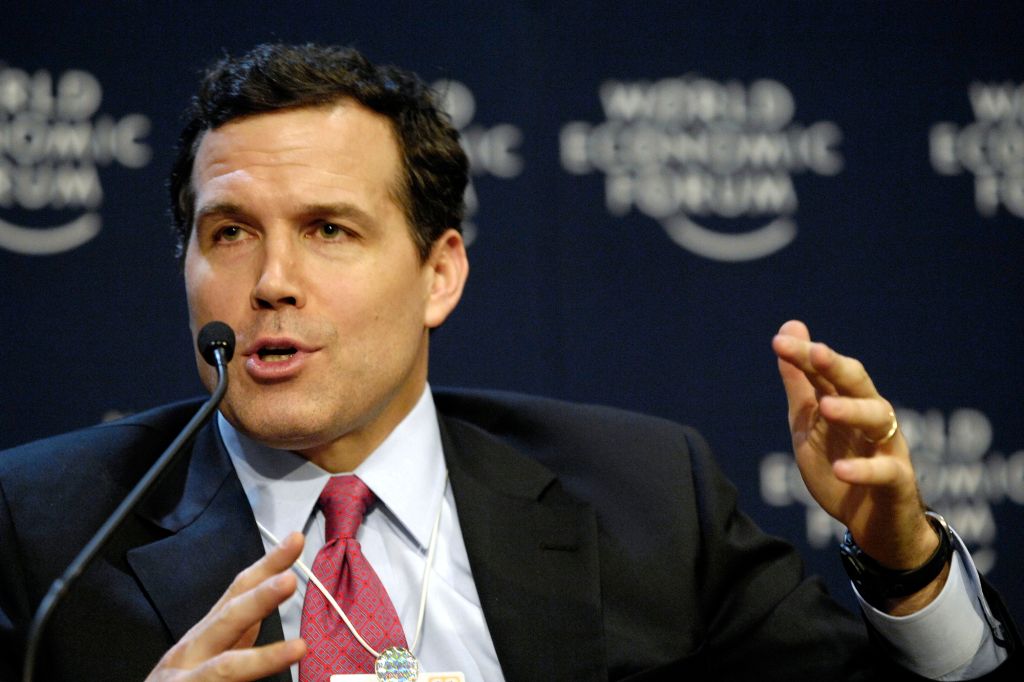
McCormick is the most recent candidate to announce the start of his campaign, making his announcement in the middle of January. McCormick, like Oz, has no experience of ever running a campaign, but he has much more political background than Oz. McCormick, a U.S. Army veteran who fought in the first Gulf War, had several roles in the Bush administration from 2005 to 2009 and was at one point the Deputy National Security Advisor for International Economic Affairs. He was considered for a couple of cabinet roles during the Trump administration, but never got the jobs. McCormick, who most recently was CEO of the biggest hedge fund in the world, Bridgewater Associates, has announced he is running his campaign against “wokeness, weakness and the radical left.”

NATO on standby as Russia places troops on Ukrainian border

international politics, Politics

Danielle O’Brien, Editor

An estimated 100,000 Russian troops are currently poised at the Ukrainian border, ready to invade the country. Tensions are high as the threat of Russian invasion in Ukraine comes only less than a month into the new year. Vladimir Putin denies allegations that Russia will in fact move in on Ukraine, however, the mass of soldiers at Ukraine’s border tells otherwise. The threat of invasion comes just a month after President Biden and Putin met via video call to discuss the repercussions Russia can expect if it does invade Ukraine. 

The threat is due in part to the refusal of Russian demands for the pulling of NATO from Ukraine, and to avow never to admit Ukraine into joining the organization. NATO’s refusal to do so is sparking Putin’s outrage. Instead of the intended purpose of placing Russian troops at the border to pressure NATO in retracting its presence in Ukraine, it has had the rather opposite effect. In fact, aside from the arms and troops already placed in Ukraine, NATO is reported as sending more military support such as ships and fighter jets to Ukraine. The U.S. plans to contribute 8,500 American troops to Ukraine which is currently on standby for deployment. It is important to note, however, that this was not the desired outcome for President Biden. 

In his meeting with the Kremlin in December, Biden took a more diplomatic path to resolve the issue, warning that harsh sanctions from the U.S. towards Russia will be put in place to deter Russia from invading. Sanctions, however, may be an unfulfilling threat towards Russia. President Biden is familiar with the effect of U.S. sanctions against Russia, considering he witnessed the invasion of Ukraine by Russia in 2014 while he was vice president, where sanctions against Russia had been put in place with little effect. One of the more promising things threatened to be sanctioned which may have a larger effect on the Russian economy is the Nord Stream 2, a natural gas pipeline between Russia and Germany. In this way, Germany’s sanction of this economic powerhouse for the two countries might encourage Russia to rethink its next steps.  

Russian influence has remained apparent in Ukraine considering it was once a part of the Soviet Union. Since its removal from the Soviet Union, Ukraine has had the freedom to make great democratic leaps. In 2016 it joined in agreement with the European Union, Georgia and Moldova to create the Deep and Comprehensive Free Trade Areas (DCFTA). DCFTA established the three countries as common grounds of free trade. Furthermore, in 2019, Ukraine amended its constitution, putting it on track to becoming a formal member of the EU. Unfortunately, however, the credible organization for measuring democracy since 1941, Freedom House, would establish that there is still much improvement to be made in Ukraine as it is not even considered a full democracy. According to Freedom House’s 2021 democracy scores, Ukraine received a 39 out of 100, establishing it as a Transitional or Hybrid Regime. This scoring is due in part to the submission of the Ukrainian government to the aggression witnessed by the Russian government in threats of military invasions such as the one we are witnessing now. A La Salle professor in the political science department with a special interest in Ukraine, Dr. Mark Thomas, provided a statement on the situation. Thomas has an impressive background in many high-profile jobs including experience as an operations specialist for the U.S army in Eastern European countries as well as receiving a NATO medal for Kosovo Forces in 2014. 

Thomas stated, “The situation at the border is undoubtedly one of concern. Putin’s demands that NATO pledge in writing not to allow Ukraine to accede is one which NATO cannot make given it opened Pandora’s box when it admitted former Warsaw Pact members into NATO in the 1990s, which violates a verbal promise by then-Secretary of State Jim Baker to Eduard Schevardnadze. It was never put in writing and the U.S. and NATO relied on a statement in the Helsinki Accords which stated every country had the right to choose which alliance to belong to. Putin’s second demand for NATO to withdraw its forces from the NATO members on Russian borders places NATO at risk of undermining its alliance commitments and causing members to lose their faith in NATO. I warned my NATO bosses in 2016 that placing troops in the Baltics and Poland was the first step in walking NATO into a direct confrontation with Russia. NATO expansion and placing troops, even on a rotating basis as done through the NATO Assurance Measures, go against the basic Russian strategic objective to avoid encirclement by a hostile power. So I understand the fears Putin is using to justify the confrontation. That said, Ukraine poses no significant military threat to Russia.  Ukraine poses an existential threat. Having another democratic country on its borders, especially one which has such historical, cultural, and linguistic ties to Russia risks a potential contagion effect on the Russian populace. Every authoritarian leader is looking over his/her shoulder for threats to his control.  There is one Russian strategic concern that mitigates against a full-fledged invasion: Prevent destruction of the homeland and avoid Russian casualties.  

A full-fledged invasion of Ukraine would be costly in terms of casualties. Even with its involvement in Donetsk and Luhansk and Crimea, Putin has avoided putting ethnic Russians in significant harm’s way.  He and his generals have in the back of their minds what happened in their invasion of Afghanistan in the 1980s and what happened in Chechnya in the 1990s. Both had a significant toll on support for the regimes.

In practical terms, the former Ukrainian defense minister from 2019 to 2020, Andrii Zahorodniuk, made an astute observation that he does not believe Putin will invade Ukraine.  Amidst the 120,000 troops on the Ukraine/Russia border, there is not the logistics, notably not the medical supplies to support an invasion.  

Also, China does not want Russia to steal the spotlight in the coming month.  China, as Russia’s closest ally, wants the world focused on the Winter Olympics.  Xi made a comment early this week that power is more than using force to accomplish influence.  This was as much oriented at Biden as it was at Putin.

All that said, Russia and the U.S. are playing a game of brinkmanship to see who blinks first. Both are likely seeking a way out without a confrontation. It is possible Russia will seize a zone between the Donbas and Crimea so Crimea has access to freshwater, which comes from either Russia or historically from Ukraine. The U.S./NATO response could be less than what Biden said would be serious sanctions”.

Following Dr. Thomas’s analysis, it is clear that Russia, following the dissolution of the Soviet Union, is clinging to any ties it still has in countries such as Ukraine. Russia dreams to recover its lost ground in reunifying former Soviet countries back into a communist power to challenge the democratic ideals of the West. Whether the United States and Europe will allow Russia’s dream to come true, however, remains up to time to tell.

Dr. Oz — the Politician?

local politics, Politics

Jada Urbaez, Staff

When someone mentions Dr. Oz, does the Pennsylvania Senate come to mind? Probably not, since Dr. Oz is popularly known for his 13-season health show that began in 2009. 

The Dr. Oz Show was a daytime television talk show first aired in 2009 and the last episode was just under two weeks ago, Jan. 14, 2022. The show discussed health issues and the Dr. Oz gave explanations and sometimes advice. The sudden shift to politics may raise eyebrows due to his popular background of medicine. 

Dr. Mehmet Oz announced in Nov. 2021 that he plans on running for the open Republican seat for the PA Senate. Until recently, Dr. Oz’s political views were mostly unknown since the TV personality did not profess his opinions publicly. However, FOX News has recently hosted Dr. Oz on their show numerous times, including once where the physician shared his opinion on COVID-19 closings and precautions. 

As many schools have switched to online instruction, there is a divide within communities on whether it would be best to keep the schools closed to prevent the spread of COVID-19, or to reopen them. Some may argue it is safe, effective and ideal to have students attend school virtually to prevent infection and possibly death. Others think attending school in person has many benefits that outweigh the risks of spreading the coronavirus disease. 

Restaurants, arenas, stores, and malls were also closed due to the health crisis and caused distress to the public. Similar to the closing of schools, people had opposing and passionate opinions about when and how to resume everyday activities. In 2020, Dr. Oz expressed on FOX News that he thinks some facilities should reopen and can be done without “getting into a lot of trouble.” At the time of this interview, schools around the United States had been recently closed for about three weeks. Dr. Oz continued by saying that opening schools would likely result in a 2-3 percent mortality rate, which “might be a trade-off some folks would consider.” 

After his FOX interview, many people criticized Dr. Oz for his comments, some taking offense and strongly disagreeing. Due to his comments causing controversy, Dr. Oz published an apology video to Twitter, admitting his choice of words may have “upset people” and he had “misspoke”. The general election takes place on Nov. 8, 2022 while the primary election falls on May 8, 2022. Registered voters in Pennsylvania will elect a member of the United States Senate, and every vote counts. Make sure to register to vote, as PA does not engage in automatic voter registration.

Tensions rising in Asia, Biden meets with Tokyo Prime Minster

international politics, Politics

Elizabeth Boyle, staff

On Jan. 21, 2022, President Joe Biden talked virtually with Japanese Prime Minister, Fumio Kishida, who was in Tokyo. They discussed two major concerns: China’s growing presence in the South China Sea: and, the rising tension between China and Taiwan. 

The South China Sea is a well-traveled commercial route and as such, it is patrolled by Naval ships from multiple countries including the U.S and China. Chinese Foreign Ministry spokesman Wang Wenbin reiterated on Jan. 13, 2022, that China believes it has the right to complete sovereignty of the South China Sea. Wang said, “China has historical rights in the South China Sea. China’s Sovereignty and related rights and interests in the South China Sea have been established in a long period of history and are consistent with international law.” 

The U.S. does not have an official position concerning China’s claims but has long held that is has the right to operate its Navy in the waters because they are classified as international. After Wenbin spoke, the U.S. replied saying China was not allowed to claim maritime zones by trying to label an island group as its territory and extending its national waters beyond the island as it is “not permitted by international law.” The U.S. has military bases in South Korea, Japan, and Guam which provides a large military presence in the region. A presence which China as, the self-considered dominant Asian power, resents and wants to undermine and scale back. For its part, Japan wants to continue a robust U S naval presence in the South China Sea and has expressed interest in enhancing its own naval presence in the area to accentuate its commitment to encumbered commercial shipping throughout the area.

China’s military incursions into Taiwan’s airspace have also drawn Japanese and US concern. Because China wishes to have complete control over the South China Sea that would include Taiwan, China has built military facilities on man-made islands In the South China Sea in order to extend its operational reach and put pressure on Taiwan. Taiwan has been made uncomfortable by Chinese warplanes flying through Taiwan’s air defense identification zone. In October of 2021, the flights hit a record of 149 total flights in just four days. 

The U.S. regularly holds military exercises in the South China Sea to demonstrate the military presence and practice military techniques. The U.S. does not have bases in Taiwan, but U.S. military forces including Navy, Marine, Army, and special forces train with Taiwan’s forces on a regular basis. The U.S. has extended military support for Taiwan “based on an assessment of Taiwan’s defense needs and the threat posed by” China, said Pentagon spokesman John Supple, but the U.S. does not have a formal treaty that commits it to defend Taiwan.

What prompted the need for communication between Tokyo and Washington, beyond the tension with China which has been an ongoing issue, was news from North Korea that they may be resuming long-range nuclear missile testing. This news was disconcerting because North Korea had halted missile testing for the past three years. Kim Jong Un was in a Politburo meeting this past week for the ruling Workers’ Party. The goal of the meeting, as stated by North Koreans was to discuss increasing their military capabilities because of the recent “hostile moves” by the U.S.

President Biden assured Prime Minster Kishida that the U.S. would be in contact with South Korea to address the rising threat. Biden accepted Kishida’s Invitation to the Quad Summit, which is a meeting between the U.S., Japan, Australia, and India. Biden has also promised to share more information about North Korean missile testing with the American people in the days to come. 

The fight for voting rights continues as the vote for bill is blocked for a second time 

national politics, Politics

Rachel Phillips, staff

On Wednesday, Jan. 19, 2022, Democrat senators made a second attempt at passing amended voter legislation laws, the “Freedom to Vote Act” and the “John Lewis Voting Rights Act”. Following the dismissal of their initial bill entitled the “For the People Act,” unsigned by all fifty Republican senators and two interparty members, Senator Kyrsten Sinema of Arizona and Senator Joe Manchin of West Virginia, Democrats believed the new two-bill proposal could offer a potential compromise. The new legislation -whilst not as comprehensive as the preceding bill- included adjustments to current voting laws and increased nationwide access to both voting and the registration process. Furthermore, the “Freedom to Vote Act” promised to reverse restrictive policies that had been enacted in 19 states in the past year. “The John Lewis Voting Act” would strengthen federal policies regarding election cases. This included requiring all states with previous histories of discriminatory voting practices to seek clearance from the federal government before implementing any state-wide voting law. However, despite the bill’s passage in the House, Wednesday’s vote resulted in the same stalemate as the initial bill, vetoed by the same people in the Senate. Both Democrats Sinema and Manchin voted against the new proposals, as did all fifty Republican senators. The verdict was ultimately disappointing to both Democrat leaders and voters, as well as the President himself, who has remained adamant about the necessity of voter reform since the bill’s inception. But despite the loss, Democratic majority leader and Senator of New York, Chuck Schumer, remains hopeful for the future of voter security and accessibility. In an interview conducted a day after the vote, Schumer expressed pride in his party and belief that such battles cannot be won in a single clash, particularly if more people do not see the necessity of the fight. Schumer  stated, “on civil rights, it is not linear. You’ve got to keep fighting. And they see that the Democrats really fought for something we believed in, even if we couldn’t win. It’s the fundamental backbone of this country — voting rights. But it’s also the core of our party.” Moving forward, it is likely Democratic leaders may segment the bills, so as to pass legislation incrementally. As of right now, however, the Democrats will need to regroup and reassess how and if the stalemate can be broken.