Breakdown of the Pennsylvania Senate race

Politics, state politics

Aidan Tyksinski, Staff

In less than 10 months’ time, the Pennsylvania state midterm elections will be upon us, and while this election may not be the most important election to some, it certainly will be the most symbolic of where Americans stand today politically at this time. The frontrunners to take former Senator Pat Toomey’s seat are a progressive from Reading, a physician from Montgomery County, a former Marine from Pittsburgh, a former TV-host-turned-politician and a politician-turned-billionaire hedge fund owner. On that note, let’s put a face to these candidates.

Democratic Candidates  


FT

John Fetterman

As the frontrunner for the 2022 Pennsylvania senate seat, Fetterman’s 6’9 size makes him seem more like a basketball player than a politician. He got his start in politics by becoming the mayor of Braddock, a small town outside of Pittsburgh. He then became Lieutenant Governor of PA, where his political status blossomed. During his time in this role, Fetterman pushed hard for LGBTQ+ equality and the legalization of marijuana. At one point in 2019, Fetterman went around to all the state’s 67 counties and created a survey that asked people their thoughts on marijuana’s legalization. According to his campaign website, Fetterman also supports a $15 minimum wage, a single-payer healthcare plan, clean energy and the Black Lives Matter movement.

TheDP

Val Arkoosh

Arkoosh has gotten the third-most donations for Democratic Candidates ($2.1 million) in this race. A physician and chair of the Montgomery County Board of Commissioners, Arkoosh has campaigned to fix problems using a scientific approach. In her campaign message, Arkoosh specifically says she will fight climate change, help push for COVID-19 safety measures and support upholding Roe v. Wade. Specifically, Arkoosh wants to codify Roe v. Wade, which would let Congress protect a women’s right to choose instead of the Supreme Court. In fighting climate change, Arkoosh promises to end fracking and push more companies to use renewable energy. Arkoosh also wants to reform immigration into the United States, create a fairer justice system and pass what she refers to as common sense gun laws.

U.S. House of Representatives

Conor Lamb

Lamb, who has been labeled as a moderate by the national media, got the second-most donations thus far ($2.6 million). Lamb, a former marine, federal prosecutor and vice-chair of the Veterans’ Affairs Committee while in Congress, has talked about several key issues on his agenda if elected to the position. Lamb, like Fetterman, is a supporter of a $15 minimum wage and a supporter of LGBTQ+ rights. He also, like Arkoosh, is running on a pro-choice platform. Lamb also wants to reform or eliminate the filibuster if he is elected and has taken a hard stance for Israel to defend itself from attacks by enemies.   

Republican Candidates


The Guardian

Dr. Oz

Mehmet Öz is known by most Americans as Dr. Oz, the former daytime television host turned politician. Oz, a heart surgeon who graduated from the local University of Pennsylvania, announced late last year that he was running for PA Senate, the first political campaign he has ever run. Oz’s main focus is on COVID-19 reform. On his website and in his campaign ads, Oz has stated that politicians got COVID-19 wrong and has been adamant that schools should not close due to the pandemic. Oz, like Conor Lamb, made it clear he supports Israel and has pushed for healthcare reform through the private sector. He is also against energy regulations, is pro-life and has stated on his website that he will protect the constitutional rights of law-abiding gun owners.

Pa. Senate GOP primary fight over candidate's business record
NYPost

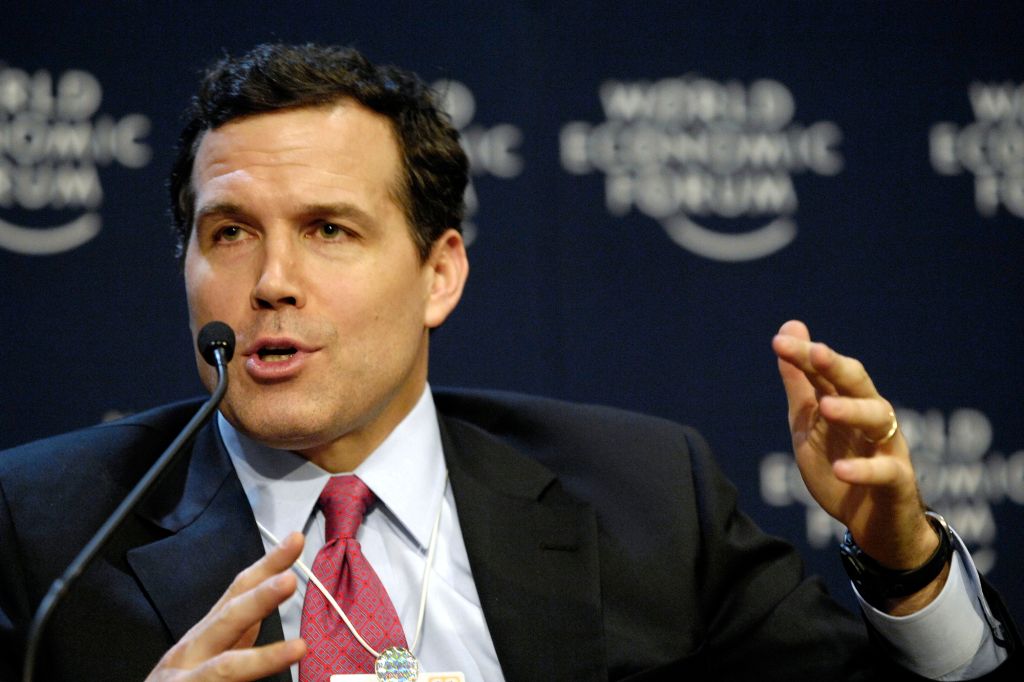
David McCormick

McCormick is the most recent candidate to announce the start of his campaign, making his announcement in the middle of January. McCormick, like Oz, has no experience of ever running a campaign, but he has much more political background than Oz. McCormick, a U.S. Army veteran who fought in the first Gulf War, had several roles in the Bush administration from 2005 to 2009 and was at one point the Deputy National Security Advisor for International Economic Affairs. He was considered for a couple of cabinet roles during the Trump administration, but never got the jobs. McCormick, who most recently was CEO of the biggest hedge fund in the world, Bridgewater Associates, has announced he is running his campaign against “wokeness, weakness and the radical left.”

NATO on standby as Russia places troops on Ukrainian border

international politics, Politics

Danielle O’Brien, Editor

An estimated 100,000 Russian troops are currently poised at the Ukrainian border, ready to invade the country. Tensions are high as the threat of Russian invasion in Ukraine comes only less than a month into the new year. Vladimir Putin denies allegations that Russia will in fact move in on Ukraine, however, the mass of soldiers at Ukraine’s border tells otherwise. The threat of invasion comes just a month after President Biden and Putin met via video call to discuss the repercussions Russia can expect if it does invade Ukraine. 

The threat is due in part to the refusal of Russian demands for the pulling of NATO from Ukraine, and to avow never to admit Ukraine into joining the organization. NATO’s refusal to do so is sparking Putin’s outrage. Instead of the intended purpose of placing Russian troops at the border to pressure NATO in retracting its presence in Ukraine, it has had the rather opposite effect. In fact, aside from the arms and troops already placed in Ukraine, NATO is reported as sending more military support such as ships and fighter jets to Ukraine. The U.S. plans to contribute 8,500 American troops to Ukraine which is currently on standby for deployment. It is important to note, however, that this was not the desired outcome for President Biden. 

In his meeting with the Kremlin in December, Biden took a more diplomatic path to resolve the issue, warning that harsh sanctions from the U.S. towards Russia will be put in place to deter Russia from invading. Sanctions, however, may be an unfulfilling threat towards Russia. President Biden is familiar with the effect of U.S. sanctions against Russia, considering he witnessed the invasion of Ukraine by Russia in 2014 while he was vice president, where sanctions against Russia had been put in place with little effect. One of the more promising things threatened to be sanctioned which may have a larger effect on the Russian economy is the Nord Stream 2, a natural gas pipeline between Russia and Germany. In this way, Germany’s sanction of this economic powerhouse for the two countries might encourage Russia to rethink its next steps.  

Russian influence has remained apparent in Ukraine considering it was once a part of the Soviet Union. Since its removal from the Soviet Union, Ukraine has had the freedom to make great democratic leaps. In 2016 it joined in agreement with the European Union, Georgia and Moldova to create the Deep and Comprehensive Free Trade Areas (DCFTA). DCFTA established the three countries as common grounds of free trade. Furthermore, in 2019, Ukraine amended its constitution, putting it on track to becoming a formal member of the EU. Unfortunately, however, the credible organization for measuring democracy since 1941, Freedom House, would establish that there is still much improvement to be made in Ukraine as it is not even considered a full democracy. According to Freedom House’s 2021 democracy scores, Ukraine received a 39 out of 100, establishing it as a Transitional or Hybrid Regime. This scoring is due in part to the submission of the Ukrainian government to the aggression witnessed by the Russian government in threats of military invasions such as the one we are witnessing now. A La Salle professor in the political science department with a special interest in Ukraine, Dr. Mark Thomas, provided a statement on the situation. Thomas has an impressive background in many high-profile jobs including experience as an operations specialist for the U.S army in Eastern European countries as well as receiving a NATO medal for Kosovo Forces in 2014. 

Thomas stated, “The situation at the border is undoubtedly one of concern. Putin’s demands that NATO pledge in writing not to allow Ukraine to accede is one which NATO cannot make given it opened Pandora’s box when it admitted former Warsaw Pact members into NATO in the 1990s, which violates a verbal promise by then-Secretary of State Jim Baker to Eduard Schevardnadze. It was never put in writing and the U.S. and NATO relied on a statement in the Helsinki Accords which stated every country had the right to choose which alliance to belong to. Putin’s second demand for NATO to withdraw its forces from the NATO members on Russian borders places NATO at risk of undermining its alliance commitments and causing members to lose their faith in NATO. I warned my NATO bosses in 2016 that placing troops in the Baltics and Poland was the first step in walking NATO into a direct confrontation with Russia. NATO expansion and placing troops, even on a rotating basis as done through the NATO Assurance Measures, go against the basic Russian strategic objective to avoid encirclement by a hostile power. So I understand the fears Putin is using to justify the confrontation. That said, Ukraine poses no significant military threat to Russia.  Ukraine poses an existential threat. Having another democratic country on its borders, especially one which has such historical, cultural, and linguistic ties to Russia risks a potential contagion effect on the Russian populace. Every authoritarian leader is looking over his/her shoulder for threats to his control.  There is one Russian strategic concern that mitigates against a full-fledged invasion: Prevent destruction of the homeland and avoid Russian casualties.  

A full-fledged invasion of Ukraine would be costly in terms of casualties. Even with its involvement in Donetsk and Luhansk and Crimea, Putin has avoided putting ethnic Russians in significant harm’s way.  He and his generals have in the back of their minds what happened in their invasion of Afghanistan in the 1980s and what happened in Chechnya in the 1990s. Both had a significant toll on support for the regimes.

In practical terms, the former Ukrainian defense minister from 2019 to 2020, Andrii Zahorodniuk, made an astute observation that he does not believe Putin will invade Ukraine.  Amidst the 120,000 troops on the Ukraine/Russia border, there is not the logistics, notably not the medical supplies to support an invasion.  

Also, China does not want Russia to steal the spotlight in the coming month.  China, as Russia’s closest ally, wants the world focused on the Winter Olympics.  Xi made a comment early this week that power is more than using force to accomplish influence.  This was as much oriented at Biden as it was at Putin.

All that said, Russia and the U.S. are playing a game of brinkmanship to see who blinks first. Both are likely seeking a way out without a confrontation. It is possible Russia will seize a zone between the Donbas and Crimea so Crimea has access to freshwater, which comes from either Russia or historically from Ukraine. The U.S./NATO response could be less than what Biden said would be serious sanctions”.

Following Dr. Thomas’s analysis, it is clear that Russia, following the dissolution of the Soviet Union, is clinging to any ties it still has in countries such as Ukraine. Russia dreams to recover its lost ground in reunifying former Soviet countries back into a communist power to challenge the democratic ideals of the West. Whether the United States and Europe will allow Russia’s dream to come true, however, remains up to time to tell.

Dr. Oz — the Politician?

local politics, Politics

Jada Urbaez, Staff

When someone mentions Dr. Oz, does the Pennsylvania Senate come to mind? Probably not, since Dr. Oz is popularly known for his 13-season health show that began in 2009. 

The Dr. Oz Show was a daytime television talk show first aired in 2009 and the last episode was just under two weeks ago, Jan. 14, 2022. The show discussed health issues and the Dr. Oz gave explanations and sometimes advice. The sudden shift to politics may raise eyebrows due to his popular background of medicine. 

Dr. Mehmet Oz announced in Nov. 2021 that he plans on running for the open Republican seat for the PA Senate. Until recently, Dr. Oz’s political views were mostly unknown since the TV personality did not profess his opinions publicly. However, FOX News has recently hosted Dr. Oz on their show numerous times, including once where the physician shared his opinion on COVID-19 closings and precautions. 

As many schools have switched to online instruction, there is a divide within communities on whether it would be best to keep the schools closed to prevent the spread of COVID-19, or to reopen them. Some may argue it is safe, effective and ideal to have students attend school virtually to prevent infection and possibly death. Others think attending school in person has many benefits that outweigh the risks of spreading the coronavirus disease. 

Restaurants, arenas, stores, and malls were also closed due to the health crisis and caused distress to the public. Similar to the closing of schools, people had opposing and passionate opinions about when and how to resume everyday activities. In 2020, Dr. Oz expressed on FOX News that he thinks some facilities should reopen and can be done without “getting into a lot of trouble.” At the time of this interview, schools around the United States had been recently closed for about three weeks. Dr. Oz continued by saying that opening schools would likely result in a 2-3 percent mortality rate, which “might be a trade-off some folks would consider.” 

After his FOX interview, many people criticized Dr. Oz for his comments, some taking offense and strongly disagreeing. Due to his comments causing controversy, Dr. Oz published an apology video to Twitter, admitting his choice of words may have “upset people” and he had “misspoke”. The general election takes place on Nov. 8, 2022 while the primary election falls on May 8, 2022. Registered voters in Pennsylvania will elect a member of the United States Senate, and every vote counts. Make sure to register to vote, as PA does not engage in automatic voter registration.

Tensions rising in Asia, Biden meets with Tokyo Prime Minster

international politics, Politics

Elizabeth Boyle, staff

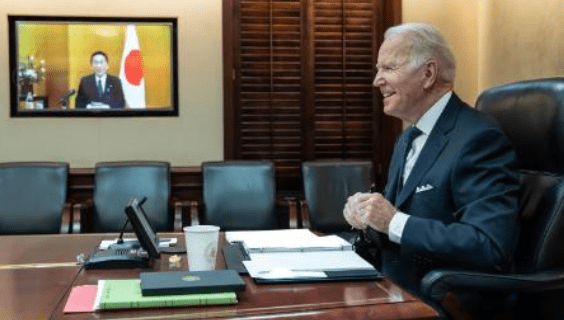
On Jan. 21, 2022, President Joe Biden talked virtually with Japanese Prime Minister, Fumio Kishida, who was in Tokyo. They discussed two major concerns: China’s growing presence in the South China Sea: and, the rising tension between China and Taiwan. 

The South China Sea is a well-traveled commercial route and as such, it is patrolled by Naval ships from multiple countries including the U.S and China. Chinese Foreign Ministry spokesman Wang Wenbin reiterated on Jan. 13, 2022, that China believes it has the right to complete sovereignty of the South China Sea. Wang said, “China has historical rights in the South China Sea. China’s Sovereignty and related rights and interests in the South China Sea have been established in a long period of history and are consistent with international law.” 

The U.S. does not have an official position concerning China’s claims but has long held that is has the right to operate its Navy in the waters because they are classified as international. After Wenbin spoke, the U.S. replied saying China was not allowed to claim maritime zones by trying to label an island group as its territory and extending its national waters beyond the island as it is “not permitted by international law.” The U.S. has military bases in South Korea, Japan, and Guam which provides a large military presence in the region. A presence which China as, the self-considered dominant Asian power, resents and wants to undermine and scale back. For its part, Japan wants to continue a robust U S naval presence in the South China Sea and has expressed interest in enhancing its own naval presence in the area to accentuate its commitment to encumbered commercial shipping throughout the area.

China’s military incursions into Taiwan’s airspace have also drawn Japanese and US concern. Because China wishes to have complete control over the South China Sea that would include Taiwan, China has built military facilities on man-made islands In the South China Sea in order to extend its operational reach and put pressure on Taiwan. Taiwan has been made uncomfortable by Chinese warplanes flying through Taiwan’s air defense identification zone. In October of 2021, the flights hit a record of 149 total flights in just four days. 

The U.S. regularly holds military exercises in the South China Sea to demonstrate the military presence and practice military techniques. The U.S. does not have bases in Taiwan, but U.S. military forces including Navy, Marine, Army, and special forces train with Taiwan’s forces on a regular basis. The U.S. has extended military support for Taiwan “based on an assessment of Taiwan’s defense needs and the threat posed by” China, said Pentagon spokesman John Supple, but the U.S. does not have a formal treaty that commits it to defend Taiwan.

What prompted the need for communication between Tokyo and Washington, beyond the tension with China which has been an ongoing issue, was news from North Korea that they may be resuming long-range nuclear missile testing. This news was disconcerting because North Korea had halted missile testing for the past three years. Kim Jong Un was in a Politburo meeting this past week for the ruling Workers’ Party. The goal of the meeting, as stated by North Koreans was to discuss increasing their military capabilities because of the recent “hostile moves” by the U.S.

President Biden assured Prime Minster Kishida that the U.S. would be in contact with South Korea to address the rising threat. Biden accepted Kishida’s Invitation to the Quad Summit, which is a meeting between the U.S., Japan, Australia, and India. Biden has also promised to share more information about North Korean missile testing with the American people in the days to come. 

The fight for voting rights continues as the vote for bill is blocked for a second time 

national politics, Politics

Rachel Phillips, staff

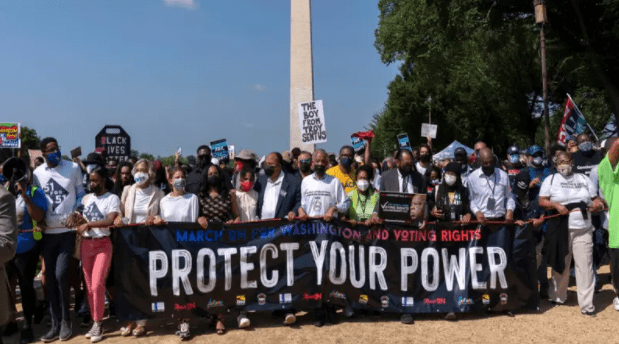
On Wednesday, Jan. 19, 2022, Democrat senators made a second attempt at passing amended voter legislation laws, the “Freedom to Vote Act” and the “John Lewis Voting Rights Act”. Following the dismissal of their initial bill entitled the “For the People Act,” unsigned by all fifty Republican senators and two interparty members, Senator Kyrsten Sinema of Arizona and Senator Joe Manchin of West Virginia, Democrats believed the new two-bill proposal could offer a potential compromise. The new legislation -whilst not as comprehensive as the preceding bill- included adjustments to current voting laws and increased nationwide access to both voting and the registration process. Furthermore, the “Freedom to Vote Act” promised to reverse restrictive policies that had been enacted in 19 states in the past year. “The John Lewis Voting Act” would strengthen federal policies regarding election cases. This included requiring all states with previous histories of discriminatory voting practices to seek clearance from the federal government before implementing any state-wide voting law. However, despite the bill’s passage in the House, Wednesday’s vote resulted in the same stalemate as the initial bill, vetoed by the same people in the Senate. Both Democrats Sinema and Manchin voted against the new proposals, as did all fifty Republican senators. The verdict was ultimately disappointing to both Democrat leaders and voters, as well as the President himself, who has remained adamant about the necessity of voter reform since the bill’s inception. But despite the loss, Democratic majority leader and Senator of New York, Chuck Schumer, remains hopeful for the future of voter security and accessibility. In an interview conducted a day after the vote, Schumer expressed pride in his party and belief that such battles cannot be won in a single clash, particularly if more people do not see the necessity of the fight. Schumer  stated, “on civil rights, it is not linear. You’ve got to keep fighting. And they see that the Democrats really fought for something we believed in, even if we couldn’t win. It’s the fundamental backbone of this country — voting rights. But it’s also the core of our party.” Moving forward, it is likely Democratic leaders may segment the bills, so as to pass legislation incrementally. As of right now, however, the Democrats will need to regroup and reassess how and if the stalemate can be broken.

Biden’s warning to Russia over Ukraine Invasion

Politics

Elizabeth Boyle, Staff

On Tuesday, Dec. 7, 2021, U.S. President Joe Biden and Russian President Vladimir Putin sat down for a virtual meeting over the course of two hours. It was the first time these leaders have met since they talked in person at the Climate Change Conference in Geneva, Switzerland in June 2021. This meeting was to discuss the increase of Russian military on the Ukrainian Border. 

            During this call, President Biden made it clear that there would be drastic economic constraints on Russia if the threat continued. Biden said he could see “a very real cost” on Russia’s economy. The U.S. placing enhanced sanctions on Moscow was addressed during the conversation. President Biden was trying to neutralize the threat of another European war during the call. He made it clear that he wants to use diplomacy and conversation to solve this issue with Russia. 

Putin raised concerns about the North Atlantic Treaty Organization (NATO) and moving troops near Russia’s border. Putin said NATO is “building up its military potential at our borders.” Putin said he wants “reliable, legally fixed guarantees excluding the expansion of NATO in the eastern direction and the deployment of offensive strike weapons systems in the states adjacent to Russia.”

President Biden reiterated his support for Ukraine. Biden was the sitting vice president in 2014 when Russia invaded Ukraine by means of taking the Crimean Peninsula on the Black Sea. At that time, the U.S. and European Union (EU) sanctions against Russia were ineffective as Russia successfully took the territory from Ukraine.

In addition to speaking with Putin, the Biden administration has been communicating with Germany about the Nord Stream 2 natural gas pipeline and what actions would be appropriate if Russia were to invade Ukraine. Nord Stream 2 is an offshore natural gas line that runs under the Baltic Sea and connects Russia and Germany. It was designed to explicitly bypass Poland and Ukraine, denying those countries of tax revenue and forging a stronger economic bond between Russia and Germany. Nord Stream 2, which was completed in Sept. 2021 but is not yet being used to flow gas from Russia to Germany, is currently supported by the Biden administration after being opposed during the Trump administration. On Dec. 7, U.S. National Security Advisor Jake Sullivan explicitly said that the U.S. was prepared to use the pipeline as a bargaining chip to deter Russian aggression in Ukraine. 

            White House press secretary Jen Psaki said “we’ve consulted significantly with our allies and believe we have a path forward that would impose significant severe harm on the Russian Economy.” Psaki said that shutting down Nord Stream 2 is “a threat. You can call that a fact. You can call that preparation. You can call it whatever you want to call it.” This shows that the U.S. is being proactive and examining a full range of diplomatic and economic options, but steering clear of an overt military response to the situation on the Russia-Ukraine border. 

Temple Shooting a Part of a Larger Pattern

Politics

This article contains Political Commentary

Sarah Hanlon, Staff

On Nov. 28, a Temple senior was shot and killed in broad daylight, just off the university’s North Philadelphia campus. At approximately 1:30 p.m., 21-year-old Samuel Collington parked an SUV at 2252 North Park Avenue and began to unload it after a trip to his family’s home in Prospect Park, Delaware County. Video evidence shows that a suspect approached the vehicle in an attempted robbery. After a struggle, Collington was shot twice in the chest. He was taken to nearby Temple University Hospital, where he died of his injuries.

Collington was a political science major, set to graduate this Spring. He was an active member of the Philadelphia community, and was working an internship as a Democracy Fellow at City Commissioner Omar Sabir’s office. The Collington family held a vigil to commemorate their son on Dec. 6. Temple is offering support for their students through the university’s Tuttleman Counseling Services.

Mayor Jim Kenney released a statement Sunday night. Kenney referred to the shooting as a case of “bad things happening to good people,” and reiterated the city’s focus on the gun violence epidemic.

The murder of an innocent college student sparked outrage in the Philadelphia area and rocked the Temple community. However, this is yet another example of the violence that holds a grip on the city. Philadelphia is experiencing its deadliest year on record, with at least 506 homicides in 2021 so far.

Collington’s murder happened just two weeks after 18-year-old Ahmir Jones was shot and killed on the 1700 block of Cecil B. Moore, also near Temple’s campus. On Nov. 16, Jones, a Pottstown High School senior, was walking with his girlfriend when two men attempted to rob them at 2:15 a.m. The men took the girl’s cellphone, then shot Jones in the chest.

Temple University and the Philadelphia Police both responded to Jones’ murder by increasing security patrols in key areas around and on campus. However, increased patrols did not deter the person who killed Collington.

Philadelphia’s rise in gun violence is not unique to this city. Unfortunately, a study by the Council on Criminal Justice estimates that homicides in United States cities increased by 30 percent from 2019 to 2020, and again by nine percent from 2020 through the first three quarters of 2021.

Politicians in cities across the country are responding to the violence by increasing funding for police forces. This comes one year after protesters nationwide called for cities to “defund the police” and re-allocate resources towards social welfare programs.

There is no definitive answer to explain the rise in gun violence across America. Some researchers point to socioeconomic strain caused by the ongoing COVID-19 pandemic. Gun sales, thus the number of guns on the streets, spiked during the pandemic. Psychological stress and poor economic outlook, both effects of the pandemic, are linked to root causes of criminal behavior. 

Other researchers suggest that the spike in gun violence is due to social unrest following the murders of George Floyd and Ahmaud Arbery. Inequality and social disruption are linked to criminal behavior, and cities across the United States experienced a similar uptick in gun violence following the shootings of Michael Brown and 12-year-old Tamir Rice in 2014. However, the exact causes of crime are complex, long-acting sociological issues that cannot be definitively proven, especially in the short-term.

Students across Philadelphia are weary following the violence at Temple. Students have the right to feel safe on their campuses. However, it is important to remember that Philadelphia residents also have the right to feel safe in their own neighborhoods.

Gun violence affects people of all races and ethnicities, but it disproportionately harms communities of color, especially Black neighborhoods. Based on a report by the Philadelphia Police Department, Black men accounted for 73 percent of all gun homicides in 2019. When Black women were added, Black Philadelphians accounted for 85 percent of all gun homicide deaths for that year, even though they account for 43 percent of the city’s demographic makeup (Everytown Research, 2021).

Temple University’s undergraduate population is 56 percent white and 12 percent Black. La Salle University’s undergraduate population is 54 percent white and 17 percent Black.

With the city experiencing a record-breaking homicide rate, college students should be aware of crime near their campuses. No one thinks they will be a victim of a crime until it happens to them. However, students must respond with outrage to all gun violence in the city, not just the homicides near their schools.

Tensions rising between Ukraine and Russia

Politics

Elizabeth Boyle, Staff

Over the past few months, the Russian army has virtually encircled the Northern border of Ukraine with over 92,000 troops. This past week Ukrainian President Volodymyr Zelensky claimed that Ukraine had intercepted communications in Russia talking about Russian involvement in orchestrating a coup d’etat against the Kiev Government. Likewise, the head of Ukraine’s Defense Intelligence Agency, Brig. Gen. Kyrylo Budanov, reported that Russian forces are preparing for a combined air, artillery and armor attack sometime in January or February.

Russia has denied any allegations that it has plans to invade Ukraine. 

Russian-Ukrainian tension has been on the U.S. and The North Atlantic Treaty Organization (NATO)‘s radar for quite a while, but any time the issue is brought to the forefront, Russian President Vladimir Putin has denied that Russia has any plans to invade Ukraine. Putin’s denials have not lessened current concern in light of Russia seizing Ukraine’s Crimean Peninsula in 2014, and ongoing Russian supported fighting throughout Eastern Ukraine.

In light of these potential allegations, the U.S. and members of NATO have begun coordinating about how to neutralize Russia’s threat to Ukrainian sovereignty. After hearing about these conversations, President Putin talked about the West’s response at his annual state of the union address. Putin warned the West not to cross Russia’s security “red line” by placing offensive weapons systems, especially advanced missile systems, in Ukraine. Putin said that if the Western militaries move high technology missiles into Ukraine, Moscow would be exposed and be open to an attack within 5 to 10 minutes. Putin explained, “if supersonic weapons are placed there [in Ukraine]” then the risk of an attack on Moscow could happen in as little as five minutes. Putin went on to explain how Russia has created a sea based hypersonic missile, which Putin said can travel nine times the speed of sound. He says, “the flight time to those who give out such orders will also be 5 minutes.” Putin said his deployment of such weaponry is specifically made to enforce Moscow’s “red line.” 

In response to Russian troops surrounding Ukraine and Putin’s explanation of a missile made to protect the “red line,” U.S. Secretary of State Anthony Blinken gave Russia a warning while he was in Latvia on Tuesday. Blinken said any aggression can “trigger serious consequences.” At the time he was meeting with the Latvian foreign minister Edgars Rinkevics. Blinken was in Latvia specifically to discuss the movement of Russian troops on the Ukrainian border and said they plan to continue the conversation as NATO ministers convene a meeting later in the week.

  In coordination with NATO, the Biden administration is debating whether or not to send U.S. military personnel and weapons to Ukraine to deter and/or prepare for a possible invasion by Russia. NATO Secretary General, Jens Stoltenberg, has told the U.S. and other NATO militaries to prepare for the worst, as he is concerned that Russia is indeed preparing to invade Ukraine. Additionally, the U.S. has been discussing possible economic sanctions with the European Union in the event that Ukraine is invaded. 

Amid the global conversation about the rising tension, Putin continues to deny that he has any plans to invade Ukraine, and has accused the U.S. and its allies of trying to challenge Russia’s efforts to secure its territory and its “near abroad” interests.

Netflix’s “Living Undocumented” a never-ending nightmare

Politics

Jada Urbaez, Writer

Immigration policies can be a sensitive topic for America, and a complex one due to the heartbreaking realities these laws cause families to face.

U.S. Immigration and Customs Enforcement (I.C.E.) was created in 2003 “to protect America from the cross-border crime and illegal immigration that threaten national security and public safety,” according to their mission statement. 

To some, I.C.E.’s mission looks promising, protective and necessary. To others, the condition of the detention centers across the U.S., those taken into custody and the procedures done by I.C.E. officers are viewed as contradictory, inhumane and unnecessary. 

To gain an empathetic perspective on deportations and separation of families, it would be ideal to see what life is truly like for individuals without proper documentation. Luckily, Living Undocumented, a docuseries produced by Many Teefy, Selena Gomez and Eli Holzman, provides authentic information and digs deep into families’ experiences with deportation. The 2019 Netflix Original is six episodes long, following journeys of numerous families who emigrated from Israel, Mexico, Mauritania, Colombia, Laos and Honduras. The eight families in the series include two each from California and Texas as well as families from Wisconsin, South Carolina, Maryland and Florida.

Alejandra, for instance, is a Mexican woman introduced in the first episode. Although she is a military wife, due to the “zero tolerance policy” of the Trump administration, her appeals were denied by the government.

Living Undocumented highlights the hardship, fear and raw reality of these particular undocumented families’ everyday lives, but also gives greater understanding of the perspectives of millions of other people who have similar experiences.

All things Omicron

Politics

Rachel Phillips, Staff

Kasey Brammell

On November 26, members of the W.H.O Technical Advisory Group on Virus Evolution identified another mutation of Covid-19, known as the Omicron variant. This strain, while initially detected in South Africa has already emerged in 20 countries around the world, the most recent being Brazil and Canada. The rapid transmission and potential immunity of the virus to current vaccinations have further raised alarm, particularly as the travel-heavy holiday season quickly approaches. However, despite its transmission rates, health experts remain optimistically hesitant to label the virus as severe or prevalent as the Delta Variant- which remains the most infectious mutation. Dr. Fauci, White House Medical Chief Advisor and Director of the National Institute of Allergy and Infectious Disease, has coordinated with South African health officials in determining the symptoms of early cases and severity of a potential outbreak. However, Dr. Fauci remains adamant that a more accurate understanding of the virus requires testing on its potential immunity evasion, which may be at least two weeks away. In the meantime, many countries are implementing global precautions through travel restrictions or temporary travel bans. In the United States, President Joe Biden has enacted a travel ban from those attempting to enter the United States from South Africa. This decision is currently being considered on a “week to week” basis, contingent on the arrival of new information regarding the variant. In his most recent statement, Joe Biden has also promised not to blind-side Europe with sudden travel restrictions before the holiday season, a decision that is again contingent on the arrival of new information in the upcoming weeks. In addition to travel bans, many countries are again emphasizing the importance of vaccination and the newly available booster shots. As Dr. Fauci states, “we don’t know what degree of diminution of protection is going to be. But we know that when you boost somebody, you elevate your level of protection very high. And we are hoping, and I think with good reason, to feel good that there will be some degree of protection. Therefore, as we said, if you’re unvaccinated get vaccinated, and if you’re vaccinated, get boosted.”