Do you smoke in grocery stores?

Commentary

Alina Snopkowski, Editor

Fair warning: this article isn’t about smoking or grocery stores, at least not really. It’s about the rules and requirements that businesses have in place, and why being asked to wear a mask in certain places shouldn’t be a big issue.

For those of you who like charts and statistics, this site tracks, among other things, what percentage of the country’s population says they always wear a mask in public; here is the specific page for the state of Pennsylvania. In Delaware, where I am currently living and working, the last updated numbers show that a little over 80% of the people in the state say they always wear a mask in public. In the restaurant where I work, the vast majority of customers come in with their masks on or, if they forget, a simple “do you have a mask you can wear while you’re inside?” has them immediately scrambling in their pockets or purses to find their masks and put them on. When I’m working at the register up front, it’s my responsibility to make sure people are following the rules when they come in, and most customers are totally fine with it. A few months ago a man grumbled “are you serious? This is America” before reluctantly putting his mask on after I reminded him, but, for the most part, people are completely on top of the requirements.

And then here comes Paula (not her real name, of course, although I doubt anyone would be able to find her anyway). Paula calls and orders some food for takeout and I tell her it’ll be ready in about ten minutes. When she arrives, she’s not wearing her mask. We have signs on the windows but people forget. “Good morning,” I say, “do you have a mask you can wear while you’re in here?”

Paula flatly says “no.” Before I can say anything else, she launches into “it’s against the Constitution, so I’m not going to wear one. I don’t want to live in a communist country.”

I’ll be on record here and now saying I don’t particularly want to live in a communist country, either. But I don’t think asking someone to wear a mask while within a business that requires it is communism. The restaurant I work at didn’t invent these rules, but we have to follow them if we want to stay open. 99 percent of people understand this.

Back to Paula. She’s shoving her money at me and grabbing the plastic bag of her food off the front desk. “We appreciate you coming in but you have to wear a mask,” I say, probably a little meekly, because I was kind of rattled at the communism comment, “we have to follow these rules or we could get in trouble.”

“It’s not real, sweetheart,” she says, in the kind of tone that one might use to correct someone who said the moon is made of cheese, “wake up.”

And then she’s gone.

The whole interaction lasted barely a minute and the front desk is far over six feet away from any of the tables, so I doubt any customers even heard the conversation. But for the rest of the morning I was thinking about what else I should have said:

Do you smoke in grocery stores?

If there’s a sign on a store that says “no shoes, no shirt, no service,” do you walk in anyway in your bare feet and then get angry when they tell you to put some shoes on or leave? Or, more likely, do you not even bat an eye, because businesses having some level of requirements on what’s allowed (and not allowed) in their buildings is completely reasonable?

I don’t need to say that small businesses are struggling in this pandemic. We all know it. I also don’t need to say that these rules don’t necessarily come from us — usually a governor tells us what we have to do — but we’re required to follow them and enforce them in order to stay open. By patronizing a particular business, you pretty much agree to follow the rules while you’re on their premises. I don’t want to tell Paula not to come back, but the fact is she’s not allowed in if she refuses to wear her mask. I suppose it’s her right not to wear one, but it’s our responsibility not to let her in if she doesn’t. I, like most people, am looking forward to the day where we don’t have to wear masks anymore. But for the time being, this is the situation we have to deal with.

Delaware.gov

Signs like this one are on display in many restaurants in Delaware.

So, forgive me for the clickbait title for this article, but I want you to think about this mask situation not as ‘communism’ or some sort of infringement on personal freedoms but in this way — how different is it, really, from being told you must wear shoes in a particular store or that you can’t smoke in certain places? For the time being, “no mask, no service” has been added to these commonplace requirements. You’re allowed to spend your money and your time wherever you see fit, but if there’s a rule at a place you want to go to, you have to follow it. If you don’t want to, you can choose to go somewhere else. Small businesses are hurting enough — please don’t make it any more difficult by refusing to follow simple, clearly posted requirements.

And, believe it or not, Paula came back about a week later. She called again one morning, I recognized her name on the caller ID on the phone, and her order was identical to last time’s. I tell her ten minutes, give or take, and I wait at the front desk watching the parking lot for her car.

She pulls up and parks, then sits in her car for what seems like ten more minutes checking something on her phone. She isn’t wearing a mask yet. Okay, fine, she’s still in her car. She opens her door. Still no mask. Crosses the parking lot. Still no mask. I’m ready now — I’m prepared to tell her to go back outside, that she can give me her money out on the sidewalk and I’ll bring her food out to her there, but I can’t let her into the building.

And then, at the very last second, she pulls a mask up from around her neck. She gives me her money and takes her food and that’s that.

I don’t know why she changed her behavior, but I’m glad she did.

We won’t have to wear masks forever. One of my favorite websites at the moment is this one by Bloomberg, which estimates how long it’ll take to vaccinate 75 percent of the country’s population based on the current speed of vaccinations. Last I checked, they’re clocking it at about six months. That’s a while, but it’s certainly not forever.

Someday this will all be over, but until then, I ask you to please support your local small businesses in any way you can — and that includes wearing a mask.

snopkowskia1@lasalle.edu

The history of Black students at La Salle: Part I (From the 1930s to the Civil Rights Era)

Features

Bianca Abbate, Editor-in-Chief

This article was written with the help of the La Salle University Archives. University archivist Catherine Carey makes the following disclaimer: “It’s difficult to tell the story of Black life at La Salle because of the lack of documentation we have in the University Archives. Most of the information we have about our first Black students or the early years of the Black Student Union is told through records created by the University administration about those people. We have very few records created by those students themselves. We can fill these gaps in the historical record by doing things like oral history interviews, but the fact is that those records were not considered to be as important as other records at that time, and so we are missing important, first-hand accounts.” 

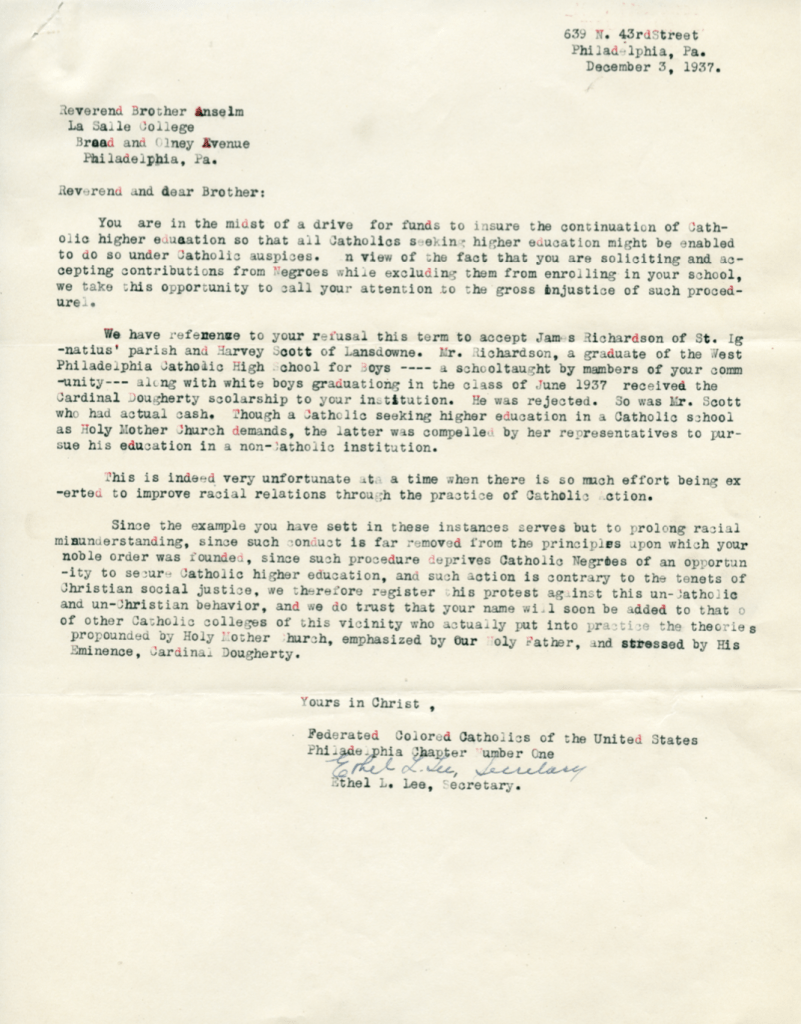
It started in 1938 with a letter from a woman named Ethel Lee addressed to the then-archbishop of Philadelphia, Cardinal Dennis J. Dougherty. Lee, the secretary of the Philadelphia chapter of the Federated Colored Catholics of the United States, had originally sent a letter to then-President of La Salle, Brother Edwin Anselm in 1937, but when it was not answered, Lee took the issue to His Eminence. The prior academic year, two Black students had been rejected — seemingly without cause — from La Salle College: James Richardson and Harvey Scott. Lee called on the cardinal to push for the acceptance of Black students into the college in order to preserve Catholic values and reject “communist” ones. “This debarring of Negroes from Catholic colleges is furnishing the Communists with additional propaganda to lure the Negro from the Catholic Church,” wrote Lee. “We direct this plea in the belief that you will make it possible for our Negro youth in this diocese to be given the advantages of a higher education under the auspices of Holy Mother Church, and at the same time protect them from the baleful influence of communism.” Later that year, the Lasallians held a meeting in which they approved the admittance of Black Catholics. Had Lee not brought the issue to the cardinal’s attention, Black students might have started at La Salle at a much later date.

The following fall, the college welcomed its first Black student on campus: a man from Philadelphia named Elmer Brown. A member of the Track and Field team, Brown was an active part of life at La Salle. While there are few official records to indicate the challenges faced by La Salle’s first Black student, Brown’s tenure on the Track team was not always smooth sailing. In fact, at one meet in a Southern state, Brown was barred from competition because of his race. The incident was criticized by the Collegian staff in its editorial section. While Brown is an important part of La Salle’s Black history, Brown was not the first Black graduate of La Salle, however. Brown ultimately enlisted in the army during World War II and did not return to La Salle. 

Elmer Brown is seated third from the left.
Photo courtesy of the La Salle University Archives

Throughout the 1940s and 50s, there would be only a small Black student population. The first Black graduate at La Salle would be Edward Murray in 1946. Following his time at La Salle, Murray would go to medical school and ultimately become a doctor. Warren E. Smith was one of the first Black students to graduate from La Salle’s Pre-Med program in 1954. He would become La Salle’s psychiatrist in 1969 and remain at the institution until 1984 when he retired. While maintaining a private practice, Smith also served on the staffs of Hahnemann University Hospital and Einstein Medical Center. Smith was also a psychiatric consultant to other Philadelphia institutions.

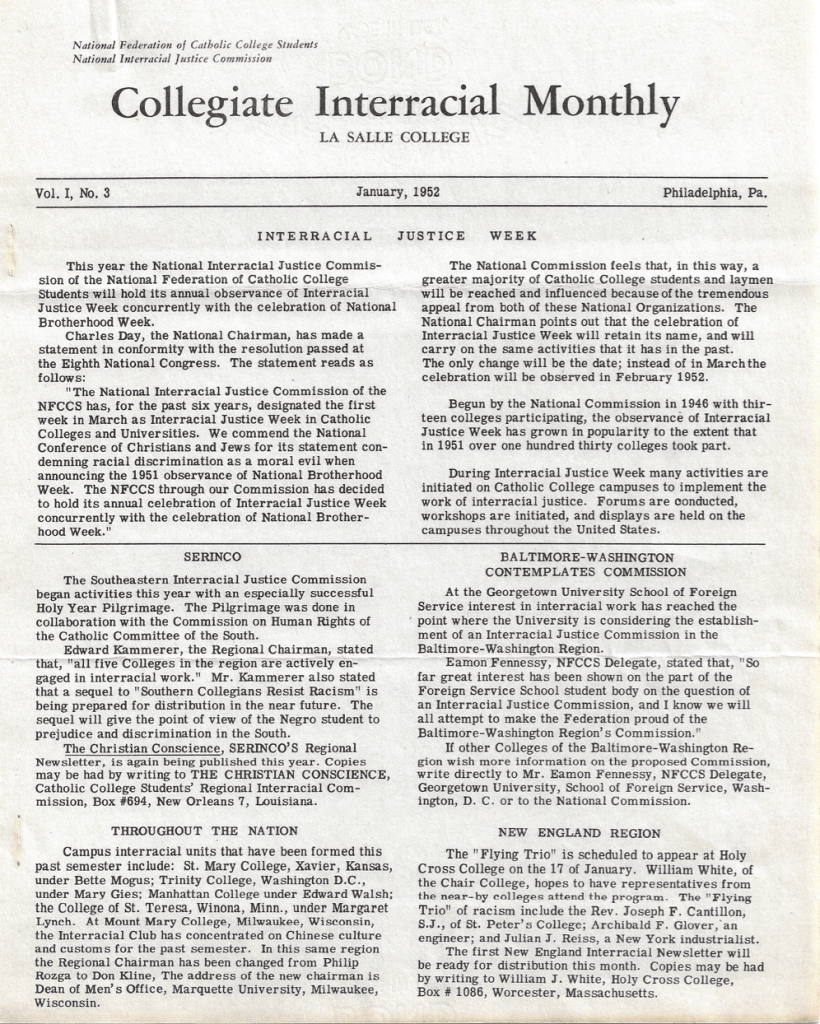
With the acceptance of more Black students, the college needed to address Black issues. In the late-1940s, La Salle became an actor in the Interracial Council — an organization created in order to address issues of race at the local colleges. According to the Collegian’s records, the Philadelphia institutions met at La Salle College for the first time. The organization discussed the work that the institutions had done for the local communities. In the 1950s, members of La Salle College also published the Collegiate Interracial Monthly which addressed issues of race. Black students did not have much of a voice on campus at this time. For this reason, the Collegian has little insight on the unique experiences of Black students or individual events of racism at the time. However, more generally, racial discrimination was pervasive in Philadelphia and across the nation in the 1940s and 50s, and racist attitudes would also exist on college campuses.

The Civil Rights Era brought many changes to La Salle, including greater inclusion and accountability. The 1960s saw a rise in activism and greater civil liberties for Black Americans across the country; that spirit of activism was present also at La Salle University. Firstly, it was at this point that the institution started to track demographic data consistently. The Black Student Union also became a critical presence on campus in the late-1960s. The organization had a sizable impact on the school. Largely because of the activism of the Black Student Union, La Salle began to accept more Black students, hire more Black faculty/staff and incorporate a Black history course into the curriculum. Yet, the Black Student Union faced many difficulties as an organization. Members of the University even labeled the organization as a “threat.”

The Black Student Union was not the only Black organization on campus to face struggles, however. According to the archival work of junior Emily Dorr, “almost every Black student group that has been present on campus was shut down, disbanded or suspended for reasons hidden under bureaucratic pretenses.” Furthermore, these groups were seen by the University as special interest groups. In 1968, then-President of the college, Brother Daniel Burke released an official report in which he stated, “As the diversity of the campus population increases, so do the number of special interest groups and subcultures. Polarization threatens the sense of community that must integrate the College. The problem is a real one at the present time. Our black students must be encouraged in their efforts to promote their self-respect and their cultural pride without separating themselves into an antagonistic relationship with the majority.” 

Photo Courtesy of the La Salle University Archives

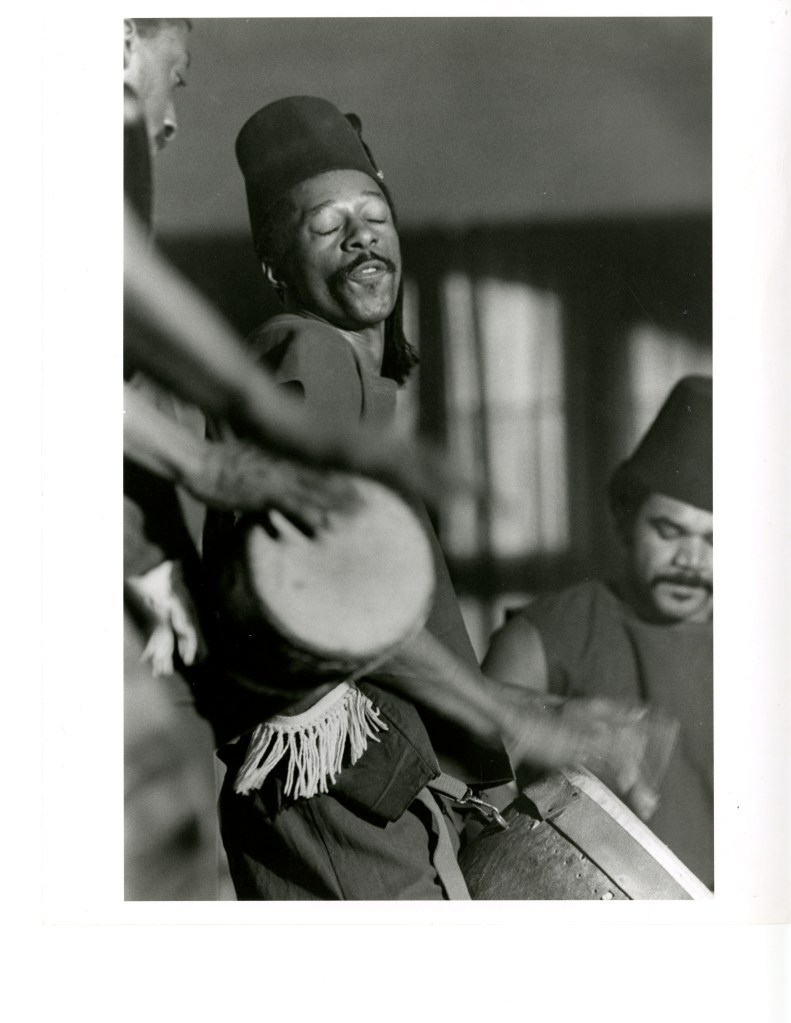
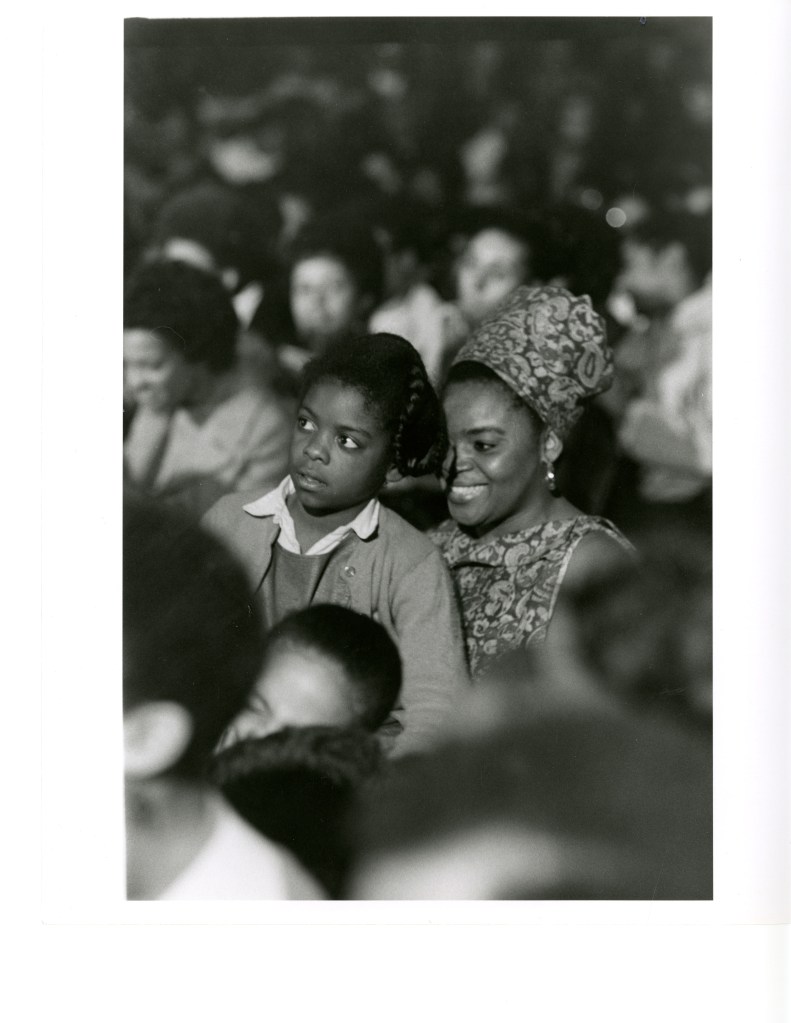
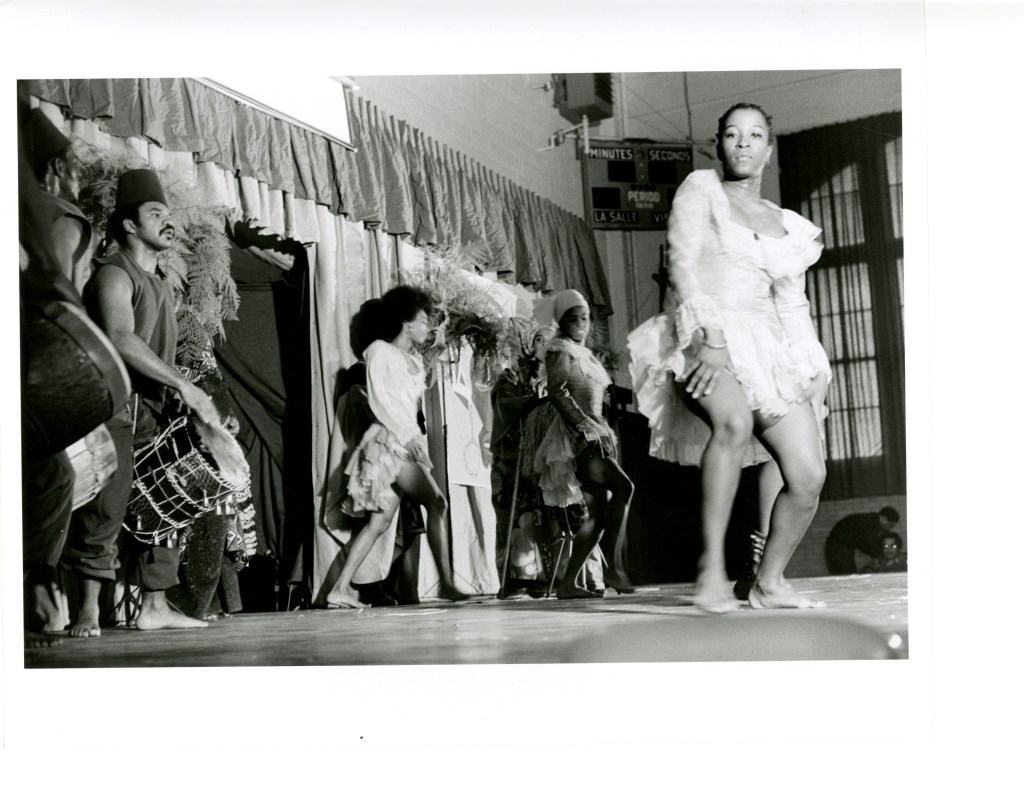
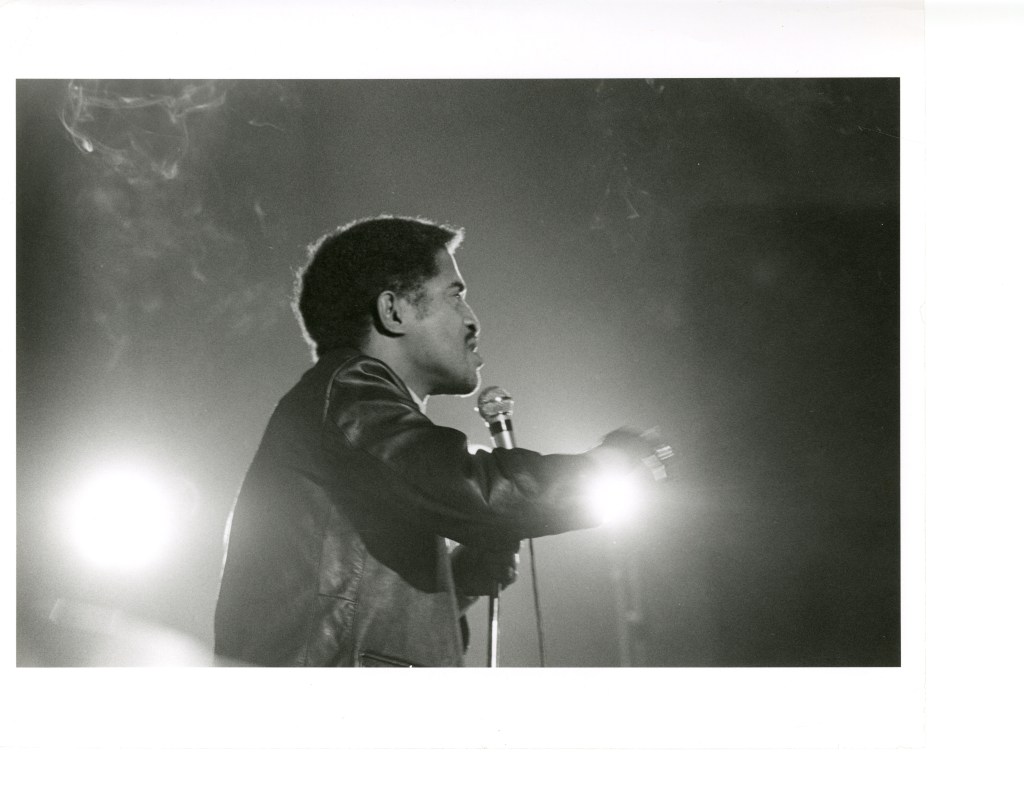
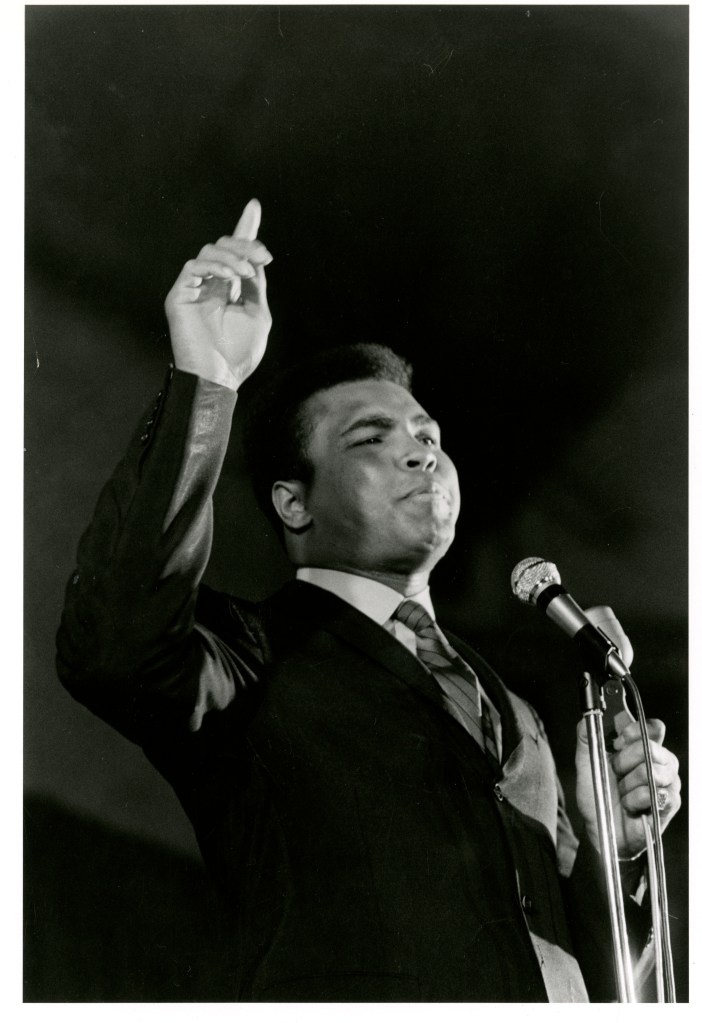
Despite the administrative challenges, Black student groups persisted. Without a complete oral history, it is impossible to quantify the unique experiences and struggles of Black students as events during this era unfolded across the country. Yet, the events and publications of these student groups offer a hint into Black culture at La Salle through the 20th century. In 1969, the first Afro-Americans Arts Festival was hosted on campus. A celebration of Black art, the event featured a number of performances. Among the attendees were names like Muhammad Ali and Sammy Davis Jr. 

Around this time, La Salle experienced a wake-up call in terms of race relations. La Salle had recently piloted its Open Door Program, which was an initiative to accept more Black students into the institution. The program was a precursor to later support programs at the University. It had partially failed, however, because the institution underestimated the level of support Black students from the local community might need. 

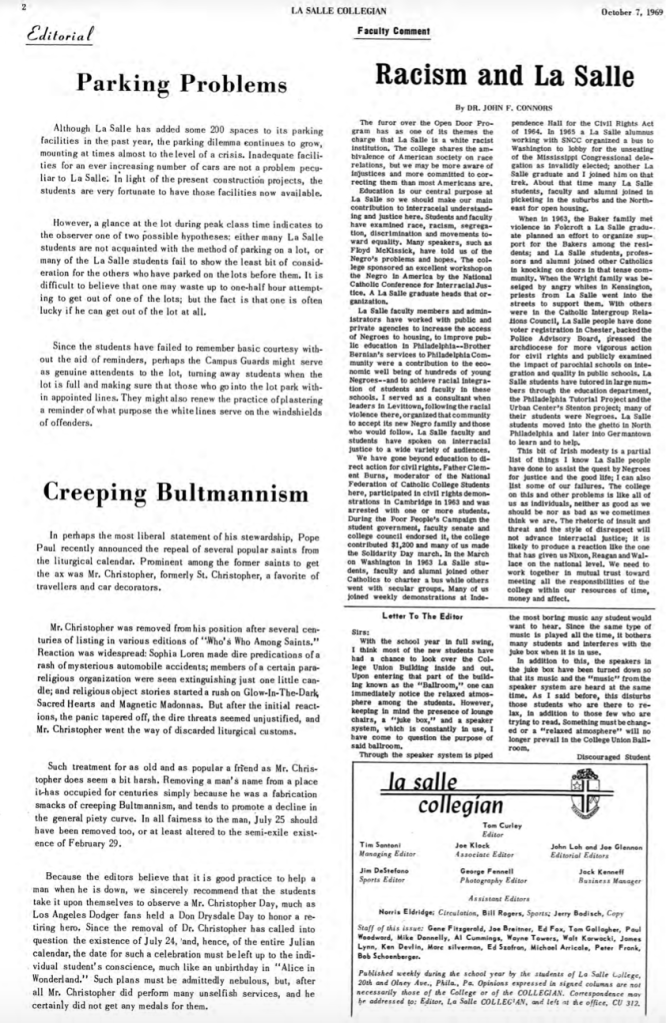
The controversy surrounding the program is an indication that efforts of Black students to bring to light the issues of racism on and off campus created a dialogue about race at La Salle. From this discourse, it was clear that there was a disconnect on campus. In an October 1969 issue of the Collegian, a sociology professor wrote about racism and La Salle in a commentary article. In the article, he defended La Salle as a school which promoted equality for the Black community and criticized those who questioned the program, saying, “The style of disrespect will not advance interracial justice.” The article was in response to another letter to the editor titled “No Compromise,” in which the author — who signed the article “Frustrated Black Student” — called out the University for the program which the student saw as a band aid solution. The student wrote, “It is rare, if ever, that Whites in positions of solving racial problems really ever want to get right down to the real nitty gritty and deal directly with the crux or the reality concerning such matters.” The student ended with a call to action: “The seeds are being sowed by whites with power, and only they can change the situation, not only mine, but my people many of whom feel just as I.” Black members of the Lasallian community were demanding change, while White members were applauding La Salle’s efforts.

The decade would end with these dynamic insights about race on campus, and a new decade would begin with La Salle opening its doors to its first Black women students…

The sequel to this article will feature Black students at La Salle from the end of the Civil Rights Era into the 21st century. To contribute your voice, please contact the author.

abbateb2@lasalle.edu

Fiscal policy moves: long-awaited COVID-19 relief bill faces approval

Business

Elizabeth McLaughlin, Staff

Getty Images

President Joe Biden delivered a speech at the White House after the Senate’s passage of the American Rescue Plan on Saturday, March 6.

On Wednesday, March 10, the House plans to finalize the Senate-approved COVID-relief bill, dubbed the American Rescue Plan, after many months of debate. Among other provisions, the bill includes $1,400 checks; in December, President Trump permitted $600 checks and in March, the amount was $1,200. That means Congress has allocated a total of $2,400 in stimulus to the average American throughout the pandemic. Additionally, the relief bill offers $300-a-week federal jobless benefits. On March 5, Senate Democrats spent more than nine hours debating the amount of jobless benefits the government should offer in the bill. 

Senator Joe Manchin (D-WV) stated that “we have reached a compromise that enables the economy to rebound quickly while also protecting those receiving unemployment benefits from being hit with [an] unexpected tax bill next year.” The deal allows the first $10,200 of the jobless benefits to be non-taxable for those with incomes of up to $150,000. Tax rules on excess business loss limitations were extended for one year, through 2026. Senator Manchin stated, “those making less than $150,000 and receiving unemployment will be eligible for a $10,200 tax break.” 

Under the bill, the Pandemic Unemployment Assistance program (PUA) and the Pandemic Emergency Unemployment Compensation program (PEUC) are extended until Sept. 6. PUA is open to workers who don’t qualify for typical unemployment benefits, such as gig workers, freelancers and independent contractors. The PEUC, on the other hand, provides additional weeks of unemployment insurance once state benefits have been exhausted.

The unemployment benefits were especially crucial because, if Congress does not pass this bill, 11.4 million workers will lose their benefits between March 14 and April 11. Given the fact that more than 80 million people have filed for unemployment benefits since the pandemic began, any sort of assistance that the government can provide is critical to the improvement of the economy.

The relief bill also provides funding for vaccine distribution and testing. Moreover, the bill provides money for K-12 schools and higher education institutions. Democrats have argued that the bill will help alleviate child poverty “and help households afford food and rent while the economy recovers from the pandemic,” according to reporting from CNBC.). Republicans have criticized Democrats for focusing on policies seemingly unrelated to the pandemic.

The bill is poised to make its final passage through the House on Wednesday, March 10; if it does, President Biden can sign it by the weekend. There is a deadline on Sunday, March 15, to renew unemployment aid, so President Biden must sign the bill before then. House Democratic Caucus Chair Hakeem Jeffries (D-NY) said he is “110 percent confident that the votes exist to pass.” There is no telling when stimulus checks will be distributed to individual bank accounts, but the IRS has had a relatively quick turnaround with the two previous stimulus checks. Unfortunately, for many Americans, the aid cannot come soon enough.

mclaughline7@lasalle.edu

The Oracle of Omaha speaks — Financial Commentary

Business

Michael D’Angelo, Staff

USA Today

Berkshire Hathaway’s CEO, Warren Buffett (right), and Vice Chairman, Charles Munger (left). Buffet is famously referred to as the “Oracle of Omaha.” His value investing strategies have created impressive returns for his company, which he views as a “collection of businesses.”

Warren Buffett is a big name in the financial sector. He is known for his down to earth approach when it comes to investing and his frugal personality despite being worth billions. 

Buffett is the definition of the old-school Midwesterner who places his hope and confidence in his fellow Americans. He disdains Wall Street, instead choosing to operate his infamous holding company, Berkshire Hathaway, from Omaha, Nebraska. He is so frugal he chooses to purchase a McDonald’s breakfast sandwich with exact change every day before he goes into the office but chooses the cheaper option if the markets performed poorly the day prior. In addition, he still lives in the same house that he purchased in the early 1950s. 

Buffett accumulated his wealth by practicing a value investment strategy he learned from Benjamin Graham. This strategy relies on analyzing a company’s book value to determine if it is worth less than the market price. If this occurs, the stock is considered to be an undervalued and a cheap option. Buffett emphasizes buying cheap companies with value and knowing how the company operates. Buffett and Berkshire Hathaway own shares of major companies like Coca-Cola, Apple, General Motors and Verizon. 

In the past week, both Buffett and his company have been popping up over news headlines in many financial publications. This is due to the release of Buffett’s annual letter to shareholders and Berkshire’s 2020 annual report. I had the opportunity to read through Buffett’s letter  and despite some criticism regarding the letter to be socially tone-deaf, I believe he is spot on and paves a strong future for Berkshire Hathaway. 

In the letter, Buffett begins by detailing Berkshire’s earnings of $42.5 billion, then he jumps to emphasizing Berkshire’s retained earnings which he believes are building “value and lots of value.” Both Buffett and Charlie Munger, Buffett’s Vice Chairman at Berkshire Hathaway, view Berkshire as a collection of businesses in which the firm has invested in the “long-term prosperity” of those businesses’ success. He writes in the letter that Berkshire’s main goal is to own parts of, or all of, a diverse group of businesses with good economic characteristics and good management. 

As the letter moves on, Buffett sheds light on a mistake he made in purchasing aerospace company; Precision Castparts. He paid the wrong price for the company and misjudged the average amount of future earnings. Also, Buffett takes a shot at bonds and says that fixed income investors face a bleak future. To increase Berkshire’s profitability, Buffett repurchased back 80,998 A class shares and spent $24.7 billion in the process.  

Despite not addressing the pandemic, social justice protests, and other events of the past year, Buffett confidently concludes, “never bet against America.” Also, he ridicules market gurus and says they can find equities to fit their tastes instead of buying Berkshire. He goes on to describe investing as a positive-sum game where even a monkey can randomly toss darts at a board of S&P 500 companies and profit. This is certainly a response to bull market and retail trader enthusiasm since March. Buffet the letter iterating plans to meet with his best friend, Munger, in Los Angeles and to host the annual meeting on May 1. 

I enjoyed reading the letter and I agree with the legendary investor, we should have faith in America. We need to look forward to our country’s prosperity, despite so many obstacles in our way. After all, why bet against America? A country which holds a report card of economic success and entrepreneurial prosperity achieved by generations. 

dangelom2@lasalle.edu

Marvel’s “WandaVision” in review

Arts & Entertainment

Nolen Kelly, Staff

Header Image: Marvel Studios

Editor’s Note: This review does not contain spoilers for the story of “WandaVision,” but does comment on some of its themes and content styles that may hint toward plot points for some readers.

I’ll start off this review by saying that “WandaVision” is already a success because it got me to rewatch “Malcolm in the Middle,” which is an amazing show. But, onto the main review: Marvel Studios has taken a quick breather from releasing two movies a day during these unfortunate COVID times to focus on a few miniseries centered on some characters that have already been introduced to the Marvel Cinematic Universe (MCU) through films like “Avengers,” “Captain America” and “Ant-Man.” The first show on their list, “WandaVision” picks up a little while after the events of 2019’s “Avengers: Endgame” focusing on Elizabeth Olson as the titular Wanda Maximoff, a Marvel Comics character known as the Scarlet Witch, and Paul Bettany as a sentient android named Vision. What follows is a story told through unique visuals, clever referential writing and very few of Marvel’s typical tropes that make this an interesting debut to the small screen.

Marvel Studios

I was excited for this show since it was announced in April 2019, but I also tempered my expectations as it would be Marvel Studios’ first television series. I enjoyed Maximoff and Vision in their previous appearances of the MCU and the creators teased that each episode of “WandaVision” would focus on different decades of TV shows, starting in the 60s and moving to modern day. At first, they had my interest — then they got my attention. Each episode’s style is based off of a different decade of television and spoof “I Love Lucy,” “Bewitched,” “The Brady Bunch,” “Growing Pains,” “Full House,” “Malcolm in the Middle” and “Modern Family.”  From the get-go they nailed the aesthetic of every single decade. They included laugh tracks, emotional music when the problem is being resolved, theme songs that pay homage to the original show while including their own unique style and most episodes even feature some fun commercials. The costumes, camera work, thematic elements and episodic style of each show is pretty impressive, but the actual plot of “WandaVision” in between is something else. 

I have been wanting Marvel to get weird and psychedelic for a while, which is why I enjoyed the “Doctor Strange” film so much. The magical aspect of the MCU is crazy and hopefully we see more of it going forward into future projects. I knew this show would be a good ticket into the weird witchery the MCU had to offer and oh man, it is weird. Maximoff is a witch and an entire show about a witch is guaranteed to get creative. Without giving too much away, the show breaks its own reality a few times and leads to some spooky and compelling moments that make you wonder what anything means. Olson’s performance as Maximoff was great and she fit comfortably into each roll she filled. She goes through several rapidly shifting emotions throughout the series, and you can’t help but feel for her along the way. Bettany as Vision was also super fun to watch because he was finally given more space to stretch his comedic chops and breathe more as a character and a sentient being. Now with that all said I, of course, have some problems. 

Marvel Studios

First off, I feel like I should appreciate it when Marvel does the whole “obscure details that come back in a big way” trope that they do, but it’s just annoying at this point. It is not of huge importance to the overall plot, but it is just a Marvel thing that bothers me when they do it. My biggest issues with the show are the momentum, an individual character and some dialogue. I would say the first five episodes do a really good job of building suspense and showing a world that unravels piece by piece each week. By the sixth episode, the show feels like it has presented everything to the viewer. There is no more mystery — and typically I would be okay with that since the world is in front of me, but not when the rest of the story is plateaued from there on out. It feels anticlimactic. There are other notable moments in the remaining four episodes, but they just don’t pack the punch I feel like they should. Just to be clear, I do not think the later episodes are inherently bad, but they just lack anything substantially interesting compared to what the series began with. The writing just gets a little weak and depends mostly on the aesthetic of the show to carry the story rather than pushing their own story creatively.

My next huge issue with the show is the dialogue. Again, I will not go too far into detail as to why, but there are a lot of jokes and forced dialogue that do not work. There are two or three characters that speak mostly in clichés and it gets pretty stale pretty fast. And speaking of pretty stale pretty fast, there is a character in the show who is from another MCU franchise who I did not like at all. I can’t say who they are because it gives a bit away, but they are presented in a very important position and almost everything about this character falls flat for me, even their eventual reveal as a comic book hero. Their chemistry with the world and other characters, their purpose, the direction and future implications are just so bland and annoying that I think the show would have progressed way more smoothly if they maintained their same arc for the first three episodes and then built them in a completely different way. If you’ve seen the show, you know who I’m talking about. 

Aside from some bland direction and a small dip in pacing, I thought this was a pretty solid start for Marvel’s venture into limited series television. There were a few scenes that made me actually jump out of my seat with excitement, and a few others during which I continually checked my phone to see what else was going on. It is definitely worth the watch for all of the Marvel freaks and geeks out there and for those who appreciate TV history like me. To rank the show from “Awful” to “Perfection” I’d say it was “Good.”

kellyf4@lasalle.edu

WHAT’S TRENDING — March 10, 2021

Arts & Entertainment

Jeriann Tripodi, Staff

Header Image: Entertainment Weekly

Lady Gaga’s dogs get stolen and dog walker is shot

On Feb. 24, two of Lady Gaga’s dogs were stolen at gunpoint. At around 9 p.m., Gaga’s dog walker, Ryan Fischer, was walking her three French Bulldogs when a car pulled over. Two men exited the vehicle and demanded Fischer hand over the dogs. When the victim struggled with the suspects, he was shot. The suspects then fled with two of the dogs. The Oscar and Grammy winning singer, who was in Rome during the robbery, offered a $500,000 reward for the dogs to be returned. Since then, a woman found the dogs, Koji and Gustav, tied to a pole and turned them in to Los Angeles Police Department. Meanwhile, Fischer is recovering at a hospital. 

Out

Billie Eilish gets restraining order against alleged stalker

Pop singer Billie Eilish has been granted a temporary restraining order against her alleged stalker, John Matthews Hearle. In legal documents, Eilish stated that the 23-year-old, who also goes by the alias “Adam Lucifer,” has been camping outside her home and watches her each time she leaves and enters. In addition, Hearle has made gestures that suggested he would harm the 19-year-old star, and has sent her letters containing death threats. 

NY Daily News

Alec and Hilaria Baldwin quietly welcome their sixth child 

Actor Alec Baldwin and wife Hilaria Baldwin have shared to social media that they have welcomed a newborn together. Fans were surprised because the pair welcomed a son five months prior; however, a source close to the couple shared that the newborn girl, Lucia Baldwin, was welcomed via a surrogate mother. In an Instagram post of the child, Hilaria Baldwin captioned: “Just like your brothers and sisters, you are a dream come true.” After Alec Baldwin fired back at a troll, the Baldwins have disabled their comments. 

The Mirror 

“The Bachelor” airs “Women Tell All” episode

The most memorable women from this season’s “The Bachelor” returned to recap and relive the craziest moments. In an audience-free studio, the female contestants got to face Bachelor Matt James for the final time to receive closure as to why they were eliminated. However, they also shared some laughs together. In addition, the ladies confronted the villains of the season. A disclaimer was aired at the beginning of the episode to inform viewers that the episode was taped before host Chris Harrison’s racial controversy took place. 

Norman Lear honored at 78th Golden Globes 

At the 78th Golden Globes, Hollywood legend Norman Lear was awarded with the Carol Burnett Award honoring his excellent career in television. The television producer and writer, who is the third person to receive the accolade, proudly shared his gratitude towards comedic actress Carol Burnett. Lear also shared that laughter and his family have helped him reach 98 without ever feeling “alone.” 

Variety

Number one on the Billboard charts: week of March 10, 2021

According to “The Hot 100” on the charts, the number one song in the U.S. is “Drivers License” by Olivia Rodrigo. This is the seventh week the pop song is number one on the charts. According to the “Billboard 200,” the number one album in the U.S. is “Dangerous: The Double Album” by Morgan Wallen. The country album is at the top spot for the eighth week straight.

tripodij2@lasalle.edu

Out This Week: Scary sci-fi, shooting skills and satire sketches

Arts & Entertainment

Jakob Eiseman, Editor

Header Image: Netflix

“Come True” — VOD

IFC Films

“Come True” is a horror movie coming from the creator of “Holidays” and “Our House,” Anthony Scott Burns. It is a sci-fi take on a traditional horror story of a troubled teenager running away from home and getting mixed up in something freaky. The main character, Sarah, played by Julia Sarah Stone who is known for her role in the Netflix crime drama “The Killing,” volunteers to participate in a university sleep study for reimbursement. After being strapped into monitors and futuristic technology, Sarah’s dreams become nightmares where the scary parts of the movie show themselves. The series uses imagery related to sleep paralysis and claustrophobic horror. “Come True” will release on video-on-demand services on Friday, March 12.

“Last Chance U: Basketball” — Netflix

Netflix

A follow-up from 2016’s Netflix docuseries “Last Chance U,” “Last Chance U: Basketball” follows the East Los Angeles University (ELAU) Huskies basketball team in their attempt to win the season championship. “Last Chance U” was critically acclaimed and praised for its presentation of a sports story through a human lens, featuring each of the players and their stories as well as the main sports story. “Last Chance U: Basketball” is looking to carry on the series with another team that is determined to perform, partnered with a coach with a dedication to his players. The docuseries is directed by Greg Whitely who is known for “Last Chance U” as well as a cheerleading documentary “Cheer.” The first five seasons of the show followed football teams, first the East Mississippi Community College team, the Independence Community College of Kansas team and the Laney College of Oakland, California team. Now, the sixth season will showcase ELAU, but feature many of the same filming and narrative themes found in the previous seasons. “Last Chance U: Basketball” premieres on Netflix on Wednesday, March 10.

“Cake” — FX, Hulu

FXX

A new season of the sketch variety show “Cake” premieres on FXX on Thursday, March 11 and on Hulu on Friday, March 12. “Cake” features both live action and animated comedy mini-sketches based around modern trends, current events, creative spins on classic punchlines and interesting animation techniques. This is “Cake’s” fourth season and although it is critically acclaimed for its humor and satire, it has no affiliation with the La Salle Collegian’s CAKE column… yet. The show has been compared to other adult sketch shows such as “Saturday Night Live” and “Robot Chicken,” but is unique in that it partners live action sketches with animated ones. While the show is listed as a comedy and satire, it is not afraid to tackle serious issues and topics in a thought-provoking, and, as FX puts it, “raw” and “artistic” manner.

eisemanj1@lasalle.edu

Why you should donate to La Salle on March 23 — Editorial

Editorial

The Editorial Board

When asked “Why La Salle University?,” many students will point to the institution’s generosity; they will tell you that they invested in La Salle because La Salle invested in them. La Salle has a history of welcoming middle and lower-income students into the school and they have made this opportunity possible through scholarships – scholarships that are largely supported by La Salle’s Day of Giving. 

La Salle’s Day of Giving is around the corner and, Explorers, it is time to return the favor. In the fiscal year of 2020, Explorers donated more than $2.7 million to the La Salle Fund. During the 2020-21 academic year, the University was able to provide 175 endowed scholarships worth more than $700,000 and 225 student-earned scholarships. This financial support ultimately contributed to the diversity of the school: 44 percent of the undergraduate students are ethnically diverse and 29 percent of the freshmen are first-generation college students. 

The only way La Salle will be able to continue its mission is through the support of its Explorers. After all, the two largest sources of income at the University are tuition and donations. If it were not for donations in the past, La Salle’s virtual classrooms might look a little emptier. Thus, the saying goes, “Explores give because Explorers gave.” Alumni, families and friends of La Salle donate for a number of reasons, but most importantly because they were impacted by the University and they wish the same for future generations of Explorers. 

Perhaps some Explorers are hesitant to donate to the La Salle Fund because they are either unhappy with University spending or, in general, in disagreement with the direction of the University on some front. However, those who participate in La Salle’s Day of Giving are able to allocate their funds, meaning: if you have the means to donate but choose not to because of some objection, you are forgetting that you are really hurting the students in the end. While unspecified funds will feed into the La Salle Fund (monies to be used at the University’s discretion), funds may support different areas of the institution, including scholarships that could enable La Salle to welcome more lower-income students into its freshman class.

This Day of Giving, reflect on where you are and who you have become because of La Salle. La Salle is a small school that has opened its doors to financially-struggling families, and that reality has come at a cost. While we have incredibly successful alumni, we do not have an especially large or rich alumni base. We do not have a research university type, seemingly endless endowment. We do not have the comfort or security that larger universities have, but we do have a shared experience. If we want to continue the cycle of a quality Lasallian education at a reasonable cost, let’s put our money where our mouth is and donate on March 23. 

How to donate (per the Day of Giving site):

  • Online: Click on the “Give Now” button above to participate with a credit or debit card.
  • Phone: Call us at 215.951.1539 (On March 23, representatives will be available from 8:00 a.m. – 9:00 p.m.)
  • Mail: To the address below (must be received by March 23 )

La Salle University
The La Salle Fund
1900 W. Olney Ave.
Philadelphia, PA 19141

  • Venmo: Find @ExplorersGive on Venmo and make your gift directly through the app. All gifts through Venmo are designated to The La Salle Fund unless otherwise specified.
              Students: include your La Salle email, full name, and class year in memo line.
              Alumni: include an email address, full name, and class year in memo line.
              Faculty/Staff: include your La Salle email address and full name in the memo line.

Letters, guest columns and opinion pieces will be considered for publication provided that they meet the editorial standards of The Collegian. All letters must be received by the end of the day Monday to be considered for the current issue. Letters can be submitted via email to abbateb2@lasalle.edu. The Collegian reserves the right to condense or edit submissions. Weekly editorials reflect the views of the editorial staff and are not representative of the university or necessarily the views of the rest of the Collegian’s staff. Columns and cartoons reflect the views of the respective writers and artists.

A call to greater accountability within the Lasallian community – Letter to the Editor

Editorial

To the editor:

As we reflect on Black History Month and its year-long observance, I ask the Lasallian community to evaluate its history of oppression before striving to be anti-racist. While taking accountability for the actions of those that have come before you is a heavily debated topic, I believe it is the duty of the administration and other acting bodies to apologize for the role it played in reinforcing racial inequality.  

The acts of racism and implicit bias that killed George Floyd, Ahmaud Arbery and countless others have emboldened the calls for justice that have been present for hundreds of years. In our own history, such pleas date back to 1968 with the creation of the Black Student Union, sensitivity training and black history classes. Yet as with all calls for change, they were met with resistance and the Black Student Union was shut down after being labeled as a “threat.” This label was given to the group by a member of the counseling center who advised the University on the Black and LGBTQ+ communities from 1952 to the mid 70’s and was supported by the President at the time. 

In my archival research it was made apparent that almost every Black student group that has been present on campus was shut down, disbanded or suspended for reasons hidden under bureaucratic pretenses. The University viewed the organizing of Black students as a threat, too radical and not inclusive of the student body. Yet the information pamphlets available in our admissions office showcase the Black and Brown bodies that are used to advertise our diversity rate and create a false narrative of representation. 

The lack of action taken by the University to address the needs of the students it advertises has led to the creation of an Instagram page which highlights the experience of Black and POC students at La Salle. This is a common trend in higher education as many students have felt the only safe place to share their stories is through an anonymous submission to these social media pages. This is a reality for students that the University must address by creating a safe space for a Black student group to form or allow the regrouping of the Black Cultural Society. 

Student Government has played a role in the history of oppression of Black and POC students as it often mirrors the opinions and racial makeup of the University. As a predominately white organization with the sole power to speak for the student body it has inherently acted against the needs of Black students. This lack of representation runs rampant across La Salle not only in supporting roles or positions of power, but also in academic opportunities as work has been done to create a Black Studies minor but it has yet to come to fruition. As the Joint Commission of Diversity, Equity and Inclusion prepares to present its recommendations at the end of the year, I implore all departments, clubs and especially the administration to take responsibility for its actions. 

Sincerely, 

Emily E. Dorr ‘22 

dorre2@lasalle.edu


Letters, guest columns and opinion pieces will be considered for publication provided that they meet the editorial standards of The Collegian. All letters must be received by the end of the day Monday to be considered for the current issue. Letters can be submitted via email to abbateb2@lasalle.edu. The Collegian reserves the right to condense or edit submissions. Weekly editorials reflect the views of the editorial staff and are not representative of the university or necessarily the views of the rest of the Collegian’s staff. Columns and cartoons reflect the views of the respective writers and artists.

Catharsis: America needs a reformation

Commentary

James LeVan, Staff

Today, Wednesday, March 10, is my birthday. I have no plans, no desires and, to be honest, there is a part of me that really does not want to celebrate this year at all. After all, this week also marks the one-year anniversary of when the pandemic hit Pennsylvania and the country began to shut down. 

This week has made me feel reflective about both my life this past year and the country as a whole and, well, we need change in this country desperately. I am not just talking about making the country pandemic-proof, but about the clashes between protestors and police over the summer as a result of the brutal murders of numerous African American men and women, the economic collapse, the election and then all of it reaching a crescendo with the terrorist attack on the Capitol. 2020 can best be described as a large mirror held up to the American soul and we can no longer deny the existence of its internal demons.

There is a myth that permeates through American society called “American Exceptionalism.” It is the belief that the United States is unique and superior to other nations. Well, as we have seen this past year, this is simply not true. We are not exceptional and are just as likely to collapse as the Romans, the Soviets or any of the numerous Chinese dynasties that lost the Mandate of Heaven. If nothing else, this year has shown us that we are not prepared for the problems of the 21st century and that we run the risk of falling by the wayside. If we do not make changes, then our experiment in the republican government— the first liberal democracy — will perish. 

In short, we need a reformation. What do I mean by a reformation? I mean that we need to start preparing our citizenry, institutions and infrastructure for the potential crises of the 21st century and beyond. We cannot just have a memory hole of this past year and all the crap we endured; we need to look at it and remember it. We need to study 2020 and all that led up to it. We also need to reconcile our history of racism and oppression and begin to bridge the gap between our ideals of equality under the law and opportunity and the reality that we do not live in a meritocracy. All this of course would take a long time to implement and will span three or four presidential terms but this work must be done. What sectors of our society do I believe need reform? Well, there are three in particular: democracy, labor and education.

We are holding onto old institutions and policies that prevent low-income and people of color from voting or being fully engaged in the democratic process. We also have a two-party system that elects leaders who seem more focused on winning reelection or auditioning for their next gig once they leave office than they are at governing or legislating. Ideas such as abolishing the electoral college, rank choice voting and laws to prevent gerrymandering are some of the lofty ideas floating around that will help improve the health of our republican government. These changes will require a lot of grassroots movement and activism from the ground up before they can be implemented. If achieved, however, we will see more pragmatic candidates emerge, more participation and more competitive districts.

Regarding labor, as an essential worker in a grocery store this past year, I have seen firsthand what the workers who have kept the supply chain stable have to go through and the horrors of corporate culture that is incredibly hierarchical and does not allow for a true voice to the people who kept this country afloat. Likewise, we are facing a huge labor shortage in trade skills across the country that if not corrected soon will spell disaster to our country’s infrastructure and economy. Therefore, we need to raise the federal minimum wage and implement a Universal Basic Income while also promoting unions and workplace democracy (allowing employees to have a say in the decision-making process of their work). This will give workers the ability to leave a company if they feel the workplace conditions are too toxic to continue.

Regarding education, universities are facing huge budget crunches resulting in part due to lack of funding from state legislatures and now lack of enrollment, as potential students are choosing to hold off on going to college because of the pandemic. Since universities are one of the United States’ more important sectors, the idea of universities closing or shrinking to where they only offer a small number of programs is incredibly problematic because it would mean the destruction of one of the few sectors of American society that is appealing to the outside world. It will also cause our workforce to become undereducated and therefore leave the United States at a competitive disadvantage to other nations. Encouraging education and making it more affordable to go to school and study while also properly investing in our universities will go hand-in-hand with preparing our workforce for the battles of the 21st century. A well-educated society is a productive and functional society.

During the pandemic, I have had the honor of learning history from one of the best scholars in the United States, Dr. Carly Goodman. In her classes, Dr. Goodman would often explain to us that one reason to study history was to inspire us to imagine a better world than the one we have now, that society is not a static force incapable of change, but a malleable thing that can be altered because we will it to. This idea is, in fact, my reason for studying history. I have always been fascinated with reformers and those who looked at their times and thought about possible solutions. I do not know about the rest of you, but I personally do not want to live through another year like 2020. I have an idea on what the world could look like post-pandemic, and if I had to take a guess, you do too. So, feel free to send your ideas to the Collegian. Maybe we can build a better America, and world, together.

levanj1@lasalle.edu