Catharsis: America needs a reformation

Commentary

James LeVan, Staff

Today, Wednesday, March 10, is my birthday. I have no plans, no desires and, to be honest, there is a part of me that really does not want to celebrate this year at all. After all, this week also marks the one-year anniversary of when the pandemic hit Pennsylvania and the country began to shut down. 

This week has made me feel reflective about both my life this past year and the country as a whole and, well, we need change in this country desperately. I am not just talking about making the country pandemic-proof, but about the clashes between protestors and police over the summer as a result of the brutal murders of numerous African American men and women, the economic collapse, the election and then all of it reaching a crescendo with the terrorist attack on the Capitol. 2020 can best be described as a large mirror held up to the American soul and we can no longer deny the existence of its internal demons.

There is a myth that permeates through American society called “American Exceptionalism.” It is the belief that the United States is unique and superior to other nations. Well, as we have seen this past year, this is simply not true. We are not exceptional and are just as likely to collapse as the Romans, the Soviets or any of the numerous Chinese dynasties that lost the Mandate of Heaven. If nothing else, this year has shown us that we are not prepared for the problems of the 21st century and that we run the risk of falling by the wayside. If we do not make changes, then our experiment in the republican government— the first liberal democracy — will perish. 

In short, we need a reformation. What do I mean by a reformation? I mean that we need to start preparing our citizenry, institutions and infrastructure for the potential crises of the 21st century and beyond. We cannot just have a memory hole of this past year and all the crap we endured; we need to look at it and remember it. We need to study 2020 and all that led up to it. We also need to reconcile our history of racism and oppression and begin to bridge the gap between our ideals of equality under the law and opportunity and the reality that we do not live in a meritocracy. All this of course would take a long time to implement and will span three or four presidential terms but this work must be done. What sectors of our society do I believe need reform? Well, there are three in particular: democracy, labor and education.

We are holding onto old institutions and policies that prevent low-income and people of color from voting or being fully engaged in the democratic process. We also have a two-party system that elects leaders who seem more focused on winning reelection or auditioning for their next gig once they leave office than they are at governing or legislating. Ideas such as abolishing the electoral college, rank choice voting and laws to prevent gerrymandering are some of the lofty ideas floating around that will help improve the health of our republican government. These changes will require a lot of grassroots movement and activism from the ground up before they can be implemented. If achieved, however, we will see more pragmatic candidates emerge, more participation and more competitive districts.

Regarding labor, as an essential worker in a grocery store this past year, I have seen firsthand what the workers who have kept the supply chain stable have to go through and the horrors of corporate culture that is incredibly hierarchical and does not allow for a true voice to the people who kept this country afloat. Likewise, we are facing a huge labor shortage in trade skills across the country that if not corrected soon will spell disaster to our country’s infrastructure and economy. Therefore, we need to raise the federal minimum wage and implement a Universal Basic Income while also promoting unions and workplace democracy (allowing employees to have a say in the decision-making process of their work). This will give workers the ability to leave a company if they feel the workplace conditions are too toxic to continue.

Regarding education, universities are facing huge budget crunches resulting in part due to lack of funding from state legislatures and now lack of enrollment, as potential students are choosing to hold off on going to college because of the pandemic. Since universities are one of the United States’ more important sectors, the idea of universities closing or shrinking to where they only offer a small number of programs is incredibly problematic because it would mean the destruction of one of the few sectors of American society that is appealing to the outside world. It will also cause our workforce to become undereducated and therefore leave the United States at a competitive disadvantage to other nations. Encouraging education and making it more affordable to go to school and study while also properly investing in our universities will go hand-in-hand with preparing our workforce for the battles of the 21st century. A well-educated society is a productive and functional society.

During the pandemic, I have had the honor of learning history from one of the best scholars in the United States, Dr. Carly Goodman. In her classes, Dr. Goodman would often explain to us that one reason to study history was to inspire us to imagine a better world than the one we have now, that society is not a static force incapable of change, but a malleable thing that can be altered because we will it to. This idea is, in fact, my reason for studying history. I have always been fascinated with reformers and those who looked at their times and thought about possible solutions. I do not know about the rest of you, but I personally do not want to live through another year like 2020. I have an idea on what the world could look like post-pandemic, and if I had to take a guess, you do too. So, feel free to send your ideas to the Collegian. Maybe we can build a better America, and world, together.

levanj1@lasalle.edu

The rise and fall and rise again of the Republicans

Commentary

James LeVan, Staff

The month of January has been one of the roughest times for the Republican Party in its history. With its members blamed for the attack on the Capitol, loss of donations from big business, divisions throughout the party and its flag bearer Donald Trump’s uncertain future, it can be easily assumed that the GOP is in ruins and on the cusp of a collapse. However, the Republican Party has a history of rising from the ashes of its self-inflicted wounds and returning to power. In the aftermath of Watergate and Nixon’s resignation, Republicans believed themselves relegated to a permanent minority status in Congress. However, a mixture of the Reagan revolution and the work of Newt Gingrich and his new generation of Firestarter Republicans helped the GOP gain control of both chambers of Congress in 1994. Calamity hit the Republican Party again in the late 2000’s when a mix of the Great Recession brought on by deregulation and frustration over then-President George W. Bush’s handling of the war in Iraq cost them both chambers of Congress in 2006 and boosted Barack Obama to the White House. Yet by 2014, a more hardline Republican Party, transformed by the Tea Party Movement, had regained both chambers of Congress and would, in some ways, set the stage for Donald Trump’s surprise victory in 2016. Perhaps the best example of Republican defeat and return comes from analyzing the party from 1932 through 1952 and how the GOP changed after what was one of its worst hours.

The 1920’s saw the Republican party put three men in the White House consecutively (Harding, Coolidge and Hoover) and maintain control of both chambers of Congress. With total power, the GOP set out to enact their platform agenda of lowering the taxes on the wealthy that were implemented by the Wilson administration to fight World War I and deregulation of the private sector. At the same time, they also raised tariffs on foreign goods and encouraged the world to buy American. The Republican Party of the 1920’s believed that the government that did the least did best. We regard the 1920’s as a roaring decade of extravagant wealth because it appeared that everything was going well, and the American economy appeared to be thriving. By 1929, however, the good times were over as the Depression ravaged the world and forced people out of work. The Hoover administration’s response to the Depression was essentially a doubling down on the same policies of lower taxes and deregulation. They had hoped that the free market would eventually correct itself. In the meantime, they told the American people to fend for themselves. The American people did not respond well to this call for personal responsibility when suffering during a catastrophe, a feeling many can relate to today. In response to the apparent lack of response from their leaders, the American people decided to give Hoover and the Republicans in  Congress the boot and decided to give Franklin Delano Roosevelt, along with his New Deal, a try, thus putting the Republican Party into a state of political exile for two decades.

Historian Heather Cox Richardson does an excellent job of documenting the Republican Party’s time in the political wilderness in her book “To Make Men Free: A History of the Republican Party,” which presents the entire history of the GOP from its founding before the Civil War to the Bush years. She describes the Republican Party, after their attempt to beat Roosevelt in 1936, as essentially being split into factions with two very distinct visions for both the United States and the party: the Taft wing and the Dewey wing.

Encyclopædia Britannica

Robert Taft disagreed with Roosevelt’s economic policies.

Led by its namesake Senator Robert Taft (the son of former president and chief justice, William Howard Taft) of Ohio, the Taft wing believed that the economic policies enacted in the 1920’s were fine and that FDR and the Democrats’ agenda would lead the nation toward socialism. According to Richardson, their hatred of the New Deal was so fierce that they were even willing to align themselves with the Southern Democrats, who were not keen on it because of the New Deal’s aid to African Americans. The Taft wing saw themselves as defenders of the American way of life, the Constitution and as the only true Republicans in the United States, unlike their rivals over in the Dewey wing of the party.

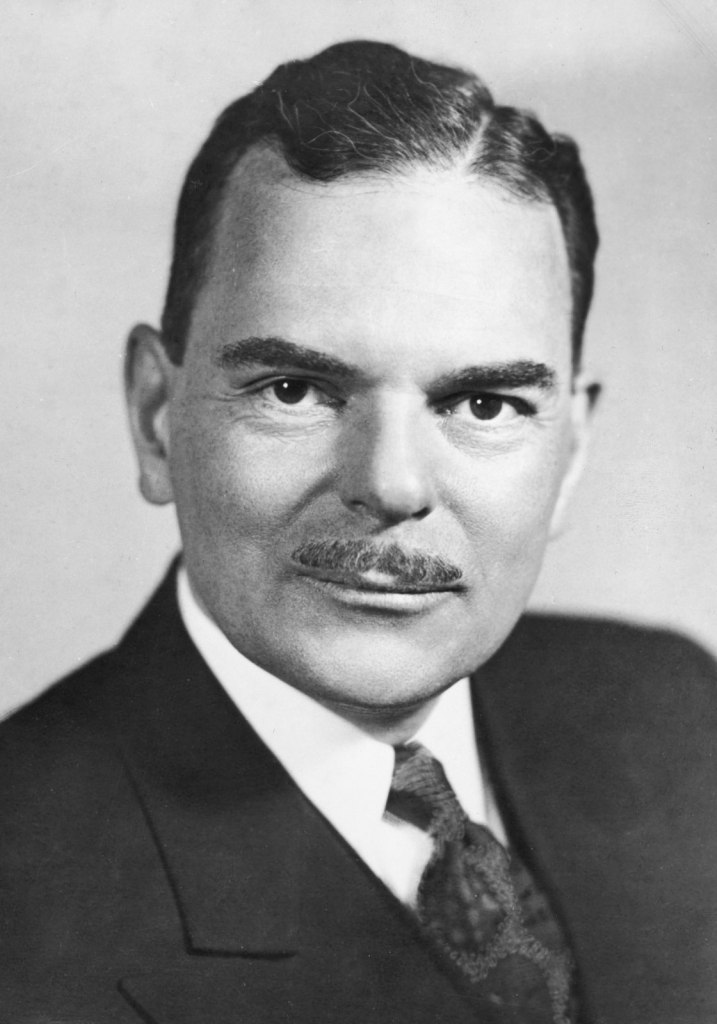
Opposite of the Taft wing were the Dewey Republicans, led by New York District Attorney, Thomas Dewey. This group believed that the government had a role in regulating business and were more open-minded about the New Deal. Dewey Republicans threw their support behind the establishment of a minimum wage, the Wagner Act and an end to child labor. They also differed from the Taft wing with their support for intervention into World War II, believing that such intervention would boost American production.

Encyclopædia Britannica

Thomas Dewey lead his namesake wing of the Republican Party.

Over the course of two decades, these two factions would duke it out over which side would be in control of the Republican Party, and each wing had their chance to prove their case to the American people. However, neither side was able to defeat FDR or his successor Harry Truman. There was one change, though. In 1952, when former allied General Dwight D. Eisenhower decided to enter the Republican primary as a Dewey Republican against Robert Taft. The Taft Wing could not hope to defeat the popular general who led the allied forces in Europe. As a consolation, Senator Richard Nixon of California was chosen as Eisenhower’s running mate to gain their support and unite the party. Together, the two won the 1952 presidential election. Eisenhower then set out to enact a fiscal policy of balanced budgets and reduction of the national debt while also advocating for labor rights and social services. Richardson says that the Republicans had been transformed through decades of exile and strife and came back a more egalitarian party akin to their forebears: Abraham Lincoln and Thaddeus Stevens.

The GOP has been down and beaten before and always finds its way back. The questions now are just how long will it be in the wilderness and what it will stand for. Will it dump Trump and attempt to cleanse itself of his legacy and most devoted supporters in Congress? Will it look to the examples of Thomas Dewey and embrace the more egalitarian vision his wing had or continue to channel the spirit of Robert Taft? Ultimately, the decision will fall upon Republicans to answer what it means to be a member of their party.

levanj1@lasalle.edu