Biden’s warning to Russia over Ukraine Invasion

Politics

Elizabeth Boyle, Staff

On Tuesday, Dec. 7, 2021, U.S. President Joe Biden and Russian President Vladimir Putin sat down for a virtual meeting over the course of two hours. It was the first time these leaders have met since they talked in person at the Climate Change Conference in Geneva, Switzerland in June 2021. This meeting was to discuss the increase of Russian military on the Ukrainian Border. 

            During this call, President Biden made it clear that there would be drastic economic constraints on Russia if the threat continued. Biden said he could see “a very real cost” on Russia’s economy. The U.S. placing enhanced sanctions on Moscow was addressed during the conversation. President Biden was trying to neutralize the threat of another European war during the call. He made it clear that he wants to use diplomacy and conversation to solve this issue with Russia. 

Putin raised concerns about the North Atlantic Treaty Organization (NATO) and moving troops near Russia’s border. Putin said NATO is “building up its military potential at our borders.” Putin said he wants “reliable, legally fixed guarantees excluding the expansion of NATO in the eastern direction and the deployment of offensive strike weapons systems in the states adjacent to Russia.”

President Biden reiterated his support for Ukraine. Biden was the sitting vice president in 2014 when Russia invaded Ukraine by means of taking the Crimean Peninsula on the Black Sea. At that time, the U.S. and European Union (EU) sanctions against Russia were ineffective as Russia successfully took the territory from Ukraine.

In addition to speaking with Putin, the Biden administration has been communicating with Germany about the Nord Stream 2 natural gas pipeline and what actions would be appropriate if Russia were to invade Ukraine. Nord Stream 2 is an offshore natural gas line that runs under the Baltic Sea and connects Russia and Germany. It was designed to explicitly bypass Poland and Ukraine, denying those countries of tax revenue and forging a stronger economic bond between Russia and Germany. Nord Stream 2, which was completed in Sept. 2021 but is not yet being used to flow gas from Russia to Germany, is currently supported by the Biden administration after being opposed during the Trump administration. On Dec. 7, U.S. National Security Advisor Jake Sullivan explicitly said that the U.S. was prepared to use the pipeline as a bargaining chip to deter Russian aggression in Ukraine. 

            White House press secretary Jen Psaki said “we’ve consulted significantly with our allies and believe we have a path forward that would impose significant severe harm on the Russian Economy.” Psaki said that shutting down Nord Stream 2 is “a threat. You can call that a fact. You can call that preparation. You can call it whatever you want to call it.” This shows that the U.S. is being proactive and examining a full range of diplomatic and economic options, but steering clear of an overt military response to the situation on the Russia-Ukraine border. 

Temple Shooting a Part of a Larger Pattern

Politics

This article contains Political Commentary

Sarah Hanlon, Staff

On Nov. 28, a Temple senior was shot and killed in broad daylight, just off the university’s North Philadelphia campus. At approximately 1:30 p.m., 21-year-old Samuel Collington parked an SUV at 2252 North Park Avenue and began to unload it after a trip to his family’s home in Prospect Park, Delaware County. Video evidence shows that a suspect approached the vehicle in an attempted robbery. After a struggle, Collington was shot twice in the chest. He was taken to nearby Temple University Hospital, where he died of his injuries.

Collington was a political science major, set to graduate this Spring. He was an active member of the Philadelphia community, and was working an internship as a Democracy Fellow at City Commissioner Omar Sabir’s office. The Collington family held a vigil to commemorate their son on Dec. 6. Temple is offering support for their students through the university’s Tuttleman Counseling Services.

Mayor Jim Kenney released a statement Sunday night. Kenney referred to the shooting as a case of “bad things happening to good people,” and reiterated the city’s focus on the gun violence epidemic.

The murder of an innocent college student sparked outrage in the Philadelphia area and rocked the Temple community. However, this is yet another example of the violence that holds a grip on the city. Philadelphia is experiencing its deadliest year on record, with at least 506 homicides in 2021 so far.

Collington’s murder happened just two weeks after 18-year-old Ahmir Jones was shot and killed on the 1700 block of Cecil B. Moore, also near Temple’s campus. On Nov. 16, Jones, a Pottstown High School senior, was walking with his girlfriend when two men attempted to rob them at 2:15 a.m. The men took the girl’s cellphone, then shot Jones in the chest.

Temple University and the Philadelphia Police both responded to Jones’ murder by increasing security patrols in key areas around and on campus. However, increased patrols did not deter the person who killed Collington.

Philadelphia’s rise in gun violence is not unique to this city. Unfortunately, a study by the Council on Criminal Justice estimates that homicides in United States cities increased by 30 percent from 2019 to 2020, and again by nine percent from 2020 through the first three quarters of 2021.

Politicians in cities across the country are responding to the violence by increasing funding for police forces. This comes one year after protesters nationwide called for cities to “defund the police” and re-allocate resources towards social welfare programs.

There is no definitive answer to explain the rise in gun violence across America. Some researchers point to socioeconomic strain caused by the ongoing COVID-19 pandemic. Gun sales, thus the number of guns on the streets, spiked during the pandemic. Psychological stress and poor economic outlook, both effects of the pandemic, are linked to root causes of criminal behavior. 

Other researchers suggest that the spike in gun violence is due to social unrest following the murders of George Floyd and Ahmaud Arbery. Inequality and social disruption are linked to criminal behavior, and cities across the United States experienced a similar uptick in gun violence following the shootings of Michael Brown and 12-year-old Tamir Rice in 2014. However, the exact causes of crime are complex, long-acting sociological issues that cannot be definitively proven, especially in the short-term.

Students across Philadelphia are weary following the violence at Temple. Students have the right to feel safe on their campuses. However, it is important to remember that Philadelphia residents also have the right to feel safe in their own neighborhoods.

Gun violence affects people of all races and ethnicities, but it disproportionately harms communities of color, especially Black neighborhoods. Based on a report by the Philadelphia Police Department, Black men accounted for 73 percent of all gun homicides in 2019. When Black women were added, Black Philadelphians accounted for 85 percent of all gun homicide deaths for that year, even though they account for 43 percent of the city’s demographic makeup (Everytown Research, 2021).

Temple University’s undergraduate population is 56 percent white and 12 percent Black. La Salle University’s undergraduate population is 54 percent white and 17 percent Black.

With the city experiencing a record-breaking homicide rate, college students should be aware of crime near their campuses. No one thinks they will be a victim of a crime until it happens to them. However, students must respond with outrage to all gun violence in the city, not just the homicides near their schools.

Tensions rising between Ukraine and Russia

Politics

Elizabeth Boyle, Staff

Over the past few months, the Russian army has virtually encircled the Northern border of Ukraine with over 92,000 troops. This past week Ukrainian President Volodymyr Zelensky claimed that Ukraine had intercepted communications in Russia talking about Russian involvement in orchestrating a coup d’etat against the Kiev Government. Likewise, the head of Ukraine’s Defense Intelligence Agency, Brig. Gen. Kyrylo Budanov, reported that Russian forces are preparing for a combined air, artillery and armor attack sometime in January or February.

Russia has denied any allegations that it has plans to invade Ukraine. 

Russian-Ukrainian tension has been on the U.S. and The North Atlantic Treaty Organization (NATO)‘s radar for quite a while, but any time the issue is brought to the forefront, Russian President Vladimir Putin has denied that Russia has any plans to invade Ukraine. Putin’s denials have not lessened current concern in light of Russia seizing Ukraine’s Crimean Peninsula in 2014, and ongoing Russian supported fighting throughout Eastern Ukraine.

In light of these potential allegations, the U.S. and members of NATO have begun coordinating about how to neutralize Russia’s threat to Ukrainian sovereignty. After hearing about these conversations, President Putin talked about the West’s response at his annual state of the union address. Putin warned the West not to cross Russia’s security “red line” by placing offensive weapons systems, especially advanced missile systems, in Ukraine. Putin said that if the Western militaries move high technology missiles into Ukraine, Moscow would be exposed and be open to an attack within 5 to 10 minutes. Putin explained, “if supersonic weapons are placed there [in Ukraine]” then the risk of an attack on Moscow could happen in as little as five minutes. Putin went on to explain how Russia has created a sea based hypersonic missile, which Putin said can travel nine times the speed of sound. He says, “the flight time to those who give out such orders will also be 5 minutes.” Putin said his deployment of such weaponry is specifically made to enforce Moscow’s “red line.” 

In response to Russian troops surrounding Ukraine and Putin’s explanation of a missile made to protect the “red line,” U.S. Secretary of State Anthony Blinken gave Russia a warning while he was in Latvia on Tuesday. Blinken said any aggression can “trigger serious consequences.” At the time he was meeting with the Latvian foreign minister Edgars Rinkevics. Blinken was in Latvia specifically to discuss the movement of Russian troops on the Ukrainian border and said they plan to continue the conversation as NATO ministers convene a meeting later in the week.

  In coordination with NATO, the Biden administration is debating whether or not to send U.S. military personnel and weapons to Ukraine to deter and/or prepare for a possible invasion by Russia. NATO Secretary General, Jens Stoltenberg, has told the U.S. and other NATO militaries to prepare for the worst, as he is concerned that Russia is indeed preparing to invade Ukraine. Additionally, the U.S. has been discussing possible economic sanctions with the European Union in the event that Ukraine is invaded. 

Amid the global conversation about the rising tension, Putin continues to deny that he has any plans to invade Ukraine, and has accused the U.S. and its allies of trying to challenge Russia’s efforts to secure its territory and its “near abroad” interests.

All things Omicron

Politics

Rachel Phillips, Staff

Kasey Brammell

On November 26, members of the W.H.O Technical Advisory Group on Virus Evolution identified another mutation of Covid-19, known as the Omicron variant. This strain, while initially detected in South Africa has already emerged in 20 countries around the world, the most recent being Brazil and Canada. The rapid transmission and potential immunity of the virus to current vaccinations have further raised alarm, particularly as the travel-heavy holiday season quickly approaches. However, despite its transmission rates, health experts remain optimistically hesitant to label the virus as severe or prevalent as the Delta Variant- which remains the most infectious mutation. Dr. Fauci, White House Medical Chief Advisor and Director of the National Institute of Allergy and Infectious Disease, has coordinated with South African health officials in determining the symptoms of early cases and severity of a potential outbreak. However, Dr. Fauci remains adamant that a more accurate understanding of the virus requires testing on its potential immunity evasion, which may be at least two weeks away. In the meantime, many countries are implementing global precautions through travel restrictions or temporary travel bans. In the United States, President Joe Biden has enacted a travel ban from those attempting to enter the United States from South Africa. This decision is currently being considered on a “week to week” basis, contingent on the arrival of new information regarding the variant. In his most recent statement, Joe Biden has also promised not to blind-side Europe with sudden travel restrictions before the holiday season, a decision that is again contingent on the arrival of new information in the upcoming weeks. In addition to travel bans, many countries are again emphasizing the importance of vaccination and the newly available booster shots. As Dr. Fauci states, “we don’t know what degree of diminution of protection is going to be. But we know that when you boost somebody, you elevate your level of protection very high. And we are hoping, and I think with good reason, to feel good that there will be some degree of protection. Therefore, as we said, if you’re unvaccinated get vaccinated, and if you’re vaccinated, get boosted.”

Netflix’s “Living Undocumented” a never-ending nightmare

Politics

Jada Urbaez, Writer

Immigration policies can be a sensitive topic for America, and a complex one due to the heartbreaking realities these laws cause families to face.

U.S. Immigration and Customs Enforcement (I.C.E.) was created in 2003 “to protect America from the cross-border crime and illegal immigration that threaten national security and public safety,” according to their mission statement. 

To some, I.C.E.’s mission looks promising, protective and necessary. To others, the condition of the detention centers across the U.S., those taken into custody and the procedures done by I.C.E. officers are viewed as contradictory, inhumane and unnecessary. 

To gain an empathetic perspective on deportations and separation of families, it would be ideal to see what life is truly like for individuals without proper documentation. Luckily, Living Undocumented, a docuseries produced by Many Teefy, Selena Gomez and Eli Holzman, provides authentic information and digs deep into families’ experiences with deportation. The 2019 Netflix Original is six episodes long, following journeys of numerous families who emigrated from Israel, Mexico, Mauritania, Colombia, Laos and Honduras. The eight families in the series include two each from California and Texas as well as families from Wisconsin, South Carolina, Maryland and Florida.

Alejandra, for instance, is a Mexican woman introduced in the first episode. Although she is a military wife, due to the “zero tolerance policy” of the Trump administration, her appeals were denied by the government.

Living Undocumented highlights the hardship, fear and raw reality of these particular undocumented families’ everyday lives, but also gives greater understanding of the perspectives of millions of other people who have similar experiences.

Biden’s approval rating is at its all-time low — how does that compare with past presidents’?

Politics

Alina Snopkowski, Editor

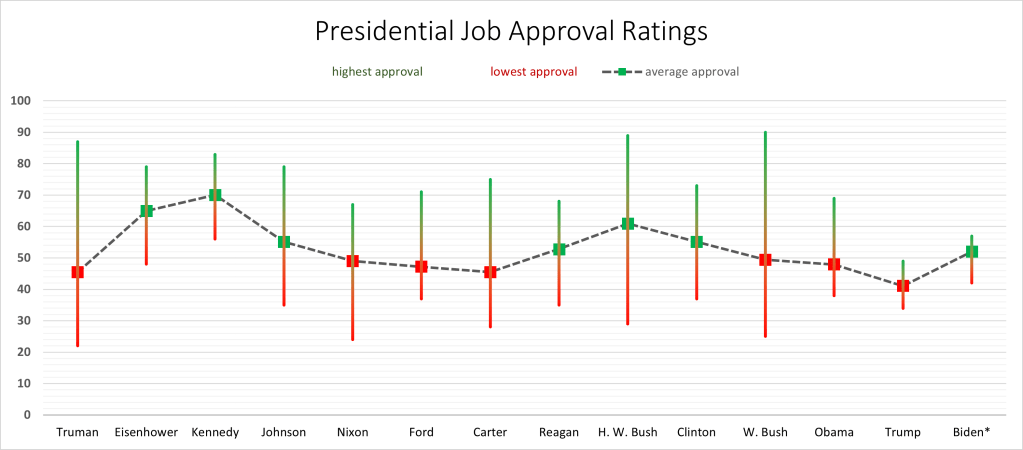
President Joe Biden’s approval rating is the lowest it’s ever been. According to recent Gallup polls, Biden’s current job approval rating is 42 percent, down from 57 percent at the beginning of his presidency. Biden’s current approval rating is lower than every other president Gallup has asked about at this point in their presidency — besides former President Donald Trump, who had just a 37 percent approval rating at around the same time in his presidency. The most dramatic difference between Biden and a past president is between him and former President George W. Bush — 301 days into their presidencies, Bush’s approval rating was 85 percent, particularly because at this time in 2001 the country was only a couple months removed from the Sept. 11 terrorist attacks.

Of course, these things tend to fluctuate, and only two former presidents — Dwight D. Eisenhower and John F. Kennedy — enjoyed net positive approval ratings throughout their entire presidencies.

This chart is a comparison of the 14 most recent presidents and their job approval ratings from throughout their presidencies, using the numbers from Gallup’s site.

Alina Snopkowski

If Biden is counted, half of the fourteen most recent presidents have had average approval ratings over 50 percent (including him), while the other half have had averages below 50 percent. There is a large difference between the highest and lowest approval ratings throughout the presidencies of both Bushes and Harry S. Truman, but the difference between Trump’s highest and lowest approval ratings is only 15 percentage points — the same number between Biden’s, as of now.

Of course, Biden is a different case, considering he hasn’t even been in office for an entire year yet, but it is interesting to see the variations in approval ratings over time among other presidents. Truman, for example, had very high approval ratings after the end of World War II, but they had dropped dramatically by the end of his presidency. Lyndon B. Johnson’s approval was on a downward slope for most of his time in office, while from the end of his first year onward, former President Barack Obama trended mostly around or just under 50 percent.

Four of these former presidents also lost their reelection bids, and all had approval ratings right before the elections in the 30s or low 40s — Gerald Ford, Jimmy Carter, George H. W. Bush, and Donald Trump. Obama and George W. Bush both had approval ratings just below 50 percent but still won their second terms, while Truman had an approval rating of just 39 percent right before the 1948 election, which he still managed to win. The 2024 election is still far ahead of us and there’s no certainty that Biden will (or won’t) seek another term, however, so it might be premature to talk about that now.

Alina Snopkowski

So, something that we can discuss now — when compared to past presidents, Biden’s job approval rating was low right after his inauguration, too. Gallup’s first poll after his election showed a 57 percent approval rating, which beats Trump again (44 percent) as well as Ronald Reagan and George H. W. Bush (51 percent each). The younger Bush’s initial approval ratings were tied with Biden’s, which means that the other nine presidents had higher first approval ratings after they took office (Truman, Johnson, and Ford weren’t elected, which might count for something).

What I find particularly interesting, however, is the percentage change between Biden’s post-inauguration approval and his approval now roughly 300 days in. The comparisons with former presidents aren’t perfect here, because the polls were taken at different points in their presidencies, but every president back to Truman (besides Johnson) has a rating from within about a month shy of 300 days in office. These numbers show that most presidents have a lower approval rating at these later times than just following their elections, but Biden still ranks among the top (or bottom, depending on how you look at it) here — his approval rating fell by 26 percent from his inauguration until now, which beats every former president besides Truman and Ford (both at 28 percent), who weren’t elected to their first terms anyway. The most dramatic increase is 54 percent for George W. Bush, again due to Sept. 11.

No poll is perfect, and there’s many other ways of gauging how a president is doing in office, but public opinion polls can be an interesting and valuable way of measuring what people think about the president’s job performance. Historical trends can show how our current president stacks up against those in the past and give us a metric to see how the public’s opinion on a particular president has changed over time.

Biden isn’t even a year into his presidency yet, so just about anything could happen in terms of what the American people think about him. Compared to past presidents, Biden’s approval rating is not the worst in just about any way you slice it, however, his falling ratings since January do show that he has lost some support since then.

First Time a Woman Graduates from the Army Sniper Course

Politics

Elizabeth Boyle, Staff

In December 2020, a woman enlisted in the Montana Army National Guard. S and she is now the first woman to complete the United States Army’s Elite Sniper School. This woman, who was stationed at Fort Benning, Georgia for her initial military training called One Station Unit Training ( or OSUT), does not wish to be publicly identified. Based on her performance at OSUT, course she was recommended for the sniper school by her superior. 

            She completed the seven-week sniper course, also at Fort Benning. In order to enter the sniper school, a soldier must be on active duty or in the National Guard or Reserves. A soldier must volunteer to begin school and have a letter of recommendation from his or her commander.     According to the U.S. Army, Fort Benning, and the Maneuver Center of Excellence, the sniper course was created to, “educate snipers to be adaptive soldiers, critical and& creative thinkers, armed with the technical, tactical, and logistical skills necessary to serve successfully at the sniper team level [and] prepare snipers with a principal understanding of team duties and responsibility.” The course trains a soldier in advanced camouflage, target detection, intelligence preparation of the battlefield (IPB), relevant reporting procedures, sniper tactics, advanced marksmanship, moving targets in the light and in the dark, battlefield awareness, and complex engagements. After a soldier is trained in these areas, he or she must pass various tests using simulated real-life events in order to pass the course. After her success in the sniper course, her OSUT company commander, Joshua O’Neill, said, “We’re all incredibly proud of her. There wasn’t a doubt in our minds that she would succeed.”

            One of the most famous female snipers was Lyudmila Pavlivhenko from Ukraine. She served in the Soviet Army during World War II. After the war, she was invited to the U.S. by Eleanor Roosevelt, said Smithsonian Magazine in 2013. She was invited to discuss her combat experience while on a tour of the country.

            In the U.S., the first women sniper, Senior Airman Jennifer Weitekamp, a member of the Illinois Air National Guard, graduated from the National Guard’s sniper school’s Counter-Sniper Course for Air Guard Security Force in April 2001. At that time this was the only sniper school open to women in the U.S. military. Weitekamp said, “they asked for volunteers for this training program, and I really wanted to go, so I volunteered.” Weitekamp understood the doors she opened for other women at the time. She explained, “I was the first woman to go through, it was because of that and the opportunities it would open up for future women that helped me get through the training and kept me motivated.”

The 2363 Act: Ohio’s Proposed Abortion Ban

Politics

Rachel Phillips, Staff

Texas may soon lose its status as the state with the most restrictive abortion law. As of Wednesday, Nov. 3, 2021, Republican lawmakers in Ohio have proposed an abortion bill with a severity that could overshadow the current “Heartbeat Bill” in Texas. The potential bill, also known as the 2363 act, a name that according to Ohio lawmakers reflects the number of daily abortions performed in the U.S., will ultimately place a total ban on abortion. If passed, the legislation will not include exceptions for rape or incest, nor will it allow for an abortion prior to the detection of a fetal heartbeat. In addition, similar to the social repercussion of the Texas bill, the 2363 Act will allow any civilian to file lawsuits of at least $10,000 to those caught receiving, aiding, or performing an abortion. Furthermore, if enacted, the bill will also ban defendants of civil suits from skirting prosecution based on claims of ignorance of the law or personal belief that it is unconstitutional.

In addition, it seems the arrival of the 2363 Act has prompted other states to consider similar copycat bills. Several states, including Arkansas, Mississippi, Missouri, North Dakota and Indiana, have publicly announced interest in an abortion ban and may attempt to initiate reform as early as January of 2022.

Current Ohio House Minority Leader Emilia Sykes has slammed the potential bill, labeling it “an egregious assault on women, a dangerous attack on healthcare rights and an embarrassment for the state.” However, despite the ongoing criticism of Sykes and the outrage from both healthcare providers and recipients, the 2363 Act has already been signed by 33 lawmakers, more than half of the House GOP caucus. While this does not guarantee a victory for the bill or Republican leaders, the early momentum does suggest an increased likelihood of passage.

Adrienne Kimmel, current president of Pro-Choice America, is one of many women who believe that the outcome in Ohio will be a decisive vote for the country and the future of healthcare freedom for women. She states, “The domino effect is well under way and will only continue to escalate in cruelty, as long as the Supreme Court allows legislation like Texas’ blatantly unconstitutional law to stand.”

Critical Race Theory is not being taught in K-12

Politics

As a result of the COVID-19 pandemic, where thousands of students K-12 were forced to learn from home, we see parents becoming more and more involved in their child’s education, as the average American home has transformed into both the work space for the parent and the school for the child. While parents defend their interest in their children’s education as looking to ensure the education their children are receiving is quality, the overinvolvement in curriculum has rather the opposite effect. Critical Race Theory (CRT) is a concept parents in recent months have been avidly protesting against teaching to K-12 students. Contrary to this opposition, however, Critical Race Theory is not being taught in K-12 at all.


Google search records of “Critical Race Theory” since 2004
google search records of “Critical Race Theory” since the beginning of the year

In a 17 year Google Trends highlight, search results for “Critical Race Theory” have only exploded in interest since June of 2021. This implies that people are ill-informed about what CRT is in the first place. 

CRT refers to a theorem practiced in law concerning the intersection of race and law and further explorations of a racially biased justice system. While this theorem may be controversial to some parents, it is not actually being taught in K-12 schools, as it is a high level law theorem discussed in law school. Thus, this begs the question — if parents are not protesting the teaching of CRT in their child’s school… what are they protesting?

What parents are protesting is the blaming of one specific racial or ethnic group in teaching history as they believe it is the political-division of America today. The Idaho State law bill NO. 377 entitled “Dignity and Nondiscrimination in Public Education Act” bans teaching in history that, “individuals, by virtue of sex, race, ethnicity, religion, color or national origin, are inherently responsible for actions committed in the past by other members of the same sex, race, ethnicity, religion, color or national origin.” This law, similar to others being introduced across the country, asserts that educators are banned from teaching students history from a specific perspective or describing how this history involves race, ethnicity, gender and religion.

Nevertheless, this is not what the law is being used to ban in practice, as there is a gray area of what educators are permitted to say about historical issues involving race, religion and ethnicity. Slavery and the Holocaust fall within this area. For example, the statement “white people have contributed to slavery because of the racial hierarchy of the time, which has effects on racial relations today,” would be banned as a result of the Idaho bill, as this statement discusses a racial group heading an action and furthermore that the historical action has effects on society to this day. The bill seeks to avoid involving discussions of race, ethnicity, gender and religion in teaching topics that concern these very concepts, such as slavery.

The bill also impacts the teaching of ethnicity-related historical events such as the Holocaust. In one Texas school district, the executive director of curriculum and instruction for the Carroll Independent School District, Gina Peddy, was recorded on tape as saying “Just try to remember the concepts of [House Bill] 3979… And make sure that if you have a book on the Holocaust, that you have one that has an opposing, that has other perspectives.” The application of the House bill in which Peddy was referencing is being used to teach America’s children an unbiased view of underlined racial events in world history such as the Holocaust, however, “unbiased” and “Holocaust” in the same sentance does not seem to make much sense ethically to some protestors, and neither does avoiding discussions of race in inherentley race-related topics such as that of slavery.

 Discussions surrounding race-related history may be uncomfortable for some, however, there is no sugarcoating history, and race is impossible to remove from events such as slavery and the Holocaust. Several bills like Idaho’s have been passed throughout the country since September, which raises questions surrounding what type of history will be taught to the younger generations. States including Arkansas, Florida, Iowa, New Hampshire, Oklahoma and Tennessee have passed similar legislation which bans the teaching of CRT. With curriculum surrounding race-related events in history being controlled in certain aspects, it begs the question of whether this will improve the quality of education and, furthermore, the wellness of our society, or worsen it.

The Votes Are In: Biden’s Bipartisan Infrastructure Bill

Politics

Rachel Phillips, Staff

Header Image: Alex Brandon/AP

Despite the Democratic in-fighting and senate stalemates of recent months, Biden’s bipartisan infrastructure bill was finally passed on Friday, Nov. 6. While the plan does not include the passage of Biden’s ambitious economic plan, it does currently quell inter-party conflict and could bolster confidence in the Democratic platform, both of which were much-needed outcomes for the party following the election results of the previous week and in preparing for the upcoming election seasons. As for now, however, Biden’s administration can celebrate the 228-206 vote of this historic legislation, whose size and anticipated effect is comparable to Eisenhower’s interstate highway agenda in the 1950s.

The $1.2 trillion bipartisan infrastructure bill will provide increased funding for federal investments of national infrastructure, particularly by expanding America’s roads, bridges and public transport systems. In addition, this legislation will also increase the accessibility of drinkable water, by replacing lead pipes in both urban and rural areas with safer alternatives. Furthermore, the bill will also invest in broadband infrastructure, to mitigate the professional and education disadvantages certain demographics still face. By investing in high-speed internet, the Biden administration is hoping to lower the cost of internet service and close the digital divide that currently affects nearly 30 million Americans.

The administration was also careful to include environmental stipulations within each infrastructure program so as to continue to progress green initiatives nationwide. Moving forward, Biden’s team is hopeful that his economic bill, also known as the Build Back Better agenda, will experience similar bipartisan success. The next anticipated vote on the bill is scheduled for Nov. 15, and, if successful, could pass a variety of Democratic priorities and pillars of Biden’s campaign.