Why do some trees retain their leaves in Winter?

Features

Sean Bradley, Staff

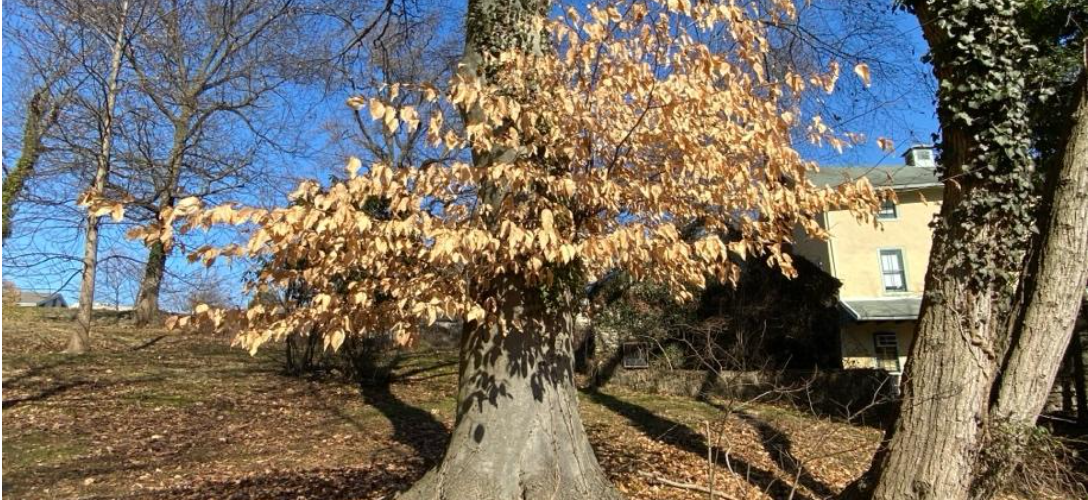
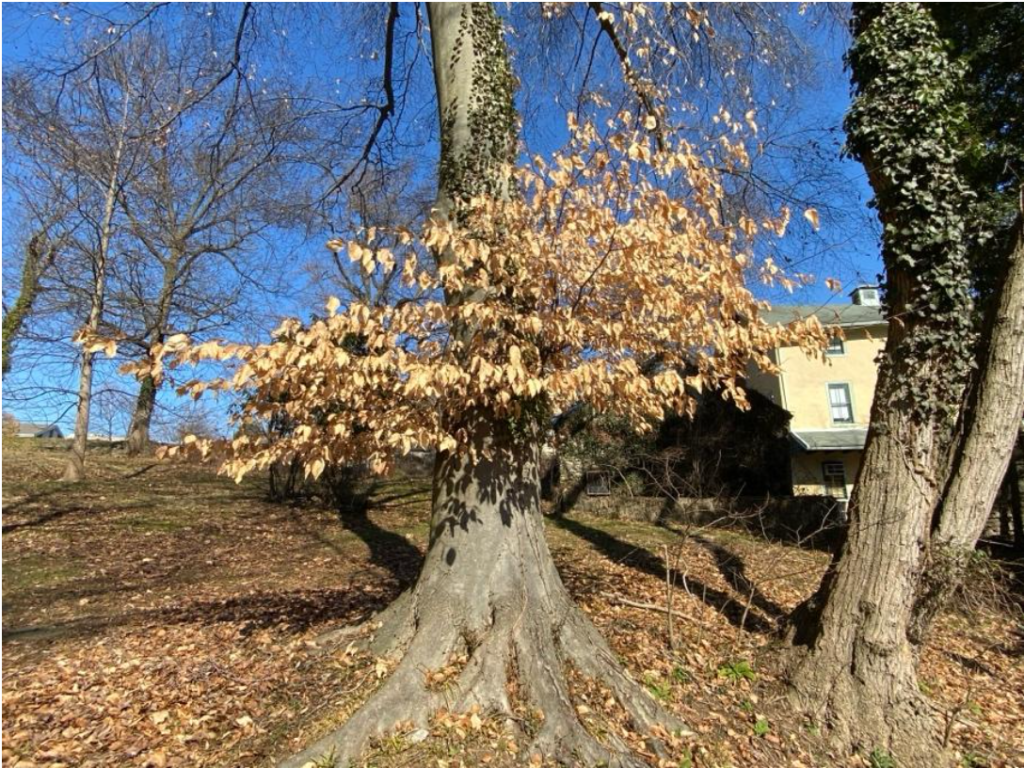
By mid-winter, most deciduous trees have shed their leaves. However, some deciduous trees, like oaks and beeches, will retain their leaves well into winter in a phenomenon known as marcescence. In this Nature at La Salle article, we’ll learn how and why this phenomenon occurs. 

The process for trees undergoing marcescence begins in the fall. Beginning in the fall, many deciduous trees create a separation layer between the leaf stem and branch called the abscission layer. For trees that shed their leaves, the abscission layer undergoes completion. Once the abscission layer is formed, nutrients and water are no longer able to be transported to the leaves and thus the leaves fall. Not only does the abscission layer protect the trees from damage as the leaves are shedding, but it also protects the trees from the cold, winter weather. By forming an abscission layer and shedding leaves, trees conserve energy as well as conserve moisture and nutrients within the trunk. The fallen leaves eventually decompose and return nutrients to the trees’ roots to ensure their survival. However, trees with marcescent leaves do not completely form an abscission layer. 

While the exact reasons for marcescence are unknown, scientists have a few ideas on why it occurs in some trees. According to a PennState Extension article, trees retain their leaves for these three reasons: protection, food and water. Starting with protection, since marcescence mainly occurs in younger trees and on lower branches, scientists believe the retained leaves help protect new, spring buds from being eaten by animals, like deer. Having marcescent leaves allows the buds to survive and the trees to continue growing. Food is another possibility for why marcescence occurs. Scientists think that marcescent trees keep their leaves until spring, so that they can add more nutrients to the soil for food and growth by shedding their leaves once all the fallen leaves from autumn have decomposed. Lastly, water is another possible reason for why trees experience marcescence. Scientists think that the marcescent leaves help direct precipitation, like snow, to the tree’s base, allowing for water to seep into the roots.

 
So, the next time you’re outside on a walk on a winter day, you can appreciate and understand the science behind this cool phenomenon.

Marcescent leaves on an American Beech at La Salle University via Sean Bradley

Support Electric Vehicles and clean energy for economic and environmental gains

Features, Uncategorized

Danielle O’Brien

Thanks to the strong car pollution standards and tax rebates in President Biden’s clean energy plan, a transition to Electric Vehicles is more feasible for the average Pennsylvania household than ever, not to mention such a transition precludes other benefits.

One of the other biggest concerns that discouraged Americans from purchasing an Electric Vehicle (EV) aside from cost, however, was the accessibility of powering stations. Nevertheless, the Commonwealth of Pennsylvania is currently putting together plans that would guarantee EV charging stations every 50 miles along 11 of Pennsylvania’s 12 primary interstate highways.

Switching to EVswill save money and help combat climate change. EVs are great for the environment as they cut down on pollution, making the air cleaner and reducing our carbon footprint. Federal policies, like tough pollution rules and tax incentives in President Biden’s clean energy plan, are encouraging cleaner cars. This transition will also boost the clean energy sector, making America more self-sufficient.

This is important in today’s world. Using EVs can reduce our dependence on foreign oil, especially given recent events in the Middle East. This change makes our energy security stronger and lessens our exposure to unstable oil prices and geopolitical conflicts that force our country to make questionable as well as drastic decisions in order to secure oil supplies.

I encourage readers to consider making the switch to electric vehicles, conduct their research, and support policies in Pennsylvania promoting cleaner transportation. After all, your choices can contribute to a more sustainable and self-reliant future. 

Fall nature at La Salle

Features

Sean Bradley, Staff

Last week, the fall foliage was in its prime. Although the colors are beginning to fade away, you still may be wondering what is behind the changing of the leaf colors and why the leaves fall in autumn. This Nature at La Salle article will explore what causes the leaves to change color as well as why the leaves fall in autumn.

There are three factors that affect fall leaf color, including leaf pigment, night length and weather. First, starting with pigment and night length, most leaves are green in summer because they contain a pigment called chlorophyll, which absorbs sunlight to convert into sugars in a process called photosynthesis. But, as the night length increases, the leaves receive less sunlight, resulting in chlorophyll breaking down and yellow, orange and brown pigments called carotenoids being revealed. Also, as the nights get longer, some leaves’ veins, which carry sugars to and from the leaves, close and cell layers form at the leaves’ bases. The sugars then become trapped in the leaves. The clogged veins cause the leaves to produce a red pigment called anthocyanin. Weather also affects fall leaf color, with temperature and moisture being major influences. Regarding temperature, warm, sunny days and cool nights often result in the most colorful foliage. Anthocyanin pigments do particularly well under these conditions. The sugars produced in the leaves during the day become trapped in the leaves at night, resulting in brilliant red foliage. Since carotenoids are found naturally in leaves, yellow, orange and brown foliage occur more consistently. In terms of moisture, warm, wet springs, warm summers and warm, sunny fall days with cool nights often produce the best fall colors. Summer droughts and warmer fall weather result in delayed and duller fall colors.

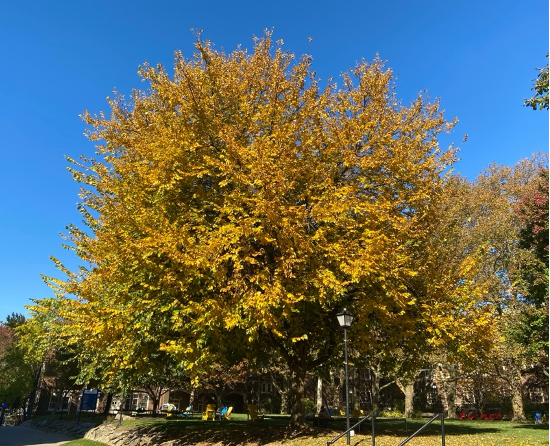
Additionally, certain leaf colors are associated with particular species. For instance, maples usually have red or orange leaves, whereas oaks have brown leaves. Birches, elms, hickories and tulip-trees have yellow leaves while beeches have tan leaves and dogwoods have purplish-red leaves.

While seeing the leaves change color and fall is a pretty sight, it is also important for the trees’ survival. Unlike evergreen needles, which have protective coatings and cells containing fluids that resist freezing, leaf tissues are tender and thin and lack these sorts of protections. Thus, many deciduous trees drop their leaves to avoid freezing. Lastly, once the leaves settle on the ground, they are still important because they decompose and help form the organic layer of the soil. This process provides nutrients and retains water for the trees to survive. The fallen leaves also provide habitat for small animals, including bees, butterflies, salamanders and earthworms, who hibernate, feed and lay eggs here.

So, the next time you’re outside on a fall day, appreciate the science behind fall foliage. Take a moment to remember the importance of fallen leaves for the trees’ survival and wildlife.

American Elm, via Sean Bradley

Sugar Maple leaf via Sean Bradley 

Red Maple via Sean Bradley

Upcoming Explorer Café events

Features

Provided to The Collegian by La Salle’s political science department 

There are more Explorer Café events coming up in November on a range of topics. Read more about them below:

Topic: Overcoming Gun Violence in Philadelphia: A Hope That Lights the Way!

Location: Holroyd Atrium

Time/Date: 12:30 (Universal Free Period)/9 November 2023

Summary: This Explorer Café will screen and provide an open discussion about the film, A Hope That Lights The Way, a community-based engagement process and a documentary that uplifts the impactful stories of people who have successfully overcome the numerous challenges posed by gun violence. The movie chronicles an ongoing narrative of progress and transformation. 

Facilitators: Octavius L. Blount, Coordinator, Mayor’s Office of Black Male Engagement, and Jude Husein, ’20, Director of State Advocacy, Senate of Pennsylvania, Office of Senator Art Haywood 

Topic: Food Insecurity, Homelessness and Poverty in America

Location: Holroyd Atrium

Time/Date: 12:30 (Universal Free Period)/Nov, 14 2023 – 12:30 PM (free period)

Summary: This café will present food insecurity on campus. Are students getting the food they need? Laura Frank, the founder of The Basket student food pantry and professor of nutrition, along with PHEED Philadelphia, student-led organization, will encourage a discussion of food insecurity, its impacts, and ways you can volunteer.

Facilitator: Laura Frank (Nutrition) and PHEED Philadelphia coordinators  

Topic: Pardon Me: Your Rights to Life, Liberty and the Pursuit of Happiness after a Criminal Conviction

Location: Holroyd Atrium

Time/Date: 12:30 (Universal Free Period)/Nov, 28 2023 – 12:30 PM (free period)

Summary: This Café will first feature a screening of the new documentary, Pardon Me (trailer here), produced and directed by Shuja Moore. The subsequent discussion will address whether people formerly convicted of a crime deserve to live in a second-class status, being denied access to employment, housing, parental rights, student loans, public office, and other opportunities.  Options to remove this second-class status, including a pardon, will be explored. 

Facilitator: Caitlin Taylor (Sociology & Criminal Justice) and Shuja Moore (local filmmaker) 

Read more about previous Explorer Cafe events. 

7 last minute Halloween costumes from your closet

Features

Karly Zimmerman, Staff

Although the long-awaited spooky season is upon us, Halloween festivities and costume planning often slip our minds as the semester continues with classes, holiday breaks and campus activities. Our ever-growing to-do lists can cause finding the perfect costume to become an afterthought, but never fear! We are here with seven last-minute costumes that are guaranteed to turn heads at any Halloween function. The best part? They are already in your closet.

1. “The Plastics”

We are starting our list with a fan favorite from Tina Fey’s Mean Girls!

Simply pair any plaid or denim mini-skirt with a matching cropped shirt or baby tee. Bonus points if it’s pink! This outfit can either be worn with sneakers or a cute set of kitten heels, making it the perfect outfit for a long day/night. Once assembled, feel free to throw on your favorite shoulder bag and load on the lip gloss to complete this nostalgic Y2K ensemble.

Whether you choose to channel your inner Gretchen, Karen or Regina George this Halloween,your costume is sure to pay homage to the cult-classic film.

2. 80s Prom Queen

Your old homecoming/prom dress may have a chance to steal the spotlight for a second time with this unique costume idea. You can achieve this look in only a few steps:

–   Put on a brightly colored dress of any length.

–   Give your hair a little tease.

–   Add some bold eyeshadow, blush and hairspray.

–   Top it all off with a tiara!

If you feel as though your closet is not living up to the drama and glamor of the 80s, visit your local thrift shop and pick out your best 80s garb for a quick, inexpensive and sustainable way to ensure you are the “queen” of the season.

3. Wednesday Addams

We are heading back to the movies for our third DIY costume!

Wednesday Addams, a character that has been dominating the Halloween scene for years, can easily be recreated with a few simple pieces from your wardrobe.

This costume can be worn with any articles of black clothing, making it a “blank canvas” for the wearer. Whether you choose to do a black skirt or jeans, a black long sleeve or tank top or a black dress, you will be unmistakable so long as you are sporting Wednesday’s two iconic pigtail braids! Adding accessories like tights, jewelry and platform boots will help make this outfit your own!

4. Freddy Mercury

Simple yet guaranteed to make a statement. All it takes to achieve Queen’s star singer’s iconic look is a white sleeveless shirt with a pair of light wash denim jeans. Be sure to add a black chunky belt for more 80s flair!

Once all is said and done, you can then add your own sneakers, Freddy’s timeless mustache, and microphone to customize your look.

5. Queen of Hearts

Much like Miss Wednesday Addams, the Queen of Hearts costume simply requires multiple pieces of clothing highlighting one color: red! Any red dress, matching set or tank top-skirt combo will help you achieve this sassy look.

If you happen to have a deck of cards lying around, try finding unique ways to feature them in your outfit! You can adhere your deck of cards using safety pins and/or fashion tape, or you can make a playful hairpiece using a few bobby pins.

6. Pirate

A classic as old as time, the pirate costume still holds to be the perfect costume for all genders. One could look for a white dress with puffed sleeves or a ruffled white shirt and pair it with a black skirt, leggings or slacks.

Accessories such as corsets, bandanas, and vintage jewelry will certainly help elevate this look! The costume could be worn with a pair of knee-high boots, platform boots or sneakers, providing you with another comfortable and laid-back costume for those longer days/nights.

7. Biker

If you are already planning on breaking out your bandana(s) for some Halloween adventures as a pirate, you might want to keep them handy for our last DIY costume!

Acting as a great co-ed option, this biker look can be completed with only a few pieces. Match any pair of darker bottoms such as leather pants, dark wash jeans and/or fishnet tights with a top of your choice (ie. graphic tee, plain t-shirt, cropped tee), then finish off the ensemble with a leather jacket and a bandana of your choosing. Adding your own touches of jewelry and sunglasses are great ways for everyone to add more style and dimension to this look!

Now it’s time to get creative and scratch “Halloween costume” off your checklist! Explore your wardrobe for these staple pieces and challenge yourself to pair some unique pieces together for some scary good costumes this year!

Fall nature at La Salle

Features

Sean Bradley, staff 

In fall, many plants produce and drop fruits to spread seeds and ensure regeneration for next year. There are some of these native fruit-producing plants on campus.

In botanical terms, a fruit is a mature, ripened ovary (reproductive structure of a flowering plant). The ovary’s purpose is to enclose and protect the ovules until the ovules fertilize and turn into seeds. All fruits have a pericarp (the part of the fruit that surrounds the seeds) with three layers, including an exocarp (outermost layer), a mesocarp (middle layer) and an endocarp (innermost layer). While there are three main types of fruit, including simple, aggregate and multiple, we’ll only look at simple fruits since most of the native fall fruits on campus are in this group. Simple fruits are fruits formed from flowers with one carpel or multiple carpels fused together so that it looks like just one carpel; and they can be fleshy or dry. Three types of simple fruits found on campus are drupes, berries and nuts.

Drupes derive from one carpel and typically have one or two seeds. The exocarp is a thin skin, the mesocarp may be fleshy, and the endocarp is hard and contains the seeds. One native drupe found on campus comes from the flowering dogwood. Dogwood drupes come in clusters of two to ten and turn red when ripe. Despite being inedible, the fruits are an important food source for songbirds because they’re rich in calcium and fats. Another native drupe found on campus comes from the black walnut. Black walnut fruits have a fleshy, brownish-green husk when ripe. Inside the husk is a hard, brown, corrugated seed shell (nut) containing a light brown, edible kernel. The kernels are enjoyed by both people and wildlife.

Drupe on campus via Sean Bradley

The next type of simple fruit we’ll look at are berries. Berries consist of a fleshy pericarp, one carpel or multiple fused carpels, and many seeds. A native fall berry found on campus comes from an herbaceous perennial called American pokeweed. Growing up to three meters tall, pokeweed has round, alternate leaves on a purplish stem. The berries are purplish-black when ripe and grow on hanging clusters. Despite being poisonous to humans, the berries are enjoyed by songbirds.

Berries on campus via Sean Bradley

The last type of simple fruit we’ll look at are nuts. True nuts are dry, indehiscent (meaning the seeds are retained in the dried pericarp), one-seeded fruits with hard exocarps. Acorns, which come from oak trees, are an example of a true nut found on campus. Every two to five years, oaks produce high yields of acorns in what are called “mast years”. While the exact reasons for masting are unknown, it is believed to have an evolutionary benefit of ensuring future offspring. Lastly, not only are they important for feeding native birds and mammals, but acorns are also edible but must be leached of tannins (a bitter plant compound that’s harmful when consumed in high amounts) and properly cooked before consuming.

Nuts on campus via Sean Bradley

“A feature: Is Western Civilization Worth Defending?” 

Features

Kylie McGovern, Editor

The John Henry Neumann Lecture series kicked off with a lecture presented by Professor Joseph Loconte, Ph.D. in the La Salle University Art Museum on Sept. 27. La Salle’s provost, Shivanthi Anandan, Ph.D. introduced Loconte and gave a few words about the history of La Salle and its grounds ranging from stories of the societal ills that once happened on the grounds of the university at the hands of the Wister, the Peales and the Fisher families. Anadan then introduced Loconte’s talk saying, “Tonight, Dr. Loconte will ask us whether Western civilization despite its blemishes is worth defending. We are acutely aware of its ills and those who walked this ground before us knew all too well and lived under their shadow. But it is because of the very western civilization which caused these ills, that these Wisters, the Peales, the Fishers and now we, are called to remedy those ills. We are the vaccine against injustice, a legacy of healing and rejuvenation of which Jean Baptiste de La Salle and those who walked this land, would be proud. Dr Loconte will help us to identify the values, heritage, and ideals to which we must cling to remedy the ills which still beset us today.”

Professor Loconte opened the lecture by discussing a speech from June 1940 from Winston Churchill after France succumbed to Nazi forces. Loconte explained that he believed this speech saved the West. From here, the lecture expanded on topics like how freedom of speech and equal justice are under assault and the negatives that developed from the West like Nazism, Racism and Sexism. Then, Loconte discussed how both liberals and conservatives are questioning the legitimacy of the Western project. 

Dr. Mark Thomas from the Political Science department offered The Collegian comments on Professor Loconte’s lecture. Dr Thomas disagreed with Loconte’s points about Nazism and Racism being leeches on Western civilization in that it understates the phenomena and all the negative consequences and outgrowths of Western civilization. Dr Thomas explained, “Nazism, Racism, Sexism and all phenomena we have experienced historically are more like the evil twin side of Western civilization. The Jekyll and Hyde of Plato, Locke and even Christian belief. The same thought which gave rise to the Enlightenment, Scientific Revolution, and Liberal Democracy also gave birth to the evil fruits.” 

During the lecture, Loconte then began a word association exercise with the audience. The audience associated words and phrases like democracy, capitalism, freedom, algo-sphere, expansion, imperialism, and the American dream with the Western World. Some of these words can be intercepted as being positive, others negative and others neutral depending on one’s viewpoint. 

Loconte also described a history of the Western World relating it to the centuries-long interaction of Greek and Roman culture transformed by Jewish and Christian traditions and transformed again by democratic and technological revolutions. 

Loconte then went on to focus on the long-lasting influence of the Bible. Loconte says he would say even if he was not at a catholic university that “every major advance in the West owes a debt to the influence of the Bible.” 

Overall, this event was well attended with an Art Museum student worker estimating about 50 people in attendance. In addition, Professor Loconte encouraged audience engagement and the audience frequently participated. The lecture was infused with Loconte’s humor throughout and ended with time to ask questions. 

Fall nature on campus

Features

Sean Bradley, Staff

As the growing season winds down, there are several native flowers that bloom to take advantage of the last warm days as well as to support pollinators. There are various native, early fall flowers found on campus.

The first flower on campus is Black-eyed Susan. Native to eastern and central North America and a member of the aster family, this iconic annual gets its name from its flower head that consists of a black, dome-shaped cone consisting of tiny disc florets surrounded by bright, yellow ray florets. Its stems and alternate, oval-shaped leaves are both covered with bristly hairs. The flower’s showy blossoms have made it a popular landscape choice. Here on campus, it can be found growing in large colonies in the Woodland Garden on the quad near College Hall. Not only is it used aesthetically, but Black-eyed Susans are also used for traditional medicines by Native Americans. One known, traditional, medical use of the plant was to take its dried roots and boil them in water to make a tea that boosts immunity,fights colds and aids digestion. Additionally, Black-eyed Susans attract pollinating insects. The seeds from the flower heads also feed seed-eating songbirds. Lastly, it is the state flower of Maryland.


Via Sean Bradley

The next flower here at La Salle is the Blue Mistflower. Like Black-eyed Susan, it is also in the aster family and is native to eastern and central North America. This perennial can be identified by its flat-topped clusters of lavender flower heads, which can have about 40-50 disc florets, as well as its opposite, triangular, toothed leaves. Here on campus,Blue Mistflowers tend to grow in isolated clumps, especially in partly shady areas with moist soil, in the Woodland Garden on the quad. However, with less competition, it can spread quickly and colonize an area. Additionally, it attracts bees and butterflies.


via Sean Bradley

Finally the Late Boneset is native to the eastern United States and a member of the aster family. This perennial can grow from 3 to 6 feet tall and consists of clusters of tiny white flower heads with 9-15 disc florets. Unlike the previous two flowers which are found on the quad, Late Boneset is found growing behind the Communication Center. It tends to grow in disturbed areas, where it forms dense colonies and out-competes other plant species. But despite its weedy nature, Late Boneset is a pollinator magnet and attracts a wide variety of pollinators, including bees, wasps, flies, moths, and butterflies.


Via Sean Bradley

Emilee Desmond feature

Features


Claire Herquet, Staff

The professors in La Salle’s Communication department  provided the opportunity for current students to connect with alumni who have gone through the job search and found themselves doing what they love in the communications career field.  

On Sept. 8, La Salle University welcomed the first guest speaker of the year, communincation alum, Emilee Desmond to speak to one of our Sports Journalism classes about not only acquiring her job working for the Philadelphia 76ers, but how much she loves what she does being a Member Services Coordinator for the professional basketball team.  

 Students were delighted to hear her insight into how she applied her studies and experience gained from volunteering at La Salle, and how it has gotten her the position she has now. 

As a child, Emilee always knew she would be doing something big in the world of sports. She often bonded with her father over professional basketball on television at home. In her time at La Salle, she played soccer alongside her teammates in college for years and became the sports reporter and scriptwriter for the Collegian and La Salle TV. Leaving her collegiate athletic career was tough for Desmond, however she was overjoyed to continue focusing on her efforts of success with her studies.  

Emilee graduated with her bachelor’s degree at the height of the initial COVID-19 outbreak, which was extremely devastating for her. However,, she pushed through and kept herself motivated by returning to school the following semester to earn her master’s degree. Looking back on this decision, she told current students that it was the most beneficial at this time to expand her knowledge instead of trying to jump into the job search while the pandemic was an increasing issue.  

In December 2020, Desmond got her job as a Salesperson at the 76ers, working in the office, mainly calling clients to sell and increase ticket sales, offered promotions, and worked at a number of 76ers events. A few months into her time there, after finishing her master’s degree, she voiced to her supervisor that she had interest in getting promoted to the job as an Executive Coordinator. A few months following the discussion, Desmond received the opportunity to take over doing just that. 

Her current position mainly consists of managing schedules, budgets, marketing plans and sales activities. In addition, she researches locations during off season to plan for events, brainstorms and directs team events such as game days, does inventory of new merchandise and more. Desmond has very long days at work, sometimes working a consecutive 16 hours (often for game days), however testifies that it is all worth it for seeing the big happy crowds cheering on her favorite team at the Wells Fargo Center. 

Desmond left students with a great deal of advice  last Friday. She is proud of herself for getting involved and finding herself as many volunteer opportunities as she could at her time here. Getting experience is extremely helpful in finding what you might have an interest in, and getting your foot in the door with doing activities related to your major while gaining that experience is something that the future version of you will never regret.  

The Communication department will be welcoming many more sports alumni speakers this semester to help students network and explore career possibilities.

Reflections on La Salle 

Features

Nya Griffin, Staff

I am Nya Griffin and I am a member of the class of 2023. I studied full time in La Salle’s communication program. After joining the education department during my freshman year, I began to find another passion leading me towards interpersonal communication. This is the story of my life, obstacles I overcame and the path that La Salle University offered me to catapult me into the next chapter of my life.

I am a Philadelphia native, the second oldest child of five siblings. I am also a fraternal twin. Unfortunately, my father became incarcerated shortly after birth and my mother was found unfit to raise me and my twin sister, which later led to in-family adoption. My twin sister, and I were taken in by our then 77-year-old great-grandmother, named Emily Darby. Shortly after, my great aunt, Esther Darby came to Philadelphia from Atlanta, Georgia. Later after moving in temporarily, I began helping alongside in the raising process of my sister and me. Now, I had gained two mother figures who were there for the long haul. In spite of financial barriers, I learned to love learning from her great-aunt who would do art projects, formulate summer learning packets, visit the free library and go to museums for educational growth. Darby never allowed me or my twin sister to feel like we were held back due to circumstances but instilled in them the principles to see beyond what they could be. I went to Thomas Holmes Elementary, later transitioned to John B. Kelly for a short time and then moved to Holmesburg Christian Academy, which was a pivotal moment in my educational journey. I later attended Samuel Fels High School and graduated from Martin Luther King Jr. High School. In between my time at Fels High School and King High School, I attended Abraham Lincoln High school, where I met La Salle ADP former recruiter, Chappelle Washington through my counselor, Dawn Seeger.

I heard of the opportunities that La Salle had to offer at the time but wasn’t sure about my options and desired awareness. About a year later, I contacted Washington and wanted to hear more about the program’s offer. I later applied to La Salle University and was accepted. Coming into one of the most valued programs at  La Salle, the Academic Discovery Program (ADP) was a game changer in my journey. I started in Summer 2019 and began to build my roots to soar. During the rigorous summer experience used to challenge incoming scholars of the ADP program, it caused me to be grounded in college readiness and prepare for the Lasallian values that I would learn to be accustomed with. Starting off Freshman year, I declared to be an education major and double majoring in English. I lost my desire for English but not for learning and looked deeper into my passion and received additional help from former Academic Success Coach, Karen McFadden. McFadden encouraged me by saying, “check out all of the majors that we offer and see what best fits you.” I later decided to switch my major to Communications and added a minor in Human Services.

“Education is the passport to the future, for tomorrow belongs to those who prepare for it today.” – Malcolm X

Being a student at La Salle has taught me perseverance, that even when the going gets tough it’s best to lean in on the community around you. Having faculty that supports you from the provost office, ADP program, Communications Dept., Graduate Education Dept., AASL, SGA, and so many more had a huge mark on why I am still thriving. I faced many obstacles in my life. A few semesters ago, My great aunt was diagnosed with uterine cancer. Around late October 2022, my aunt’s cancer progressed, and she transitioned. For me, this curveball in life struck hard. At times, I felt demotivated, unsure of graduating, and hopeless. If it wasn’t for the ADP faculty, my friends, and close family in my ear continuing to push and support me I don’t know if I would have made it this far. I want to express that there were many times when I felt like giving up but kept my aunt’s memory and conversation of me finishing strong in the forefront.

Though life’s adversities tried to knock me down, it has been my resilience that has held me together. It wasn’t easy, but I’m doing it and when I heard from my other ADP fellows, I understood that I wasn’t in this alone, we are all dealing with something.  Hearing those experiences caused me to gain my momentum to finish the race and finish it strong. I will be pursuing my masters at American University to gain a degree in teaching. The impact that people have made on me as a student has propelled me to want to pay it forward to students just like me. I am ready to turn that tassel as a La Salle undergraduate alum and walk across that stage holding power in my hands and the dignity and memory of what my great aunt told me. I have triumphed and conquered many tough seasons. Though I know there will be many more ahead, I will be ready. I offer my thank you to the entire La Salle community for thoughts, uplifting words and prayers expressed on my behalf during my time of bereavement. I will always remember the support and presence felt by the La Salle community for many years to come. I encourage other scholars to persevere through any obstacle because I say, “You can do it”.