The rise and fall and rise again of the Republicans

Commentary

James LeVan, Staff

The month of January has been one of the roughest times for the Republican Party in its history. With its members blamed for the attack on the Capitol, loss of donations from big business, divisions throughout the party and its flag bearer Donald Trump’s uncertain future, it can be easily assumed that the GOP is in ruins and on the cusp of a collapse. However, the Republican Party has a history of rising from the ashes of its self-inflicted wounds and returning to power. In the aftermath of Watergate and Nixon’s resignation, Republicans believed themselves relegated to a permanent minority status in Congress. However, a mixture of the Reagan revolution and the work of Newt Gingrich and his new generation of Firestarter Republicans helped the GOP gain control of both chambers of Congress in 1994. Calamity hit the Republican Party again in the late 2000’s when a mix of the Great Recession brought on by deregulation and frustration over then-President George W. Bush’s handling of the war in Iraq cost them both chambers of Congress in 2006 and boosted Barack Obama to the White House. Yet by 2014, a more hardline Republican Party, transformed by the Tea Party Movement, had regained both chambers of Congress and would, in some ways, set the stage for Donald Trump’s surprise victory in 2016. Perhaps the best example of Republican defeat and return comes from analyzing the party from 1932 through 1952 and how the GOP changed after what was one of its worst hours.

The 1920’s saw the Republican party put three men in the White House consecutively (Harding, Coolidge and Hoover) and maintain control of both chambers of Congress. With total power, the GOP set out to enact their platform agenda of lowering the taxes on the wealthy that were implemented by the Wilson administration to fight World War I and deregulation of the private sector. At the same time, they also raised tariffs on foreign goods and encouraged the world to buy American. The Republican Party of the 1920’s believed that the government that did the least did best. We regard the 1920’s as a roaring decade of extravagant wealth because it appeared that everything was going well, and the American economy appeared to be thriving. By 1929, however, the good times were over as the Depression ravaged the world and forced people out of work. The Hoover administration’s response to the Depression was essentially a doubling down on the same policies of lower taxes and deregulation. They had hoped that the free market would eventually correct itself. In the meantime, they told the American people to fend for themselves. The American people did not respond well to this call for personal responsibility when suffering during a catastrophe, a feeling many can relate to today. In response to the apparent lack of response from their leaders, the American people decided to give Hoover and the Republicans in  Congress the boot and decided to give Franklin Delano Roosevelt, along with his New Deal, a try, thus putting the Republican Party into a state of political exile for two decades.

Historian Heather Cox Richardson does an excellent job of documenting the Republican Party’s time in the political wilderness in her book “To Make Men Free: A History of the Republican Party,” which presents the entire history of the GOP from its founding before the Civil War to the Bush years. She describes the Republican Party, after their attempt to beat Roosevelt in 1936, as essentially being split into factions with two very distinct visions for both the United States and the party: the Taft wing and the Dewey wing.

Encyclopædia Britannica

Robert Taft disagreed with Roosevelt’s economic policies.

Led by its namesake Senator Robert Taft (the son of former president and chief justice, William Howard Taft) of Ohio, the Taft wing believed that the economic policies enacted in the 1920’s were fine and that FDR and the Democrats’ agenda would lead the nation toward socialism. According to Richardson, their hatred of the New Deal was so fierce that they were even willing to align themselves with the Southern Democrats, who were not keen on it because of the New Deal’s aid to African Americans. The Taft wing saw themselves as defenders of the American way of life, the Constitution and as the only true Republicans in the United States, unlike their rivals over in the Dewey wing of the party.

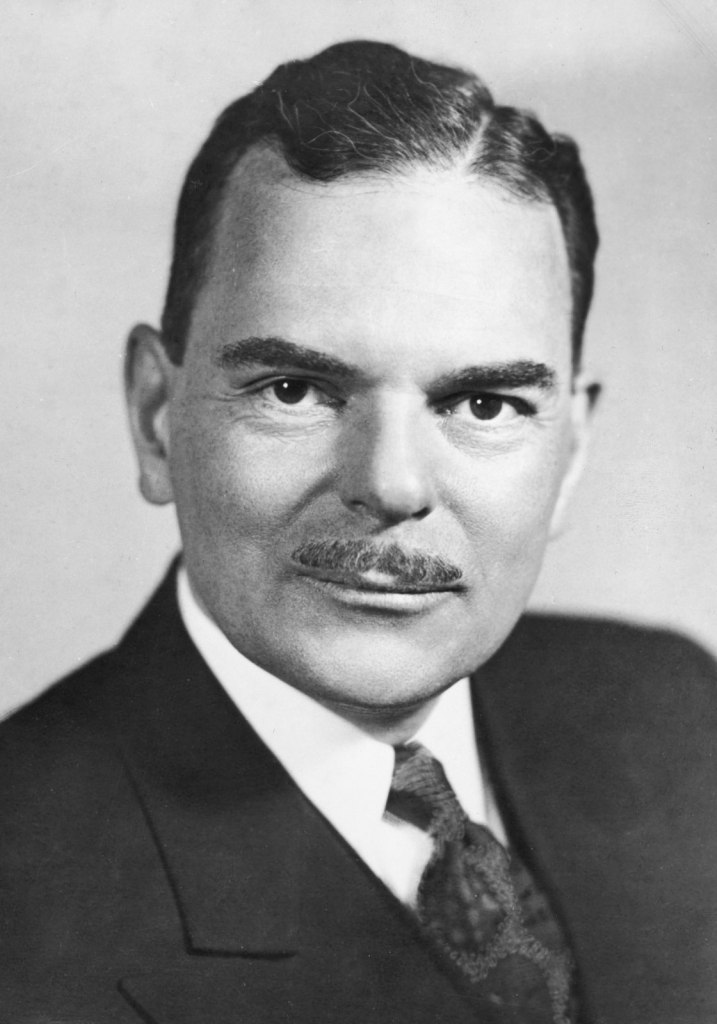
Opposite of the Taft wing were the Dewey Republicans, led by New York District Attorney, Thomas Dewey. This group believed that the government had a role in regulating business and were more open-minded about the New Deal. Dewey Republicans threw their support behind the establishment of a minimum wage, the Wagner Act and an end to child labor. They also differed from the Taft wing with their support for intervention into World War II, believing that such intervention would boost American production.

Encyclopædia Britannica

Thomas Dewey lead his namesake wing of the Republican Party.

Over the course of two decades, these two factions would duke it out over which side would be in control of the Republican Party, and each wing had their chance to prove their case to the American people. However, neither side was able to defeat FDR or his successor Harry Truman. There was one change, though. In 1952, when former allied General Dwight D. Eisenhower decided to enter the Republican primary as a Dewey Republican against Robert Taft. The Taft Wing could not hope to defeat the popular general who led the allied forces in Europe. As a consolation, Senator Richard Nixon of California was chosen as Eisenhower’s running mate to gain their support and unite the party. Together, the two won the 1952 presidential election. Eisenhower then set out to enact a fiscal policy of balanced budgets and reduction of the national debt while also advocating for labor rights and social services. Richardson says that the Republicans had been transformed through decades of exile and strife and came back a more egalitarian party akin to their forebears: Abraham Lincoln and Thaddeus Stevens.

The GOP has been down and beaten before and always finds its way back. The questions now are just how long will it be in the wilderness and what it will stand for. Will it dump Trump and attempt to cleanse itself of his legacy and most devoted supporters in Congress? Will it look to the examples of Thomas Dewey and embrace the more egalitarian vision his wing had or continue to channel the spirit of Robert Taft? Ultimately, the decision will fall upon Republicans to answer what it means to be a member of their party.

levanj1@lasalle.edu

American soccer culture needs to exist beyond a World Cup cycle

Commentary

Siobhan Nolan, Staff

I don’t know about you, but I’ve been counting the days until September. After what happened in 2017, this redemption arc is a long time coming. Such a plethora of young talent will surely propel us further in this competition than we’ve gone in recent memory.

I’m, of course, talking about the upcoming qualifiers for the 2022 World Cup. The United States men’s national team didn’t qualify for the 2018 World Cup after a disastrous and heartbreaking loss to Trinidad & Tobago in 2017. At least, it was heartbreaking for American soccer fans — of which there are not as many as there should be.

When I say American soccer fans, I don’t mean people that are aware that the United States has a national team, could name a couple of players (bonus points if they can name players other than Landon Donovan or Clint Dempsey!), and will don something red, white and blue when the U.S. does appear in a World Cup. I mean genuine fans that follow the national team year-round, keep up with the American youngsters currently dominating Europe and are desperately trying to turn the United States into a legitimate soccer nation.

Soccer is the world’s sport. In many countries, it’s essentially the national religion. You have your club team and your national team, and those are the teams that you would die for. In a large majority of the world, the population eats, sleeps and breathes soccer.

So why is such an influential country like the United States so different?

It’s a strange situation. About 3 million American kids play soccer — which is the most of any country in the entire world. The United States (specifically MLS youth programs) is producing some of the most promising young talent in soccer right now — Christian Pulisic, Weston McKennie, Gio Reyna, Tyler Adams, Brenden Aaronson, etc. etc. The United States women’s national team is the best women’s soccer team in the world. Yet, Americans are more interested in watching football, basketball, baseball and hockey. If you’re even aware that your city has an MLS team (go Union!), you probably don’t follow them closely. The USMNT becomes a source of national pride every four years. It’s inconsistent, frustrating and frankly quite confusing.

Francisco Seco/Associated Press

The U.S. women’s soccer team won the 2019 FIFA Women’s World Cup.

Kids in Europe and South America are kicking soccer balls the minute they can walk. They take training seriously, and will willingly move away from their home countries at as young as 14 years old in order to pursue a prosperous career in the sport. Their countries take immense pride in their national teams, and the unity that comes from a winning team is unmatched. Soccer is a sport that truly brings all kinds of people together, and is a true joy to watch. The creativity, the passion, the devotion that exists in soccer is life-changing. It’s something immeasurably beautiful that everyone should experience at some point in their lives. It’s not something I can fully and accurately articulate, but once you feel it, you want everyone else to experience it too. It really is that amazing.

So I challenge you, in preparation for the 2022 World Cup, learn more about your national team. Learn their names, their strengths, their weaknesses, their backstories. Watch the World Cup qualifiers, let yourself get sucked into the heat of the game and relish in the thrill of having your team qualify for the most coveted trophy in the game. Root for them when 2022 rolls around, and let yourself be devastated if they lose or overcome with joy if they win the whole thing. Allow yourself to fall totally and completely into the beautiful game.

It’s a lot more exhilarating than the Super Bowl, I promise.

nolans5@lasalle.edu

“Senioritis” — More like Senior Anxiety

Commentary

Shayna Ortiz, Staff

In just three months and 19 days, this will all be over. I will delete Canvas, break up with Google Drive and immerse myself in a whole new life. I will take my final steps as an undergraduate student and my first steps as a college graduate. In just 15 weeks, I will say goodbye to the university that has consumed the last four years of my life. While I am grateful and excited to complete this story, I am filled with emotion. As the date gets closer, the nights get longer, and my brain begins to work the hardest it has ever worked. I am overwhelmed with questions — what will come next? What friendships will last? What city I will move to, and where I will be in June of 2021? I am sure that I speak for most seniors when I say that senior year is not just about completing this journey but accepting this experience with every mistake and every reward and allowing myself to enjoy this moment.

But, as the days get closer and the reality of life after college becomes much more evident, I see myself starting to crumble. Imposter syndrome, an internal experience of believing that you are not as competent as others perceive you to be, was never something I imagined myself going through. As the reality of graduating during a pandemic becomes less surreal and much more of a reality, it is hard to imagine yourself outside of your comfort zone. Mine happens to be on Olney Avenue, where my biggest concern of the day is if Pauline’s is still open. As I began this semester, I started to see that I was not alone in this anxiety; I was one of many seniors developing imposter syndrome and felt as if they were not ready to take on the adult world. Regardless of your education or institution, as the job market and grad school deadlines become days away, it is impossible not to second guess yourself.

While I cannot speak for the majority of the senior class, I can speak for myself, and hopefully others relate when I say undergrad is not going to be the peak of our time in this world. It is simply a necessary stepping-stone to conquer the adult world. My time at La Salle has not only prepared me for the post-undergraduate experience but has made me capable of seeing who I can become. If you are anything like me, questioning if you should or should not apply to that program or that school, or if you should apply to that job across the country, I say go for it because while having senior anxiety is discouraging, we are well-equipped for our time after La Salle.

ortizs8@lasalle.edu