Chill on the Hill: the sweetest treat in chill-adelphia

Features

Sam Klein, Editor

PHILADELPHIA – As the weather gets colder, the insatiable desire for a sweet treat remains. While most ice cream stands begin to close down as the temperature decreases, one frozen yogurt shop is dedicated to delivering premium services year-round. 

Chill on the Hill, located in Chestnut Hill, is a self-serve frozen yogurt shop open six days a week from 12 – 9 p.m. There are 10 flavors to choose from daily with two vegan and one sugar free option. Customers are able to come in, choose their flavor and include any of the 40 available toppings, ranging from fresh fruit to candy. Finishing off their yogurt with any of the six different sauces, customers then place their filled cups on the scale to determine the cost of their gooey goodness. 

Yet, it isn’t the self-serve nature of Chill on the Hill that makes it so special, nor the attraction of an all-year-round chilly treat. Rather, community is the foundation of Chill on the Hill and what keeps customers coming back again and again. 

Owner of Chill on the Hill, Michael Hurst, purchased the business over three years ago for one sole purpose: the neighborhood location and overarching it’s community climate.

“People have been coming here for years,” Hurst says. “Those relationships and those people that we see coming back and coming back because this is a part of their community – it’s a part of their life, that’s what’s important to me.” 

As part of serving the community, Chill on the Hill offers both event inquiries, such as birthday parties, and fundraising opportunities to local schools and organizations. As a result of partnering with Chill on the Hill, they donate a percentage of their total profits to said organization and are willing to partner with any organization in need. If you or someone you know is interested, check out their application here

Hurst runs Chill on the Hill as part of a larger family business, using his wife and kids as fuel to make everything they do for the community that much more important. Interacting with families as if they were his own serve as an unofficial mantra for Hurst, as he remembers details about the lives of repeat customers and their families who are a part of the Chill on the Hill community.

“My favorite part of owning Chill on the Hill is the people I meet each day- a lot of new and repeat customers,” Hurst says. “I know a lot of people by their first name, I know their kids, I know where their kids go to school. That is just because of owning this business and being here.”  

The community mindset exists beyond the owners, however, and comes from the employees that make Chill on the Hill a special place as well. Elena, one Chill on the Hill employee, enjoys coming to work every day because it is more than just a job – rather, “a reprieve.”  

“Chill on the Hill is a home away from home. You can relax, wind down and get something yummy to eat,” Elena says. The joy that new and repeat customers alike embody is what creates the store atmosphere that Elena “feeds off of.” 

“We’d love for people to stop by regardless of if you’re in the area or not,” Elena says, as she is “eager to meet new people,” each day when she comes into work.

To stop by and try Chill on the Hill’s fantastic frozen yogurt for yourself, visit the store at 5 E Highland Ave, Philadelphia, PA 19118, or you can check out their website, Instagram or feature on La Salle TV’s recent episode of “Just Next Door” to learn more! 

Want another sweet treat? Use this article as a coupon to get 15% off of one cup, regardless of weight (only to be redeemed once). Simply print out, show at the register and enjoy this legend-dairy deal!

Chill on the Hill Logo via Owner, Michael Hurst

What is ‘Homecoming,’ and why do we celebrate it?

Features

Jamila Robinson, Staff Writer

In the United States we have a tradition of celebrating Homecoming, but do you really know why we celebrate this occasion? Homecoming has many meanings, but for the purpose of this article, Homecoming is a celebration that takes place at a school or college, usually in the fall, to welcome back alumni and celebrate school spirit. Sometimes, Homecoming consists of a week of events, including a pep rally, parade and a big football game that’s typically a match-up against your school’s rival. 

Homecoming celebrations date back to the early 1900s, first originating on college campuses in America. In 1910, the University of Missouri held the first official Homecoming event, with college students on the school’s campus requesting that alums return to their alma mater to cheer alongside them at a football game. Since this first “welcome back” event, students have added activities before and after the big game to unite the student body and rejoice at the start of a new school year.

It was not until the 1920s that Homecoming Week infiltrated high schools. Since the first Homecoming at the University of Missouri, the celebration has grown in purpose and scope. What originally was a chance to get together with old friends and watch a football game has evolved into a week-long class competition to see who has the most school spirit. The week usually has a theme–like decades, cartoons or movies–and the scored events that take place throughout the week require you to be within the confines of the subject matter.

Homecoming offers a wonderful opportunity for personal reflection on your achievements and a chance to reconnect with classmates and faculty. It’s a moment to remember the growth and perseverance that shaped you during your academic journey. Additionally, it’s a time to give back—consider sharing your time by speaking to a class in your former major, showcasing your talents and offering insights and strategies. Donations are also appreciated, as the university is always grateful for your contributions.
Here at La Salle, we are proud to welcome alumni, parents, students, faculty and staff home again to participate in many events throughout Homecoming Weekend. Our Homecoming Weekend is planned for Nov. 8-9, 2024, it will include tents on the quad, a doubleheader La Salle men’s and women’s basketball game, Alumni Awards Dinner, 50th Class Reunion, a Brunch Celebrating Lasallian Women in Leadership and more! There is an action-packed weekend planned full of fun activities, exciting games and prizes. All events are open to students, and your attendance is encouraged. Be sure to formally register and see a full list of events here. You can also make payments.

Squirrels & snakeroots & Solidagos, oh my!

Features, Uncategorized

Sean Bradley, Staff Writer 

What do squirrels, snakeroots and Solidagos have in common? Not much other than they all start with the letter “S,” but more importantly they’re three things found in nature commonly associated with fall. In this fall-themed Nature at La Salle article, we’ll learn about these three fascinating organisms.

Starting with squirrels, a squirrel is any mammal found in the family Sciuridae. There are two squirrel species that occur regularly on campus: eastern gray squirrel and groundhog. The eastern gray squirrel is the most common squirrel on campus and is found throughout campus. Gray squirrels are omnivores, and they eat seeds, nuts, buds, insects and eggs. They also play an important role as seed dispersers. In fall, they bury their food for later in several locations but sometimes forget where they left those food items. These forgotten seeds or nuts benefit the ecosystem by germinating and growing into new plants. Squirrels have two types of homes: nests of leaves, called “dreys,” or tree dens which are used for resting and raising young.

Eastern Gray Squirrel via Sean Bradley

Groundhogs, believe it or not, are squirrels and belong to a ground squirrel tribe called Marmotini. As La Salle’s largest squirrel, groundhogs can be found near the Peale House, Hansen Quad, and South Campus. Groundhogs are mostly herbivores and mainly eat leafy, green plants but do occasionally eat insects. They’re extraordinary diggers and use their claws to create a system of underground burrows, which they use for shelter, safety, raising young, hibernation and defecation (there’s a separate “bathroom” chamber). Additionally, burrowing aerates, or provides oxygen to the soil, which helps plants absorb nutrients for growth. Groundhogs are also called “whistle pigs” due to their whistle-like alarm call.

Groundhog via Sean Bradley

White snakeroot is a pretty perennial with a dark past. The species’ name comes from the medicinal use of its roots by Indigenous peoples to treat snake bites. However, the plant itself is toxic. During westward expansion times, many settlers, notably Nancy Hanks Lincoln, mother of President Abraham Lincoln, died of “milk sickness” after drinking contaminated milk from cows that grazed on snakeroot. Despite its dark past, white snakeroot is beneficial. The plant is adaptable and thrives in disturbed, shady areas on campus, where it forms colonies via rhizomes – fast, horizontally growing underground roots – which may also be a drawback for gardeners. More importantly, white snakeroot blossoms provide nectar to bees and flies, especially when food is less available in fall.

White Snakeroot via Sean Bradley
Common Eastern Bumblebee on White Snakeroot via Sean Bradley

Lastly, there’s Solidago. Solidago is the scientific name for a genus of flowering plants commonly called goldenrod. Goldenrods are misunderstood since they’re often viewed as weeds and blamed for causing Hay fever. When it comes to fall allergies, the real culprit is ragweed, whose pollen floats easily while goldenrod’s pollen is too sticky to float. While they’re prolific spreaders, goldenrods are quite hardy because they’re drought tolerant, deer-resistant, and thrive in many environments. Their blossoms are also beneficial to insect pollinators, like bees and butterflies, and many other insects. La Salle has one goldenrod species, tall goldenrod (Solidago altissima), whose pretty yellow blossoms can be appreciated on South Campus.

Tall Goldenrod via Sean Bradley
Common Eastern Bumblebees on Tall Goldenrod via Sean Bradley
Narrow-headed Marsh Fly on Tall Goldenrod via Sean Bradley
Broken-backed Bug on Tall Goldenrod via Sean Bradley

SEPTA changes

Features

Jamila Robinson, Staff Writer

Living in a city with a robust mass transit system makes getting around easier, and often, the fastest way to navigate is by utilizing public transportation. For those unfamiliar, SEPTA offers a convenient option for commuting to and from campus while also allowing for enjoyable leisure time in the city. If you’re not yet comfortable using the system, I’d like to share a brief guide to help you out. Many, if not most, residents rely on public transport to travel throughout the city.

SEPTA currently operates across five counties in the greater Philadelphia area and connects with transit systems in New Jersey and Delaware. It’s worth noting that it can sometimes be unreliable, crowded, slow, or even not available. However, for the most part, it remains a dependable means of transportation within Philadelphia and its surrounding areas. Whether you’re a visitor, a novice, or an experienced traveler, you’ll eventually need to utilize the public transportation system.

SEPTA train via WikiCommons

I would advise that you be alert and vigilant in your travels and stay aware of your surroundings at all times. If it looks suspicious, keep away. If you see something, report it and keep it moving. Your safety should be the number one priority at all times. You will come in contact with all walks of life, so be courteous and keep your head on a swivel.

SEPTA’s Broad Street Line, commonly referred to as the “Orange Line,” can be accessed from campus at the Olney Transportation Center. Here, you can catch both local and express trains, as the subway travels north and south along Broad Street. Once you arrive in Center City, depending on your destination, you have the option to switch to the Market-Frankford Line, known as the “Blue Line”. This line runs from the  Far Northeast to 69th Street Transportation Center in Delaware County, with connections to the Norristown High Speed Line. Additionally, SEPTA’s trolley services, often called the “Green Line,” will take you to West Philadelphia and even further into Delaware County.

Unfortunately, there is no place on campus to obtain any SEPTA products, however, the Olney Transportation Center is easily accessible for all purchases; you can reload funds to your SEPTA Key Card via the website which is highly recommended for safe and easier processing. It is also very easy to add purchases to your card and order a replacement if needed. 

You can make purchases online via the SEPTA website here. Now, let’s get to cost:

  • $2.00 – fare for a one-way fare using SEPTA’s Key Card, contactless payment (Apple Pay, Google Pay, etc.), and KeyTix via SEPTA’s app.
  • $2.50 – a one-way fare on transit using cash or SEPTA’s Quick Trip card
  • $25.50 – for a weekly TransPass+ for use within city limits
  • $96.00 – for a monthly TransPass+ for use within city limits

This is only the basics of what the traveling experience can be like on SEPTA; all this will remain the same while SEPTA navigates financial issues. They have a $240 million operating deficit, and the state legislature has yet to solidify a deal for public transit funding for this fiscal year despite mounting pressure from the transit agency. The public transit system is the lifeblood of the city’s economy. People use it to get to work, get their kids to school and it impacts every aspect of day-to-day life for many Philadelphians. These funding issues will affect the SEPTA and the roads and bridges throughout Pennsylvania. If the transit agency doesn’t get funded, it will have to cut services that it currently provides.

Cuts to service could look like sales offices closing, making it difficult to make purchases. Fare increases affecting us all, bus route replacements (with some being removed), and SEPTA access programs being downsized are all options the agency must consider. This would cripple the city and cause the funding deficit to worsen. A strike could happen for the current Transit Workers Union (TWU) whose contract expires in November 2024, and transit employees have gone on strike before. SEPTA is hopeful to reach an agreement during the ongoing negotiations.

Gone but not forgotten…

Features, Uncategorized

Jamila Robinson, Staff Writer

When we suffer the loss of a loved one, friend, relation or someone we knew, the loss is felt deeply, personally and affects us greatly. This time will require some solace and adjustment. However, when we lose someone we admired or enjoyed as an entertainer, the loss feels very different, and rightfully so. 

These famous individuals, giants in their fields, ICONS in fact have also had a part in our lives and upbringing. They have walked with us as we try to make major decisions and helped us navigate life during the good and bad times. But overall, they brought us a sense of joy, excitement and exhilaration in times they were most necessary.

That is why this article is so difficult to write because the month has started off like any other October. The weather is changing, the campus is showing more fall foliage and we all are in the midst of our fall semester studies, particularly midterms. However, we are losing some very profound and impactful entertainers, and as we know in life, death is unavoidable.  Below we share a few who have passed on to glory. We will forever cherish their talents and gifts they shared with us and hopefully carry on the good works by re-watching, and introducing them with others.

“And in the end the love you take is equal to the love you make.” — John Lennon

James Earl Jones

Years: 9/17/31 – 9/9/24

Profession: Actor/Film, TV and theater 

Known for: Voiced Darth Vader in “Star Wars” movies and voiced King Mufasa in “The Lion King”

Dame Maggie Smith

Years: 12/28/34 – 9/27/24

Profession: Actress

Known for: Professor Minerva McGonagall in “Harry Potter” movie series, Downton Abbey, Violet Crawley and the Dowager Countess of Grantham

John Amos

Years: 12/27/39 – 8/21/24 (There is some controversy about his death which the family just informed the public about this month.)

Profession: Actor

Known for: Kunta Kinte in the landmark miniseries “Roots” and James Evans Sr. on the CBS television series “Good Times.”

Kris Kristofferson

Years: 6/23/36 – 9/28/24

Profession: Country Singer, Actor, Oxford scholar, Golden Gloves boxer and Army Ranger

Known for: Whistler in the Marvel movie “Blade,” “A Star is Born,” (He won a Golden Globe for this role) and he was in “The Highwaymen.” 

Dkembe Mutombo

Years: 6/25/66 – 9/30/24

Profession: Athlete/Basketball

Known for: He was a Basketball Hall of Famer who was one of the best defensive players in NBA history. Mutombo spent 18 seasons in the NBA, playing for Denver, Atlanta, Houston, Philadelphia, New York and the then-New Jersey Nets. 

Tito Jackson

Years: 10/15/53 – 9/15/24

Profession: Entertainer

Known for: Guitarist in the Jackson 5

Frankie Beverly

Years: 12/1946 – 9/10/24

Profession: Entertainer, Singer, Songwriter and Producer

Known for: His recordings with the soul and funk band Maze 

Ken Page

Years: 1/20/54 – 9/30/24

Profession: Voiceover Actor

Known for: Original Cast Member of Broadway’s “Cats” and voiced Oogie Boogie in “The Nightmare Before Christmas”

Rich Homie Queen 

Years: 10/4/89 – 9/5/24

Profession: American Rapper

Known for: 2013 single “Type of Way”

John Aston

Years: 2/22/48- 9/26/24

Profession: Actor

Known for: “Beverly Hills Cop” movie series, “Some Kind of Wonderful” and “Midnight Run”

Drake Hogestyn

Years: 9/29/53 – 9/28/24

Profession: Actor/Daytime Soap, former New York Yankee prospect

Known for: His nearly four decades on “Days of Our Lives”

Flag football in Pennsylvania

Sports, Uncategorized

Jamila Robinson, Writer

The Pennsylvania Interscholastic Athletic Association (PIAA) has declared high school girls’ flag football an officially sanctioned sport in the Keystone State. The announcement was made following the PIAA Board of Directors meeting on Wed, Sept. 18, 2024 in Mechanicsburg, PA where girls’ flag football was reviewed and approved on the third and final reading to be designated as a state-sanctioned sport. 

The approval was also made with some help from the Philadelphia Eagles and Pittsburgh Steelers. The flag football program is set to begin next fall for the 2025-2026 school year. It is also one of the fastest-growing sports in America. This is a very exciting addition to the roster of several high schools across the Commonwealth, meaning that young ladies will be able to get engaged with the sport, as well as gain exposure to the game of football and all of the excitement surrounding it. 

Let’s begin with a basic lesson of what flag football is. Flag football is a non-contact version of American football where players remove flags from the ball carrier instead of tackling them to the ground. The goal of the game is to advance the ball into the opposing team’s end zone. There is no contact, and players are not allowed to tackle, block, dive, screen or fumble. 

Here is where the flags come into play. The players wear flags attached to their waists, one on each side and one at the back. Defenders remove one or both flags to “tackle” the ball carrier. Flag football fields are usually 25-30 yards wide and 70 yards long, with two 10-yard end zones.

In the case of girls’ flag football in Pennsylvania, it was required that there be at least 100 participating teams across the state. According to the PIAA, that threshold was achieved in April with 65 schools from the eastern side of the state (Eagles) and 36 from the western side (Steelers). And yes, both of these teams had to work in collaboration to ensure that this momentous sanction was a success. 

Many people may not be aware that the NFL is heavily involved in this major addition to PIAA sports. The Philadelphia Eagles heavily invested in growing the game of girls’ flag football. The Eagles have ensured access for young girls across the Double-A region in southeastern Pennsylvania, Delaware and southern New Jersey to utilize their facilities for practice, games and even the use of their equipment.

Between the three states, there are currently over 100 teams with the hopes of 100 more teams participating. These teams will span public, private and parochial schools. There is major anticipation of opportunities for scholarships for these young ladies to not only play in high school but to play collegiately. It’s a very competitive environment, and I feel that great things will come from this endeavor. Many colleges are now starting a girls’ flag football program which only means more doors opening and exposure for so many young ladies who might otherwise not have an interest in this sport.

The Pawpaw: The Forgotten All American Fruit

Features

Sean Bradley, Writer 

During the first few weeks of classes, I had the fortune of harvesting and trying pawpaw.  Now, many of you reading are probably wondering what a pawpaw is, and I’m glad you asked. In this Nature at La Salle article, we’ll learn about America’s forgotten fruit, the pawpaw.  

What is a pawpaw? A pawpaw is an edible fruit in the “custard apple” family (Annonaceae) native to the eastern United States. In fact, it’s the largest edible fruit native to the U.S. While most fruits in this family are tropical, pawpaw are the northernmost fruit of this family and are found in temperate climates despite having the appearance of a tropical fruit.  

The fruit comes from a forest understory tree that does best in fertile soils near water or on hillsides. Last fall, I found a specimen growing on campus in front of a bamboo stand near a runoff stream near the old Japanese Tea Ceremony House. This spring, I saw that the tree had lovely maroon blossoms that eventually transformed into fruits over the summer after being pollinated.

The fruit itself resembles a mango. One must treat a pawpaw like a mango when harvesting and eating one. During the first few weeks of classes, I harvested some pawpaw on campus and brought them home. When I initially harvested them, the fruits were hard, so I let them ripen over a few days by placing them into a brown bag with bananas. Once ripe, the skin should appear slightly yellow with brown spots and feel tender. The flesh should also appear yellow-orange when ripe. Although the flesh is custard-like, the taste is quite delicious and has a nice tropical flavor that’s sort of a combination of banana, pineapple, and mango. Since the skin and seeds are toxic, the easiest way to eat pawpaw is to cut it in half, remove the seeds and squeeze the flesh from the skin.  

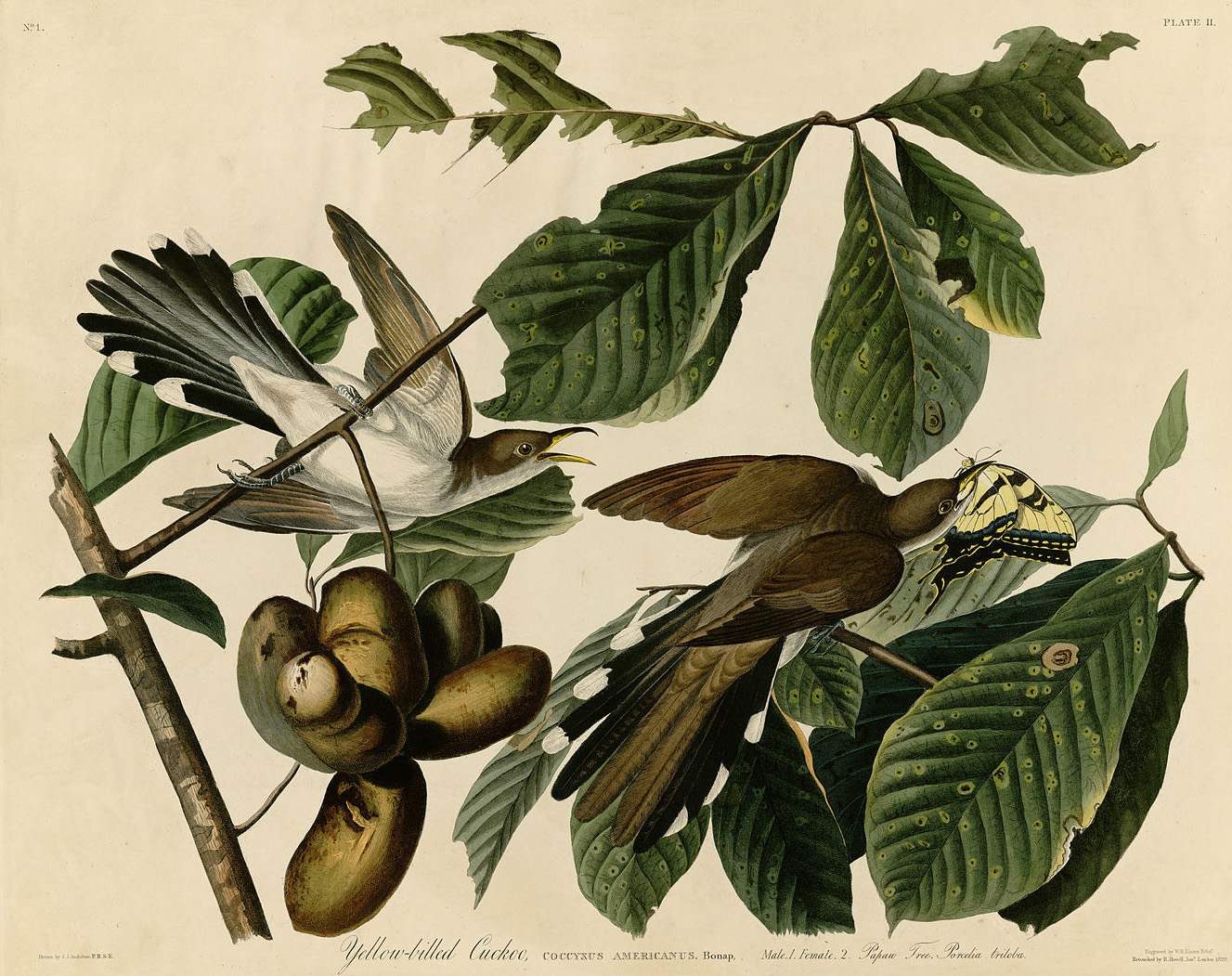
The pawpaw has a long history in America. For centuries, many indigenous tribes used the fruit for food and medicine. The word “pawpaw” is derived from early European explorers who confused the fruit with papayas. The species’ scientific name, Asimina triloba, is derived from an Algonquin word for pawpaw “assimin.” In 1541, Spanish explorer and conquistador Hernando de Soto noted seeing indigenous people of the Mississippi Valley eat pawpaw. George Washington and Thomas Jefferson both grew and ate pawpaw. Pawpaw was also eaten during the Lewis and Clark Expedition. Painter John James Audubon even included the fruit in a painting of yellow-billed cuckoos. There’s even a folk song about the fruit titled  “Way Down Yonder in the Pawpaw Patch.” Since 1998, the Ohio Pawpaw Growers’ Association has annually sponsored the Ohio Pawpaw Festival near Albany, OH. Despite its presence in American culture, why isn’t the pawpaw talked about regularly? 

Unlike apples, pawpaw fruits are not sold commercially due to their short shelf life. However, in recent years, interest in pawpaw cultivation has become popular among scientists and organic farmers, suggesting the fruit might one day become popular. Only time will tell.

via Sean Bradley

La Salle to host national journalist, author

Features

Peyton Harris, Editor

Founding editor of Jacobin. Columnist and writer for The Guardian US, The New York Times and The Washington Post. President of The Nation magazine. These are just some of the titles held by La Salle’s latest guest speaker Bhaskar Sunkara, set to visit campus this Thursday, Sept. 26.

Sunkara’s talk, “What Capitalism Gets Right, What Capitalism Gets Wrong, and Is There an Alternative?” aims to foster discussion on the benefits of the current economic system within the United States, that system’s flaws and whether an alternative might be able to address the issues that the country faces.

Sunkara, 35, was born and raised in Westchester County, New York. In an interview with the New Left Review, he credits his reading of authors such as George Orwell and Leon Trostky for his first experiences with politics in his early teenage years. By the age of 17, he had joined the Democratic Socialists of America and began writing and editing for their online blog forums.

At age 21, while on leave from George Washington University, the concept of a socialist news outlet came to fruition: Jacobin. Initially launched in September 2010, Jacobin now reaches an audience of 75,000 readers per quarterly print publication, and over 3,000,000 readers per month accessing their online forum. 

As the son of immigrant Indian and Trinidadian parents, he acknowledges the role that his parents played in the shaping of his political views. 

“They were always supporters of left populists, in a very broad sense,” Sunkara says. “They liked both Castro and Clinton in equal measure.”

Using his experience as a former international relations student at George Washington, Sunkara has also written for Foreign Policy and Vox, as well as participating as a frequent guest on MSNBC, FX and PBS. 

By 2019, Sunkara had written and published his first book, “The Socialist Manifesto: The Case for Radical Politics in an Era of Extreme Inequality.” The following year, he was featured in Fortune magazine in their “40 Under 40 Most Influential in Government and Politics” as an individual with a large impact on current affairs. 

After becoming president of The Nation in February 2022, Sunkara aims to continue the legacy of the 159-year-old organization by upholding and strengthening the value of independent journalism, while fostering critical debate and bringing focus to issues that matter to working-class Americans. Having been a writer for the periodical since 2013, he is eager to step into this role and continue his work. 

The multi-faceted journalist will be visiting La Salle to share his views on the current economic climate and what he believes can be done to change the trajectory of American economic policies. For any further questions regarding the visit, students can contact Dr. Barbara Allen at allenb@lasalle.edu.

Sunkara’s talk, sponsored by La Salle’s School of Arts and Sciences, will be presented Thursday afternoon at 12:30 p.m. in the Union Building’s Second Floor Music Room. Students and faculty alike are invited and welcomed to attend for an interactive, thought-provoking discussion.

Nature at La Salle: native spring flowers on La Salle’s campus

Features

Sean Bradley, Staff

Spring has officially sprung, and many flowers are in full bloom. In this Nature at La Salle article, we’ll learn about three native spring flowers that you can find on campus. 

Virginia Bluebells

The first flower we’ll learn about are Virginia bluebells. This lovely, spring ephemeral gets its name from its small, blue, bell-shaped flowers. The flowers grow in clusters off of arching stems from erect clumps with smooth green, oval-shaped, alternative leaves and start as purplish pink buds before blooming into blue flowers. The flowers are tube-shaped and consist of five petals, with five white stamens and a long, white, central pistil. The flowers also attract many pollinators, including bumblebees, butterflies, moths, flower flies and hummingbirds. Once pollinated, the flowers produce wrinkled nuts that each have four seeds: these seeds eventually grow into new plants the following year. As a native species, Virginia bluebells occur naturally in moist woodlands and floodplain forests and are often planted in woodland gardens for their beauty. Here on campus, you can find Virginia bluebells growing in the university’s woodland garden on the Hansen Quad near College Hall. 

via Sean Bradley

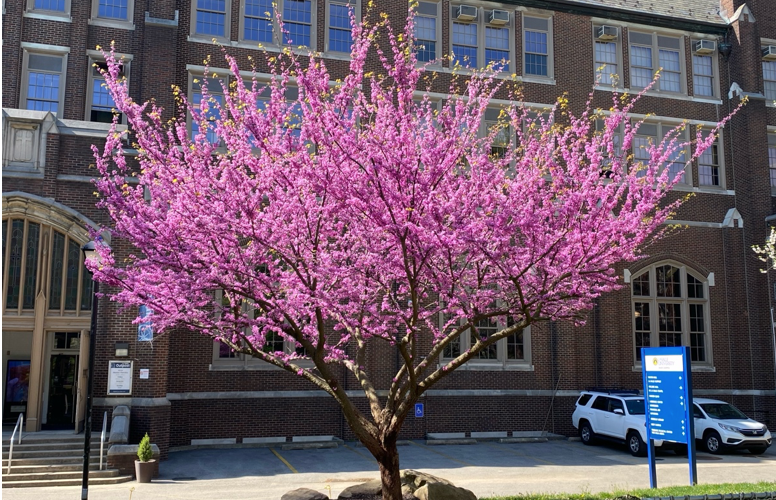
Eastern Redbud 

The next flower we’ll learn about comes from a flowering tree known as the eastern redbud. This species is also native to our area and grows naturally as an understory tree in forests with moist, well-drained soils. The eastern redbud is a cauliflorous tree (flowering from the main stems) and gets its name from the pink flowers that grow on and cover the tree’s twigs and branches in springtime. The flowers come in clusters of four to eight flowers and can come in colors, such as pink, magenta and white. Each flower has five petals and 10 stamens. The flowers are also a source of nectar for pollinators, such as bumblebees and honeybees. And believe it or not, the flowers are even edible and are high in vitamin C. They can be eaten raw or added to salads. Here on campus, eastern redbuds can be found along the path leading to the Communication Center as well as in the university’s woodland garden and lawn on the Hansen Quad. 

via Sean Bradley

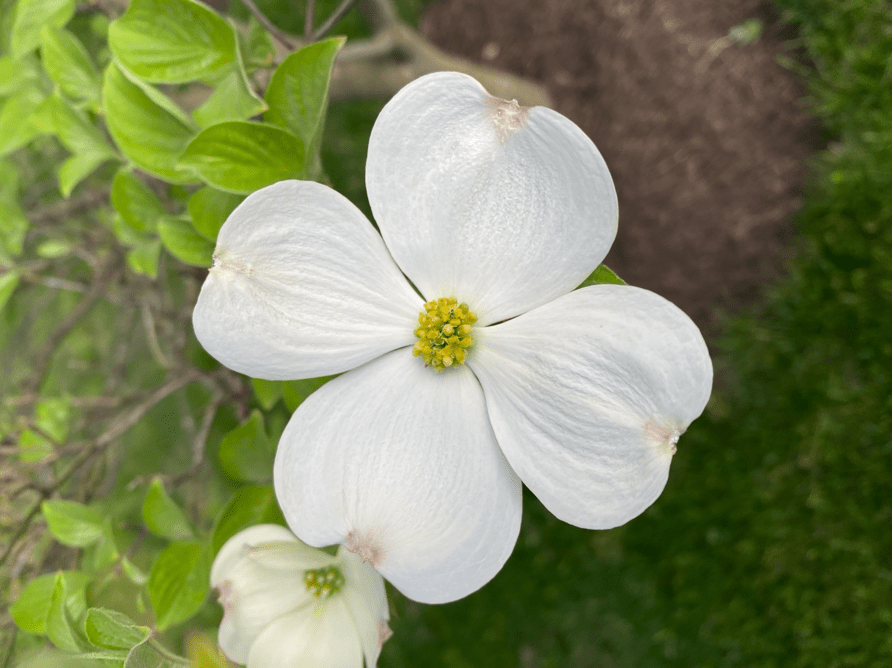
Flowering Dogwood 

Finally, the last flower we’ll learn about also comes from a flowering tree and is often regarded as the most beautiful native flowering tree in  all of eastern North America. It is the one and only flowering dogwood. Each spring, these small, lovely trees produce showy flowers from a spreading crown of branches. The flowers consist of a cluster of greenish-yellow petals surrounded by four showy bracts that come in white or pink. The flowers also attract bees, flies and butterflies. Here on campus, flowering dogwoods can be seen growing near St. Benilde Tower and along the path down to the Communication Center. There are also a few growing near the Independence Blue Cross Fitness Center and the gazebo. 

via Sean Bradley

So, the next time you’re out on a nice, sunny spring day on campus, take some time to appreciate these three beautiful native spring flowers around La Salle.

The Eastern Pheobe: the true sign of spring

Features

Sean Bradley, Staff

The American robin is a songbird familiar to many and has long been considered a sign of spring. However, contrary to popular belief, most robins in Philadelphia are found here year-round. In this Nature at La Salle article, we’ll learn about a songbird that would be a better harbinger of spring, which is Sayornis phoebe, or more commonly known as the Eastern Phoebe.

Measuring about five to six inches, weighing less than an ounce, and with a 10 to 11-inch wingspan, the Eastern Phoebe is a rather drab bird. Its plumage on the back and wings is grayish brown, with the wings each having two bars. Its forehead is dark brown, and its bill is black. Its throat is white, and its chest and belly are pale gray but change to faint yellow in the fall. Lastly, its legs and feet are black.

Despite its dull appearance, the Eastern Phoebe is still an interesting bird. For one thing, the species gets its name from its distinct fee-bee song. Found in the tyrant flycatcher family (Tyrannidae), Eastern Phoebes, like all tyrant flycatchers, engage in a flycatching behavior, often perching and waiting patiently for insects to fly by before catching those insects in short flights and returning to the same perch. When perching, they also have a cute habit of wagging their tail up and down. Eastern Phoebes are also quite adaptable and are found in a variety of habitats, including woodland edges, stream sides, and farmlands. Not only do they nest in natural settings, like rock outcrops and streambanks, but they also nest on human structures, like bridges and buildings. They typically nest in areas near water and with woody understory vegetation. The nests are open cups with mud bases and are lined with moss, grass, and animal hair. Females lay two to six eggs, and both parents raise two broods per year. Additionally, unlike most North American birds whose populations have declined, eastern phoebe populations have increased in the last five decades, partly due to their ability to adapt to urban settings.

So, why is the Eastern Phoebe a better sign of spring as opposed to the American robin? Well, unlike robins which are year-round residents in Philadelphia, Eastern Phoebes are migratory. They spend the spring and summer months in the northern United States and southern Canada and migrate south and winter in the southern United States and northern Mexico. Since they’re short-distance migrants, Eastern Phoebes are one of the first migrants to return north, returning as early as March, as well as one of the last migrants to migrate south, leaving as late as November. 

Additionally, while robins are omnivorous (feeding on earthworms and fruit), Eastern Phoebes are insectivorous, meaning their diet consists entirely of insects. When insects become less abundant as the weather cools, eastern phoebes migrate to warmer climes where insects are more plentiful.
So, if you see a small, grayish-brown bird perched wagging its tail on a warm day in March, then surely enough spring is here.

Original Illustration by Sean Bradley