La Salle Triathlete Balances Elite Racing, Graduate Studies and Team Leadership

Features

Marc Regen, Editor

For La Salle University graduate student, Fiona Davoudi, triathlon isn’t just a sport — it’s a lifestyle. Balancing swimming, cycling and running, she trains up to three times a day while pursuing her MBA and mentoring the young Division I team.

“I was a swimmer through high school and wanted a new challenge when I started college,” she said. “I found a club team at UC Davis and loved getting to balance three different sports.”

Now competing in NCAA draft-legal sprint races — the same format used in the Olympics — she swims five to six days a week, runs five days and bikes three. Her workouts vary in intensity and focus, from long-distance swims to fast-paced bike rides, keeping training fresh and purposeful.

“Triathlon really is a lifestyle,” she said. “You’re always fueling or recovering for your next workout.”

She completed her first triathlon at 18 and now plays a leadership role on La Salle’s team, which is composed mostly of first-year undergraduates. As a graduate student, she’s embraced the role of mentor, sharing racing tips and bike skills she has picked up over the years.

“I feel like an older sister to the team,” she said. “I’ve learned a lot from having multiple coaches and mentors and love helping others grow.”

Triathlon is currently an emerging NCAA sport. With more than 40 schools now participating, the NCAA is expected to vote on elevating it to full championship status in the coming years.

La Salle’s team is already making waves. At the Patriot’s Triathlon, they placed second overall, with Davoudi finishing in second place individually. At the Beaver Country Tri Cup — the team’s first official NCAA draft-legal race — she placed seventh, and the team finished sixth.

Her performance earned her the NovaCare Student-Athlete of the Week award, a recognition she says was especially meaningful for a smaller team in a growing sport.

“It was awesome to receive votes from friends and supporters to represent triathlon,” she said.

Despite a demanding academic schedule — including full-day classes on Mondays and three online courses — she finds creative ways to balance training and schoolwork, even watching lectures while riding her indoor bike trainer.

Looking ahead, she’s excited for the team’s trip to Arizona for the National Championships and some off-season lake swims and bike rides in the spring.

After graduation in August 2026, she plans to continue racing in Elite Continental Cup events, with hopes of progressing to World Championship and Olympic-level competitions. Eventually, she aims to transition to middle-distance races like Ironman 70.3.

Her success, she says, comes from staying open to new training opportunities and learning from others.

“Listening to or observing high-performing athletes is the best way to pick up on things you might be missing,” she said. “Learning never ends in our sport.”

And when it’s time to unwind, the team knows how to have fun — from post-practice dinners to singing in the van on long road trips.“It’s all part of the adventure,” Davoudi said.

The La Salle Collegian joins emerging nonprofit, the Philadelphia Student Press Association

Features

Claire Herquet, Editor

Student journalism is a stepping stone, providing young individuals with the opportunity to experience storytelling and reporting outside of the classroom and preparing aspiring journalists for successful careers in the media industry. It has been a long time coming for an organization like this to develop, fully dedicating itself to recognizing successes for student journalists and creating a space for them to represent themselves on a larger scale. But for Jackson Juzang of Haverford College ‘26, he finally figured it out. 

Philadelphia has long been a city rich with stories. Going from the birthplace of American independence to its diverse neighborhoods today, media and journalism have played a crucial role in shaping how our city has evolved and how its residents have navigated such avenues and changes. Student journalism is an essential part of this ongoing narrative. 

The Philadelphia Student Press Association (PSPA) exists to support this important work. By bringing student publications together, the nonprofit organization not only exists to amplify young voices, but also strengthens the overall media landscape in Philadelphia. With the slogan “Rooted in Philly, Reporting for All,” the statement stands to remind viewers that when our Philadelphia community is truly united, student journalists can tell more impactful stories, while engaging with broader audiences and continuing the city’s legacy of journalism. 

At colleges and universities throughout Philadelphia and neighboring regions, student reporters typically address important topics, both on campuses and in the wider community. Issues such as local concerns, admission changes, campus happenings and more have been covered, often receiving little attention in mainstream media outlets. However, along with professional journalism, student reporting includes accountability, encourages meaningful conversations and ensures that young perspectives and voices are valued. In an interview with empowerment speaker Lawrence Harris, PSPA Founder and CEO Jackson Juzang sheds light on the issues he hopes to fix with the presence of PSPA in the broader journalistic environments that students enter. He says, “I want to fix consumption issues from the media…and try to figure out ways that there can be connectivity among our generation. [It] emits this individualism that we see within content and lack of attention span, you know, short-form domination – that is something I’m looking to spearhead.”  

While the PSPA is still relatively new and was only founded in April 2025, the organization already currently consists of eight member student-run newspapers: The Clerk (Haverford), The Villanovan (Villanova), The Phoenix (Swarthmore), The Gleaner (Rutgers-Camden), Bi-College News (Bryn Mawr and Haverford), The Whit (Rowan), The Triangle (Drexel) and of course, our very own La Salle Collegian (La Salle). The PSPA currently has an executive board of four involved and dedicated students, two of whom are writers of the La Salle Collegian. They look forward to heavily contributing to the PSPA’s mission of providing student journalists with shared resources, professional mentorship and cross-campus collaboration opportunities. They are looking forward to hosting networking events and educational development opportunities in the upcoming months. 

To stay updated about what’s happening with the Philadelphia Student Press Association, check out the new official website at phillystudentpress.org, and follow us on Instagram (@phillystudentpress), X (@pspapress) and check out our LinkedIn.

PSPA logo courtesy of the PSPA

10 days in the Emerald Isle 

Features

Sean Musial, Editor 

This past July, I took a trip to Ireland with my mom and pop. It was an eye-opening experience that showed me a place outside my little bubble in northeast Philly. Since it was my first time leaving the country, with the exception of Niagara Falls once as a kid, I was going in blind. But thank God I took my pop’s offer back in March to go. 

We left for the airport on July 13. When we landed in Dublin, my pop left with my cousins, of whom came back over with us from Ireland so he could visit his hometown in Donegal. My mom and I booked two nights at a nice hotel that was only a few blocks from the famous Grafton Street. During the first day alone, we covered most of the area and had a couple of Guinness’s to fuel the journey. We took the tour bus, checked out the variety of different pubs they had to offer, saw Trinity College, walked by Temple Bar and finished the day off by accidentally walking down one of the worst parts of Dublin after making a wrong turn to get home. 

The second day was much more jam-packed. We started it off by having breakfast in the hotel’s restaurant which was filled with all types of delicious foods ranging from eggs and Irish sausage to fruit salad and pastries. Our first official stop of the day was the Guinness Brewery Storehouse where the famous stout was founded and is continuously crafted to this day. We walked through the old-time looking warehouse doors and signed in to get the instructions so we were able to wander. Throughout the entire tour, we learned the history of the brewing company in great detail while they handed us three different pints each. The one stop even put a picture of me on top of the pint, which they labeled a “stoutie.” After having lunch with a distant cousin who apparently let my mom stay with them for a couple of days back when she was a kid, the Jameson Distillery was our next stop. We decided to go to bed earlier that night because of the long journey we had to make across the country the next morning. 

At 7 a.m., we hopped on the bus to take us all the way to Donegal. It felt like we stepped into the scene from Harry Potter and The Prisoner of Azkaban where the bus was flying down the road uncontrollably. The same feeling occurred with our bus driver, except our trip was a 4-hour journey across the winding, open roads of Ireland with occasional stops through certain towns sprinkled on top. We get to our destination around 11 o’clock. My mother’s cousin and her daughter picked us up outside the Abbey Hotel in downtown Donegal. The rest of the day was a history lesson by my grandfather as we drove through his hometown, looking at the now torn-down house where he and his siblings grew up, which only had a broken-down barn left to mark the spot. He showed us where he went to school, different hot spots like a waterfall, and the day came to an end when I climbed one of the highest cliffs in all of Europe, Sliabh Liag. I was staying at my distant relative’s house while there. The view from my room was mesmerizing as I looked out the window, seeing the mountains, lakes, houses and whatever else the beautiful country had to offer. 

The next couple of days consisted of adventures with my 84-year-old grandfather and my cousin, who is just a year younger than me. Each night, I went to just about every pub in Donegal. There are many in the downtown area, and one was even in between a cliff. Another was on top of a mountain that used to be a post office, market and pub all in one. While with my grandfather, he started off drinking strictly Guinness, as he convinced me it was the best the world had to offer, but then he shifted to drinking small cups of brandy since the Guinness was making him use the bathroom quite often. 

My cousin was an interesting guy. He showed me the open ranges that were much more hidden while driving around in his quad. He drove me to the places where he would go with his friends to help the town gather turf, check out the ranges where massive windmills were, and drove up the mountains that I could see from my window to get a glimpse of the hidden waterfall that he explained to me him and his friends went swimming in once. When we had to drive his car that was barely an inch off the ground, we would compare notes on the different cultures we had, running errands he needed to do for his job, or something simple like going to the movies with his friend who was a few towns over. He showed me the nightlife there as we hopped from pub to pub, meeting his friends, watching live bands and coming across an Irish dance show while accompanied by the rest of my family that lived there. 

A major thing I wanted to do while there was check out the Game of Thrones studio tour in northern Ireland. I have seen the show three times now and apparently, over 30% of it was filmed there. The tour clearly explained the different scenes that were filmed. It had props, outfits, sets, designs, outlines and mannequins that were reenacting different scenes from the iconic show. The Lannisters, the Starks, the Barathians– all of the families could be seen throughout the entire exhibit. Huge dragon skulls, the painted floor of Westeros, weaponry and the very iron throne that was a centerpiece for the show could be found inside. 

The day after we went to Derry, a historical place that had mural after mural for the hunger strikes, “Bloody Sunday” and an homage to the show Derry Girls on Netflix. While stopped in front of a building that has a painting of a man standing in front of a tank, we got stopped and talked to the very man the picture was based on. He went on about how he was shot by the tanks moments after the original picture had been taken, how he had gotten cancer due to being exposed to something similar to “Agent Orange” while fighting in the troubles, and had given us a signed photograph of this picture he was continuously talking about. 

Ireland is a vibrant place of immense cultural differences when compared to the United States. Simple things like driving on the other side of the road, certain pronunciations of words, quadding to get around places, and a good bit of cursing in their everyday vocabulary made my Irish experience unique. The experiences I had there were very eye-opening and a whole lot of fun. After a long freshman year of living at home and commuting to school, this was a great way to break the routine of living in my own little bubble in northeast Philly.

Ireland via WikiCommons

The story of survivors during the Great Tokyo Air Raids of 1945

Features

Kelsey McGovern, Staff Writer

The Great Tokyo Air Raid occurred on March 10, 1945, when the United States dropped incendiary bombs on Tokyo, killing an estimated 100,000 innocent Japanese civilians. Survivors of the raid were left with the most horrific memories of what happened that night. 

Shizuo Nishio is an 86-year-old survivor who tells her story at the Center for the Tokyo Raids and War Damage. She was six years old when the U.S. B-29 bombers began to bomb her home. 

On March 10, 1945, Shizuo Nishio was excited to go to kindergarten with her classmates. Her father told her family to go to the school nearby the house because it was made of cement and not wood. Shizuo recounts how the shelter was so packed that she and her mother went to find safety someplace else, leaving her 19-year-old cousin and the nurse behind. Shizuo thought they would be fine since they were in the school, but “hours later they were among 200 people discovered dead in a steamed state, cooked alive in the shelter by the raging fires outside”(Center of the Tokyo Raids and War Damage). Shizuo and her mother found safety in another school, and when the bombings were over, Tokyo was barren like the moon. She recounts seeing bodies on top of one another like the picture below.

Courtesy of Center of the Tokyo Raids and War Damage

Yoto Kitamura was 8 years old when the bombings occurred and remembered the sky being an eerie red. She remembers hearing “that the river was filled with bodies” (Center of the Tokyo Raids and War Damage). She recounts the sky looking as if it was daytime when it was at night. She recounts a flame catching on a person in front of her, but she could not ask if the person needed help because she was fleeing for her life. After the air raid, victims were being buried in masses and bodies were unidentifiable. Lots of survivors took their pain and turned it into their career. Kitamura and Nishio became doctors because they wanted to help people. Kitamura discusses wars going on today and says, “When I was watching television of the Ukraine situation, there was a little girl crying at a shelter. . . I thought, this is me!” 

The “New York Times” article “Survivor of Tokyo firebombing chronicled its horrors” by Phil Davison outlines the experiences of survivor Katsumoto Saotome. She was 12 years old during the firebomb living with his parents and sisters. Mr. Saotome was at home when “334 low-flying American B-29 ‘Flying Fortress’ warplanes firebombed the city, leveling much of it.” He explains that the flames made the world look like there was a red filter over it. He describes that the fire was living due to how fast it spread. He emphasizes how the Great Tokyo Air Raid has been forgotten over the decades due to the atomic bomb being dropped on Hiroshima and Nagasaki. 

The Saotome family fled to the river to escape fires, but the napalm bombs were so strong the jelly made it hard for residents to reach water. In the article, Davison mentions how one of the U.S. Air Force pilots said, “At 5,000 feet you could smell the flesh burning. . . . I couldn’t eat anything for two or three days. You know it was nauseating, really. We just said ‘What is that I smell?’ And it’s a kind of a sweet smell, and somebody said, ‘Well that’s flesh burning, had to be.’” These pilots described the burning flesh odor to be so nauseating that they felt relief when steering the plane toward the Pacific ocean exiting the smoke.

Mr. Saotome notes that although the atomic bomb on Hiroshima had a larger death toll, the Great Tokyo Air Raid resulted in more casualties than the bomb on Nagasaki. Mr. Saotome dedicated his life to writing, and reached out to the “New York Times” decades after the air raid questioning why none of their lectures included the air raids. The “New York Times” expressed that they did not have many sources to write about, and Mr. Saotome recognized what his new purpose was.

Mock Trial: where law meets performance

Features

Jack Wagner, Editor

PHILADELPHIA – A gavel gives a loud whack! on a raised podium, the judge glaring down at the lawyer who stands before him. The opposing lawyer starts to stand, an objection already forming on his lips while a witness shifts nervously on the stand. But this is no normal courtroom; the witness, the lawyers and even the defendants are all students, and are all acting.This isn’t a real trial, it’s a mock trial. And to some students at La Salle University, it is a passion.

The members of La Salle University’s Mock Trial Association didn’t all plan to get involved, or even necessarily know what Mock Trial was when they first came to the school.

“I remember Pat and I, we were walking around the Involvement Fair,” said the president of Mock Trial, Cole Welsh. “We have a bunch of Father Judge guys from high school. And, you know, Pat and I wanted to argue about something, right? We love to argue politics, whatever it might be. And we saw Mock Trial, you get to argue. So we did it. We signed up, and we love it.”

Each year, the team is given a fictional case where they have to come up with theories and arguments for defending or prosecuting the characters involved. They get assigned roles where they have to play one of the characters in the case, such as a witness, and go to tournaments where they are graded on acting, how well researched their theories are, and how effective their arguments are. The cases are all unique and present new challenges, and the team is already thinking about next year.

“We just finished our last case, which was based off of Murder on the Orient Express. It was some guy who was a billionaire in their little fictional town called Midlands,” said Pat Malloy, vice president of Mock Trial. “His daughter was suing her brother for being responsible for their father’s death. That was a civil case, because nobody was actually going to jail in that case, it was just based off of money, and next year is going to be criminal. We know that because every year it goes civil, criminal, back and forth.”

Though the organization seems very law-focused, several members are not interested in a career as a lawyer. Instead, they see it more as a way to develop the wide variety of skills required to be successful in Mock Trial, such as acting or researching, or even looking at avenues for their current focuses that they hadn’t thought of before.

“I think that it really gives you a lot of expertise,” said Eddie Slegel, vice president of Personnel. “I think it can help in all fields. I’m personally an accountant, and I think that it’s really interesting to learn about some expert testimony, because technically that’s a career field someone like me could enter.”

The team attends and hosts a series of tournaments throughout the year. Last year, they attended invitationals at William and Mary College in Virginia, as well as one at Temple. La Salle also has its own invitational tournament which happens in the fall.

Even with all the excitement from the cases and the tournaments, what really keeps students in the organization is the community that they form while working on the cases together.

“What you find in Mock Trial is that you all work really hard on this case for months and months and months, and then you go and finally put it together,” said tournament director Isabella Teti. “And when everything comes together, I feel like all the hard work is finally paying off. And I would say that it’s one of the best feelings you’ll ever feel, especially when you’re dealing with people you really care about.”

“We’re with each other 20 hours a week, and we spend entire weekends with each other,” said Malloy. “It’s less of just an organization where we come to do simulation trials, and more like a long lost family who comes together for a family reunion every once in a while.”

If you are interested in joining the La Salle University Mock Trial Association or want to learn more about the organization, you can follow them on Instagram @lasalle_mocktrial.

Morgan’s Message plays key role in changing mental health stigma

Features

Peyton Harris, Editor

(Trigger warning: this article has mentions of mental health struggles, suicide and death)

Across the country, student-athletes gear up to take the field, court, track or pool to represent their respective schools. From junior varsity high school teams to NCAA collegiate-level squads, students go out to participate in a sport that they love, to grow their skills and to foster a sense of camaraderie. 

As student-athletes, these individuals often have demanding schedules, multiple responsibilities and countless reasons for stress. If overlooked, however, mental health can develop further issues.

Morgan Rodgers was recruited to play Division I lacrosse for Duke University in 2014. She had struggled with anxiety in high school, which she sought treatment for. During her sophomore season at Duke, she suffered an injury to her knee which caused her to withdraw from the season and enter a year-long recovery period. As Rodgers seemingly presented a positive attitude while trying to return to the field, her struggles with anxiety and depression worsened.

Morgan Rodgers died by suicide on July 11, 2019, at the age of 22. The exact reasons she took her own life we may never know, but her personal struggles with self-worth and isolation, not to mention the loss of what she’d known for years – her sport – certainly were factors in that tragic decision. Morgan’s family and friends were devastated at the loss. From their loss, however, they were able to form a foundation that aims to tackle the issues that Rodgers faced.

Courtesy of @morgansmessage_lasalle via Instagram

Morgan’s Message was founded on Duke’s campus by Rodgers’s teammates in 2021. Directed toward student-athletes, the organization’s goal is to start the conversation among athletes about the personal mental health struggles they face. Within months, clubs had begun sprouting up on schools and campuses across the country. La Salle University’s Morgan’s Message club began that same year. 

Katie Johnson is a La Salle senior majoring in dietetics. She is also a member of the women’s lacrosse team and one of the student leaders involved in coordinating La Salle’s Morgan’s Message chapter. 

Courtesy of @morgansmessage_lasalle via Instagram

“My freshman year, [the chapter] started with a field hockey girl who also lost a friend to suicide,” said Johnson. “I grew up in a home that was very focused on mental health, so it’s always just kind of been something that I want to make sure everyone is doing their best, and whatever I can do to help.”

As the La Salle chapter enters its fourth year, it has grown to encompass athletes from all areas across campus. The goal is to foster open peer-to-peer communication on the tough topics surrounding mental health challenges, learn what these student-athletes can do to support one another and connect those in need with the proper resources. 

“La Salle lacrosse, we had a personal situation happen six years ago… and so it’s always been a very significant topic on our team, to sort of carry on that message,” said Johnson. 

On Dec. 8, 2019, the La Salle community was rocked by the sudden passing of women’s lacrosse player Brittany Stevens. “This is a devastating loss for our lacrosse family. We will miss her enormously,” said head coach Katie Rhodes Abbott.

“It shifted my perspective to how important it is and how much of an impact it can have on an environment,” said Johnson. “I want to carry that on to all of the student body and La Salle Athletics in general.”

Johnson highlighted the partnership between Morgan’s Message and the Athletics Department, while saying she appreciates the work they already do and would like to see more. 

Courtesy of @morgansmessage_lasalle via Instagram

“I think [Morgan’s Message] is an important presence because an athletic department can only do so much, and I think there is a difference in the impact when it comes from students versus when it comes from administration,” Johnson said. 

“We have various events, speeches and presentations from various people that are hosted by athletics. But it can be sort of more of a business in that regard, and to have that sort of smaller community where if you did need help, you had a peer that was there to help, or even just to listen.”

Johnson acknowledged the hesitancy that is common among students when it comes to opening up about sensitive topics. “I’m not the type of person to admit everything to my advisor or athletics advisor, but I would feel comfortable, or a sense of comfort, just attending a meeting for Morgan’s Message and know that there are other people that are experiencing the same thing, because it [the chapter] is just students,” she said

As Johnson prepares to graduate this spring, she hopes that Morgan’s Message will continue to foster discussion among student-athletes and within campus culture surrounding mental health awareness, including further partnership with the university and athletics.

“There are so many speakers and other organizations that specialize in universities’ and colleges’ student-athletes. Our strength coaches and athletic trainers have an open-door policy. But I think that coaches and administration, if it’s a full Athletics Department effort, it creates an environment where everyone’s on the same page.”

To take part in a meeting with La Salle’s Morgan’s Message chapter, follow their Instagram account @morgansmessage_lasallefor updates on events around campus and Morgan’s Message-dedicated games throughout the athletic calendar. As students, student-athletes and human beings, we have a responsibility to be kind and considerate to one another. As the foundation says, “Recovery is possible – let’s take a shot.”


If you or someone you know is struggling, the first step is to reach out for support. You can contact the 988 Suicide & Crisis Lifeline by calling or texting 988, or by chatting online at 988lifeline.org. These services are available 24/7 and can provide free, confidential, and judgment-free support. The La Salle Student Counseling Center can be reached at (215) 951-1355, and Public Safety Office at (215) 951-2111. If you or a loved one are in immediate danger, call 911.

Lasallian organization resurfaces following Trump’s return to office

Features

Sam Klein, Editor

PHILADELPHIA – The early morning stillness of Nov. 6, 2024, was disrupted by a wave of emotion from nearly every American citizen on both sides of the political spectrum. Donald J. Trump was declared the 47th president of the United States, beating out former vice president Kamala Harris.

The results of this election were enough to bring many to tears and others to a celebratory victory. For some, however, Trump’s reinstatement into the Oval Office served as ignition to light a previously burnt-out fire amidst the ashes of a dormant organization.

La Salle Democrats is back on La Salle’s campus and this time with a much different agenda.

The organization was originally founded in 1993 during the Bill Clinton administration and operated until the COVID-19 pandemic when the organization was forced to take a hiatus.

Now, in 2025, La Salle Democrats President Lilly Geneva Billarrial believes an organization to discuss the current administration under a lens of honesty and criticism isn’t only helpful to La Salle, but necessary.

“Our agenda is spreading democratic values on La Salle’s campus and making sure that Lasallians, even if they don’t fully agree with us ideologically, understand that the Democratic Party is trying to rebuild our country in the fear of how democracy is acting right now,” Billarrial said.

The group meets every other Monday in the La Salle Union Compass Club with the intention of educating members and fostering a welcoming space for political conversation that many students do not have otherwise.

“I feel safe,” Billarrial said. “Safe with people who understand the same thing I do and are fighting for the same thing I do, because right now, there’s ideological battles against all of us.”

Vice president Jose Bruno is grateful for the opportunity to express his passion for politics and the desire he has nurtured to have a voice.

“I come from a place where my friends told me to my face, ‘Hey, I don’t care about politics,’ so I would just shut up about it,” Bruno said. “But I feel like here I can have a voice, have a say, and  [can] work towards a greater goal.”

This goal: discussing the difficult. This means raising questions about the political atmosphere that suffocate news outlets and holding one another accountable to staying informed on issues in a non-biased, open-minded way.

Each member of the executive board aimed to assert despite the organization’s title, there is no anti-Republican agenda, nor are the majority of stereotypes about liberal-leaning organizations true.

“We’re not all blue-hair liberals,” Billarrial said. “We’re people with honest opinions and people who believe that the Trump administration is hurting us. But we’re not anti-Republican at all.”

Secretary of La Salle Democrats Patrick Malloy also attempts to reduce the stigma surrounding his organization and many like it.

“We’re actually hard working, normal American people who love our country and love what we’ve come to know as America,” Malloy said. “We just want it to have a better tomorrow.”

An ideology exists that lies rampant in the minds of many American citizens that current events do not pertain to them, that they are in some way exempt. Bruno, however, wants to negate this way of thinking.

“It’s important that we stay active on what’s going on in our government, in our country,” Bruno said. “Every decision that Congress makes affects us in some way or another.”

Just this past year, new legislation was signed to remove “radical” Diversity, Equity and Inclusion (DEI) programs from the Foreign Service, leaving many Americans, like Billarrial, fearful for what is to come.  

“I’m a Latina woman. I’m a third generation Mexican American. My father lives in Texas,” Billarrial said, “I’m scared.”

Despite the uneasiness, La Salle Democrats was reinstated for that purpose: informing, educating, supporting and minimizing the polarization that exists in the world today one unified, passionate club at a time.

“We’re tiny, but mighty,” Billarrial said as she looked to the rest of her executive board with pride. “And I wish people would know that we’re open to everybody.”If you would like to learn more about La Salle Democrats, follow them on Instagram @lasalledemocrats, or you can attend their next meeting on Apr. 28 at 5 p.m. in the La Salle Union Compass Club.

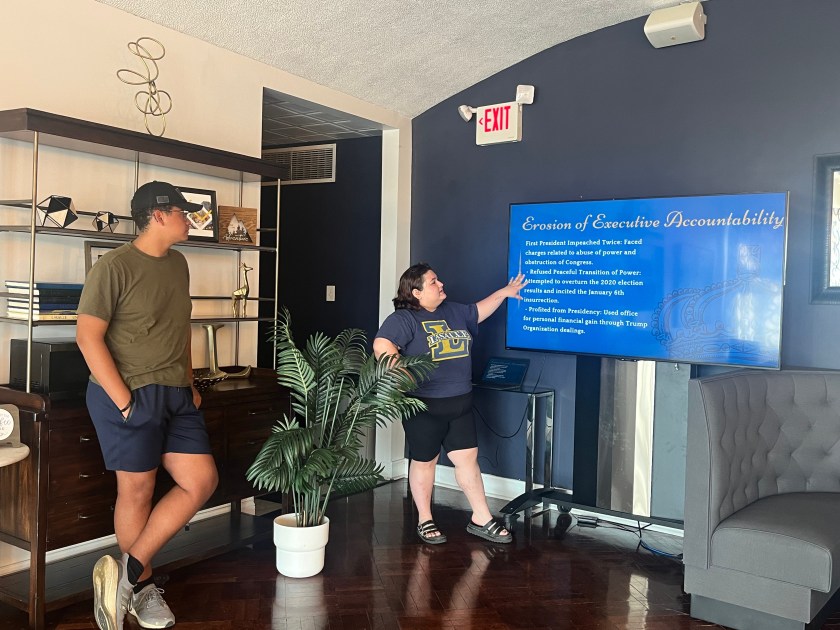
Bruno and Billarrial presenting

La Salle’s revamped pep band ignites gameday energy

Features

Maya Martin, Editor

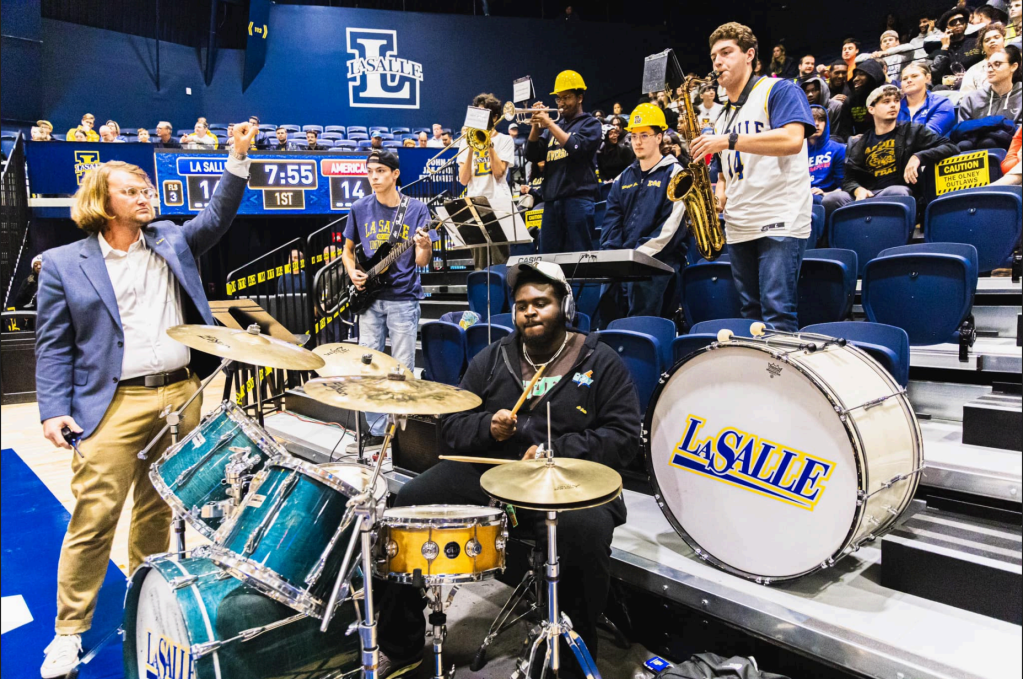
PHILADELPHIA – The drum’s beat resounds through the newly updated walls of the John Glaser Arena, sending intense energy through the crowd. The brassy blare of the saxophone cuts through the air, and the sharp ring of the trumpets adds to the symphony of sound. It is game night at La Salle University, and the pep band is in full swing, a powerhouse of sound and spirit that fuels the frenzy of the fans.

As both the men’s and women’s basketball teams charge the court, the pep band rises to the occasion as the beating heart of the arena. Their music, a mix of fight songs and high-energy anthems, ignites the fans. With each strum of the guitar and each slap of the snare drum, they are not merely playing tunes; they are shaping the very atmosphere of the game. For La Salle’s basketball fans, the pep band is not just a part of the game—it is the game.

The La Salle Pep Band via La Salle Athletic Communications

“Rather than just recorded music, it’s much better… just having humans actually playing the music live, witnessing what’s happening during the game,” explained men’s basketball player Charles Ireland. “When there’s good momentum, when there’s bad momentum, I feel like the pep band reads off of it and gives us what we need in the moment.”

Thanks to La Salle Athletics and a new pep band director, Turner Gray, the program has expanded in size, strength and sound. For a moment of time after the COVID-19 pandemic, the band was very small and on an unfortunate hiatus.

“My freshman year, it was all seniors and then me as a freshman, so everyone graduated, so the pep band consisted of just me for my junior year,” explained saxophone player Ethan Leibiger. “We didn’t get any new people joining, and then this year, there was a new director hired, and then he was able to get a lot of new recruits, so then the pep band started up again.”

This past year, the band grew to 11 members, allowing them to perform at more events outside of the men’s and women’s basketball games. The band has been invited to perform at various on-campus and citywide events including the 32nd annual La Salle Charter Dinner, the Thoroughbred Society Race, the Eagles Super Bowl pep rally and the Philly 5K.

“I like to say yes to everything because we’re in a position that we need to not only give back to the community but also get out there,” said pep band director Gray. “One of our mottos is ‘be known for more.’ Be seen and be heard. That’s two things that the band could do really well.”

The pep band at Wells Fargo Center via La Salle Athletic Communications

Outside of boosting the gameday atmosphere and amplifying La Salle Athletics, the band also has pride in being a creative outlet for students interested in music and artistic performance. While the university does not have a music major, the pep band is a less intense and more leisure-filled extracurricular that students can channel their creative spark into.

“Giving students the ability to come together, make music and do something that they just are very passionate about– I think is more important than anything,” Gray shared. “At the end of the day, the band makes a difference in so many people’s lives, and especially the students– students that are participating in the student athletics.”

“I like being able to perform in an organized musical ensemble again, because that was like my main hobby in high school,” Leibiger explained. “The best way to play your instrument is with other people, so being in a group of people that will play music with you makes it more fun than just playing by yourselves.”

The pep band performing via La Salle Athletic Communications

With the revamping and revitalization of the pep band, La Salle is offering various incentives for new members to join. Membership in the program allows for travel opportunities, priority course registration and community engagement opportunities. The most notable incentive, however, is that all new or transfer students will receive a $5,000 scholarship towards tuition.

“We have a spot for you, and we’ll work together even if it means you’re just hitting the crap out of a cowbell or you’re hitting our big bass drum,” Gray assured. “We have an instrument and a way for you to get involved, and we’d love to have you– anyone, regardless of skill level, ability, time, anything.”

For any questions or more information on how to join the pep band look to the La Salle Pep Band website, La Salle University Band Instagram account or email grayt@lasalle.edu.

The pep band performance at 32nd annual La Salle Charter Dinner via Maya Martin

La Salle’s Explorers CARE program meets students where they are

Features

Nashalie Alvarez, Staff Writer

PHILADELPHIA – Located in the basement of College Hall at La Salle University, the Explorers CARE (Campus Awareness, Resources, and Empowerment) office provides a safety net for students facing various challenges. The program addresses fundamental needs ranging from food insecurity and housing stability to transportation barriers and emotional well-being.

However, many students don’t know this program exists.

Dr. Serita Reels, director of student support and equity, said, “The idea is that in order for students to be successful and to really thrive as a student here at La Salle, they have to have their basic needs met. So, you can’t do as well as you can possibly do if you’re trying to find safe and stable housing, or you don’t have enough money to buy nutritious foods every month.”

A student struggling with food insecurity might be distracted in class, focusing more on when they’ll get their next meal than on studying. Prioritizing when the next meal will come, rather than focusing on what’s being taught, can lower academic performance and cause students to miss learning opportunities. According to the United States Department of Agriculture (USDA), 18 million U.S. households experienced food insecurity at some point in 2023.

Students can access what benefits they can get help with through a screening called Singlestop. The screening connects students with resources that can combat food insecurity, housing and more, resources such as the Supplemental Nutrition Assistance Program (SNAP).

“The program helped me with the specific needs I had at the time. It provided me with financial assistance for transportation and helped me apply for SNAP, which was a huge help when it became difficult to afford food while in college,” said sophomore Charnae Johnson.

Explorers CARE provides students with individualized support through case management. Students can either walk into the office or email to set up a meeting with a staff member. During the meeting, the staff member and student work together to determine the best way to support the student. The staff member also introduces available resources that may be beneficial.

Staff at La Salle and many who work with Explorers CARE believe that many students are unaware of the resources available to them and may not realize they’re eligible for various forms of support.

“We are doing our best to increase awareness about Explorers CARE. It’s been admittedly a slow process, but we definitely want more students to know about it,” said Reels.

By connecting students with these resources, Explorers CARE helps ensure that students receive the support they need throughout their academic journey at La Salle and beyond.

“The process varied depending on the type of support I needed. When I first applied for transportation assistance in my freshman year, it took some time to reach out and go through the process, but I knew it was necessary to ensure I could get to class on time,” said Johnson. “When I applied for SNAP in my sophomore year, the process was much quicker. The program head was very responsive and helped me complete everything efficiently.”

Among the many services the program offers, they have a student of concern process. It consists of a team of different faculty members at La Salle who can refer certain students to the committee as well as go over the student of concern cases. Multiple faculty members such as the deans of the schools meet on a weekly basis.

“Anybody at La Salle, faculty, staff or student, can file a student of concern report, and we get that information, and we meet weekly as a team about the information that we’re receiving and how we can best support that student,” said Reels.

The Explorers CARE program has had a significant impact on students allowing them to succeed academically.

“I definitely think the program is beneficial,” said Johnson. “Without it, I would have struggled to afford transportation and food, which would have negatively impacted my ability to focus on my studies.”

The program is particularly valuable, because It helps remove barriers to success that some students might encounter, ensuring students can focus on their education.

“There were a lot of times when my friends and I could have used the support of a program like this – especially when it came to accessing materials for classes. We made due with what we had but something like Explorers CARE would’ve been really helpful,” said success coach Igbal Attaelmanan.

While the program has helped students through the years, one area for potential enhancement is increasing awareness of the program. Many students are still unaware of the services available to them, and greater outreach could help ensure that those in need know where to turn for help.

“I think the program should be better advertised so more students know about it. Many students are struggling with transportation, food insecurity, or other financial difficulties, and they might not even be aware that Explorers CARE exists. Hosting events, setting up booths, or sending out more emails about the program could make a big difference,” said Johnson.

Another area where Explorers CARE could see improvement is in staffing assistance. Though the program does not have a lot of traction right now, when it does grow, there may be a need for additional staff to manage the increasing workload. In addition to the lack of sufficient staff, there may also be issues with the funding allocated to support students.

“One of the issues that is really beyond the control of the program is that there are not enough staff members to manage the requests that come in,” said Attaelmanan. “Another challenge that is also beyond the scope of the program is the amount of funding received. It would be great for them to be able to support everyone all the time, but, at this moment, that is not always realistic.”

Students who are interested in learning more about Explorers CARE can contact Reels at reels@lasalle.edu or visit the Explorers CARE website.

Visit the Career Center! 

Features

Claire Herquet, Editor 

No matter what major or year you are, the Career Center at La Salle is here to support you in achieving your career goals. Located on the first floor of Founders’ Hall, the career advancement group provides a wide array of personalized assistance and tools to each student coming in for career readiness such as headshots, resume/cover letter proofreading, interview preparation, major and career self-exploration, business attire and more. Depending on the help you are looking for, you can schedule a remote or in-person appointment with your career counselors, making it super easy and accessible to utilize their services. These sessions provide a supportive space to explore career options, develop personalized job search strategies and ask questions pertaining to your studies and/or possible job opportunities. 

The Career Center also hosts many networking and professional events during the fall and spring semesters on campus, normally in the Founders’ Hall Atrium or the Student Union. Catered towards many different majors and career paths, the group works hard to put together job forums and career fairs, sometimes featuring 90+ employers waiting to meet and connect with the students here at 20th and Olney. 

La Salle’s Career Center adopts a one-on-one approach, recognizing that career development is an ongoing process that is unique to one’s academic and professional life. The center’s end goal and mission is to equip every graduating student with key skills and opportunities needed to achieve their unique goals, whether they wish to go onto graduate studies, full-time employment, volunteer opportunities or other endeavors.  

Assistant Director of Employer Relations & Events, Noelle Stueck, had a few words to say about how important feedback is to her in hopes of making Career Center events worthwhile and helpful for those who come.

 “For me, since I do more employer and event jobs, I like finding as many touch points as I can with students to understand what types of companies they want to see more of [on campus],” she explained. “I put out feedback surveys to those who attend. Even if I can’t always get [those employers] to come, it’s good to know what students are looking for so that way for future events, it is more tailored to what students want to see at our center.” 

The center loves having attendees at their job fairs, meetups and information tables throughout the year, but they would not improve effectively without student voices and ideas. 

Julia Kane, Assistant Director of Career Development, shared her thoughts on how one of her favorite parts of her job is doing career exploration appointments with students. With the countless online resources the Career Center uses, it makes it super organized and accessible for Kane to show mentees what they can do with their skills or desired major and minors while in undergrad. Run by the Department of Labor Statistics, Kane spoke about the program O*NET, a tool for career exploration and job analysis that she helps students navigate in her office during appointments. 

She said, “Some students get stuck thinking things are black and white, and I love showing them all the different avenues and options they can explore and how they can narrow it down.” Focus 2 is another platform Kane utilizes with students, offering self-assessments and results aligning with their skills and majors.  

Student workers are crucial to the smooth operation of the Career Center on a weekly basis. From working anywhere from 8-10 hours a week, their responsibilities include event preparation and welcoming attendees, creating social media graphics, assisting with resume and cover letter approvals and representing the center on a larger scale. When asked about the Career Center’s mission, Career Peer Diamond Amara shared that she would like to see more students engaged with their resources.

 “A lot of students aren’t aware of the services available to them, and I can relate because until I started working at the Career Center last semester, I didn’t know much about it either. We want students to use the Career Closet for business attire, get their resumes reviewed, take professional headshots and just stop by to ask questions about their career goals. Overall, we want to see the student body more involved in events, panels and other activities that we hold.” 

The Career Center still has two more professional development events as part of their  “Summer Sendoff” series before the spring 2025 semester comes to an end. On Monday, Apr. 14, Resume Bingo will be held in the Union Music Room from 3:30 p.m.- 5:30 p.m., in partnership with the Student Success Coaches. Also stop by their table in the Founders’ Hall Atrium for “Download for Donuts,” on Tuesday, Apr. 22 anytime from 9 a.m.- 11 a.m. – download the Handshake app and learn how to navigate it like a pro in preparation for internship applications, and even earn a sweet treat!  For more information and to keep up with their many upcoming events and helpful tools, follow them on Instagram @lasalleu_careers, email them at careers@lasalle.edu or call them at (215) 951-1075. Their office door is also wide open during their hours of operation, 8:30 a.m.- 4:30 p.m., Monday-Friday.