
Maya Martin, Editor
This past June, I had the wonderful opportunity to travel to San Diego for a Philosophy, Politics, Economics and Law (PPEL) Summer School. The program was through the University of Arizona’s Center for the Philosophy of Freedom, and took place on campus at the University of San Diego.
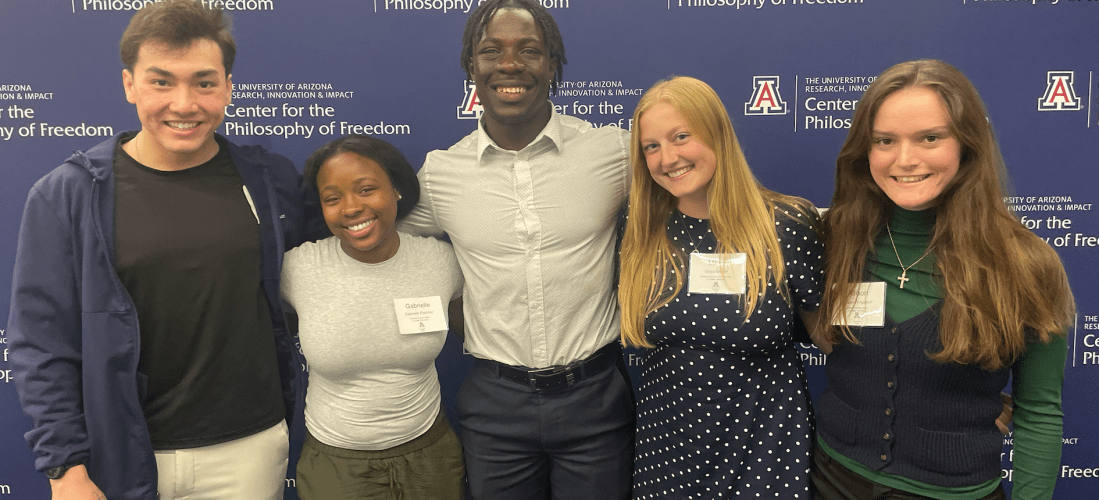
I was accompanied on the program by my fellow La Salle students, Allie Ringsdorf, Lawrence Manny, Gabby Fletcher and Kenny Lynch. We gathered for a four-day-long session with teachings from renowned professors, professionals and philosophers from across the country. The program graciously covered the cost of housing, food and the school itself.

The purpose of the summer school was to explore foundational and contemporary questions about society, exchange and governance. Presenters shared their work and topics with us throughout the week on a variety of interdisciplinary issues. Two of my favorite presentations were “International Jurisdictions, Water, and the Internet” and “Schadenfreude Representation.”
The presentations given were extremely insightful and thought-provoking. Although we sat through about four presentations a day, each kept students engaged.
Additionally, during the program, students broke into groups of five and researched, organized and worked to present a project called the “Big Question Project.” The goal of this project was for groups to think of a burning question related to PPEL and reflect on its importance or significance.
My group won third place for our presentation on the question “How can privatized prisons be justified as a form of punishment?” The presentation served to speak about the history of private prisons and its interpretation through philosophical, political, economic and legal lenses.

Right before attending the summer school, local issues arose regarding Delaney Hall, an immigration detention center, in Newark, NJ. Being from New Jersey, these issues deeply affected my community and piqued my interest, so we stemmed the topic from there.
During our presentation, we talked about major issues occurring in private prisons, including discrimination by nationality, exploitation, cruel and unusual punishment, and non-disclosure issues.
Researching this topic was very interesting and opened my eyes to much more than I knew about private prisons. We learned through our research that, on average, inmates in privatized prisons make much less than inmates in public prisons. Additionally, while most public prisons offer free basic necessities, private prisons typically charge these items at an inflated cost.
Additional research also led us to the discovery of which companies support GeoGroup and CoreCiviC, the monopolies owning and profiting off of private prisons. Brands that many people know and love, including Nike, Starbucks, Microsoft and Bank of America all donated money to these companies.
The program gave us the opportunity to deep-dive into a topic of our choosing and allowed us to broaden our knowledge and analytical skills. Researching and creating this project also gave me a greater craving for justice.
I highly encourage any students who are interested to apply for the program and attend.
It is held annually in June and is open to all undergraduate students, including students who have just graduated from their senior year.

 The La Salle Collegian