Janet Yellen Confirmed as Next United States Treasury Secretary

Business

Elizabeth McLaughlin, Staff

The Washington Post

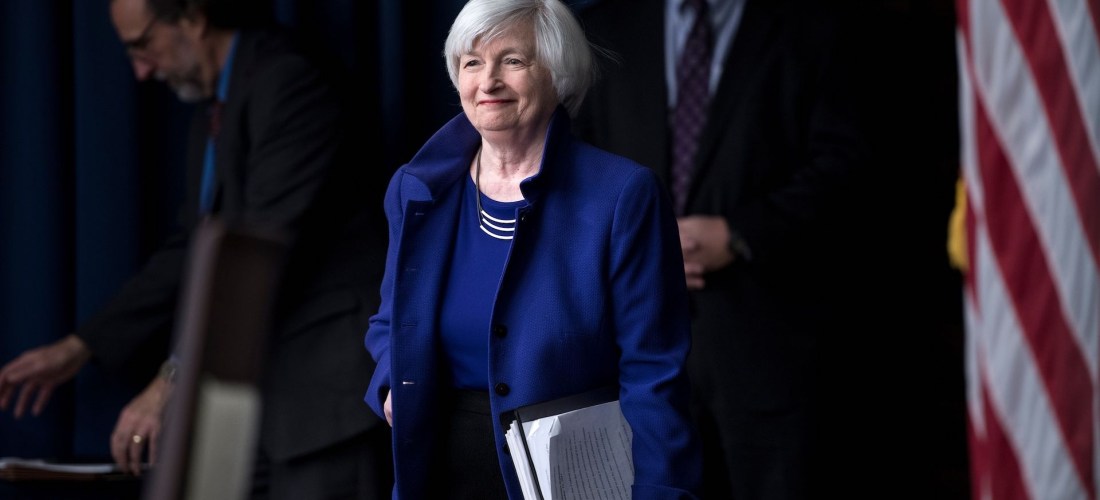
Janet Yellen, pictured above, was recently confirmed by the Senate in a bipartisan, 84-15 vote, making her the 78th Secretary of the US Treasury and first woman to hold the position.

She got her undergraduate degree in Economics from Brown University and then a PhD in the same field from Yale. From there, she taught economics as a professor at Harvard. After that, she researched international monetary policy as an economist with the Federal Reserve’s Board of Governors. She taught at London School of Economics and University of California, Berkeley. She was confirmed unanimously by the Senate to chair the Council of Economic Advisers under Bill Clinton. Then, she became the president and CEO of the Federal Reserve Bank of San Francisco, as well as a voting member of the Federal Open Market Committee. From there, she graduated to the vice chair of the Federal Reserve Board of Governors and eventually the chair of the Federal Reserve — the first female to hold that position. As if that weren’t enough, she became a distinguished fellow in residence at the Brookings Institution. She holds nine honorary degrees ranging from a doctorate in science to a doctorate in philosophy. Her name is Janet Yellen, and her most recent accomplishment to be added to an already long list is being confirmed as the newest secretary of the United States Department of the Treasury.

Janet Yellen is the first female treasury secretary and the first person ever to lead the three most powerful economic bodies in the United States government: the Treasury Department, the Federal Reserve, and the White House Council of Economic Advisers. She was confirmed by the Senate on Jan. 25 in a bipartisan vote of  84-15. In her role as Fed chair, Yellen was well-liked by both Democrats and Republicans. Her ability to appeal to both sides of the aisle will likely bode well for the Biden administration, which begins amidst unprecedented partisan tension.

Yellen is a Keynesian economist and considered by many to be a dove, which is another way of saying she is generally more concerned with unemployment than with inflation. She received criticism for keeping interest rates too low for too long in her capacity as chair of the Federal Reserve. Some of her opponents admit that she can act more as a hawk by hiking interest rates if necessary.

As Yellen steps into her role as treasury secretary, she inherits a hefty to-do list: propose and pass another fiscal stimulus bill, advise President Biden on carbon tax policy, maintain the dollar as the world’s international reserve currency, provide insight on long-term economic recovery post-Covid-19…the list goes on. Some of these issues may appear more immediately pressing than others — Americans have been waiting months for much-needed and adequate stimulus. Regardless, Yellen will play a key role in bolstering a floundering economy.

On Jan. 20, Yellen appeared before the United States Senate Committee on Finance to persuade lawmakers to pass President Biden’s $1.9-trillion Covid-19 relief plan. The plan includes increasing the minimum wage and expanding family and medical leave — two policies that do not have strong Republican support. Yellen believes that “we have a long way to go before our economy recovers,” so Congress must “act big” to support millions of struggling American families.

Another item on Yellen’s agenda is climate action. For years, Yellen has opined that climate change poses a risk to global financial stability indicating that she will “act big” on climate action in her role as treasury secretary. Her support for a carbon tax goes all the way back to her time as chair of the White House Council of Economic Advisers under President Bill Clinton. In addition, she co-founded a nonpartisan, international think tank called the Climate Leadership Council (CLC), which advocates for a carbon tax of around $40 a ton and increases 5 percent each year. In turn, this tax would filter back into American pockets in order to offset the costs of increased energy prices. Moreover, the CLC advocates for penalties on carbon-intensive products in the form of border-adjustable taxes on imports. The plan has drawn some criticism from progressive climate activists and groups and, perhaps deservingly so; ExxonMobil and Shell were quick to sign on as “founding corporate members” of the plan. Beyond that, Yellen plans on pushing for emissions reductions. She does not believe that a carbon tax alone is enough to address climate change and ensure global financial stability. In her capacity as treasury secretary, Yellen could establish a national green bank to encourage investment in sustainable infrastructure. She could also pressure international financial institutions to divest from fossil fuels.

Yellen’s bipartisan confirmation by the Senate represents a marked shift in the political and economic cultures we have grown accustomed to for the past four years. An exceptionally qualified expert with a robust resume has been appointed to a cabinet-level position with support from both parties. Her appointment is uncontroversial, expected, and comforting; three adjectives we could all use a little more of these days. The only thing lengthier than her impressive curriculum vitae? Her to-do list.

mclaughline7@lasalle.edu
ESG investing: a path to a resilient portfolio

Business

Bill O’Brien, Editor

Goldman Sachs

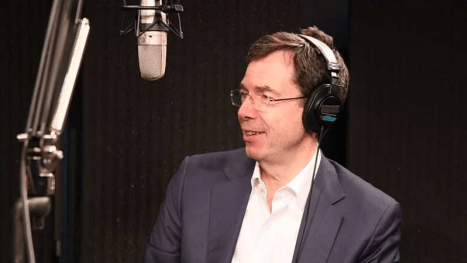
Photographed above is Goldman Sachs Senior Advisor Steve Strongin. As the former head of Goldman’s Global Investment Research Division, Strongin has lead Goldman’s research efforts on ESG investing.

Markets are rapidly evolving in nature, especially in today’s climate as they continue to reel in volatility amid a global pandemic. No one can deny that COVID-19 has been a catalyst for drastic change in society and markets, but it is important for investors and people to see that it can catalyze positive change as well. One trend we are looking at moving forward is how investors embrace environmental, sustainability and governance (ESG) investing. Wall Street’s sentiment on ESG investing ranges from stark pragmatism to optimism and hopefulness depending on what financial institution you are asking. 

Earlier this summer, Goldman Sachs covered the topic on their podcast, “Exchanges at Goldman Sachs,” where they cover trends shaping markets. The episode, titled “Sustainable ESG Investing: Turning Promises into Performance,” featured Steve Strongin, a senior advisor at Goldman and former head of its Global Investment Research division. Strongin outlines a report he and his team drew up on ESG investing, outlining a pragmatic viewpoint on how investors should shape their ESG investment strategies. One of the first points he makes is how investors need to think long-term in regards to generating return from ESG-centric strategies. The key idea behind ESG investing is when companies care about the environment, diversity and, overall, how their company is governed, then they will be able to take advantage of greater opportunities in the future and the seizing of those greater opportunities is what garners return in the long haul. Strongin specified that investors should expect a liability of no less than three years, with the possibility of needing to extend that liability based on market conditions. 

Perhaps the most interesting point Strongin made is that people mistake ESG as more of a “bumper sticker” than an investment style, in that they do not view it pragmatically enough: “[People think that] as long it’s on the right side of history, it’s supposed to be a good investment — the world isn’t that kind.” Instead, he brought up carbon as an example of how investors should view ESG as a style of investing. According to Strongin, someday, within the next 5 to 10 years, we will end up with a price of carbon, within the regulations, that will set the “efficient frontier” for addressing climate change. Opportunities investors should look out for are investments that can help companies operate in regulatory environments that are more focused on climate change; for example, a tech company that helps automakers decrease the carbon emissions of their vehicles. 

BlackRock’s “The Bid” lends a different perspective on how sustainability should be factored into investment decision-making in a post-COVID world. Host Mary-Catherine Lader, in the episode titled “Can sustainability accelerate economic recovery?”, brings together some of the brightest minds in the ESG investment space to discuss how ESG investing can spur an economic recovery after the pandemic, which caused massive economic contractions across the globe. Globally, $12 trillion dollars is being injected into the global economy and, as a society, we can use that money to shape markets around sustainability or revert them back to a “business-as-usual, highly fossil fuel driven economy.” Guests on the show made it clear that there is a great opportunity ahead, in large part due to COVID-19, to change course toward sustainability. Guest on the show, Fiona Reynolds, CEO of Principles for Responsible Investment, discussed how people are now beginning to understand how interconnected issues are throughout the world — “if you don’t have healthy people, and you don’t have a healthy planet, then you can’t possibly have a healthy economy. The three things go together.” What this should mean for the investment industry is clear: ESG, or lack thereof, poses risk to markets and participants investing in them. Peter Bakker, CEO and President of World Business Council for Sustainable Development (WBCSD), echoed this sentiment and took it a step further, stating that investors need to begin factoring in companies’ performance in sustainability into its cost of capital.

It sounds far-fetched, but his rationale is based on the assumption that Steve Strongin of Goldman Sachs spoke about: companies that care about the environment, diversity and, overall, how their company is governed, will see higher returns in the long-run and, if we accept this to be correct as it is becoming the overwhelming consensus, we should find ways to price companies based off of their performance in ESG. Financial institutions are beginning to see this as reality more and more but, as guests on “The Bid” later discuss, convincing individuals has been the latest hurdle in convincing the world that ESG investing is an incredible investment opportunity and not just an obligation that must be fulfilled on behalf of all mankind. Guests on the show all agreed that acting as soon as possible is imperative to avoiding the costs that will be incurred for not paying mind to sustainability in our environment and our society. They suggest that, in order to convince policymakers to jump in on that action, the data we use to measure sustainability impact still needs to come a long way. The reality is the more case studies that can be used to demonstrate where sustainability created a value add-on for a portfolio and for markets, the more likely individuals of our society will jump onto the ESG train and pressure their elected officials and other policymakers to do the same.