What the death of Queen Elizabeth signifies for the future of the U.K.

international politics, Politics

On Sept. 9, 2022, a monarch of the British family, Queen Elizabeth II, passed away unexpectedly. The Queen’s death marks the end of the longest-serving monarch in British history and the second-longest monarch of a sovereign country. And with such a monumental period coming to an end, a question raised by the British people and countries around the world remains: what is next?

Preparations for the death of the queen, an operation entitled “London Bridge” was put into place years prior to her majesty’s death, outlining the day of the queen’s passing down to the very minute. Yet, the plan does not outline a clear indication as to what is next for the monarch and its international territories. Countries in the Caribbean have already made abundantly clear their wants for complete independence prior to the death of the Queen, especially Jamaica. Jamaica, which has been a part of the British commonwealth since its independence from Britain in 1962, outlined to Prince William and his wife Kate during their visit in March its plans to become a republic. As stated by Jamaican Prime Minister Andrew Holness to Prince Charles, “Jamaica is as you would see a country that is very proud… and we’re moving on. And we intend… to fulfill our true ambition of being an independent, fully developed and prosperous country.” This widespread want for complete independence in the Caribbean as reflected by Jamaica comes after Barbados made a bold deposition of the British queen as a head of state back in November of 2021, officially making the country its own republic.

Alongside wants for independence in the Caribbean is the want for a redress of the horror that was slavery. This is what Jamaican prime minister Holness references when he says, “there are issues here which as you would know are unresolved.” This sentiment has been shared by the rest of the Caribbean commonwealth countries that have suffered under the stained legacy of slavery at the hands of the British monarchy which they feel they should be compensated. Political scientists have often pointed to slavery as the cause for political, social, and economic stuntment in the Caribbean region while the proprietors of the transatlantic slave trade such as the British Monarchy remained wealthy. As a result, it was announced in 2021 by the longest serving parliamentarian in Jamaican history, lawmaker Mike Henry, that Jamaica plans to petition for an estimated 7.6 billion in reparations to the head of the commonwealth (which was Queen Elizabeth at the time). While it remains unknown if the petition is still being brought forth to the British Government, it is very unlikely that the new head of the British government, Prince Charles, would grant such a petition. On top of the international territories that may be questioning their status after the passing of the queen, more generally, the world stage continues to question the importance of any monarchical system in the 21st century. A Newsweek article reported that according to a 2022 statistic questioning those in favor of abolishing the monarchy in the U.K., young people have become increasingly more supportive of abolishment than in prior years. As stated by the article, “Within the 18- to 24-year-old age range, 40 percent wanted to abolish the monarchy compared to 37 percent who supported continuing with it” (Queen Has ‘Huge Problem’ as Support for Abolishing Monarchy Rises, 2022). Statistics for support of the monarchy by the more general population of the U.K., however, were not any more promising. As stated further in the article, “The research suggested 27 percent wanted to abolish the monarchy compared with 60 percent in favor of keeping it” (2022). The research collected in the Newsweek article may reflect that those commonwealth countries of the U.K. and the wider world, in general, may have had enough of the monarchy of Britain. Especially following the death of Queen Elizabeth II, it remains unclear how the legacy of the royal family will carry on, especially as the crown transitions to a less liked Prince Charles. Such a transition may promote British territories to depose the monarchy as their heads of government now more than ever.

EU Energy Prices Soar as Russia Cuts off Natural Gas Exports

Politics

Ian Krysztofiak, Staff

Energy prices skyrocketed on Monday as the state-controlled Gazprom PJSC announces the shutdown of the Nord Stream Pipeline that supplies the EU with 40% of its natural gas. The Nord Stream Pipeline runs from Vybord Russia under the Baltic Sea to Greifswald Germany. The Kremlin says western sanctions has made maintenance of the pipeline impossible yet declines to send the gas through other functioning pipelines. Prior to Russia’s invasion of Ukraine, wholesale natural-gas prices in northwest Europe were at around seventy euros a megawatt-a hour, as of Sept. 5, 2022, the price per megawatt-a hour is 252 euros.

Europe is on the front lines of this economic war with Russia, the soaring electricity prices and natural gas shortages has hindered the European economy and has them concerned about blackouts and shortages in the winter months when energy demand picks up. Heading into the winter, the analysts believe Europe will be able to survive without state-directed rationing. European utilities companies are working endlessly to find replacements to Russian gas, the U.S. and the middle east are sending them a supercooled liquified-natural gas alternative.

EU governments fear that power markets are posed to break due to the massive cash payments that these companies are required to make to trade on energy exchanges. Officials see that these failed payments could promote financial instability creating a vicious cycle of volatility.

By cutting gas supplies to Europe creates risk for Moscow, recently the EU has agreed impose a price cap on Russian oil to limit Russia’s ability to finance its war with Ukraine. Russia has threatened to retaliate by cutting off oil and gas exports to countries that implement this price cap.

But German Chancellor Olaf Scholz mentioned earlier this week that his country was “much better prepared” to secure enough national gas for Germany to avoid blackouts during the winter than they were a couple of months ago. He also mentioned that “we can deal quite well with the threats that are coming our way from Russia.”

Supreme Court draft opinion suggests Roe v. Wade reversal

national politics, Politics

Jakob Eiseman, Editor-in-Chief
Header Image: APNews

“The Constitution makes no reference to abortion, and no such right is implicitly protected by any constitutional provision…” states a draft opinion by Justice Samuel Alito which was recently leaked from internal Court communications to policy news outlet Politico. “We hold that Roe and Casey must be overruled,” reads the draft. 

Before diving deeper into the draft and the claims made therein, it is important to state that this is a draft opinion. While the draft was confirmed to be authentic, it does not yet represent any official decision or confirmation by the Supreme Court. While it is likely that the voting process ended with the majority opinion lying with an overruling, or at least altering of abortion laws as this opinion was drafted at all, the voting results are still unknown, and an opinion cannot be officially made public until a majority of justices sign onto the opinion claiming that it accurately reflects their determinations on the matter, and a Supreme Court ruling can have no affect on law until the official opinion is made public. 

Just the facts

While justices have changed their final votes between preliminary voting and final opinion, there is nothing to suggest now whether that will or will not be the case.

There is some speculation as to why Justice Alito would be tasked with writing this opinion, leading some to suggest that the draft does not reflect true discussions, this piece will largely avoid speculation and focus just on the facts of Alito’s draft opinion, and what its implications would be if it were accepted as is.

As quoted above, the opinion contains several sections that outright denounce Roe v. Wade, a landmark Supreme Court decision from 1973 that has repeatedly served as precedent on abortion cases. The main stipulation of the case is that criminalizing abortion violated women’s right to privacy as protected by the Constitution. The opinion also suggests an overturn of Planned Parenthood of Southeastern Pennsylvania v. Casey, a 1992 case which made several changes to how abortion laws were interpreted in the United States, as well as instituting an undue burden standard into law that any state law that would impede a woman from receiving an abortion before their pregnancy progressed too far would be invalid.

Alito’s draft was first presented to the justices in February, but the information leak happened on Monday, May 2. The main repeated claim from the draft opinion is that Roe v. Wade protects women under a right that is not expressly protected by the Constitution. Claiming that the case has had “damaging consequences,” Alito calls for a full reversal, allowing for any state in the union to allow abortion procedures to take place within established frameworks, but also allowing states to place bans on the procedures or criminalize them.

Alito also hammers in on the idea of fetus viability, citing several critical works against Roe v. Wade and stating that one of the ruling’s weaknesses in regards to maternal health was in relation to its determination of “viability.” In the draft, he details the tenants of Roe v. Wade that directed state’s abortion regulation by trimester, stating that during the first trimester, the abortion should be approved by a physician, but gives the right to the pregnant woman to receive an abortion, during the second trimester, a state can regulate abortions by using maternal health laws and regulations at the state level, so long as it does not delay the procedure from happening until the window has passed and the third trimester grants states’ the right to ban abortions unless the pregnancy threatens the life of the woman herself.

Alterations have been made since, but using parts of Roe v. Wade as a reasoning for its overturn, Alito describes the framework set out by the ruling stating “Neither party advocated the trimester framework,” reads the draft, “nor should either party or any amicus argue that ‘viability’ should mark the point at which the scope of the abortion right and a State’s regulatory authority should be substantially transformed.” 

A concession that is made in the draft is that this overturning does not concern any other laws or rights other than those directly related to the termination of pregnancy, and that the precedent that would be set by the opinion cannot be applied to any other rulings or overturnings. 

What does it mean?

While Alito’s draft mainly targets Roe v Wade’s regulations for their constitutionality, reversing that ruling would likely result in a massive schism of states who ban or strictly regulate abortion procedures, and those that continue to allow them, likely along party lines.

The reasoning for the reversal is wholly political, but the ramifications should this draft come to fruition are medical, social, financial and societal in nature. If Roe v. Wade is overturned, the protections that women have held for years will vanish in states whose representatives are actively seeking to put an end to reproductive rights.

Several states have “trigger laws” which would ban abortion in almost all cases if the Supreme Court goes through with this draft, with some going into effect immediately and others having a ticking timer. Kentucky, Oklahoma, Louisiana and South Dakota are often looked to when discussions of abortion bans come up, as their trigger laws would ban abortion throughout the state immediately. 

It is important to note that almost every state in the union that has trigger laws or that has historically banned abortion makes medical exceptions should the life of the mother be at risk due to pregnancy. However, there is also a history of laws in these states interfering with treatment in any case, making it difficult, and forcing women to move across state lines to receive the care they need to survive. Very few abortion banning states currently have concessions related to pregnancies caused by rape.

A conversation has sparked as a result of this leaked document discussing the true tolls this reversal would take. Many point to the fact that if abortion bans are left up to the states, that wealthy women, or those with support, will be able to fly or be driven to a state that allows abortions and receive help, while those that are in dire financial situations will be unable to receive this care, even in the case that they were raped. 

Some have been pointing to a Tennessee bill proposed this spring that would allow citizens to sue anyone suspected of receiving or assisting in an abortion. Should Roe v Wade be overturned and bills like this passed in certain states, risky or illegal abortions would now carry an even greater risk. While this is a specific case, this law would also allow a rapist to take their victim to court if they abort the fetus in Tennessee.

According to a data analysis by NBC News, 21 states and/or territories would likely continue to protect abortion rights, nine would restrict abortions with various laws, including Pennsylvania, and 23 would ban abortion altogether or except in situations where it is medically necessary.


Editor’s note: Please allow concessions as we are currently in preparations for final exams and simply do not have the time to perform such an analysis ourselves. We implore you to read further on quality news sites to get the big picture, and just use this as a jumping off point for your understanding of the draft and its implications, not a whole summary.

Russia to officially declare war on Ukraine, U.S. officials speculate

international politics, Politics

Elizabeth Boyle, Staff
Header Image: BBC

Just weeks after the Russian military was accused of war crimes by Ukrainian President Volodymyr Zelenskyy, Western officials are speculating that Russian President Vladimir Putin could be moving towards an official declaration of war against Ukraine. The speculation comes in preparation for “Victory Day” in Russia on May 9. The day commemorates Russia’s victory against the Nazis in 1945. The day is symbolic to the Russian people and Putin himself. British Defense Secretary Ben Wallace said Putin “is probably going to declare on this May Day that ‘we are now at war with the world’s Nazis and we need to mass mobilize the Russian people.”

U.S. officials have begun to speculate the Declaration of War may be coming on May 9 after reviewing Putin’s language in the months since Russian troops invaded Ukraine. Putin has been careful to avoid the word “war “and called the invasion a “special military operation.”

If Russia is moving towards declaring war it could mean Putin could move all of his troops in the reserves to action in Ukraine.According to Russian Generals, it looks like their eyes may be on Moldova next. 

When the Soviet Union fell in 1991 Moldova became independent. Russia then led a separatist movement into Transnistria which declared itself independent from the Moldova Republic. If the trend continues that Putin wants to rebuild Russia’s empire by taking over former countries in the Soviet Union, Moldova is a logical target. Last week the senior Russian Commander explained that his goals for Russia’s next move into Ukraine is to gain access to Southern Ukraine and move into Transnistria. 

Transnistria is a strip of land approximately 1,350 square miles wide in-between Ukraine and Moldova and is not internationally recognized. There are roughly half a million people who live there that have their own constitution, military and flag. The majority of those people are Russian speakers. Russia has previously used the justification for freeing oppressed “Russian speakers’” when invading Ukraine. By going through southern Ukraine and securing Transnistria, Russia would also gain access to the Ukrainian port city of Odessa on the Black Sea.

Moldova is increasing security measures after an explosion occurred in the towns of Maiac and Tiraspol located in Transnistria to the northeast of Moldova. Moldova has implemented military checkpoints in its cities and canceled its annual victory day parade on May 9. 

An expert on Moldova, Bob Deen, who is a senior research fellow at the Clingendael Institute think tank in the Netherlands says, “We have seen that the topic of Transnistria is becoming discussed more openly in the Russian public domain. Russian recent statements could be an indication of the ambitions Moscow has there.” 

In addition to Russia’s military operations increasing in Ukraine, Russian Foreign Minister Sergey Lavrov stated that “NATO is essentially going to war with Russia through a proxy.” President Biden addressed these comments saying that calling out NATO is a sign of “desperation that Russia is feeling about their abject failure.”

Russia pulls out of Kyiv, U.S. meets with Ukraine to discuss aid

Politics

Elizabeth Boyle, Staff

Header Image: Kyiv Post

Secretary of State Antony Blinken and Secretary of Defense Lloyd Austin traveled to Kyiv, Ukraine to meet with Ukrainian President, Volodymyr Zelenskyy. While in Ukraine they engaged in a three hour meeting where they discussed the turning tide of the war, Russia’s strategy, and what aid Zelenskyy needs. 

After the Russian Military failed to take Kyiv, they turned their attention to the Donbas region in Eastern Ukraine. The Donbas region has had Russian supporters fighting there for years, since 2014. The region is on the Russian border, so it makes it easier for Russia to fight there. They are close to supplies and reinforcements from Russia. The Donbas region changes the nature of the fighting because it is a flat and open space. Russia retreating from Kyiv is progress for Ukraine, but they now must focus on using long-range weapons, such as artillery, to fight the Russians from a greater distance. Russia’s repositioning away from Kyiv was one of the topics brought up during the meeting and Blinken said, “When it comes to Russia’s war aims, Russia is failing. Ukraine is succeeding. Russia has sought as its principle aim to totally subjugate Ukraine, to take away its sovereignty, to take away its independence. That has failed.”

Blinken and Austin demonstrated the US’s continuing support for Ukraine. They are the two highest-level Americans to visit the Ukrainian capital since the war started in February. They were cautioned of the dangers of traveling to Ukraine, but Blinken explained, “We had an opportunity to demonstrate directly our strong ongoing support for the Ukrainian government and the Ukrainian people. This was, in our judgment, an important moment to be there, to have face-to-face conversations in detail…The strategy that we’ve put in place, massive support for Ukraine, massive pressure against Russia, solidarity with more than 30 countries engaged in these efforts are having real results.”

The next step to help Ukraine is to send military equipment that meets current needs, especially long-range weapons such as howitzers and anti-artillery radars. On Thursday, April 21st President Biden announced, “An additional $800 million in military aid will be sent to Ukraine.” This aid includes howitzers and artillery ammunition, tactical vehicles, and drones. The US has provided an estimated $3.4 billion worth of aid since February 24 at the start of the war. President Biden has also accused Russian President Vladimir Putin of genocide and war crimes in Ukraine. 

The US is not the only country to help Ukraine and more continue to join. Canada, the Netherlands, and the United Kingdom have all offered to give military aid to Ukraine. English Prime Minister Boris Johnson said, “They need support with more artillery; that is what we will be giving them.”

The US embassy in Ukraine has remained closed since the beginning of the hostilities, but President Biden announced Bridget Brink as his nominee for Ukrainian ambassador on Monday, and this, along with SecState Blinken’s assurances on Sunday signal the embassy may be up and running in the next few weeks.

Secretary of State Blinken returned to Washington after the meeting, but Secretary of Defense Austin did not accompany him. Austin traveled to Ramstein, Germany along with 20 other representatives for a North Atlantic Treaty Alliance (NATO) meeting. In the April 26 meeting assistance to the war in Ukraine was discussed along with long-term remedies for the current conflict in Europe. 

War crimes in Ukraine: easy to see — hard to prosecute

international politics, Politics

Elizabeth Boyle, Staff

Header Image: Euronews

The world watched with horror as Russia invaded Ukraine in mid-February. Russian forces surrounded Ukraine from the east on the Russia-Ukraine border all the way to the Belarus-Ukraine border to the northwest of Ukraine. Currently, there are an estimated 24,000 deaths and over 565 billion dollars worth of property damage in Ukraine. 

As part of the Russian operations in Ukraine, President Vladimir Putin’s forces tried to take Kyiv, the Ukrainian capital, but were met with stiff Ukrainian resistance and were unable to take the capital. 

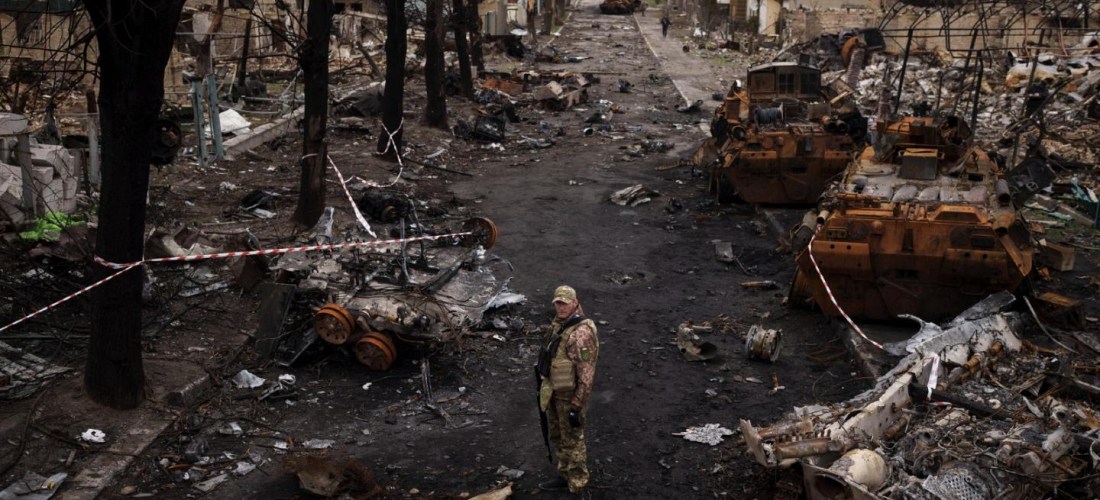
Bucha, Hostomil, Irbin and other surrounding suburbs of Kyiv were effectively destroyed by Russian forces. When those forces withdrew to pursue operations in the east of Ukraine, over 400 civilian bodies were found in the suburbs of Kyiv’s nearby towns. Ukraine has accused Russia of committing war crimes through the unnecessary killing of non-combatants. European leaders, as well as President Joe Biden, have condemned these actions. There have even been claims from Ukrainian President Volodymyr Zelenskyy and other officials that Ukrainian civilians have been tortured and killed in cold blood. The amount of civilian property damage, torture and mass killings of non-combatants continues to grow. Mass graves discovered in the town of Bucha contained the bodies of Ukrainian civilians. Others like them have been found in other locations outside of Kyiv.

War crimes are classified as “Grave breaches of the Geneva Conventions of 12 August 1949,” according to the U.N. Office on Genocide Prevention. International laws have been established to maintain humanitarian decency and respect for personal dignity during wars. War crimes are best understood to be cruel and/or unusual acts in which people are unnecessarily harmed during a time of war. Examples would be the willful killing of civilians, genocide, torture or inhumane treatment, taking hostages, unnecessarily destroying civilian property and compelling prisoners of war to fight for an opposing faction.

Zelenskyy described the destruction around Kyiv as “a scene from a horror movie.” He reported that he had seen such atrocities as corpses of women who were raped, killed and then burned. He said, “This is genocide.” He is calling for the West to employ more sanctions on Russia, and is asking for more weapons to defend Ukraine.

Zelenskyy spoke to the United Nations Security Council on April 5, 2022, and said that those responsible for these crimes should be immediately brought in front of a court similar to the one established at Nuremberg after World War II. Zelenskyy told the Security Council, “The Russian military searched for and purposely killed anyone who served our country. They shot and killed women outside their houses when they just tried to call someone who is alive. They killed entire families, adults and children, and tried to burn the bodies. They used tanks to crush civilians just for their pleasure.” He said that the Russians who gave the orders and performed the actions “must be brought to justice immediately for war crimes.”

Biden spoke out on the issue saying that Putin was acting brutally. The U.S. Secretary of State Anthony Blinken said that when looking at the images from Bucha he saw that it was “not the random act of a rogue unit” but “a deliberate campaign to kill, torture — to rape — to commit atrocities.” Blinken said that he found the reports of war crimes in Ukraine to be credible.

How will Russia’s alleged war crimes be investigated and prosecuted? One truism of war crimes is “The victor determines what is a war crime and who gets punished.”

Biden administration rescinds Title 42

international politics, national politics, Politics

This article was written in collaboration with the Foreign Policy Youth Collab (FPYC) , an organization striving to bridge the gap between politicians and teens across the political spectrum.

Header Image: US News

On Friday April 1, 2022, the Centers for Disease Control and Prevention (CDC) announced that May 23 will usher in an end of Title 42, this being an arguably nontraditional marker by the CDC of the U.S. emerging from a two-year-long pandemic. Title 42 was enacted for the first time in the nation’s history on March 20, 2020, at the start of the COVID-19 pandemic by the CDC as ordered by former Vice President Mike Pence. With an end to Title 42 in sight, it would be important to clarify what is to come next in immigration trends, and furthermore, an evaluation of whether Title 42 achieved its intended purpose in the first place.

What is Title 42?

The Title 42 Health and Public Wealthfare Act was originally passed in July of 1944 in response to the influx of soldiers during WWII returning to the United States when they were infected by tuberculosis and influenza. Thus, Title 42 addresses the “regulations providing for the apprehension, detention or conditional release of individuals to prevent the introduction, transmission or spread of such diseases,” according to section 264 b of the act.. Under Title 42, the president and CDC have the right to order a halt, holding or denial of immigrants from entering a country during a period of high risk infection. Some persons can apply for exclusion from the title in extreme circumstances, however, the plaintiff requires a medical screening if the excuse is to be applied. 

Similar practices of health screens had been put in place at ports of immigration even prior to Title 42’s enactment. During the Spanish Influenza in 1918, for example, although immigration rates were already much lower than in previous years, inspections of health were put in place in high concentrated migration ports, such as Ellis Island. However, the National Library of Medicine reports that rejection rates of immigrants on medical grounds in 1918 were estimated to be only 2 percent to 3 percent. The low rejection rates of immigrants, even in the height of a pandemic, in 1918 contrasts what we are witnessing today. In 2020, it was reported by the Migrant Policy Institute that over 1.7 million expulsions (or apprehension of immigrants at the U.S-Mexican border) were carried out. This means that immigrants and asylum seekers alike were expelled back to Mexico, or their countries of origin, by the United States without the opportunity to argue their case. This is the highest record of apprehensions at the U.S-Mexican border recorded in history.

What are Title 42’s consequences?

The most important result to note is that immigration into the United States has not decreased one bit, but instead, it is the manner in which immigrants are entering the U.S. that has changed following Title 42. One way in which entry has changed under Title 42 is that it can occur repeatedly. Under Title 42, immigrants are not deported, but simply returned back to Mexico where they have the opportunity to try to enter several more times, sometimes even on the same day. That is why the highest record of apprehensions of immigrants in one year in the United States was reached under Title 42. In October 2020, 40 percent of all immigrants apprehended had crossed the border repeatedly; while in 2019, this figure stood at just 7 percent. In this way, Title 42’s attempt at preventing border apprehensions had an inverse effect. 

The other way in which immigration has changed is how immigrants get into the country, even under Title 42. Undoubtedly, Title 42 did not discourage “illegal” entries into the United States, as higher concentration and regulations in safe points of entry at U.S. borders only corral immigrants into less regulated points of entry, at times dangerous ones.  

When the title was enacted in March of 2020, the United States and Mexico agreed that adult migrants who were denied entry into the United States would be turned back to Mexico. Shortly after, the Biden Administration took over in 2021, and in February, Mexico announced that they no longer would accept families with children under seven who were set to be expelled from the United States during Title 42’s application. As a result, the Biden administration was either forced to fly these families back to their country of origin aside from Mexico, were permitted asylum in the U.S., or were placed into ICE detention centers for months at a time. This is what resulted in Vice President Kamala Harris announcing to potential immigrants and asylum seekers during her visit in Guatemala to not come in the summer of 2021. 

What are the concerns about Title 42 and lifting it?

Lawsuits against the U.S have been taken up on each side of the aisle about receding Title 42, however, for different reasons. In summer of 2021, The American Civil Liberties Union, Texas Civil Rights Project, RAICES, Center for Gender & Refugee Studies, Oxfam, ACLU of Texas, and ACLU of the District of Columbia​​ filed suit against the United States after the negotiations to end Title 42 with the Biden administration turned sour. In September, the federal court ruled that found that Title 42 expulsions are “likely unlawful” . The Biden administration was quick to appeal that ruling in hopes to continue turning away refugee families from the border. This appeal has reached a D.C circuit court with the case continuing into the first year anniversary of President Biden’s inauguration. Democrats, human rights advocates, and even the CDC itself push for the executive branch of the United States to rescind Title 42 has been a long time coming, bearing in mind all of Title 42’s effects. 

The act faced scrutiny as human rights advocates describe that pushing immigrants out of one disease inflected country into another does not properly address the issue of the migrants safety, nor America’s safety. Rather, it is a short-term solution by politicians to “protect” the citizens of one country at the expense of the safety of the ones trying to enter.  

Furthermore, human rights advocates argue that Title 42 does not address the crisis asylum seekers are fleeing as a result of even amidst a pandemic. Reflecting back on all the major conflicts that occurred even during the two year pandemic such as the earthquake and assasination of the president in Haiti, ongoing violence in Central America, and now the struggle of Ukranians, asylum seekers have not stopped seeking asylum because of the pandemic. It is sighted by human rights advocates that Title 42 in fact is a violation of international law on the part of the United States as it is actively denying the acceptance of asylum seekers which all countries must uphold. Article 33(1) of the 1951 Refugee Convention protects any “refugee” “against refoulement if his or her ‘life or freedom would be threatened because of race, religion, nationality, membership of a particular social group or political opinion’.”

As summarized in the legislation, immigrants are guaranteed the right to have their application for asylum reviewed when they request it at a U.S. port of entry. However, under Title 42, all immigrants, including asylum seekers, have been turned away from U.S. ports of entry without question of their situation except for some special occasions. The Trump and Biden administration alike have argued that Title 42 supersedes the Article 33 provision’s guarantee of rights for asylum seekers. Considering this is the first time in the nation’s history in which Title 42 has been put to work, there are still a lot of questions surrounding the extent and power of the title. A webinar was held in May of 2021 by the Physicians for Human Rights on the issue of Title 42 where a wide range of experts from human rights organizations around the country contributed answers to this question. 

One of those experts was Lee Gelernt, the deputy director of the American Civil Liberties Union’s Immigrants’ Rights Project. Gelernt commented that even in Title 42’s creation back in 1944, it did not authorize expulsions, especially of asylum seekers. As further stated by Gerlernt, “[Title 42] has never in its history throughout the worst pandemics ever been used to send people back… Even if it could somehow be construed to authorize deportation, it cannot override asylum laws.” Gelernt’s comments reign true as at the time the title was enacted in 1946, Title 42 only addressed the prevention of immigrants posing the risk of infection from entering a country, not what would happen when they are within the United States.

Title 42 has also been criticized by progressives as not addressing the safety concerns for denying immigrants entry into the United States as well as the threats posed when forcibly returning them to their country of origin. It is cited by the Human Rights First organization that of the 1.7 million expulsions occurring under Title 42, of which at least 9,886 cases of kidnappings, tortures, rapes and other violent attacks on people occured as a direct denial of entrance into the U.S. These figures do not even yet take into account the expulsions where an immigrant was deported to a country they fled from for fears of persecution. 

Conservatives feel just as strongly as liberals about rescinding Title 42, however, in a contrasting way. On the other side, conservatives are concerned that rescinding Title 42 would result in an increase in infection rates by permitting COVID-positve illegal immigrants into the country, as Texas Governor Greg Abbott put it. In fact, on Sunday April 4, the state of Louisiana, in conjunction with Arizona and Missouri, filed suit against the Biden administration for rescinding Title 42 for what it claims is “an imminent, man-made, self-inflicted calamity: the abrupt elimination of the only safety valve preventing this administration’s disastrous border policies from devolving into an unmitigated chaos and catastrophe,” as quoted in the filing. What the GOP attorneys write into the filing is a concern echoed throughout the United States. However, what the filing does not address is what should instead be the answer. Eventually the COVID-19 pandemic will formally conclude and the recession of Title 42 would be consequently imminent. Title 42 is not meant to be a permanent solution to migration into the U.S. as it is only a preemptive measure to protect the integrity of health in the U.S. during increased times of infections.

The CDC fought against enacting Title 42 when it was first discussed considering evidence remains unfound that prohibiting immigrants from entering a country has any real effect on the transmission of a virus. Dr.Fauci echoed this message as well as further epidemiologists and health experts. The Columbia University Public Health program found that “the Omicron variant highlights that community transmission within the US, and not introduction of the virus from Mexico, is driving the spread of COVID-19, and that public health authorities need to focus on mitigation measures that are known to work. Title 42 is not among these measures and, if anything, makes matters worse”. Nevertheless, stigmatizations and scapegoating immigrant populations as the contributor to high infection rates is not uncommon in American culture. A poll by Axios was released in the summer of 2021 which observed a trend between vaccinated and unvaccinated persons’ placement of blame for high infection rates of COVID-19. Interestingly, 75 percent of vaccinated Americans blamed unvaccinated Americans for high infection rates, while unvaccinated mostly blamed COVID-19 transmission on foriegn travelers with over 25 percent agreement. Not only are the results of the Axios poll demonstrative of today’s political climate but further telling of attitudes towards immigrants and their role in American public health that can lead to stigmatization.

Human rights advocates highlight that politicians play into the attitudes exemplified in the poll when naming a disease and or virus after an entire ethnic group or country as witnessed when influential politicians referred to COVID-19 as the “china-virus.” Human rights advocates argue that naming a virus after a country can pose real harm especially to people of that nationality. This was witnessed throughout the pandemic when the FBI found that in 2021, hate-crimes directed at Asian Americans spiked at a rate of 73 percent and the rate of other hate crimes rose by 13 percent that same year. 

What lifting Title 42 in May means

The most encouraging takeaway about the rescission of Title 42 is that the world may be emerging from the tail end of a two-year pandemic which has rattled the lives of billions. One side however, argues that rescinding Title 42 signifies chaos ensuing as immigrants entering the United States will increase COVID-19 infection rates while the other side argues that this is a step in the right direction for human rights. Although there is still no conclusive evidence that the immigrants seeking asylum or entrance into the U.S. will restimulate infection rates of COVID-19 in the U.S., conservatives are not wrong in stating that the application of Title 42 has been leaving a storm of migration building up behind its border wall for two years. The commissioner of ​​Customs and Border Protection (CBP) aired his concerns after the announcement from the Biden Administration that lifting the policy will “likely cause an increase in encounters with illegal immigrants along the southern border”. However, many experts who disavow Title 42 argue that the potential numbers of encounters from rescinding Title 42 could not be more than the record high expulsions that occurred under the title. Furthermore,  it is important to highlight that the mass of people waiting for entrance into the U.S. is not more than to be expected at this time of year as there usually is a yearly trend of an increase in immgration to the U.S witnessed every spring. What remains up in the air is the Biden Administration’s handling of pending suits filed against it that advocate for and against Title 42’s rescission. How the administration seeks to navigate these legal battles will be especially pivotal for the legacy of the Biden administration and furthermore indicative of whether Title 42 can be applied in the future.

Senate hearings on SCOTUS nominee Ketanji Brown Jackson

Politics

Jakob Eiseman, Editor-in-Chief

Header Image: CNBC

Judge Ketanji Brown Jackson had her third and final day of Senate hearings on Wednesday, with critical Republican Senators and supportive Democratic Senators lobbing dozens of questions her way regarding her experience with prison time rulings, critical race theory, her sentencing regarding sex offenders and even her empathy as a human being. These questioning hearings have been described as marathons, with Brown being before the podium for hours at a time. Here is a breakdown of some of the major takeaways from all three hearings:

In the opening remarks on Monday, the Republican Senators stated that this nomination would be pivotal to the future of the systems of government in place in the U.S., referencing frequent attacks on the Supreme Court’s legitimacy by political analysts and representatives as well. Democratic Senators echoed the importance of this nomination, instead opting to refer to current political topics that the Supreme Court may weigh in on in the coming years such as access to, and support of abortion. Both sides of the aisle agreed, at least publicly, that the nomination of Jackson is monumental in U.S. history as, if confirmed, Jackson would be the first Black woman to serve on the Supreme Court. On the third day, Dick Durbin, D-IL, began the session as Senate panel’s Judiciary Committee chairman stating that “America is ready for the Supreme Court glass ceiling to shatter.”

Expectedly, Ted Cruz, R-TX, used his time slot in the opening remarks to bash Democratic Senators and how they have handled the last few Supreme Court nominations, barely making mention of anything related to Jackson or her history in law. Several other Republican Senators including Mike Lee, R-UT, echoed this sentiment in their remarks, additionally hitting Democrats for their suggestion to expand the number of justices on the court. Democratic Senators also strayed from discussion of Jackson herself quite a few times, with Amy Klobuchar, D-MN, referencing cases that the Supreme Court will soon weigh in on such as health care reform.

When actually addressing Jackson, or speaking to their colleagues about Jackson, most comments came back to Republicans insinuating that Jackson was too soft on crime during her time as judge, and Democrats stating that just because she was a federal public defender does not correlate to her being overly-empathetic toward defendants.

At the end of the first day’s event, Jackson was allowed to issue a closing statement, and in a lengthy speech, she said “I stand on the shoulders of so many who have come before me… I have dedicated my career to ensuring the words engraved on the front of the Supreme Court building, ‘equal justice under law’, are a reality and not just an ideal,” a motto she has frequently upheld in her rulings in the past.

Boston Globe

Some common themes in questions from Republican Senators on following days included questioning Jackson’s rulings on sex-related crimes during her service as a federal judge. Some questions and criticisms for Jackson by Republicans stated that she tended to issue shorter or lighter sentences to sex offenders than is recommended federally, accusing her of endangering children and people because of her actions. To this Jackson responded that regulations are not one size fits all and that “As a mother and a judge, nothing could be further from the truth.”

Jackson represented Guantanamo Bay detainees in court in the aughts, and Republican Senators seemed to be under the impression that this made Jackson a terrorist-sympathizer despite public defenders having little control over who they defend and that she was doing her duty as a federal employee.

When questioned on her beliefs regarding critical race theory, Jackson responded that as a judge she is to be impartial, therefore it “wouldn’t be something I would rely on.” Some criticized her as dodging the question, but others have supported her that her personal beliefs regarding the sanctity of the government have little to do with her actions as an arbiter of the law and constitution.

She also managed to avoid answering questions regarding policing, again declining to answer on the grounds that her opinions on policing have little to do with her service as a lawyer, judge or justice.

In a third and final attempt to crack open Jackson’s personal life and beliefs in order to disparage her character, Lindsey Graham, R-SC, asked Jackson to discuss her religious beliefs to which she responded that there is a separation of church and state in the U.S. and that she would uphold this within herself and her service as a court justice.

On the subject of abortion, one that was put toward her from both Democrats and Republicans, Jackson said that she has a personal religious belief regarding abortion, but, as was stated before, would put that aside when ruling on cases and intends to uphold the precedents established by Roe v. Wade and Planned Parenthood v. Casey.

A question came from Thom Tiillis, R-NC, and again accused Jackson of being soft on crime. But, rather than attacking, like Cruz and others, he implied that Jackson was too sympathetic as a person to rule as judge, a concern that pundits and political commentators from both parties have expressed in the past and is her main blocker during this nomination period.

After being repeatedly targeted by Senators regarding her rulings on sex crimes in the past, somewhat heatedly, Jackson snapped back at Josh Hawley, R-MO, stating “Senator, what I regret is that in a hearing about my qualifications to be a justice on the Supreme Court, we’ve spent a lot of time focusing on this small subset of my sentences.” “No one case, Senator, can stand in for judging an entire record,” said Jackson.

The Democrat-majority senate is likely to affirm Jackson’s nomination to the Supreme Court. An update will be applied to this article when the voting comes to a close.

Three men who killed Ahmaud Arbery convicted of federal hate crimes

national politics, Politics

Jada Urbaez, Staff

The three men who killed Ahmaud Arbery, Gregory McMichael, Travis McMichael and William “Roddie” Bryan Jr., were convicted of federal hate crimes last week. 

The murder took place on the coast of Georgia on Feb. 23, 2020. Brunswick, GA had been home to Arbery and his family since his “peewee football days,” says Aaron Morrison, a reporter who sat with the victim’s family. 

On that February day, Arbery, 25, was going on an afternoon jog in a surrounding neighborhood known as Satilla Shores. Gregory McMichael reported to police that Arbery had fit the description for the suspect who allegedly committed break-ins in the area. The suspects claimed to have been doing a citizen’s arrest. The police confirmed there had been no break-ins, and therefore there was never a suspect. 

Travis and Gregory McMichael were both armed with a pistol and shotgun when they surrounded Arbery with their truck. Bryan Jr. joined the McMichaels in this encounter, utilizing his pickup truck, and three shots were fired by Travis McMichael, killing Arbery. 

The McMichaels were arrested over two months later, on May 7, and Bryan Jr. was arrested on May 21, 2020. The three men were indicted by the state of Georgia on nine counts. These include: one count of false imprisonment, four counts of felony murder, two counts of aggravated assault, one count of malice murder and one count of criminal attempt to commit false imprisonment. 

According to Georgia state law, malice murder is commited when one, “unlawfully and with malice aforethought, either express or implied, causes the death of another human being.” Travis and Gregory McMichael are sentenced to life in prison without possibility of parole. Bryan Jr., the third suspect who later joined and filmed the Arbery encounter, would be eligible for parole after thirty years. 

Last week, however, a federal jury found the three murderers guilty of federal hate crimes. To convict someone of a hate crime, the jury must see if the actions of the suspects were racially motivated. 

What aided in this conviction was a suspects’ internet usage that shows a history of racial slurs, offensive/racist memes and conversations. For many consecutive years, Bryan wrote content that mocked Martin Luther King Jr. Day. Travis McMichael left a comment in a 2018 Facebook post, “I’d kill that (expletive).” Gregory McMichael shared a post that implied disregard for slaves’ suffering in the U.S. The post said that Irish slaves suffered more than any race in American history. 

In addition to internet use, there is direct evidence provided by witnesses who testified and shared that they heard the suspects make racist comments and slurs. 

The case’s prosecutor, Christopher Perras, stated that there was no evidence that 25-year-old Arbery was a threat, but the suspects assumed so because he was Black. The suspects pleaded not guilty to the hate crime charges, but were found guilty and must serve their respective sentences for their murder charges.

Former President Trump refers to Putin as a “genius” for his invasion of Ukraine

Politics

Danielle O’Brien, Editor

On Feb. 2022, former President Trump made remarks on the “The Clay Travis & Buck Sexton Show” concerning Russian President Vladimir Putin’s invasion of Ukraine, commending it by referring to Putin as a “genius.” The remarks made set forth a disturbing precedent for political scientists to analyze whether these encouraging comments can have a welcoming effect on Russia’s dream of reforming the USSR.

Former President Trump states in the show, “I went in yesterday and there was a television screen, and I said, ‘This is genius.’ Putin declares a big portion of Ukraine, of Ukraine, Putin declares it as an independent. Oh, that’s wonderful… So Putin is now saying, ‘It’s independent,’ a large section of Ukraine. I said, ‘How smart is that?’ And he’s going to go in and be a peacekeeper. That’s the strongest peace force,” It’s important to point out that besides referring to Vladimir Putin as a “genius” for his moves in Ukraine, Trump also refers to Russia’s presence in Ukraine and more specifically Vladamir Putin as a “peacekeeper.” It’s possible that the people of the United States could give former President Trump the benefit of doubt as the United States government has a habit of invading countries unwarranted and referring to it as “peacekeeping.” 

Although these comments could have been intended in a joking manner, these potential jokes were certainly not sarcastic, considering Trump goes on to declare that the “savviness” of Putin for his invasion of an independent country is the same savviness the U.S. needs to take up towards its southern border. Trump states, “We could use that on our southern border. That’s the strongest peace force I’ve ever seen… Here’s a guy who’s very savvy… I know him very well. Very, very well.” What President Trump alludes to in his comments about the southern border, whether he is stating that invading our neighbors south of the border and claiming them as our own is a “savvy” idea, remains unclear. 

 Dr. Mark Thomas from the political science department weighed in on how comments like these may be encouraging Putin’s actions in Ukraine. Thomas stated, “Trump’s praise of Putin as a ‘genius’ has only as much credence and bearing on the global stage as his remaining sycophants in the U.S. give to it. He hardly speaks for the U.S. and even many of his most ardent supporters in the U.S. are viewing him as increasingly irrelevant and more as a roadblock to the future success of the Republican Party.” 

“That said, to those foreign leaders and people, who share Putin’s perspective that peoples divided by the post-World War I and II borders can be altered by force, his words can justify their actions, the same way the Jan. 6 protestors listened to his calls for action against former Vice President Pence and Congress in certifying the 2020 election results. The borders drawn in the post-war era are not logically based on geographical or ethnic lines; they are the equivalent of gerrymandering peoples to achieve the political goals of those drawing the lines. Needless to say, the Soviet Union (Russia), the U.S. and the U.K. drew those maps together,” continued Thomas.

“As to whether Putin is a genius is definitely doubtful. He is, at best, a judo expert who waits for his adversary to make a move to which he can leverage their own force against him so Putin can gain the advantage. His threats to use nuclear weapons are that type of move. It is what we used to refer to as ‘crazy Ivan,’ acting so unpredictably and apparently insanely to provoke fear, either to intimidate the opponent into appeasement or to push him into a position to justify another crazy act. Putin has been doing this since 2008 and he told us so in his 2014 Russian Security Strategy. He has been doing the unthinkable, be it information operations to undermine political stability in the U.S. and other Western countries, annexing Crimea and de facto annexing eastern Ukraine, assassinating dissidents abroad, cyber-attacks (ransomware are the publically known ones) on the industry. He has been softening us up for his move on Ukraine and his ultimate objective of creating a polycentric order where nobody discounts Russian military might again. Putin sadly underestimates his Eastern flank and that China is ‘playing the U.S. card’ to gain an advantage over Russia’s economy,” Thomas Concluded

Dr. Thomas’s comments seem to indicate that positive remarks surrounding Putin’s character, such as the ones made by former President Trump, may act as an endorsement for countries to declare others theirs to conquer. This is the opposite of the values of American democracy, something which it is willing to go to war over.