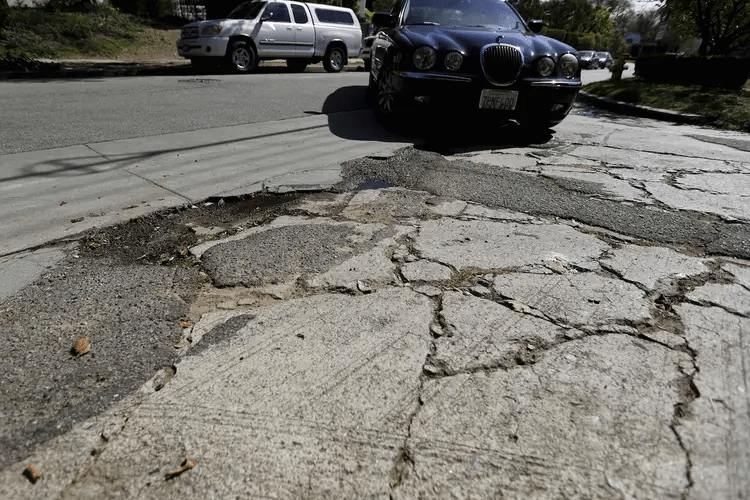
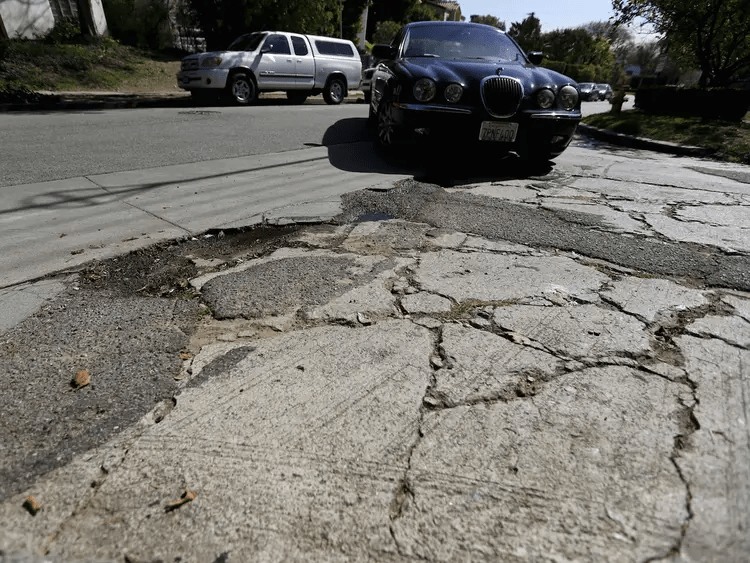
Business Insider A car driving over cracked pavement, one of many examples of infrastructure that needs repairs.
America has had a long history of transportation and public works projects implemented by the government in an attempt to take the United States from good to great. One of the earliest major partisan political policies was Henry Clay’s American System, which supported internal improvements and federally-funded roads and canals to help the agricultural market. Stephen Douglas and Lincoln orchestrated the creation of the transcontinental railroad, one of the world’s most remarkable engineering achievements in its time. Hoover and Franklin Roosevelt responded to the Great Depression by funding infrastructural improvements to provide jobs to those who lost them in the major economic downturn. In the 1950s Dwight Eisenhower passed the Interstate Highway Act, which created over 41,000 miles of highways and made transportation across the United States easier than ever. Despite all of these great achievements for modern infrastructure throughout American history, throughout recent years, things have not been going as well. In 2017, the American Society of Civil Engineers (ASCE) published its quadrennial grade for the infrastructure of the U.S. The United States scored the same as it had in 2013, a D+. According to the ASCE, the United States would need to spend about $4.5 trillion over the course of the next five years to improve the state of American roads, bridges, dams, airports, schools etc. The report has sixteen different categories that discuss the grading for each individual aspect of infrastructure and shows the reasoning why it has such a poor grade, ranging from just under 100-year-old pipe systems that desperately need repairs to the poor conditions of urban and rural roads throughout the country.
Unlike most issues circulating in Washington, this is not a partisan issue. President Trump has stated numerous times in his 2020 State of the Union address that he wants to increase federal spending on infrastructure. He even claimed to be in support of creating a two-trillion-dollar infrastructure plan as a part of phase four of the stimulus package. In 2019, the house passed a $1.5 trillion infrastructure bill that would follow the instructions and recommendations of the engineers who warned us of the dangers of the current state of infrastructure. However, both of these plans were shot down in the Senate. Senate Majority Leader McConnell and Senate Minority Leader McCarthy both said they would like to wait and see the state of things as the pandemic continued before they passed Trump’s initiative. McConnell also publicly stated that the House’s infrastructure bill would never see the light of day as he stated it was a “pure fantasy” that would die in the Senate. Trump also claimed he would veto the bill if it made it to his desk since it contained too many clean energy initiatives.
President-elect Biden has claimed that a large part of his economic revival plan for the country will focus around an infrastructure plan based on FDR’s works progress administration, sending numerous construction workers, engineers and tradesmen back to work. The focal point of his infrastructure initiative is the idea of bringing clean energy into public works and having the government entirely run on clean energy by 2050. His reasoning behind pushing such a plan is not only bringing America infrastructure back to the top of the world’s number national rankings, which it is currently 13th, it is also to reduce unemployment and poverty. His plan is estimated to cost $2 trillion. It is incredibly likely that he will face the same issues as the House and President Trump with this sweeping proposal as McConnell will likely block this proposal from ever being voted on. However, Biden does hope to reach bipartisan agreement on the bill through its initiative to provide jobs to those who are now unemployed because of the Coronavirus.
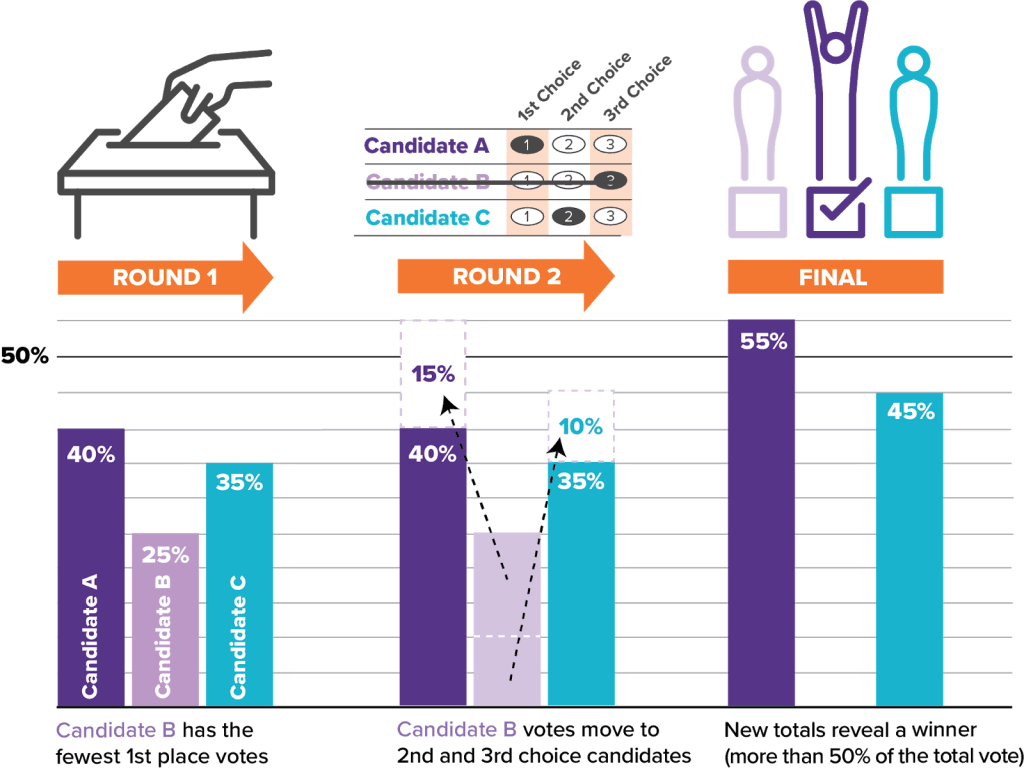
FairVote A visual explanation of rank choice voting, election reform that promotes third parties.
The electoral college was established in 1788 by James Madison and Alexander Hamilton. It was engineered to replicate the British government’s original two party system. Madison even stated that he built the system so it would always have two factions run against each other. Thus, third parties were never meant to win elections, but instead to replace one of the established parties and then participate in elections. Every election between three individuals has also resulted in extreme civil distress, an example being the election of 1912.
The Republicans replaced the Whigs not because of their strong abilities as a third party but instead because they planned to replace the Whigs as the then liberal party. The Progressives (The Bull-Moose party) could’ve replaced the Republicans, if they didn’t immediately disband after their first failure and if modern technology didn’t work in favor of the establishment. The rise of technology led to the failure of all other third party candidates throughout the 20th and 21st centuries. Third party candidates cannot win elections, not because of their bizarre political views, but because of the established aristocracy of the party system. Third parties cannot win because they have to replace one of the two established parties, which they can’t because of the rise of mass broadcasting in the modern world. Republicans and Democrats run journalism. They have unrelenting power because the average American doesn’t have the time nor ability to fully educate themselves on the political institution they reside in. Politicians are aware of their stranglehold on the uneducated public and know that even if a new party attempted to replace a party, whether that’s the Green Party with the Democrats or the Libertarians with the Republicans, they could not because of the lower class’ lack of awareness of the “revolution” needed to change things and the upper-class’ desire to keep the system in check through the manipulation of the masses.
This system has led to most candidates who have beliefs coinciding with third parties to run on Democrat or Republican tickets and modify their views to fit the public. Bernie Sanders, an independent, has become a star of the Democratic primary in both elections he participated in. Gallup polls suggest Republicans support Libertarian views more than their own, as many of us saw during the Tea Party Movement. Third parties should not be viewed as their own platform running alongside Democrats and Republicans but instead as replacements for major parties because that’s what the architects of the constitution intended. It is not the faults of the establishment that third party candidates that lack a voice, it is the fault of the system itself. Do not blame the DNC or the RNC for the failures of third party and anti-establishment candidates, blame James Madison, John Jay and Alexander Hamilton.
This situation does not necessarily mean the United States is doomed to pick between a lesser of two evils forever. This system can be changed, and numerous states like Georgia and Maine have instituted election laws that challenge the founders’ system. Rank choice voting, open primaries and runoff elections are all viable solutions to fixing this problem and providing people a larger voice in our democracy. Rank choice voting is a system that allows people to vote for third party candidates, and if the third party candidate does not get enough votes for things to matter, the vote shifts to the second favorite candidate voted for and so on and so forth until the race ends with a majority. This would allow people to actually be able to vote independent and still have their vote matter if the candidate gets barely any votes. It would also allow large third parties, like Libertarians and Greens, to stand a chance in state and national elections. Another solution is open primaries which would allow people registered independent to vote in primaries anyways. With more people having a voice during primaries, the radicalism of parties is bound to collapse as a new wave of moderates will have a say in primary elections, thus leading to less radicals in government and less gridlock in government. Georgia’s solution to the problem is not anywhere close to as efficient as these, however, it does serve as a start. This state uses a runoff election system where, if no one receives a majority in the election, the two candidates with the largest percentage are allowed a second election which determines who holds office. This way of conducting elections does provide reform to the system. However, it still works against third party systems as the “throwing your vote away” problem remains. While these are by far the most efficient ways of reducing radicals and restoring the people’s voice in government, establishment politicians have fought these in the state legislature by complaining it will lead to fraud and corruption, which is simply not true as it would allow escape from the corrupt party system we currently live under. The biggest battle in ratifying election laws that will lead to a government that we can have a say is the current establishment and system, thus it is important to be an activist and work hard to actually change the system, as our current representatives certainly will not.
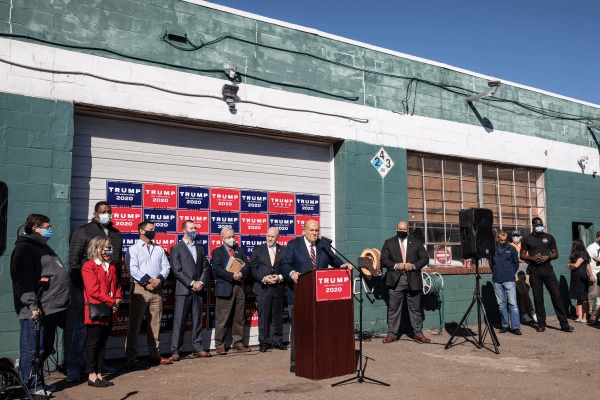
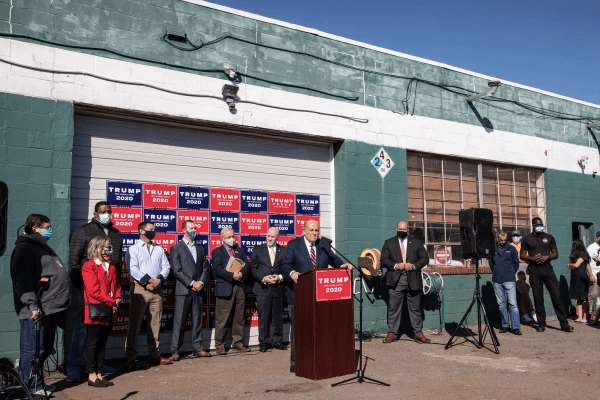
Marketplace Rudy Giuliania announces the election is not over.
Rudy Giuliani, former mayor of New York City and Trump’s personal lawyer, berated people celebrating and lamenting the outcome of the election pre-maturely by saying, “networks don’t get to decide elections, courts do.” Immediately after this remark, many dismissed Giuliani’s statements as false on the premise that courts do not decide elections, voters do, and the voters have chosen Biden. With a projected 306 votes, Biden has won. While ignoring the states that networks have refused to call such as Georgia, Alaska and Arizona, Biden still leads with 279 votes. Despite this, Trump supporters still have faith in the President by believing that voter fraud is rampant in the election and will be stopped once the court steps in.
Trump has made three major claims surrounding voter fraud that have all been called to national attention. The first was a video circling social media of a man burning ballots in a plastic bag. Election officials, however, have proven that the ballots burned in the video were not actual ballots, but actually sample ballots. The absence of bar codes on the ballots shows the viewers that they were not actually real ballots. In response, the Trump camp claimed that you cannot trust election officials. The second major claim was from a picture that went viral of Michigan’s count for Biden’s drastic increase by 138,000 votes. This too has been deemed false, as it was apparently a clerical error from the Shiawassee, MI county of presidential data. Once the error was identified, it was replaced by the correct information. The election officials then proved that there was an error, and quickly fixed it. Despite this, Donald Trump has reposted the picture onto his Twitter account and claims that it serves as evidence that the establishment and the election officials are out to get him. The final major claim of the Trump camp is that a large amount of votes received for Biden were actually by people who died before election day. This is the only concrete argument he makes, so is it enough to derail Biden’s trip to the White House? According to Axios, even if the Trump camp managed to delegitimize numerous votes, it would take a miracle for over 12,000 to be thrown out in each swing state. According to Deutsche Welle, the Trump administration’s argument is that 14,000 votes cast in Michigan were actually by the deceased. This has subsequently been proven false. The only example given for this statement was that William Bradley, a man who died in 1984, voted for Biden. This was a clerical error as the ballot was supposed to be registered for William Bradley Jr. who voted for Biden. This means no extra vote occurred, in this case at least.
Many supporters of Trump believe that a similar outcome to Bush v. Gore is possible after the election. However, things are not the same twenty years after this famous court decision. While the Supreme Court remains conservative and a presidential candidate is demanding a recount, the situations are quite different. While Gore’s failed attempt at winning a recount was over 600 votes in Florida, Donald Trump hopes to win a recount by flipping 12,000 votes at the minimum in numerous states. David Boies, Gore’s lead election lawyer, has stated, “There’s no legal avenue for the Trump campaign to plausibly dispute the results in any one state.” Gore’s recount also began because all major news outlets claimed Florida was too close to call, while Georgia and Arizona remain too close to call, despite Biden’s 13,000 and 14,000 vote lead. Trump does not have this luxury either as, even with Arizona and Georgia switching sides and voting red, he still lacks the majority needed to win. Finally, the butterfly ballot issue was the primary argument for Gore. Butterfly ballots were the method of counting votes in Florida, where a hole puncher would stamp out who your vote would go to. This system was flawed, however, as many votes were not fully stamped out, thus a recount was a logical move since many of the ballots were thrown away despite being filled out. Mail-in votes also do not have this issue, as they were all filled out via coloring in a hole on the ballot. Thus, the precedent set by Bush v. Gore does not necessarily apply to this election as the circumstances were widely different. Gore argued over 500 votes because of ballots he believed were counted incorrectly. Trump is arguing that numerous states have committed fraud and election officials have formed a kabal to take him out of office.
Despite this, Trump continues to claim the Supreme Court will settle this. Trump has hired lawyers nationwide to run these lawsuits in each swing state. Some of these lawyers include outgoing congressman Doug Collins, former counsel to the president Kory Langhofer and Ron Hicks. Trump is also launching a new campaign in each swing state that voted for Biden in an attempt to garner more support for his crusade against the election results. Trump has also founded a political action committee (PAC) to help fund changing the outcome of the election in his favor. The PAC, known as Save America, is known as a leadership PAC. The PAC is allowed infinite people to donate to it with a max donation budget per person of $5,000. The goal for Save America is to help Donald Trump maintain his power over the presidency as well as the Republican party after he leaves office. 60% of donations to the Trump campaign and the RNC will now be put into Save America. The PAC is said to have been in the making, win, lose or draw. Despite Trump’s belief that the election is far from over, prominent Republicans have congratulated Biden on his victory and denounced Trump for his actions. The 43rd President, George W. Bush, has congratulated Biden and stated that the election was fair and the outcome was clear. Republican senators Ben Sasse (NE), Pat Toomey (PA), Mitt Romney (UT), Susan Collins (ME) and Lisa Murkowski (AK) have all openly stated they believe Biden has won and all believe Trump should cooperate with the transition.
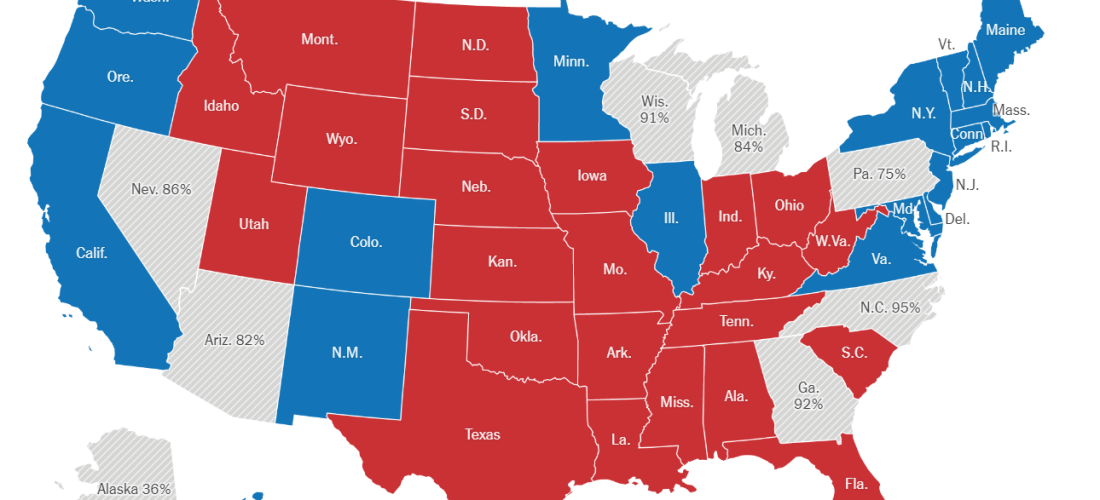
New York Times This map of the election depicts which candidate has won each state, along with percentages of votes counted in states too close to call.
The battle rages on the day after election night, as many mail-in ballots are yet to be counted in the swing states. Mail-in ballots will be the name of the game at this point, as they are the only ballots left to be counted in almost every state. Currently, most states have incumbent candidate Donald Trump beating former Vice President Joe Biden. However, most of the votes remaining are mail-in ballots, which makes things much trickier for both sides. At the time of writing, votes in numerous states — NV, MI and WI are within one percentage point of both candidates. These will likely be the states that officially turn the tide in either candidate’s direction and they are both still anyone’s game. Even though Republicans have a lead with .5 percentage points in Michigan, currently, the New York Times predicts that most of the remaining ballots to be counted will lean Democrat. Michigan is the closest state and the outcome of Michigan will likely be contested by either candidate. In Michigan, the race is still anyone’s game. Nevada has currently stopped counting votes and will resume doing so on Thursday at 12:00pm EST. Despite Nevada’s razor-thin margin of .6 percentage points, it is likely to paint a Democratic picture by the end of the election as the remaining votes are mail-in ballots dropped off on Election Day.
Things become more clear in the states of Alaska, GA, NC, and AZ. While North Carolina and Georgia are still not technically decided, each has over 90 percent of the vote counted and lean towards the Trump column. In Georgia, Trump is up by 2.3 percentage points and the votes there will be counted by the end of the day today. There does not seem to be any information on what kind of votes are left to be counted. Most of North Carolina’s remaining votes will likely go to Democrats as they, like most of the other ballots left to go, are mail-ins. North Carolina’s mail-ins have until Nov. 12 to arrive, which is likely to be the latest day possible this election will end. Despite this, Republicans are currently up in North Carolina by 1.4 percentage points with only 5 percent of the vote left to be counted. This situation leaves the question of “will the mail-in ballots be able to swing the vote in the Democratic party’s favor?” Arizona has been predicted, by Fox and CNN, to go in the Democratic party’s column since Biden is up by 5 percentage points. While Alaska currently has only 36 percent of the votes counted, the state usually leans conservative and many believe it is far too early to even think about whether it is breaking from the party it historically sides with.
This leaves one state remaining to discuss: Pennsylvania. This is the key(stone) state for both parties. The state has the second-least amount of ballots counted and many polls show the remaining votes in Pennsylvania going to Biden. Trump has an incredibly large lead at this point, of about 600,000 votes or 11.5 percentage points over Biden. However, the counties that are still in play are some of the largest, and are thus likely to swing Democrat: Philadelphia, Philly’s surrounding counties, and Allegheny County, which houses the city of Pittsburgh, still have hundreds of thousands of votes to be counted. Mail-ins are far from being fully counted, which makes this election much closer than it seems currently in Pennsylvania. The question for voters is can Trump hold onto the lead he has which consists of mostly in-person voting and rural counties?
Most of the votes remaining are absentee ballots and urban centers. Trump currently has the lead in Pennsylvania, but by the end of the election many news outlets predict this may change. It is still anyone’s game.
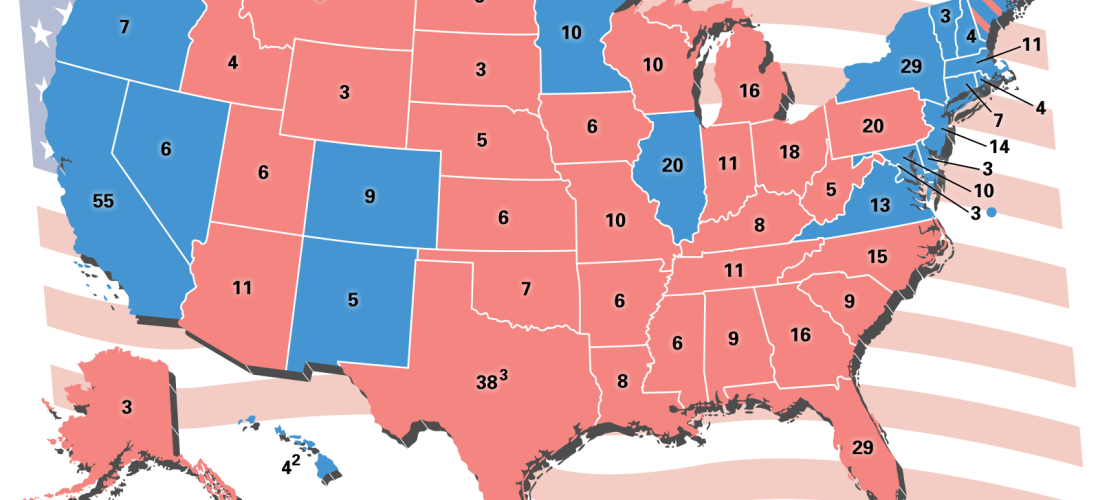
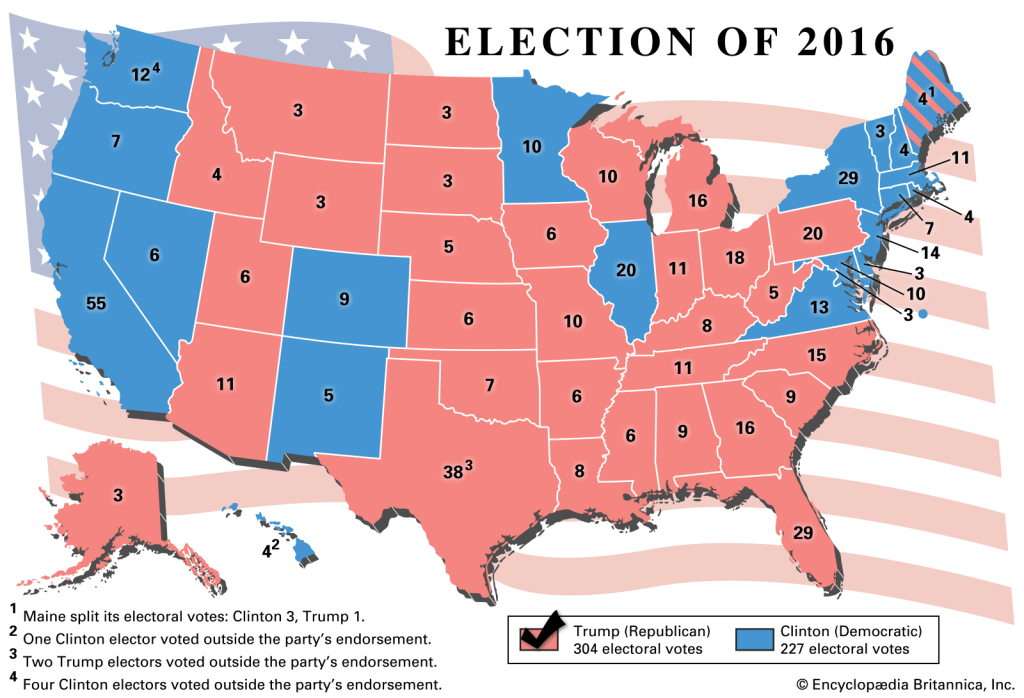
Britannica Electoral College results of the 2016 election. Despite Donald Trump’s victory, statistics show Hillary Clinton won the popular vote by over two million votes.
Only five presidential elections in American history have led to the president of the United States winning the electoral college and losing the popular vote. Each has led to major controversies. Andrew Jackson claimed that John Quincy Adams only won the presidency through a corrupt bargain with the Speaker of the House, Henry Clay, resulting in Congress refusing to follow his agenda. Rutherford B. Hayes is remembered by historians as one of the most corrupt and controversial presidents of all time because of his “compromise of 1877,” where Hayes promised to end reconstruction as long as Democrats stopped contesting the election and stopped attempting to have a recount. Grover Cleveland replaced Benjamin Harrison after his election, as majority of people saw Harrison’s victory as nothing more than a result of party machinery and the corruption of the Gilded Age. George W. Bush won the election of 2000 because of a controversial 5-4 Supreme Court decision to end the Florida recount. Of course, over the past four years we have all heard the many different arguments on whether or not Trump deserves to be in office since he lost the popular vote by the largest margin in U.S. history. Many Americans have become fed up with the electoral college. Numerous congressional representatives, senators and governors have publicly endorsed abolishing it, and replacing it with an electoral system where whoever wins the popular vote becomes the president. Here is the question — what are the positives and negatives of the electoral college, and should you be for or against it?
Supporters of the electoral college argue that the electoral college is necessary to maintain the balance of power between the states, as well as help the people who may be forgotten in a normal popularity vote to have proper representation. Without the electoral college, presidential candidates would be able to be elected by only campaigning in major urban centers like New York City and Los Angeles. This situation would result in people who many believe to be the backbone of America, such as farmers, rust belt factory workers and small town families, to be marginalized. Many argue that if candidates only need support from major urban centers, they may only support policies that benefit essential backers at the cost of harming those not needed for election. Many argue that without the electoral college, politicians will become populist demagogues who are willing to simply help the 51 percent and leave behind the 49 percent. Supporters also see the electoral college as an institution that provides much needed stability to the election process. Supporters of the electoral college believe abolishing it would result in more contentious outcomes, marginalization of valuable voting blocks and communities and overall harm Americans more than help them.
Opponents of the electoral college claim the reasoning behind its founding is no longer necessary. Originally it was created because the founders feared that the people would not know enough about their candidates to vote properly. The founders did not have complete faith in a true democracy, thus the college was necessary. Opponents of the college find this idea appalling, because they believe a true democracy is the only way a government should be run and democracy is what makes America great, not the founders’ system. Undemocratic principles of the college are plenty for many to support abolishing it. Opponents also believe that swing states like Pennsylvania, Arizona, Michigan, Wisconsin and Florida have too much power under the current system. They believe that with the current system, not all votes matter. If California is always blue, there’s no reason for a Republican to vote there as their vote will not mean anything. This situation furthers their claim that the electoral college is undemocratic, as it leaves many people’s votes meaningless, thus it should be repealed. Finally, people believe that the electoral college violates the general will of the people. Opponents follow the political philosophy of popular sovereignty — if a candidate gets a 51 percent majority, they simply deserve to win, as that is the general will of the people.
The issue is not fully black and white, however. Some believe that if numerous counties in a state vote blue and numerous counties vote red, the state should not fully endorse one candidate. Instead, the college’s votes should be split. Thus, the college should remove its policy of endorsing candidates entirely by state but should keep its district voting system. This system would allow the election to remain stable, non-urban citizens to still have valuable votes, and for people of all states to have votes that “matter.” Two states have decided to experiment with this plan. In 1972, Maine and In 1992, Nebraska both passed legislation for this plan and it seems to be quite well for the state. Perhaps this idea is the compromise that could be a good resolution between supporters and opponents.
With this current election, many are questioning the importance of the electoral college. Many believe that once all the ballots are counted, a candidate may be put in office without the majority of people supporting them, like last election. This outcome may lead to protests and arguments from both sides that refuse to acknowledge the other’s argument.
CNN Money Above is a political cartoon illustrating the mascot of the board game “Monopoly” leaping from the Google search engine, alluding to Google being a monopoly.
Many people enjoy the thrill and fear from the imaginary monsters that populate Halloween season, however, it seems that there is one much scarier and more powerful in our very own homes. On Oct. 20, the Department of Justice (DOJ) filed an antitrust lawsuit against Alphabet, Google’s parent company. The DOJ’s lawsuit’s primary claim is that Alphabet is using its role as the number one current browser to stifle competition. Google has been using its vast wealth to secure as many deals as possible to become the default browser on most systems. The most recent agreement Google has made is a $10 billion deal to become the default browser on Apple’s Safari browser. The DOJ is arguing that Google is using its powerful position to gain special treatment for its search engine on numerous devices, leading to a self-reinforcing cycle that helps maintain Google’s position as the dominant browser. The Department’s goal for the lawsuit is to force Google to become restructured and to be put under government scrutiny until its behavior stops. The suit has no concrete idea or method for this solution, however, the DOJ claims that currently nothing is off the table. The suit could also result in the numerous other services and industries Google is involved with to become separate companies, thus the browser and phone-lines may become two separate companies altogether. The largest effect of the lawsuit, win or lose, is the end of Washington DC’s adoration for big tech companies. Many antitrust officials, like Gene Kimmelman, a former senior antitrust official, see this as the beginning of the end for the deregulated tech sector.
If the dangers of monopoly were not enough to make the average person afraid of Google, its place as the search engine used by 80 percent of Americans has also led to biased search results concerning media conglomerates and major election issues. Studies show that Google provides stories and articles from liberal news outlets 62 percent of the time. In contrast, conservative outlets only show up among articles and stories 11 percent of the time. Google provides liberal news networks as the answer to search results and news stories about five times more than their conservative counterparts. This extreme contrast in results can only mean one thing — partisan bias on platforms that are supposed to facilitate bipartisan answers to policy-related questions and bipartisan answers for questions surrounding current events. This leaves the question — can freedom of speech and freedom of press survive when one company controls 80 percent of organic search results? The idea that the most popular search engine uses its power to push its own political agenda is scary enough, and coupled with a monopoly it proves to be a dangerous threat for not only our politics but also our economy. With Google’s lack of competition and its ability to buy its way into becoming the default search engine on many different devices, one must understand the dangerous implication of allowing a single company to control the perspective of the news and stories themselves for the people.
Inquirer.com A dairy farmer being forced to dump milk despite the fact that numerous cities need more.
As the election approaches, the Department of Agriculture is projected to pay $46 billion this year in farm subsidies. The agriculture sector will receive the largest government contribution to farm income since 2005. Government support is projected to account for 40 percent of farm income this year. Without these subsidies US farm income would be poised to decline. Despite these large government payments, debt in the farm sector is projected to increase to four percent this year, to a record-breaking $434 billion.
The combination of the trade wars under the Trump administration and the coronavirus pandemic have led to extreme difficulties among markets for farmers. The trade wars with China and many European nations have led to foreign tariffs on corn, soybeans, lobster and peanuts, drastically reducing sales. As if this was not enough, the coronavirus pandemic has interfered with global supply chains as well as destroyed the hotel and restaurant industries, reducing demand even further. This has led to the lowest cash receipts since 2010. Farmers have been forced to destroy millions of pounds of beans and cabbage and dump vast quantities of milk simply to maintain their way of life.
A bipartisan committee in Congress has agreed on a short-term funding bill for farmers amidst these trying times. The only issue they were forced to compromise on was whether or not to increase child nutritional assistance funding, which Republicans eventually agreed to. However, numerous critics have come out against the unequal method of disbursement. Many believe aid is being dispersed in a method to curry favor for the Trump administration in swing states directly before the election. $13 million have been given to Wisconsin farmers while many people in less valuable electoral states receive nothing. While the tobacco industry is legally prohibited from receiving federal funds, $100 million has been given to them via separate accounts funded by the government. Many believe this is because North Carolina, the largest tobacco producer and exporter, is a battleground state. The Secretary of Agriculture, Sonny Perdue, has also used his position to support Trump in this election by promising more subsidies and food programs in a speech in North Carolina. Special Counsel is now forcing him to reimburse the government for the event as he apparently used government funding for this event, adding even more controversy to the Department of Agriculture’s use of funds.
These massive subsidies have not managed to quell issues that small-time farmers face. Most of these distributed funds have gone to massive plantations as well as foreign-owned farms rather than small family farms. Members of Congress on both sides of the aisle have criticized these methods of disseminating funds. Studies show that even if subsidies are given out equally, farmers will only get about $10,000 each, money that will almost fully go to paying off service debt. Despite all of the criticism and controversies, 51 percent of rural adults approve of Trump, 10 percent more than his national approval rating.
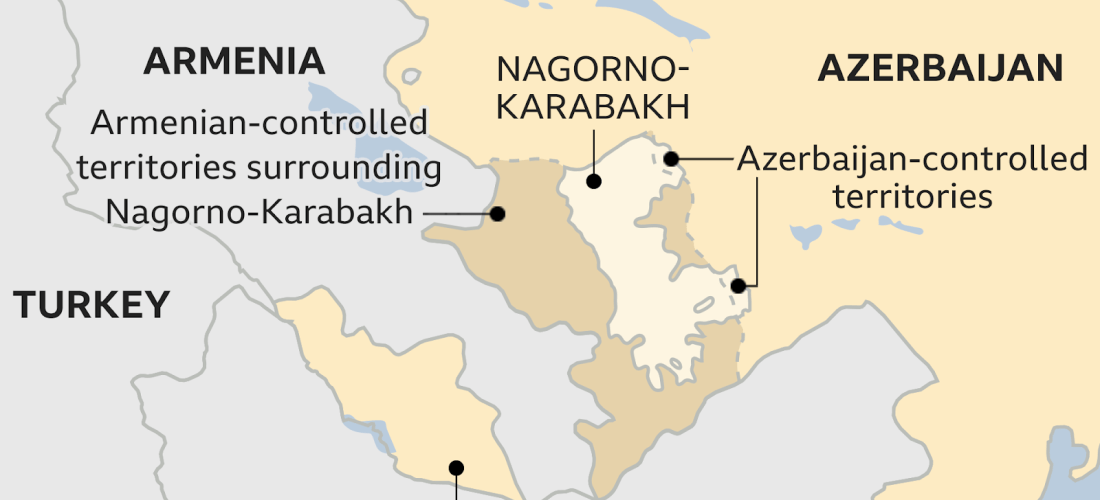
BBC News Map of the conflict, shows the relationship of each country involved, geographically.
A new war has sparked in Asia as Armenia and Azerbaijan fight for the Nagorno-Karabakh region. The Nagorno-Karabakh region is officially ruled and recognized as a part of Azerbaijan, however, the region claims to be an autonomous republic, known as the Republic of Antsaleh. The area’s population is primarily ethnic Armenians.
While the new conflict started on Sept. 27, the situation goes as far back as 1988. The region declared independence and won numerous revolutionary battles which culminated in a cease-fire in 1994. However, this was meant to only be a temporary truce while a comprehensive peace deal was established. The conflict resulted in 600,000 people left without homes and forced away from their country. Azerbaijan pledged that they would one day reconquer the territory. The conflict re-emerged when Azerbaijan claimed Armenia launched an unprovoked attack. Armenia denied these accusations and proceeded to blame Azerbaijan for their own unprovoked attack.
The territorial conflict has major international implications as each side is backed by major countries on the world stage. France and Russia have both backed Armenia and Turkey has backed Azerbaijan. While originally Turkey and Russia both worked to maintain peace in the region, as the two of them have attempted to establish dominance over the Middle East since the United States began to exit the area, the nations have become distant. Turkey attempts to cement their power globally, and the EU and Russia have become increasingly frustrated with Turkish military action in regions like Syria, Libya and now Nagorno-Karabakh. Armenia has claimed Turkish aircrafts have been deployed and have shot down numerous Armenian fighter jets. Armenia also claims numerous troops have been sent from Syria because of Turkish pressure and manipulation. While Turkey denies both of these claims, the French and Russians believe Turkey is intervening, as these strategies were previously used in the Turkish conflict with Libya. France has denounced Turkish actions and warned Turkey to stand down. France also claims they will not accept nor tolerate Azerbaijan victory or conquest of the region. Russian parliament is on the fence on what their next course of action should be. Russia wants to attempt to negotiate a peace deal, however, Parliament is beginning to believe their next course of action should be to send in troops to maintain order in the region and keep the peace. While Russia attempts to negotiate peace in the region, Azerbaijan has denied to make any peace talks. Over one hundred people have died in the conflict for the mountainous, 1,700-square-mile region as of the time of this publication.
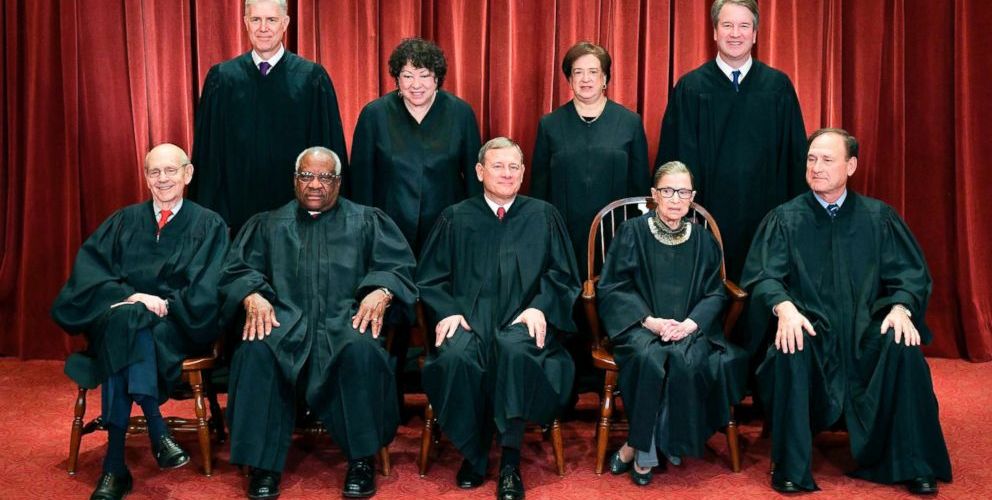
While the media frequently focuses on the Presidency and Congress, the third branch of the United States government is rarely looked at until a new justice is appointed. Few people have a good understanding of the Supreme Court’s role as an agency and its members’ political philosophies beyond their party. This article will examine each conservative Justice’s judicial philosophy, background and controversies.
(Chief Justice) John Roberts:
The Chief Administrator of the Court, Roberts has the additional responsibility of representing the Court when addressing Congress and the president. He also works as the mediator for impeachment hearings and swears in the president. Chief Justice Roberts worked under the Reagan and first Bush administrations as a member of the justice department. He then worked in private practice for fourteen years, frequently appearing before the Supreme Court. His highest profile case was Microsoft’s antitrust trial. The second Bush appointed him to the District of Columbia’s appellate court and then to the Supreme Court in 2005. Roberts frequently swings between the conservative and NY Times liberal camp of the court when writing opinions. He firmly believes in the concept of judicial restraint; however, he does support the idea of overturning laws if they are flagrantly unconstitutional. He frequently rules in favor of big business and supports civil liberties. He authored numerous opinions against segregation and almost always votes in favor of free speech. While originally ruling against gay rights, he eventually switched positions and now frequently sides with the liberal camp on trials regarding LGBTQ issues. Roberts usually sides with liberal justices on abortion cases.
Clarence Thomas:
Thomas started his career in the Reagan administration as the chairman of the Equal Educational Opportunity Commission. Bush senior appointed him to the District of Columbia Court of Appeals and in 1991, to the Supreme Court. He narrowly passed the Senate’s vote for his approval because of sexual assault violations by Anita Hill. Despite the fact that he almost always votes in favor of states’ rights, he voted in favor of Bush’s policies on executive privilege and supports the idea of a powerful executive. He has voted against LGBT rights as well as abortion rights; he frequently makes the argument that the federal government has no control over these matters because the constitution contains nothing discussing them. He is a strict textualist, meaning that he believes in abiding by the original meaning of the constitution.
Samuel Alito:
Alito worked as an assistant Solicitor General under the Reagan administration and argued 12 cases to the Supreme Court. He then went on to become assistant Attorney General where he worked tirelessly to increase the power of law enforcement. Afterwards, he worked as the US attorney for the district of New Jersey. He worked as an adjunct professor at Seton Hall, teaching constitutional law until he was appointed to appellate court’s third district. He was nominated to the Supreme Court by George W. Bush. His judicial beliefs are the most pro-business on the court; he frequently publishes opinions stating that corporations must have stronger rights and must be seen as living organizations. He also remains tough on crime and has strong tendencies to support states’ rights. He has sided against minorities and women in numerous equal and civil rights cases.
Neil Gorsuch:
Gorsuch began his career in public service as principal deputy counsel to the associate attorney general. He was then appointed to the tenth court of appeals by George W. Bush. Donald Trump nominated him to the vacancy that was unable to be filled by President Obama which was unable to be filled because the Republican Senate refused to hold hearings for Obama’s appointment of Merrick Garland. The reasoning behind this was it was too soon to the next election. Gorsuch is an advocate for judicial restraint and believes that liberals allow judicial activism to play too large of a role in courtroom decisions. He, like Thomas and Alito, is a textualist. He believes the constitution must be followed by its original intent. He has sided with liberal wing numerous times, especially with abortion and Native American laws. He has also voted in favor of the LGBTQ community.
Brett Kavanaugh:
Kavanaugh began his career working with Attorney Ken Starr, best known for working as prosecution for the Clinton impeachment trial. Kavanaugh helped author the Starr report for the impeachment trial. Kavanaugh also worked for the Bush legal team in 2001. His job was to help stop the Gore camp’s ballot recount attempt in Florida. President Bush nominated him to the appellate court afterwards. Donald Trump nominated Kavanaugh to the Supreme Court, where he barely was approved by the Senate by a 50-48 vote. Kavanaugh was accused of sexual assault by three women. Kavanaugh believes in executive privilege and arguably has the most leeway given to the executive branch of government out of all of the justices. He has voted against LGBTQ workplace rights, claiming that Congress should be in charge of issuing opinions on these matters, not the courts. He also has issued opinions against abortion. Kavanaugh has ruled in favor of reviewing Trump’s tax records.
The Liberals
While the media focuses on the Presidency and Congress frequently, the third branch of the United States government is rarely looked at until a new justice is appointed. Few people have a good understanding of the Supreme Court’s role as an agency and its members’ political philosophies beyond their party. This article will examine each liberal Justice’s judicial philosophy, background and controversies.
Ruth Bader Ginsberg:
Ginsberg spent most of her early career working for the Women’s Rights department of the ACLU after she struggled to get work because of her gender. She also worked as an adjunct professor at Columbia University before being appointed to the Appellate Court by Jimmy Carter. In 1993, President Clinton appointed her to replace Byron White’s seat on the court. She firmly believes that all members of the liberal wing should have one voice, unlike the conservative bloc who frequently make multiple dissenting opinions. She firmly believes in a right to abortion and has been known to write majority opinions for cases discussing gender rights. She often cites foreign and international law as reasoning behind her opinions, a relatively unheard of concept on the court. She is a firm believer in judicial activism and frequently uses her position to push the Democratic agenda, a practice many find unsavory for her position.
Stephen Breyer:
Breyer worked as a professor at Harvard Law School and the Kennedy Public Policy school before his appointment to the Appellate Court by Jimmy Carter. He was well known as the country’s best expert on administrative law. Clinton appointed him to SCOTUS directly after Ginsburg in 1994. Breyer believes in sociological juripendce, believing that law must change as present circumstances change over time. He believes originalism is fundamentally flawed as the nation’s issues change constantly over time, thus the law must as well. He has an incredibly liberal interpretation of law in that every trial should interpret each law to provide as much liberty as possible to the individual being tried. He is also vehemently opposed to the Second Amendment.
Sonia Sotomayor:
Sotomayor started her career as assistant district attorney for New York. She was tough on crime as well as extremely tough on officers who committed acts of police brutality. George H.W. Bush appointed her to the district court for the Southern District of New York. Clinton appointed her to the second appellate court, and eleven years later she was appointed to SCOTUS by Barack Obama. She was narrowly not appointed because she made comments discussing her race when being appointed, which led to senators questioning her ability to remain impartial. She frequently votes in favor of upholding First, Second, and Fourth Amendment rights over state decisions. She almost always votes in favor of minorities in civil rights disputes as well as women. She has also voted in favor of upholding citizen’s property rights over the state. She also votes in favor of unions and against big business.
Elena Kagan:
Kagan worked as a professor at the University of Chicago Law School before becoming an associate White House council and then a policy advisor for the Clinton Administration. She then worked as a professor at Harvard Law and became its first female dean. In 2009, she was appointed as the first female solicitor general for the Obama administration. She was then nominated to the Supreme Court without serving on the bench prior. She often votes in favor of a defendant’s First and Sixth Amendment rights. She is also known for writing decisions opposing gerrymandering. She is known for writing her opinions with rhetoric rather than legal facts.
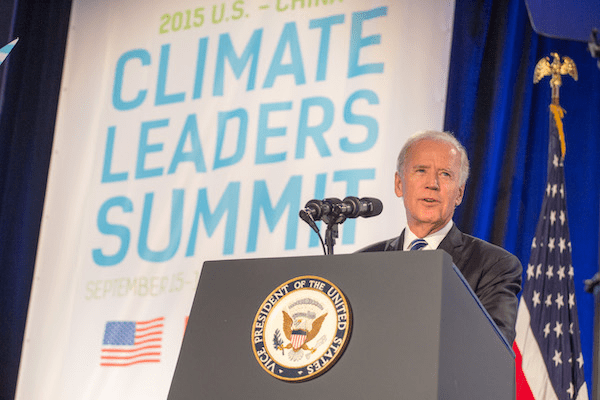
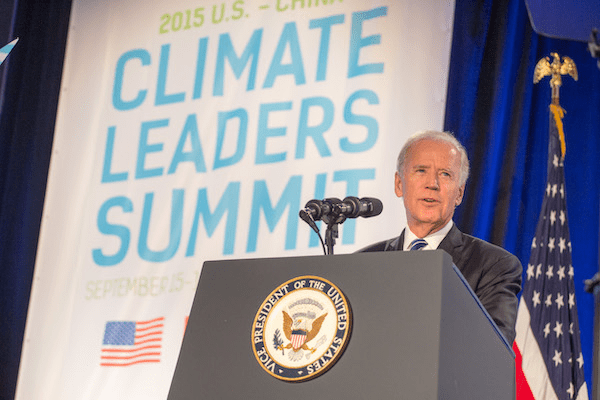
JOEBIDEN Photographed above is Joe Biden at the 2015 Climate Leaders Summit.
The Biden-Sanders manifesto contains the entire policy agenda of the Democratic presidential nominee, Joe Biden. It would be impossible to condense all one hundred and ten pages into a Collegian article, so this article will examine individual policies and summarize them for the busy reader.
The cornerstone of Biden’s plan is to use federal funding to create a new clean energy initiative. By allocating federal funds to the climate initiative, the carbon footprint will be reduced while simultaneously creating much-needed new jobs in the post-coronavirus job market. The Democratic nominee plans to allocate funds to retrofit two million households and four million buildings to make them more energy efficient. By doing so, numerous government jobs will be created. Furthermore, Biden plans to immediately rejoin the Paris Climate Agreement and use the United States’ power to help enforce stronger climate policies throughout the world. Federal bills will be introduced that will remove carbon pollution from power plants by 2035. The administration will also attempt to expand solar and wind power through community-based efforts across the country. Biden plans to provide federally-funded education for the impoverished and underrepresented to help lead this effort, as well as providing a New Deal-esque program to put people who may have lost their jobs from the COVID-19 pandemic to work.
The manifesto asserts new energy policies will lead to a lower power bill for households across the country and will increase the life expectancy of the average American through cleaner air and water created by a lack of pollution. The federal government will also pass legislation providing better health benefits to those affected from ailments stemming from the fossil fuel industry. Tax cuts will be given to businesses that have clean air initiatives. Businesses that do contribute to the carbon footprint will be held accountable and forced to provide funding for cleaning up industrial sites so that they can be replaced with new businesses that help restore some of the lost economic opportunity. The Biden administration will create a climate change task force that represents all facets of the Democratic party, co-chaired by Representative Alexandria Ocasio-Cortez and former Secretary of State John Kerry.
While the main focus of the environmental agenda is pollution, the manifesto also discusses the clean water crisis. The crisis will be resolved by investing in wastewater as well as freshwater infrastructure. The federal government will prioritize low-income areas for federal and state grants for public schools so they can install clean water filters and remediate lead in drinking water. The administration will also focus on assisting poor, rural communities by utilizing the Rural Utility Service and the Clean Water State Revolving Fund. Finally, Biden plans to overhaul the transportation industry by making strict regulations for manufacturing cars, providing government grants to the scientific progress of electric cars and invest in clean cars and buses. Biden’s sweeping environmental plan is just one aspect of his administrative plan. While there is no way to know what aspects of this sweeping plan he would prioritize if elected to office, Biden certainly has big goals for the United States’ involvement in reducing the carbon footprint.






 The La Salle Collegian