With all the cold weather here in Philadelphia, I’m sure we are all dreaming of warm weather and sunny beaches. Recently, there has been activity out at sea other than tourists enjoying a vacation. Activity in the South China Sea could be increasing tension between the United States and China. Over the past few months, China has been unhappy with U.S. Naval ships sailing in the South China Sea near islands claimed by China. There have been claims of the U.S. purposefully trying to increase tension with China but, when asked, Rear Admiral Jim Kirk, commander of the Nimitz Carrier Strike Group, assured that the U.S. is only focusing on lawful use of the sea.
Recently in the South China Sea, China complained that two U.S. aircraft carrier strike teams were allegedly doing tactical drills. The commanders of the U.S. aircraft carrier strike groups had a conference call. Rear Admiral Doug Verissimo, commander of the USS Theodore Roosevelt strike group, made it clear that they were focusing on tactical proficiency and working to improve how well the two ships, the USS Theodore Roosevelt and the USS Nimitz, can work together. He emphasized there was no malicious intent. Verissimo went on to explain the reason for the drill in that location and at that time was because of the travel plans of each ship. The Nimitz was preparing to head home after a 250 day deployment. As the Nimitz was on its way home, the Theodore Roosevelt arrived to patrol the area. The Commanders decided it would be efficient to perform a drill because the ships were crossing paths.
The tension between the U.S. and China in the South China Sea is not something new. The U.S. has accused China of showing military force in the South China Sea to intimidate its neighbors, such as the Philippines and Malaysia. Similarly, China has accused the U.S. of using its navy as a “show of force.” As we enter President Joe Biden’s second month as president, the U.S.’s relationship with China may be on the path to significant change. President Biden, along with Secretary of State Blinken and Secretary of Defense Austin, has used the first few weeks of the new administration to improve the U.S.’s international relations. The U.S. has contacted many countries including Canada, The United Kingdom, France, Japan and China. On Feb. 6, 2021, President Biden and President Xi Jinping had their first conversation of the Biden presidency. The American public should keep an eye out for future discussions between President Biden and President Xi Jinping as they sort out how the U.S. and China will address a relationship dealing with the countries’ economies, human rights and military competition.
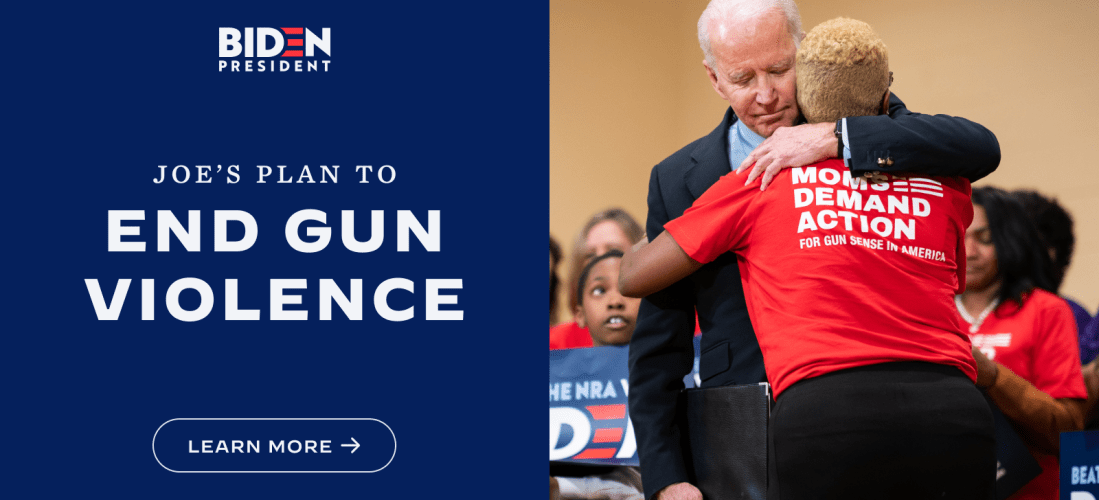
Joe Biden for President Biden Administration campaigning on a gun reform platform.
Lost in the chaos due to former president Donald Trump’s impeachment trial, last Sunday marked the three-year anniversary of the deadly Parkland shooting. The attack was carried out by a former Stoneman Douglas high school student, who killed 14 students and three teachers. The attack led to many protests around the country for more restrictive gun laws, or to ban the owning of semi-automatic rifles altogether.
On Sunday, to remember the victims, President Joe Biden put out a statement on the @POTUS Instagram account to show his sympathy for the victims as well as his plans for gun reform. In the statement, Biden says “The Parkland families have spent birthdays and holidays without their loved ones.” He then shows his support for what their families have done, saying they “have showed us how to turn our grief into purpose — to march, organize, and build a strong, inclusive, and durable movement of change.” Biden ends the statement by calling on Congress to pass bills that require background checks, ban assault weapons, ban high-capacity magazines and eliminate immunity to gun manufacturers, who Biden says have “knowingly put weapons of war on our streets.”
Politicians and groups were quick to come out with responses following the statement. The NRA Instagram page issued a post highlighting the Biden administration’s plan for gun reform, then ended the post by saying “NRA will NEVER stop fighting for the 2nd Amendment.” Freshman congresswoman Marjorie Taylor Green posted a picture of a line from the Second Amendment from the U.S. Constitution, which states “The right of the people to keep and bear arms shall not be infringed.” However, not every statement was politically motivated. Florida Senator Marco Rubio said that the parents’ “grace in the face of the most traumatic loss has been humbling.”
On Jan. 8, former house representative Gabrielle Gifford, who was shot during the Tucson shooting in 2011 that killed her staffer Gabe Zimmerman and nine-year-old Christina-Taylor Green, sent out a tweet for the ten-year memorial of the shooting. Biden responded to the tweet by saying “I pledge to continue to work with you — and with survivors, families, and advocates across the country — to defeat the NRA and end our epidemic of gun violence.” This tweet also got swift pushback from Republicans.
Like many issues Congress is dealing with, gun reform is a very partisan issue that seems to have no end in sight. During the 2020 primary, many Democrats had different plans for gun reform, such as using the federal government to buy guns back from citizens, to acquiring gun licenses and background checks through the federal government. Republicans, on the other hand, have called for red flag laws and some universal background checks, but have failed to pass several gun laws that have reached the senate and house floors. There is also the issue of the Second Amendment, which states that citizens have the right to own weapons. The NRA’s goal is to protect the Second Amendment, which puts Republican lawmakers in a tight spot, since the NRA donated close to $30 million to Republican campaigns in 2020. It seems that President Biden and the Democrats will once again be facing an uphill battle to pass gun reforms that are opposed by a huge Republican donor and several Congress members currently serving.
NYTimes A Russian protest for the unjust arrest of political dissidents.
As the world watches Russia erupt into pro-democracy protests, we must question what has been the catalyst to push them into this state? Was it the long periods of systematic oppression? The silencing of people’s freedom of speech? There are many explanations as to why the Russian people are tired of the status quo, but the martyr of these protests could be Alexei Navalny, the Russian opposition leader who escaped an assassination attempt last August, has now been sentenced to serve three years in prison for seeking treatment outside of Russia.
Alexei Navalny, an outspoken political opponent to Vladamir Putin, has gained support from the youth of Russia as he promises to return Russia to its rightful owners: the people. Navalny, a lawyer, is a popular geopolitican, posing as a threat to President Putin himself best known for his bravery to stand against Russian corruption even in his early days as a lawyer, exposing insider trading. Navalny has attracted his youth following through his connections to social media and YouTube channels dedicated to investigating the higher ups in Russian society, including President Putin himself. Navalny posed a clear threat to Putin in the upcoming September elections with his rapidly growing following. Recently, however, Navalny’s political career has taken a bleak turn;within this last week, he has been sentenced to spend the rest of a previous house arrest sentence in jail. The sentencing was an obvious reach for the Russia government trying to hold back Navalny from becoming involved any further in politics. However, the government had missed out on their chance to silence Navalny in August considering he has an even bigger following now, specifically as a result of such blatant corruption.
Navalny was poisoned last August, by poison nerve agent novichok, a poison specific to Russia. Miraculously, Navalny survived. As Navalny was transported to a hospital in Germany for treatment of his poisoning, he was to be charged with violation of his sentencing from a previous embezzlement case, and arrested as soon as he landed back in Russia. In 2014, Navalny and his brother were put on trial for embezzlement, a case which was deemed by the European court of human rights as “arbitrary and manifestly unreasonable.” During his retrial in 2017, his brother was sentenced to three years in prison, while Navalny was released to five years on house arrest. Russian officials who charged Navalny with violating the terms of his suspended sentence point to his recovering in Germany and supposed “failure to report ” to his scheduled reporting times. Considering Navalny had spent two years of his sentence on house arrest, the remaining almost three years will be spent in prison, one can assert that Navalny’s imprisonment is a clear sign from the Russian government of his powerful effect on the Russian public which government officials, like President Putin, wish to silence. Nevertheless, this is even more unlikely now considering the support Navalny has gained in the face of Russian corruption. In fact, thousands have taken to the streets to break their silence on the issue.
It is reported that 5,100 protestors have been arrested in Russia as a results of these protests. Clips of the treatment of such protests by police have been circulating throughout social media.. Even from prison, Navalny continues to urge on his supporters, pleading for them to “overcome their fear and free the country from a bunch of thieves.” In a cold Russia, we are witnessing history being made as hundreds of thousands of Russians are breaking their silence to take a stand against the Russian establishment.
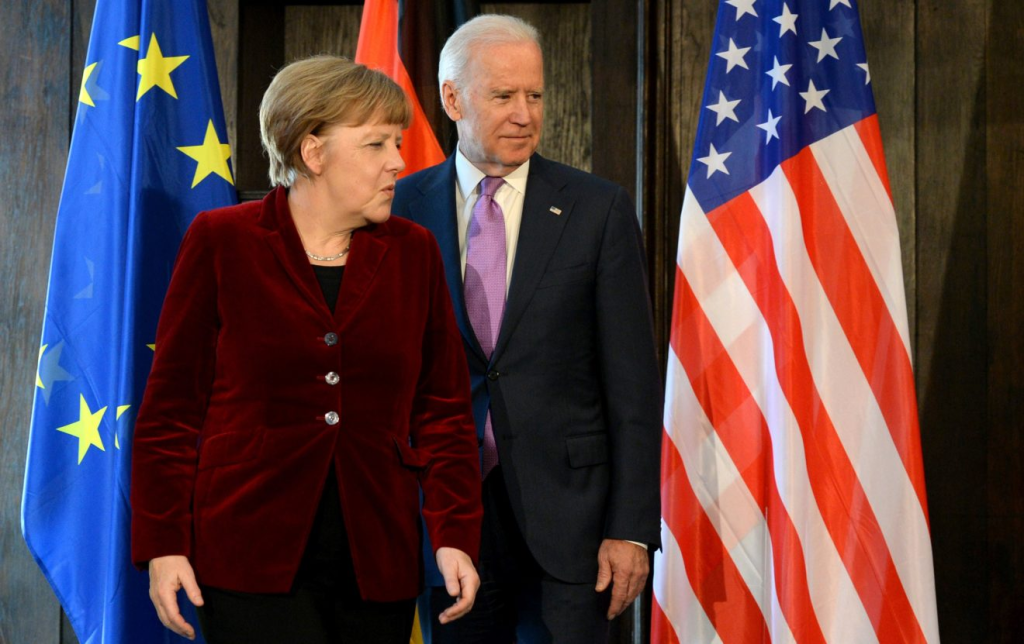
Politico President Biden and Prime Minister Merkel
With the recent inauguration of President Biden, the United States has seen many changes implemented very quickly. President Biden has been prioritizing a change in U. S. international relations. One way President Biden has shown this is through his appointment of the new U. S. Secretary of Defense, Lloyd Austin. Since Austin has taken office, he has been communicating with the North Atlantic Treaty Organization (NATO) and trying to strengthen the U.S. bond with the organization.
A significant shift with NATO left behind from the Trump administration was the removal of U.S. military personnel from Germany. President Trump wanted to pull out over ten thousand troops from Germany. The U.S. has twenty-one bases in Germany including ones in Ansbach, Bamberg, and Grafenwoehr. The U.S. also has the Landstuhl Regional Medical Center which is the largest American hospital outside of the country. Two elements of President Trump’s motivation for this decision to remove U.S. personnel were his frustration with NATO countries, including Germany, not applying their agreed upon 2% of GNP to defense spending and his disagreements with German Chancellor Angela Merkel. During his time in office, President Trump was very vocal about his dispute with NATO and made claims that NATO countries were not giving the amount of money to military spending that was previously agreed upon.
President Biden has recently stopped the withdrawal of nearly twelve thousand troops from various bases in Germany. This essentially reverses President Trump’s plans for action against NATO. Presidents Biden’s actions demonstrate his plans to improve the U.S.’s relationship with NATO. It looks as though he is using his actions with the military to back up the communication he has had with NATO. It also shows that he is making an effort to stay true to the goals of his campaign, such as enhancing relationships with traditional allies.
Now that U.S. troops will be staying in Germany, the U.S. will be able to watch as the country moves out of a semi-isolated position and potentially has more communication and agreements internationally, especially with long-term allies.
As of last Thursday, chaos has consumed Wall Street in what seems to be a war between multi-million dollar hedge fund holders and retail stock holders. If you lack an account with the popular social media platforms, TikTok or Reddit, this ongoing battle may appear nonexistent. Essentially, the hedge funds of Wall Street planned to short sell a few companies who were estimated to go bankrupt by the end of the year including companies such as GameStop, AMC and Nokia. A series of redditors on the subreddit entitled “r/WallStreetBets” had advised regular retail holders (normal people who invest in stock through apps such as Robinhood or Cash App), to buy shares of these companies Wall Street has been betting on going bankrupt, thus, skyrocketing the price of the shares, specifically starting with company GameStop ($GME). $GME, a stock Wall Street has profited off by betting on its bankruptcy, displayed share prices in early January that stopped at $17 a share. A share of $GME was $347 as of last Wednesday. With the average person and a collaboration of redditors forcing a phenomenon on the capitalists of Wall Street referred to as “short squeezing,” the apps that support the investments in these companies for the common people have suspiciously stopped working.
Robinhood, one of the biggest platforms for retail stock trading, faced a suspicious technical difficulty amongst stock prices of GameStop rising, further preventing investors to buy shares of companies such as GameStop, Nokia and AMC since last Thursday when prices were beginning to soar. This has sparked lawsuits against Robinhood by retail shareholders, claiming these actions prevented users of potential profits they could have made by investing in these stocks. Besides uniting people all over the country to overturn hedge fund holders, it is possibly introducing some bipartisanship to tackle the suspicions introduced around investing apps.
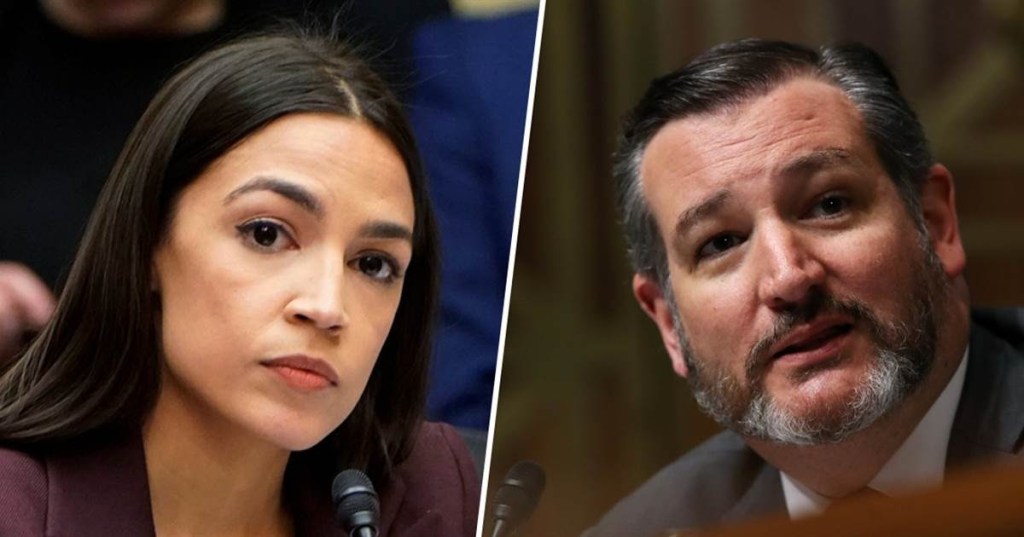
Congresswoman Alexandria Ocasio-Cortez (AOC) has commented on the suspicions surrounding platforms such as Robinhood from blocking investors from getting in on overthrowing Wall Street. AOC issued a tweet last Thursday describing the situation as “unacceptable,” and implied that she would be open to an investigation of Robinhood’s “decision to block retail investors from purchasing stock while hedge funds are freely able to trade the stock as they see fit.” Although this reaction may be viewed as typical from AOC considering her progressive politics, what was not anticipated was Senator Ted Cruz’s support of AOC’s tweet, replying “fully agree.” Her colleague’s reply did not sit well with her, considering Senator Cruz’s involvement in recent events which AOC claims has posed a threat to her life. AOC responded to Senator Cruz’s reply by saying, “I am happy to work with Republicans on this issue where there’s common ground, but you almost had me murdered 3 weeks ago so you can sit this one out. Happy to work w/ almost any other GOP that aren’t trying to get me killed. In the meantime if you want to help, you can resign’.’
Other politicians have commented on the situation including Bernie Sanders and Elizabeth Warren. Sanders, who has famously had a complicated relationship with the “billionaires on Wall Street,” issued a tweet last Friday regarding hedge fund owners such as Leon Letterman’s complaints about the situation. Sanders said, “Oh look, another billionaire is mad that he might have to pay more taxes while children in America go hungry and veterans sleep on the street. Cry me a river”. Sanders has highlighted the need to ensure that capitalists on Wall Street pay their fair share in taxes throughout his campaigns, but especially during this historic economic event. Warren has also pushed this agenda, questioning as to why the Robinhood app had stopped retail holders from trading stocks such as GameStop, AMC and others in a pivotal moment. Like Sanders, Warren has run her political campaigns highlighting how this is not random on Wall Street, but a result of long periods of corruption. Warren is quoted as saying, “Understand: What’s happening with GameStop is just a reminder of what’s been going on on Wall Street now for years, and years and years. It’s a rigged game… we need a market that is transparent, that is level and open to individual investors. It’s time for the SEC to get off their duffs and do their jobs.”
The billionaires of Wall Street, however, have commented on the situation, suggesting that stocks will drop, and, according to Fox Business commentator Stuart Varney, “end in tears.” The real “Wolf of Wall Street” himself, Jordan Belfort, has put his own two cents into the situation. Belfort, in an interview with CNN, insinuated that the redditors colluded to create an economic phenomenon with repercussions, furthermore defending platforms such as Robinhood from protecting their best interests legally rather than siding with the billionaire hedge fund holders against retail stockholders. Belfort echoes the cries of other billionaires, stating “when this is over, and it will end, and all these stocks come crashing back down to their fundamental values, there are going to be lawsuits flying aimed at Robinhood, Ameritrade, all the platforms that did the trades…”. In response to a post sent out by r/WallStreetBets which essentially stated they did not have the resources to bail themselves out of bankruptcy if all goes wrong, unlike the hedge funds of Wall Street, Belfort stated “I love you guys, but it is laughable because what you will do it to hire a class action attorney and sue everybody on your behalf.”
With an economic battle occurring between retail stockholders and billion dollar hedge fund holders, politicians and economic commentators are taking sides. What side certain public figures fall on may go on to shape the future of the stock market in America and the way Wall Street is operated well into the future.
Politico Biden’s Secretary of Defense is four-star general Austin J. Lloyd III.
After a year of quarantine, masks and working from home, people are looking for big changes in 2021. Government officials have been busy since the election in November 2020. One notable difference since the change in administrations, is the strengthening of the United States’ relationship with the North Atlantic Treaty Organization (NATO).
Former President Donald Trump pushed towards an isolationist approach when it came to international communications. A common theme President Trump mentioned, which can be particularly seen within his Republican National Convention speech in August 2020, where he voiced his disappointment in the size of NATO spending. President Trump believed that the United States’ partners in NATO were behind on their payments. President Trump and his administration wanted to distance the U.S. from NATO until its members were able to increase the amount of money put towards their national defense. With the Biden administration this could be changing.
President Joe Biden, inaugurated on Jan. 20, 2021, quickly went to work appointing a new Secretary of Defense. On Jan. 22, Lloyd J. Austin was sworn in as the 28th Secretary of Defense. Prior to his cabinet position, Austin attended West Point and served in the Army for 41 years before retiring as a four-star General.
Austin’s first call as Secretary of Defense was to NATO’s Secretary General, Jens Stoltenberg. Austin discussed wanting to keep the NATO alliance strong and the current missions in Afghanistan and Iraq. Austin wants to continue a strong defense position in NATO as a method to deter potential and known threats. Austin also told Stoltenberg that he wanted to re-strengthen the U.S.’s relationship with Europe. Stoltenberg congratulated Biden after his inauguration and told Austin that he feels positive about President Biden’s policy goals mentioned during his campaign.
This sequence of events could be indicative of a change in U.S. foreign relations over the next four years. Whereas the Trump administration focused on isolationism and taking a stern approach with foreign relations, one can assume President Biden is planning for a return to normalcy in American foreign policy. The call to Secretary General Stoltenberg, change in US Secretary of Defense and the policy plans President Biden has mentioned are showing a focus on increasing international communications for some upcoming potential changes.
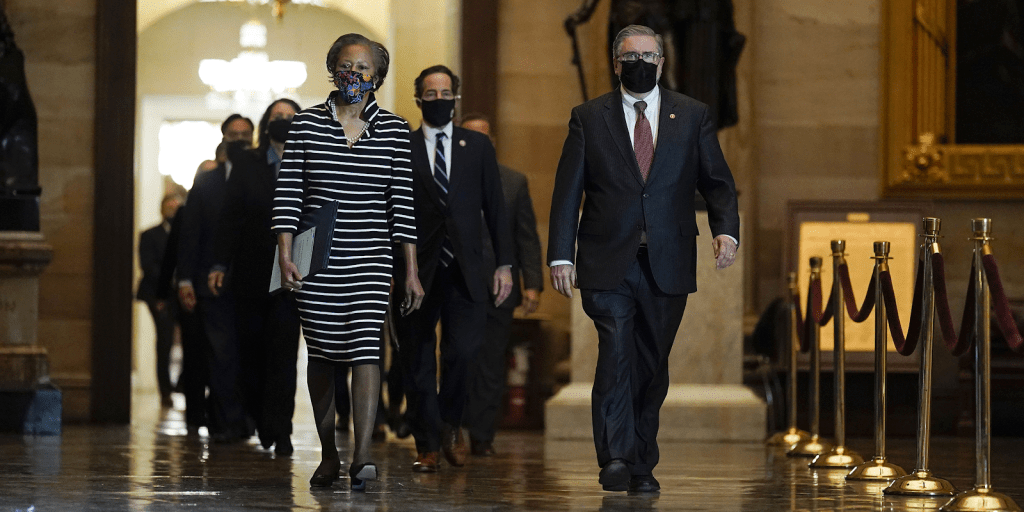
NBC Democratic impeachment managers delivering the articles of impeachment to the Senate.
Last week, new House Majority Leader Chuck Schumer announced that the articles of impeachment against former President Donald Trump would be delivered to the Senate floor early in the week. This comes two weeks after the House pushed the articles through, making the impeachment official. In total, 232 Democrats and 10 Republicans voted yes to impeach, 197 Republicans voted no and 4 Republicans did not vote. Former President Donald Trump has made US history with this trial, becoming the first president ever to be impeached twice.
The beginning stages of the trial are set to start almost three weeks after the deadly insurrection on Capitol Hill on Jan. 6, in which many people wearing Trump gear and carrying pro-Trump signs broke into the building to stop the certification of the 2020 election due to voter fraud claims. None of the claims made by anyone on the Trump legal team or claims made by his supporters about the election rigging have been proven true. Many Democrats blamed then President Trump for inciting the riot, and the official reason for this impeachment trial is incitement of an insurrection. Senator Benie Sanders said that President Donald Trump was directly responsible for what happened at the Capitol. At the same time, Senator Elizabeth Warren called on the Senate to impeach and convict Trump on her Instagram page.
Just like the first impeachment trial, there have been few Republicans to speak out against the former president. Senator Marco Rubio called the trial stupid and counterproductive, while South Dakota Senator Mike Rounds told Meet the Press, “There are other things we’d rather be working on instead.” One Republican figure who is in favor of the impeachment trial is Senator Mitt Romney of Utah. Romney, who appeared on CNN on Sunday, said that the trial is constitutional, contrary to what some of his Republican colleagues have said. The Republican candidate in the 2012 election was the only Republican to vote yes to impeach the first time around.
If found guilty, Trump would risk the chance of never being able to run for public office again and would also lose presidents perks, such as travel expenses of $1 million and a pension. The Democrats are fighting an up-hill battle at the moment. There must be a two thirds majority yes for a guilty verdict and with the senate split 50-50; this seems unlikely to happen.
There is also a question about whether this trial is worth it. The trial is set to take place while the Biden administration is starting up, potentially delaying the hearings of candidates for important cabinet positions and the passing of COVID relief packages. With Schumer and McConnell disagreeing on what to do with the filibuster, this trial could potentially take a long time.
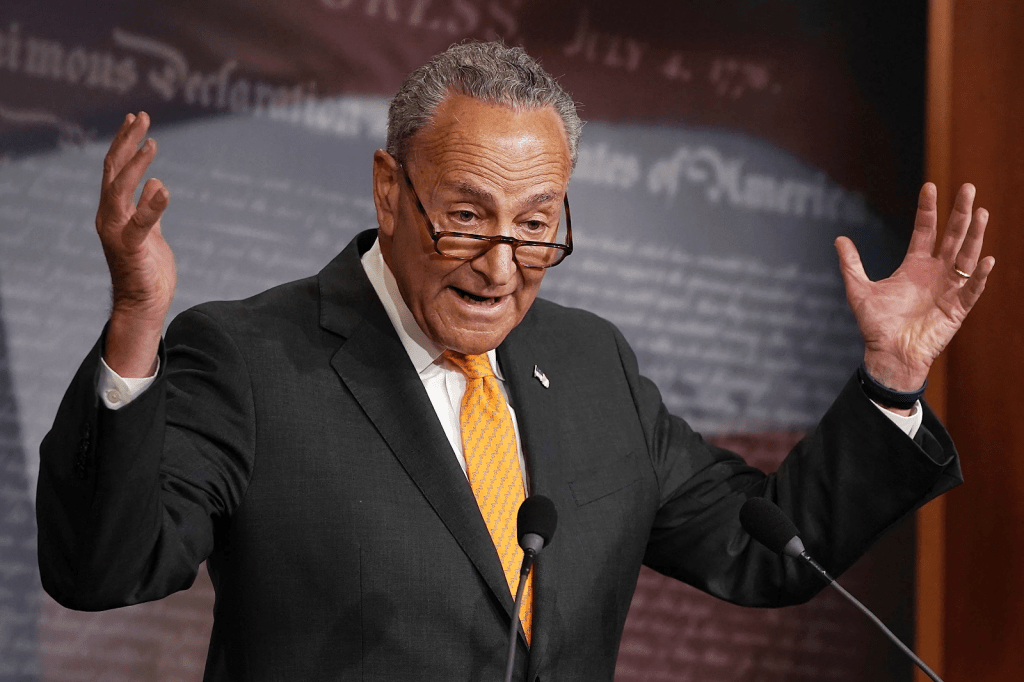
Pictured above is Senate Majority Leader Chuck Schumer.
The seemingly unending election season of 2020 has not only resulted in Joe Biden assuming the presidency, but also in a unique situation not seen in the Senate since 2001. With Kamala Harris’ tie breaking vote, the Democrats have achieved a narrow majority in the Senate, split 50-50 between Democrats and Republicans. Despite President Biden’s calls for unity and bipartisanship in the country’s time of crisis, things have begun with a rocky start. Between the Capitol insurrection, claims of election fraud, social media censorship, the pandemic and the partisan divide on major issues, the Senate is already facing major problems. Despite this massive divide, the Senate is currently debating some major issues that will affect the political landscape of America forever.
The new majority leader, moderate democrat Chuck Schumer, is dealing with a logistical nightmare with the progressive wing’s desire to abolish filibuster. Former President Barack Obama and Representative Cortez have called on majority leader Schumer and President Biden to abolish the filibuster. Over forty progressive groups have already begun running ads throughout the state of New York and national media outlets to push this unprecedented legislation, claiming that the filibuster is the largest detriment to passing landmark bills such as: Medicare for all, reform for ex-convicts’ voting rights, COVID relief bills and more. Schumer is also aware of the fact that, if he does not placate the desire of progressives, he is at risk of becoming primaried in his upcoming 2022 re-election. Representative Cortez has refused to make a statement on whether or not she plans to run for his seat, which she would be significantly more likely to attain if Schumer does not answer to progressives within the next two years. As progressives pressure Schumer to abolish the filibuster, minority leader McConnell pressures democrats to stop in the name of bipartisanship. McConnell is currently demanding Schumer to shut down the filibuster issue if he wants a peaceful transition of power within the Senate. The divide between the two parties in the Senate has already resulted in gridlock despite the fact the issue is not even on the floor, since McConnell is refusing to accept the transition until the issue is resolved. This situation has resulted in a very bizarre turn of events where all committees in the senate are currently being led by Republicans, despite the Democratic majority. Of course, it is unlikely for the filibuster to even be abolished since president Biden has actively stated it must remain in place for the sake of bipartisanship, which likely means Vice President Harris will vote against abolishing it, and Senator Joe Manchin (D-WV) has stated he will not abolish it unless it is absolutely necessary.
As the transition is halted by filibuster talks, former President Donald Trump’s impeachment trial is resulting in even more chaos within the Senate. According to the Constitution, the Chief Justice only presides over currentpresident’s impeachment trials and senators preside over all other impeachment trials; thus, since Trump is no longer president, President Pro Tempore Patrick Leahy will preside over the trial, not Chief Justice John Roberts. The time frame for the trial is currently unknown, but many believe it will not take as long as the previous trial, twenty-one days, to reach a verdict. The trial officially begins Monday, Feb. 8. Ten house republicans voted for impeachment; it is likely Republicans in the Senate will as well. Senator Josh Hawley (R-MO) is currently filing seven counter-complaints to the ethics committee against Democratic Senators who requested investigations into Hawley and Cruz’s conduct surrounding the capitol insurrection. Senators Portman (R-OH) and Toomey (R-PA) have also both stated they would not run again in 2022, adding even more discord and discontent among Senate Republicans during this time of struggle for their party. The impeachment trial is just one of the many current issues that demonstrate the collapse of cooperation within the Senate.
Despite the various issues within the senate surrounding procedure, impeachment, ethics and resignation, Majority Leader Schumer and President Biden want a new COVID-19 relief bill by March. With McConnell and other Republicans against the $1.9 trillion bill, it is unlikely it will get the 60-person support necessary for it to pass. If this occurs, Senator Sanders may invoke a rule allowed by the chair of the budget committee to pass fiscal bills with only a 51 person majority. However, he will still need support from across the aisle if he invokes the rule because Senators Joe Manchin (D-WV) and Angus King (I-ME) have already pledged to vote against the $1.9 trillion bill because of the cost and certain statutes within it.
Despite Biden’s inaugural address’ focus on unity among the nation and its two parties, it looks as though the United States will continue to grapple with its polarization and partisanship within the Senate.
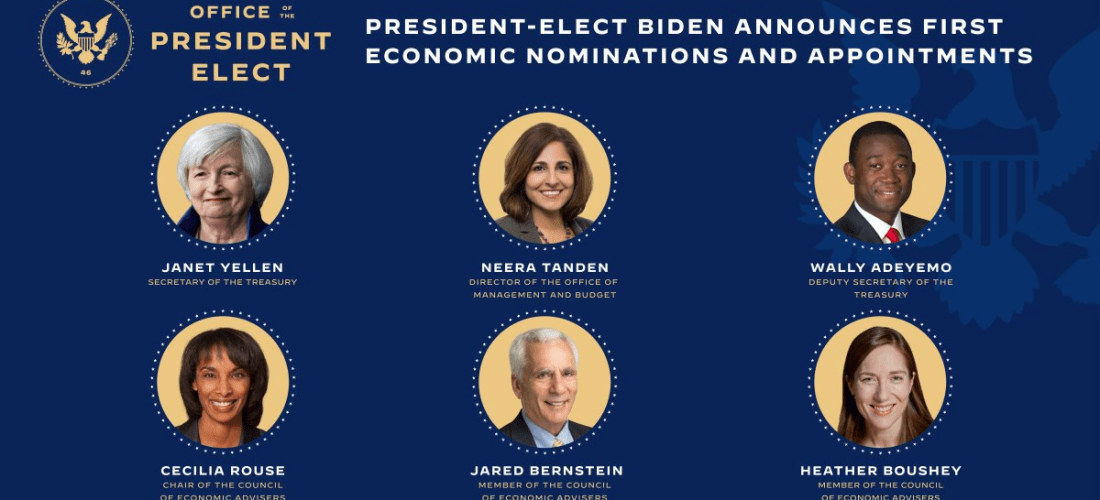
Morning Brew Pictured above are Biden’s economic nominations and appointments.
Soon after being sworn into office, President Joe Biden began appointing his cabinet members and various other positions. Some of these appointments may need to be approved by the Senate, while others have been approved or do not require approval. La Salle Alum William Burns has been appointed to be the director of the Central Intelligence Agency. Burns is president of the Carnegie Endowment for International Peace. He had a 33-year career in the foreign service, including serving as ambassador to Russia and earlier to Jordan. “Bill Burns is an exemplary diplomat with decades of experience on the world stage keeping our people and our country safe and secure,” Biden said. Burns was a member of La Salle’s Honors Program and studied history, which he says “gives you perspective.” Antony Blinken was approved to serve as Biden’s secretary of state. The two worked together closely during Biden’s vice-presidency as Biden worked on the Senate Foreign Relations Committee while Blinken served as deputy national security adviser. In addition, Retired Gen. Lloyd Austin has been appointed and approved to be the secretary of defense. Austin is a retired U.S. Army four-star general who served in the military for 41 years. He is the first African American to fill this position. Biden’s administration continues to have “firsts” in the appointment of Rachel Lavine as assistant health secretary. If confirmed by the Senate, Levine, a pediatrician by trade, would become the first openly transgender federal officer in the United States. According to Biden, “She is a historic and deeply qualified choice to help lead our administration’s health efforts.” Janet Yellen seeks Senate approval to be secretary of the treasury. Yellen was the first female to run the Federal Reserve, and, if confirmed, would be the first woman to run the Treasury Department. Ron Klain will serve as Biden’s chief of staff. Klain was a longtime aide to Biden during the Obama administration and oversaw the White House response to the Ebola epidemic in 2014. Pete Buttigieg, who endorsed Biden after dropping out of the presidential race, will serve as secretary of transportation. Buttigieg makes a jump from local politics in South Bend, IN to national-level politics with his appointment to this position. Jen Psaki will serve as press secretary. In the past, she served under the Obama administration as communications director and as the spokesperson for the State Department. There are various other positions that Joe Biden has appointed to fill his staff and some of these appointments make history.
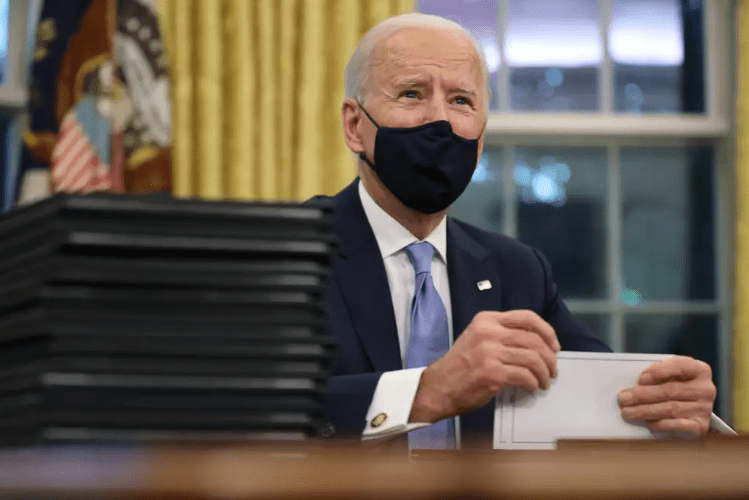
Chip Somodevilla/Getty Images President Biden pictured with a stack of executive orders on his desk within hours of his inauguration.
As the 46th President of the United States was inaugurated this past Wednesday, Jan. 20, former President Trump’s legacy — already quite controversial — began to crumble, not only throughout the Oval Office, but also through executive orders overturning previous ones conducted under the Trump administration. As of Jan. 27, President Biden has instituted thirty-three executive orders, ten of which directly reverse the executive orders instituted by the Trump administration. The executive orders cover topics from environmental issues, immigration, and the economy, to the ongoing pandemic. It is important, not only to review these orders, but to understand what they command in their power as well.
Environmentally,President Biden has reentered the United States into the Paris Climate Accord, which the Trump Administration considered too costly . Furthermore, the President has halted construction of the Keystone XL pipeline, which posed a clear environmental threat to the Antarctic.
Immigration wise, President Biden has lifted the “Muslism-ban” which has restricted the traveling of citizens from seven Muslim-majority countries. Furthermore, President Biden has undone former President Trump’s expansion of immigration enforcement through programs such as 297 (g) and universal victim techniques employed by ICE. President Biden has also ended the national emergency financial funding used to construct the southern border wall and has extended deferrals for Liberian-immigrants threatened with deportation and work permits until June of next year. Finally, he has reinstated DACA as a program undocummented citizens can now re-apply to.
Economically, the president has enforced a pause on the payments of student loans and the accruing interest for said loans, implemented holds on bill collectors from enforcing evictions foreclosures until at least March 31 supported food banks and the unemployed, and finally has officially laid the foundation for a $15 minimum wage as well as protecting federal workers.
Related to the pandemic, President Biden has signed orders to create federally-supported community vaccination centers, established the Pandemic-testing board, put into place a preclinical program to boost the development of therapeutics, expanded the federal financial support for states to distribute the COVID-19 vaccine, accelerated the distribution of vaccines through manufacturing and development, reentered the U.S into the World Health Organization, enhanced the communication of data of COVID-19, and most notably, enforced a mask mandate on federal property. President Biden has already set goals to accomplish within his first 100 days related to the pandemic, such as administering 100 million vaccines. This goal seems plausible to the CDC considering vaccinations have increased to over 1.3 million per day compared to a 900,000 a day average under the Trump administration.
There are many more executive orders to be included in this long list such as: making the national census inclusive of undoccumented Americans, enforcing prevention of workplace discrimination, requiring appointees of the executive branch to sign an ethics pledge and even overturning the Trump administration’s ban on transgender Americans enlisting in the military.
With most of these executive orders put in place within the first 48 hours of Biden’s inauguration, in overturning the last 48 months, the future of the Biden administration seems to hold a lot of potential. Addressing the economy, the pandemic, crucial environmental issues, racial injustice issues and overall Biden’s plan for “healing this country” are the main priorities set by the Biden administration, which it has already started to act on. This list of executive orders is only expected to increase within the upcoming days. The Biden administration will have plenty of trials and tribulations to overcome in its path with the looming global pandemic, and now with the second impeachment trial of former President Trump consuming the Senate. Nevertheless, it seems the administration will tackle these issues with a fast pace as exemplified through President Biden’s first 48 hours, hinting to an underlying theme of getting right to work within the new administration.













 The La Salle Collegian