
The most crucial week of the Biden administration

Politics

Danielle O’Brien, Editor

Header Image: South China Morning Post

This week is critical in establishing President Biden’s legacy as the House plans to vote on the $1 trillion infrastructure bill passed by the Senate back in August, the $3.5 trillion Build Back Better Plan which also passed in the Senate following the $1 trillion bill as well as a bill to increase the debt ceiling and negotiate spending bills for the fiscal year which begins Oct. 1. With so many bills on the line, and each one having a different value or motive in getting passed, it is important to understand what each and every bill does and the challenges in the way of passing them. 

Initially the bipartisan $1 trillion infrastructure plan was said to be voted on the past Monday, Sept. 27. However, fears over division within the Democratic party over the bill’s passing has prompted Speaker of the House Nancy Pelosi to delay the vote to Thursday, Sept. 30. The $1 trillion infrastructure bill which passed in the Senate back in August with flying colors (69 to 30) was a light leadway for Congressional Democrats to introduce the larger and more dividing $3.5 trillion infrastructure bill. However, the bill’s vote being postponed to only 24 hours before the 2022 fiscal year starts (which has yet to be worked out) poses real danger to the vitality and support of said bill. The $1 trillion infrastructure bill is said to include: $110 billion for roads and bridges, $66 billion for railroads, $65 billion for the power grid, $65 billion for broadband, $55 billion for water infrastructure, $47 billion for cybersecurity and climate change, $39 billion for public transit, $25 billion for airports, $21 billion for the environment, $17 billion for ports, $11 billion for safety, $8 billion for Western water infrastructure, $7.5 billion for electric vehicle charging stations and $7.5 billion for electric school buses. The bill emphasizes influsing green energy with infrastructure to transform the future of the U.S. This bipartisan bill passed in the Senate, however, a stalling of votes in the House may promote delay in support.

The $3.5 trillion infrastructure bill has generally the same motivations behind it but different allocations of money. The bill includes: $135 billion for the Committee on Agriculture, Nutrition, and Forestry, $332 billion for the Banking Committee, $198 billion for the Energy and Natural Resources Committee, $67 billion for the Environment and Public Works Committee, $1.8 trillion for the Finance Committee, $726 billion for the Health, Labor, Education, and Pensions Committee, $37 billion for the HSGAC Committee, $107 billion for the Judiciary Committee, $20.5 billion for the Indian Affairs Committee, $25 billion for the Small Business Committee, $18 billion for the Veterans Affairs Committee, and $83 billion for the Commerce Committee. The Senate passed the outline of the $3.5 trillion bill back in August on a 50 to 49 vote. Republican counterparts have apprehension towards supporting trillions more dollars on a second infrastructure bill. Thus, the viability of this bill, as well as the opportunity for it to even have a vote, remains up in the air, as Friday is the first day of the 2022 fiscal year. Nevertheless, there is no agreement of a fiscal budget to go off of, which proposes the threat of a government shutdown.

The House faces another issue in passing a yearly bill determining the 2022 fiscal spending budget, which is supposed to be completed Oct. 1. With so many bills being passed this week, there is little time to put forth a bipartisan fiscal 2022 budget. Instead, Democrats proposed a temporary budget outline, which could be changed in order to avoid a shutdown. Nevertheless, Republican counterparts are voting down the bill as it does not adhere to the debt ceiling (acting as an emergency fund), even if temporary. The issue with so many bills being voted on this week, rather than a new budget for the 2022 fiscal year which starts Friday, is that if a fiscal budget is not passed by Oct. 1 (which it looks like it will not), the government risks shutting down. A shutdown would further block the Biden Administration’s legislation from passing, as well as create other issues, such as federal workers not getting paid. This week transformative legislation, the legacy of the Biden administration, and the threat of a potential government all lie with the House.

Blurred Lines : The U.S Justice Department Sues Texas over New Abortion Law Upheld by Supreme court while Mexico Overturns it 

Politics

Danielle O’Brien, Editor


Taylor Lowder via Dallas Innovates
From left to right: Texas State Flag, American Flag, Mexican Flag

Tensions run high in the U.S. this week as Texas enacts a new abortion law, which bans women from getting abortions after six weeks of pregnancy. This is just one point of the bill which remains controversial, as frequently, women do not know they are pregnant until the six week mark or later. Another controversial point of the law is that it does not allow any exceptions to those who are victims  of incest and rape. 

Furthermore, the law also affects those who conduct the procedure or help women to gain access to abortions, including Uber drivers. The law calls on Texans to report women they know  who undergo the procedure after six weeks to a website. It also allows civil lawsuits to be filed against these women. One of the most divisive applications of this law is that Texans reporting or suing women who havean abortion after six weeks can earn up to $10,000 in damages from a lawsuit. 

The law, which was put into effect September 1, puts forth many questions surrounding how accurately it could be carried out in the state because of its incongruities. Nevertheless, it was upheld by the Supreme Court on September 8 in a five to four vote where the Supreme Court refused to block the law from going into effect. It is important to note that refusing to block does not mean the same thing as endorsing the law. However, the law can only be overturned if another case is brought to the Supreme Court. 

24 hours after the Supreme Court decision, the U.S. Department of Justice announced a lawsuit against the state of Texas. Remarked by the U.S. Attorney General Merrick Garland, “this kind of scheme, to nullify the constitution of the United States, is one that all Americans, whatever their politics or party, should fear.”

Meanwhile, on the other side of the Rio Grande, the attitude towards abortion is moving in the opposite direction. The Mexican Supreme Court ruled on September 7 to decriminalize abortion. While Mexico’s supreme court ruling does not automatically make abortion legal throughout Mexico, it does allow women who have been incarcerated for having an abortion to sue the state’s authorities and have their prior charges dropped. The ruling of Mexico’s supreme court not only sets a precedent for the rest of South and Central America, but also for the North. One of the largest Catholic countries is voting against it’s inherently conservative ideas, while it’s neighboring country, the United States, is still struggling to stick to a legal consensus on abortion. Only time will tell if the U.S. will be able to reach a general public conclusion on the abortion debate, as well as stand by it.

Trouble facing U.S. forces leaving Afghanistan

Politics

Elizabeth Boyle, Staff

The Atlantic
Image depicts American troops in Afghanistan.

Last February, the Trump administration negotiated with the Taliban and a plan was agreed upon that U.S. troops would leave Afghanistan by May 1, 2021. President Biden decided to proceed with the plan to leave, but decided to adjust the timeline. Biden declared that all U.S. forces would leave Afghanistan by September 11, 2021, exactly 20 years after the attack on the U.S. by the Islamic extremist organization Al-Qaeda.

         Since the U.S. has failed to meet the agreed upon May 1 deadline, the Taliban has announced that it believes the U.S. has violated the terms agreed to in February 2020. At that time, the Taliban agreed not to attack U.S. troops through the May 1 deadline, and they did indeed stop the attacks. The Pentagon is now concerned that U.S. forces might be attacked while in the process of moving out because it is beyond May 1.      

The U.S. military tries to always be prepared for potential threats, and currently has an aircraft carrier nearby, and is ready to move multiple B-52 bombers as well as an Army Ranger task force into the area. The U.S. State Department has also instructed diplomatic personnel in Kabul, Afghanistan to vacate the country unless it is absolutely necessary that they remain. Military specialists say there is hope for a peaceful withdrawal but also potential for the Afghan government to fall soon after the U.S. departs.

Russia orders withdrawal of troops at Ukrainian border

Politics

Elizabeth Boyle, Staff

NPR
Depicted above is the Ukrainian and Russian border.

During the week of April 14, 2021, Russia increased its military presence along the Ukrainian border, setting off warning flags for the U.S., Ukraine’s ally.

Russia invaded Ukrainian territory near the Crimean Peninsula in February of 2014. Since then, Russia and Ukraine have been in conflict with each other. Two weeks ago, Russia massed the largest number of its troops near its border with Ukraine since the initial invasion in 2014. That same week, President Joe Biden had a phone call with Russian leader Vladimir Putin and emphasized the U.S. alliance with Ukraine. Western officials speculated that Putin is either testing President Biden or instigating a military conflict in Europe.

In the week of April 22, 2021, Russia ordered the withdrawal of its troops from the Ukrainian border. President Biden is stressing the importance of de-escalating the tension and reducing Russia’s military presence in Crimea and in other areas adjacent to Ukraine. Moscow said the troops will be returning to their normal bases but there has not been any movement yet. Moscow says the date for completing the withdrawal has been set for May 1, 2021. Ukrainian President Volodymyr Zelensky welcomed the removal of troops because it reduces tension and helps to ensure Ukraine’s safety. 

 Russia claims that its movement of forces on Russian soil was training to insure unit readiness. Russia’s Ministry of Defense has stated that the presence of enhanced troop units near the Ukrainian border shows no threat to the status quo. 

Ukraine has requested additional weapons and military aid from the U.S. to deter further Russian aggression. In the future, President Biden may meet face-to-face with Putin, as the Russian president was already involved in President Biden’s virtual climate summit which happened this past week.

Biden’s Build Back Better Bill: Biden’s Infrastructural Legacy

Politics

David O’Brien, Editor

USNews.com
President Biden campaigned with the “Build Back Better” plan as a keystone of his platform.

On Wednesday, Biden will make his first address to a joint session of Congress. While Biden’s first one hundred days have focused primarily on Trump’s legacy, getting his cabinet in place and COVID-19 relief, this will be Biden’s first attempt at passing the massive infrastructure plan on which his campaign was built. 

The “Build Back Better” infrastructure plan, or The American Jobs Plan, is a sweeping infrastructure bill that will fix roads, restore clean water, create new electrical grids and broadband internet for rural communities, create government subsidized caregiver jobs to care for those unable to afford caregivers and restore union and manufacturing jobs. While this bill may sound too good to be true, the $2 trillion price tag that comes along with it makes its contents seem more realistic. While $2 trillion on infrastructure may seem far too expensive, according to American Society of Civil Engineers, the United States would likely have to spend over $4.5 trillion on infrastructure to fully restore its roads and public works projects.

Biden’s previous calls for this bill’s passage have focused on the U.S.’s competition with China, just infrastructure and wages and the bipartisan agreement that a solution to America’s infrastructural decline must be established. Despite these previous pleas for votes, Biden’s congressional address will primarily focus on convincing moderate Democrats and Republicans to vote in favor of the bill rather than keeping their eyes on the federal budget and deficit. Seeing as the COVID-19 relief bill passed without any Republican votes in Congress, the likelihood of this bill receiving bipartisan support remains low. Republicans continue to hold the view that while the bill does address many key issues, the price is simply too high. It is likely Biden will have to unify the Democratic Congress once again to allow the bill to pass with a narrow 51 votes in the Senate.

The bill served as a keystone of Biden’s campaign and, if not passed, will certainly damage his legacy. The bill and its components were frequently discussed in his campaign as additional help to revitalize the post-pandemic economy. While the COVID-19 relief bill was certainly costly and results can already be seen, this bill would quicken the United States’ effort at economic recovery at exponential speed.

A Nation’s Admission of Guilt: Derek Chauvin guilty on all three charges for the murder of George Floyd

Politics

Danielle O’Brien, Staff

Victor J. Blue/The New York Times
A group of protestors gathers beside a sign that reads “Justice for George Floyd Justice Served” after receiving news of the jury’s verdict for the George Floyd case.

April 20, 2021 will be a date that will be remembered as former police officer Derek Chauvin was found guilty for all three charges of second and third-degree murder, as well as second-degree manslaughter. After almost a year since the murder of George Floyd, suffocated by Chauvin’s knee for 9 minutes and 29 seconds, a ruling was finally made, signifying a long overdue holding of accountability of the racial injustice in today’s criminal justice system. 

Nevertheless, while justice for George Floyd indicates the victory of one battle, there is undoubtedly still injustice for victims of police brutality that have not had their day in court, such as Elijah McClain, Breonna Taylor, Sandra Bland, Michael Brown, Tamir Rice, Eric Garner and so many more. While police brutality has always been an issue within the United States, it is only after the verdict of this case that it has been made clear: nobody is above the law. The verdict of the case finds Chauvin to be the first white police officer to be found guilty of murdering a civilian in Minneapolis. While this fact in itself describes the state of the American criminal justice system, the case may have political implications to truly make a change in preventing horrors like these from happening again.

The George Floyd Justice in Policing Act of 2021 has been introduced for the Senate to pass, promoted by the family of George Floyd and even the President and Vice President of the United States on National TV. The legislation, if passed, would reform the policing system as the bill seeks to end the disproportion at which people of color are being killed by the criminal justice system. The bill seeks to accomplish this by ending no-knock warrants which contributed to the death of Breonna Taylor, as well as the chokeholds which evidently killed Eric Garner and George Floyd. Furthermore, the act calls for ending racial and religious profiling by law enforcement officers, racial profile training and educating officers about the different communities they serve, requiring the wearing of body cams and, most importantly, investigating police misconduct and holding such misconduct accountable through court. The act, passed by Congress on March 3, 2021, would introduce improvements to prevent racial discrimination witnessed in the justice system, nevertheless, it will face an uphill battle to pass through Senate. 

In his address to the nation regarding the verdict of the case and discussing the implications of the bill, President Joe Biden stated, “but we can’t stop here, in order to deliver real change and reform, we can and we must do more to reduce the likelihood that tragedies like this will ever happen and occur again… to ensure the Black and brown or anyone so they don’t fear interactions with law enforcement, that they don’t have to wake up knowing that they can lose their lives in the course of just living their life.” Here, Biden is referring to the legislation helped put forth by his own Vice President. “(Our) administration’s priorities to root out unconstitutional policing and reform our criminal justice system, and they deserve to be confirmed, we also need Congress to act. George Floyd was murdered almost a year ago. There’s meaningful police reform legislation in his name, you just heard the vice president speak of it, she helped write it…legislation to tackle systemic misconduct in police departments to restore trust between law enforcement and the people that are entrusted to serve and protect.” President Biden, in his speech to the nation concerning the act, hints at the struggle it may face in its journey to become law. This demonstrates that while the verdict reached by the trial is pivotal for minorities victimized by police brutality, as well as promoting that police officers can be charged for their crimes, legislation is not promised to pass which would prevent instances of police brutality from occurring again or at least with consequence. 

It is unfortunate that the murder of a human being must be politicized to prevent further instances of police brutality that disproportionally affect minorities in this country or even that legislation that would reform such a system is not assured. The future can only tell if the act will pass. While the politicians of the congress and senate would establish a connection to the communities most affected by police brutality in passing the act, the tensions between constituents prohibit progress concerning the subject and further politicalizes police brutality yet refuses to solve it through legislation and change. Nevertheless, hopes are high that the verdict of this case will cause a sea of change in politics concerning the racist undertones of today’s criminal system, and that, as a result, the act will pass with flying colors. Nevertheless, with one win in the pocket of Americans, time will only tell if it is a winning or losing streak to come.

Is the U.S. headed into a foreign policy conflict?

Politics

Elizabeth Boyle, Staff

Brilliant Maps
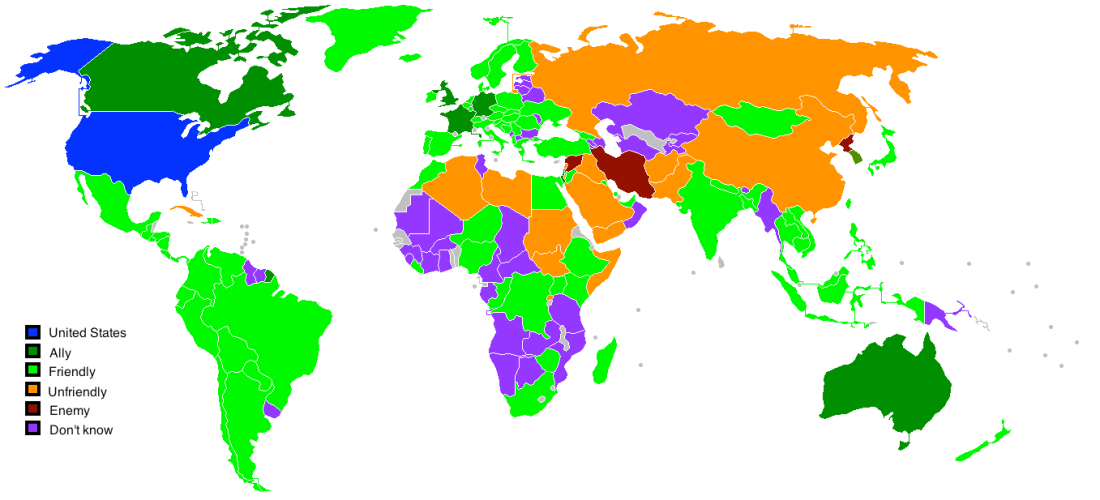
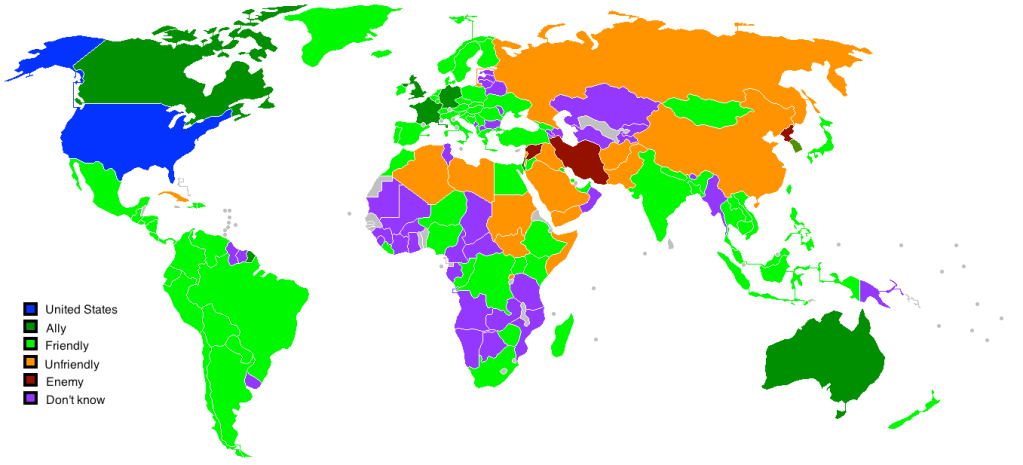
Map of the United States and their relations with other nations.

Today, in America, two big things are changing. The hegemony of the American military used to be an absolute, and now it is in question, not only by U.S. citizens but by other countries. Second, other countries know they are closing the gap between their militaries and the U.S.’s. Mindful of this situation, the U.S. could be headed for foreign policy crises in the near future in Ukraine and Taiwan. 

 David Ochmanek is a former senior Defense Department official who helps run war games for the Pentagon and the RAND Corporation think tank. Ochmanek uses simulations to look at potential outcomes of conflicts and makes educated predictions as to when potential conflicts could occur. In one of his recent simulations, he looked at China attempting to invade Taiwan and the U.S. almost always loses. There is a “blue team” representing the Americans and “red team” representing the Chinese. In the simulations, Taiwan’s entire air force is wiped out in minutes. These simulations are relevant because they could be predicting actual invasions. 

 Recently, there has been an increase in tensions between Russia and Ukraine. Russia has moved approximately 80,000 troops close to its border with Ukraine. It has been estimated that the combined NATO European forces, as currently constituted, could not defeat Russian forces close to the Russian border. In order to defeat Russia, they would need reinforcements from the U.S. mainland. 

            How likely is it that the U.S. will actually engage in these conflicts if they occur? Well, if Taiwan or Ukraine were attacked, there are no legal obligations for the U.S. to fight in those conflicts. However, we have seen in the past that global participation in a conflict can occur and escalate very quickly. The U.S. has been planning to send troops to Taiwan if it is ever attacked, but does not have plans to do so if Ukraine is attacked. This could mean potential U.S. intervention in Ukraine would be postponed, perhaps figuring into Russian calculations about whether attacking Ukraine stands a higher probability of success.

            We should look to President Joe Biden for upcoming news on these topics as he has proposed a summit with Russia to reduce tensions and continues to try to restart relations with China. 

Which states have the most say in elections? It depends on how you count.

Politics

Alina Snopkowski, Editor

With the talk about Washington, D.C. possibly becoming its own state, conversations have arisen about D.C., which traditionally votes strongly Democratic, gaining its own senators and representatives. “Taxation without representation” (or, in some cases, “end taxation without representation”) is the slogan on D.C. license plates, and a reason often given for why D.C. should have representatives in Congress. But with a population greater than only Vermont and Wyoming, D.C.’s representation in congress, which would almost certainly mean two more Democratic senators and an additional Democratic representative, means many Republicans are opposed to the plan.

Writer’s note: There would still be 435 representatives, but D.C. would get one, which means another state would lose one of theirs. To be honest, I’m not sure how they calculate that, and it’s not really the point of this article, so I’m not going to go into it here.

But how valid are these claims, anyway? And are there states that are better off than D.C. in terms of how many votes they get compared to the size of their population? I was curious.

So, using the 2019 state population estimates from the U.S. Census Bureau (the most recent numbers available) and some Excel tables, I determined which states get the most “bang for their buck,” so to speak, in terms of how much of their population is represented by a single representative in the House of Representatives and electoral vote in presidential elections. Here’s what I found.

How many people are represented by one electoral vote?

Image by Alina Snopkowski, created with mapchart.net

Here, I divided the state’s total population by the number of electoral votes that state (and D.C.) gets. I used the total population, not the voting-age or voting-eligible population. Oftentimes the claim arises that the electoral college favors the states with smaller populations and gives them more than their ‘fair share’ of electoral votes, which appears to be pretty true — large states such as California and Texas have over 700,000 people to each electoral vote, while Wyoming has less than 200,000 — but, as shown in the map above, some states are certainly ‘better off’ under this system than others.

Which states are above and below average for representation per electoral vote?

Image by Alina Snopkowski, created with mapchart.net

By dividing the country’s total population by 538, the total number of electoral votes, I got the average amount of people that one electoral vote would represent if these votes were allocated based on that system (if you’re curious, it comes out to about 610,000 people per electoral vote). The above map shows which states are currently above and below that average.

In 2020, which party got more votes than they ‘should have?’

Image by Alina Snopkowski, created with mapchart.net

Here’s where it gets interesting. To find the numbers for this map, I divided the state’s total population by the average-per-vote number I found earlier (the ~610,000). By subtracting the state’s actual number of allocated electoral votes from that new number, I was able to see how many votes each state would get if they were divided up this way. Using this system, each state would get at least one vote (we’d have to round up just a little bit for Wyoming, since the state’s population is less than 610,000), and some would get many more — Texas and California would both gain ten votes, bringing their totals from 38 to 48 and 55 to 65, respectively.

The above map compares the current system for dividing electoral votes with the division system I used and breaks down which states, by party, received more or fewer electoral votes in the real 2020 election than they would have using the other system. For example, in the current system of allocating electoral votes, Pennsylvania gets 20. If these votes were divided up using the ~610,000 number, Pennsylvania would have roughly 21 electoral votes — a difference of one that, in 2020, would have gone to the Democrats. In Delaware the situation is opposite — the state currently has three electoral votes, but with the other calculations it would get two, which means the Democrats in 2020 got an ‘extra’ vote there.

When all these ‘extra’ and ‘missing’ votes are tallied up, states that voted Republican in 2020 had about 21 ‘extra’ votes and about 19 ‘missing’ ones. For states that voted Democrat in 2020, they were ‘missing’ about 20 and had about 18 ‘extra.’

Note about Nebraska and Maine: These states split their electoral votes instead of having a winner-take-all system, and I wasn’t sure how to deal with that. Nebraska’s votes were 4 republican and 1 democrat and Maine’s were 3 Democrat and 1 Republican, and each state has one ‘extra’ vote, so I just factored Nebraska into the Republican count and Maine into the Democrat one).

How many people are represented by each state’s representatives in the House?

Image by Alina Snopkowski, created with mapchart.net

Last but not least, let’s go back to D.C. I did the math on this one in the same way as the first electoral college map: total population divided by number of representatives in the House. I found this one a little bit perplexing — Delaware and Montana are at the bottom of the list with the most people ‘sharing’ a representative, and, while Wyoming is, not surprisingly, again in the category with the fewest people to one representative, West Virginia, which also had a fairly low number of people to one electoral vote, but not that low, is also included at a similar level as Wyoming in this map. The state with the fewest people to each representative is actually Rhode Island, with about 530,000 people sharing a representative. Montana, at the opposite end, has a whopping 1,068,778 people for their sole representative.

Where does D.C. fall into all of this? If D.C. got one representative, the district’s population of about 706,000 would all be represented by that single person — putting it in twelfth place overall when states are ranked by the fewest-to-highest number of people accounted for by their representatives.

So, what’s the point of all of this information? Really, I just like math and maps and was curious about how the states compare to each other. I’m not a political scientist and I’m not suggesting we change the current electoral college allocation system to the one I used for my calculations, but I do think it’s interesting to think about.

Writer’s note: If you’re interested in any of my numbers and whatnot, email me and I’ll send you the Excel spreadsheet.

U.S. and Iran Indirect Nuclear Talks

Politics

Elizabeth Boyle, Staff

            On Tuesday, April 6, indirect nuclear talks began between Iran and the U.S. The Joint Comprehensive Plan of Action (JCPOA), also known as the Iran Deal, could potentially be revived. On July 14, 2015 in Vienna, Austria, an agreement concerning the Iranian nuclear program was reached between Iran and the six permanent members of the United Nations Security Council: the U.S., U.K., China, France, Germany and Russia. In 2018 Former President Donald Trump withdrew the U.S. from the JCPOA. President Biden is pushing to restart the JCPOA and started negotiations with Tehran, the capital of Iran, albeit through proxies.

            The U.S. and Iranian diplomats are not speaking directly to one another. The talks from the past week were mediated by the other signatories of the agreement. The two main goals of the meeting right now are for Iran to agree to strict limitations on their nuclear program and for the U.S. to agree to lift the sanctions placed on Iran by President Trump. Iran is refusing to agree to anything until the sanctions are lifted. On the other hand, President Biden is hesitant to remove the sanctions because Iran has an upcoming election and the U.S. is concerned Iran will elect someone less likely to be open to diplomacy.

            The negotiations are expected to take a long time, seeing as neither side wishes to change. Russian diplomat Mikhail Ulyanov has been tweeting about how he is pleased that the negotiations have begun and that work toward the goals has been started. Jason Brodsky, a senior analyst at Iran International and former policy director at United Against Nuclear Iran, cautioned President Biden about rushing into a new deal and reminded the U.S. that other countries are watching these negotiations unfold.

The globe experiences inequitable progress on COVID-19 vaccinations

Politics

Elizabeth Boyle, Staff

Michigan Health Lab
Image depicts a person being given a COVID-19 vaccination.

As the weather in Philadelphia finally starts to feel like spring, you may be thinking back to what you were doing last year at this time before the pandemic. A year ago this March was the beginning of the government shutdowns due to the COVID-19 pandemic. In one year multiple companies, including Moderna, Pfizer and Johnson and Johnson, have made and released COVID-19 vaccines approved by the FDA for emergency use. The various COVID-19 vaccines have been distributed first to those 65 years of age and older or those with underlying health concerns. Currently many states, such as Illinois, have made plans to start vaccinating everyone over 16 years of age as early as April 12. 

            Based on the number of vaccines produced and distributed, one would expect to see the world-wide number of COVID-19 cases decreasing. However, this is not the case in Europe. . Europe was one of the first places to have widespread deaths due to COVID-19, primarily in Italy. Recently the European Union (EU) vaccine distribution has been slower than expected, especially relative to Great Britain and the U.S., and positive cases of COVID-19 are rising. There are several potential reasons for Europe’s unexpected predicament. First, it took the EU longer to come together and sign an agreement with vaccine producers. The EU waited for all 27 member countries to come to an agreement about vaccine procurement, whereas other countries rushed into individual agreements to try and move along the process. A second reason is that Europeans have been more vaccine-skeptical than many other developed areas. Nature Medicine Journal published a survey of 19 countries that were asked how comfortable they were with receiving a COVID-19 vaccine that was “proven safe and effective.” China had the highest national response rate with 89 percent positive response compared to  the United States’ 75 percent. The European countries had much lower approval rates; for example, Germany had 65 percent approval and France had 56 percent. 

            For many European countries, an increase in positive COVID-19 cases seems like a step backwards. Conversely, the U.S., Britain (which left the E.U. in January 2020) and Israel are continuing to see an overall decrease in cases subsequent to an increase in vaccinations according to the New York Times, health agencies and hospitals.