Energy drinks are consumed by many people for a variety of reasons, and for some, energy drinks replace soda, coffee, tea or water. Primarily due to their harmful ingredients, energy drinks can have a plethora of negative effects on a person’s body.
According to WebMD, energy drinks are a common dietary supplement, and some of them contain excessive levels of caffeine. Since the Food and Drug Administration (FDA) does not approve these drinks, a brand can include any ingredient that they choose to. Some of the most common ingredients in energy drinks include caffeine, taurine, sugar, guarana and L-carnitine.
Caffeine is the main ingredient that can be found in energy drinks. A 16-ounce can can have up to 240 mg of caffeine. Caffeine can affect a person’s level of attentiveness and alertness, and can also affect athletic performance. The FDA recommends that people consume less than 400 mg of caffeine per day. This suggestion is for adults and is equivalent to two or three 12-ounce cans.
Taurine is another ingredient that is found in energy drinks. It is an amino acid that is naturally found in the body, but is also found in meat. It is used by the body’s cells as a way for energy to be processed. It assists the body in creating bile acid and neutralizing salt and minerals. Consuming too much of it can drain a person and can also lead to a hindrance in one’s sleep.
Sugar provides energy to the body, but it can create issues, specifically for people with conditions such as prediabetes. The dietary guidelines for sugar consumption indicate that people should not consume more than 10% of their daily calories from sugar.
Guarana is an ingredient that originates from the seeds of the Paullinia cupana plant. When it interacts with caffeine, it can have side effects that include an increase in heart rate or anxiety.
L-carnitine is a usual ingredient found in energy drinks as well. It is a molecule that aids the body in turning fat into energy. Medical conditions can cause a person to not produce enough carnitine in their system. High levels of it can create gut problems such as diarrhea.
Users should speak with their doctor before consuming energy drinks, especially those who are taking blood thinners, dealing with hyperthyroidism or are taking valproic acid.
Energy drinks can make people feel fatigued once the caffeine wears off, negatively impacting the amount of sleep that a person gets. When a person feels groggy, they have a greater tendency to consume another energy drink. This can generate a dangerous cycle where users decide to drink more caffeine than usual due to their fluctuating caffeine tolerance.
Reading is a hobby that people enjoy doing, and some people prefer to do this activity in a variety of places, including the library, a park or in the comfort of their home. Reading is something that has several benefits. These benefits include improving vocabulary, sleep, mental wellness, problem solving skills and general strengthening of their education.
Reading can help to increase a person’s vocabulary. According to Reader’s Digest, researchers have approximated that 5-15% of every word people recognize is by way of reading. It is specifically mentioned how audiobooks have a lead over paper and ink text. This gap is due to the fact that encountering a new word can prompt you to figure out the word’s definition, but not be able to pronounce it.
Reading can also positively impact a person’s sleep. Shutting off screens and settling into a book can refine a person’s sleep aspects. Not having the sharp blue light of devices can give an indicator to your brain that it is time to decompress. This benefit specifically pertains to books that are physical, not digital.
In addition, reading is something that can benefit a person’s mental health. Reading is an action that can transfer people to a pleasant place. This especially occurs if the story is outstanding. This can also be true for stories that are not optimistic and have characters that are balanced. This can cause people to feel less isolated when the characters have understandable difficulties.
Reading can benefit a person’s problem solving skills. According to 95percentgroup, in order to solve problems, people normally have to determine the issue first. They also have to evaluate the causes and figure out unique answers to it. Reading is something that can educate someone on these skills. This correlates to reading comprehension as readers must be able to grasp what is occurring in a story. They also have to be able to study the events and how the characters behave. When people read, the uncovering of original ideas can help people create in regards to problem solving.
Cognitive processes can be strengthened through reading. The more that people read, the more parts of a person’s brain become activated. This can create everlasting effects. Being immersed in reading can consistently reinforce cognitive processes due to the brain being conditioned.
People should read more than current statistics suggest that they have been. According to psyche, this involves making reading a greater urgency. People may have to adjust their usual habits in order to adapt to additional reading.
It also involves discerning intrinsic and extrinsic inspiration. Intrinsic motivation is doing something for no external incentive. This correlates to the likelihood of success that people can receive due to choosing a book that they find naturally enjoyable. They may also find the book to be peaceful, amusing or engaging.
This also relates to allowing yourself to stop reading books that you do not find captivating. Some people believe that they are trapped when they choose a book to read, however, people are still able to pivot to another book they enjoy instead.
Overall, reading prompts many health benefits, allowing for better sleep, increased problem solving skills and mental health self care. Happy reading!
In our current world surrounded by social media, our brains are being starved. Social media has warped our perception of ourselves. In order to feed your brain, it needs to be given free range for creativity–not confinement to your feed. Doomscrolling may give you instant distraction from your life, but it pulls you into someone else’s. Another person’s online life that looks perfect causes you to desire their life, maybe even become obsessive, causing mental health issues. Unhappiness results when you realize you can’t copy your favorite Instagram influencer’s life because it is not real.
Comparison is highly encouraged on social media. You begin comparing yourself to peers or models, resulting in a distorted self-image. You begin to look at what post will receive the most likes, allowing your viewers to be in control of your life. External validation becomes more important than self-worth.
Social media consumes our lives, causing us to not reflect on what we actually need and want. We want to follow others, lacking self-responsibility and leadership. When someone copies someone else, it could be because they admire them. Or, it could be because they have no idea what they truly want. Trends cause people to indulge in uniformity. Clothes and even self-expression are adopted as their own. Personalities become diminished when you attempt to constantly fit in. As younger children are now on social media, they do not have the chance to form who they truly can be. They are fed ingenuine content, making them believe this is how they can fit into the world.
Social media makes it incredibly easy for people to never tap into their own creativity. They are able to do exactly what their favorite influencer tells them to do. They begin to have no knowledge of themselves; the same way you are curious about someone you love should be the same way you are curious about yourself. When you reach a life-altering point, you will not know what to do. Alix Earle cannot tell you what you actually want in life. Only you can do that.
Instead of doomscrolling all day, pick up a book. Opinions should be formed without influence from others. Gen Zers may be more informed on political events and mental health than other generations, but they lack self-identity. We must recognize that self-identity is decreasing. Humans will begin performing like robots because they have no autonomy. Leadership will therefore decline.
In class, how many people do you see scrolling on TikTok? People should be more concerned about their education. College students should want to accumulate as much knowledge as possible. By learning more about how the world functions, you are able to form ideas about how you want your own life to function, and that cannot be done through others. Every individual should analyze their relationship with themselves. Allow yourself to engage in full creativity without needing approval from a celebrity. You are the only one who can make your life decisions. It is better if you learn how to do that now.
Philosopher Søren Kierkegaard, in his use of leveling, explains this by saying that we pretend to do things, such as learning, but only to make everyone think we are, without actually learning. Kierkegaard believes a writer should write for himself, not for his audience. On social media, people present distant or artificial versions of themselves instead of actually becoming the person they want to become. Most people do not want to be different or search for meaning because they would have to make decisions. Kierkegaard’s use of leveling allows individuals to recognize their own lives of action, hoping that readers will understand they must make decisions, take responsibility and ultimately find themselves inwardly through authenticity.
Journaling is an activity that people may do only on a daily, weekly or monthly basis. They can choose to do it for a variety of reasons. Some may choose to partake in it as a way to cope with difficulties they may have in their lives, while others do it because they find it relaxing. The benefits of journaling include improving self-distancing, self-confidence, stress, memory and productivity.
According to Verywellhealth, a person’s self-distance, a person’s ability to ponder on events in the past and emotions, can be improved through journaling. In addition, journaling allows people to encounter a decreased amount of responsive emotions, as journaling leads to a positive expression of these often repressed emotions. People also have a smaller amount of symptoms of physical anguish.
A person’s self-confidence can be improved through journaling. There is a type of journaling called reflective practice journaling which is connected to a raise in self knowledge, confidence and coping skills. This is particularly seen in students who are in nursing. It is a type of journaling where people speculate on realistic experiences.
According to Psychology Today, journaling is something that can benefit an individual’s stress levels, as writing down your experiences and emotions is something that can be healing. In order to obtain the fullest benefits of journaling, one should write more routinely as compared to occasional writing. In addition, writing with sincerity rather than what you believe will please others, which is also important.
Memory can also strengthen from journaling as people can reflect on experiences that they’ve had in the past. They can also recall details that they forgot. Writing in a journal is something that can help people reminisce on significant things that happened in their lives. An added benefit of journaling is that this pastime allows people to have an easily accessible log of notable places, people or events.
Finally, increases in productivity are closely related to journaling. When a person writes, it helps them better manage their tasks and layout their day. A productive person usually has a system of planning as it is something that succeeds for them. Writing can help people organize their week.
About 13.6% of people in the world struggle with mental health, translating to over 1 billion people. These struggles affect people of all different ages, ethnicities, genders and social statuses. This worldwide crisis has been around for centuries, but has only just recently been seen as a health hazard and extremely detrimental. Mental health comes in different forms like depression, anxiety disorder, childhood development issues, post-traumatic stress disorder and so on. Mental health struggles are sometimes visible in a person’s life, but most of the time they are often disguised by many of the victims– where they can smile throughout that day while their mind is overwhelming them. Although the ability to hide is successful, there are many ways the strain is revealed.
Mental health not only affects the mind, but the physical body as well. Chronic stress can lead to unhealthy weight changes and sometimes triggers eating disorders. Depression often causes the inability to get out of bed and fatigue, which can be a vital clue that someone is struggling mentally. Depression can drain energy and motivation that are reflective in the inability to go on throughout the day, which later affects the desire to eat.
Mental health also extends beyond personal strain, straining friendships, romantic relations and familial relationships as well. Withdrawal and sudden disassociation cause loved ones to feel hurt or mistreated. This can lead to loss of contact or removal of the person who is struggling mentally because it’s not revealed to family and friends. This becomes a severe issue because the miscommunication can lead to a detrimental cause. Relationships and support are a huge necessity for people who struggle mentally, for the stability and support are what pushes them forward to bettering their health. Without communication, the silent battle is almost invisible and hard for the outsider to read, emphasizing the danger of mental struggle.
This invisible burden of mental struggles can also affect productivity and the role of everyday life– even through simple daily responsibilities like leaving school/work early, cleanliness and goals. These day-to-day things become neglected because of the struggle within, such as depression taking away motivation. Anxiety disorders affect overthinking and the inability to prioritize important things. Fatigue and lack of focus may lead to missing work/school deadlines, terrible performance and other harmful mistakes. These troubling effects on the body, mind, relationships and daily responsibilities reveal just how severe mental health struggles can be.
Mental health isn’t just individual issues that affect the mind, but affects a person’s wellbeing and the people closest to them. Fatigue and eating disorders show how the mind can affect the body, withdrawal and miscommunication shatters relationships, and mental struggles challenge the ability to fulfill everyday needs. Mental struggles can be extremely scary and draining causing a person to lose themselves entirely if they do not get the help they need. Because most of these struggles go unnoticed, the problem goes on until it’s worsened. Addressing and helping people who struggle with mental health should become an obligation because it does not just affect the person, but the ones around them and our world as whole. Mental health deserves action just like any other illness, for no one deserves to suffer silently.
You Are Not Alone Quote Board on Brown Wooden Frame via Pexels
The term “burnout” was first coined in 1974 by clinical psychologist Herbert Freudenberger who borrowed “drug-addict slang” to describe the emotional exhaustion he observed in the East Village of NYC among drug clinic volunteers. Since Freudenberger’s research, the concept of burnout has evolved beyond healthcare and into the everyday lives of people–professionals and students alike, who suffer chronic and severe stress. A “burnout epidemic” is sweeping the nation now more than ever as society encourages a fast-paced, “hustle” culture, prioritizing long hours to achieve success while disregarding intentional self-improvement.
What is Burnout?
Erica Rogers PhD, Assistant Director of the Student Counseling Center at La Salle, defines burnout as chronic and prolonged stress, dividing burnout into three categories: emotional exhaustion, depersonalization and hopelessness.
As a Brown University and City University of New York graduate, Rogers has been working with students for over a decade, as well as providing students at La Salle with necessary burnout-prevention training since 2019. As part of this training, Rogers emphasizes burnout is more than just stress, although the physical symptoms mimic that of anxiety, and instead extends into fatigue and apathy.
Emotional exhaustion, as outlined by Rogers, is the fatigue that comes with chronic stress when an individual is unable to take a break or have a healthy release. This exhaustion then directly leads to depersonalization, the feeling of disconnection from yourself and the things you care strongly about.
“Let’s say you are… [a] therapist. Let’s say you don’t care as much about what people are telling you, you’re not feeling that same kind of compassion,” Rogers says, demonstrating a lack of empathy towards patients in a client-focused, humanity-driven field is an example of what burnout can look like professionally.
After an individual starts to experience apathy, hopelessness begins to kick in; therefore, people might feel a decreased sense of accomplishment, or as Rogers explains “the feeling that nothing that you do makes any difference, [so] why do it anyway?”
What Does Burnout Look Like?
For students, burnout can look like not going to class, failing to do homework or study for exams or generally isolating yourself from interests–whether clubs, organizations or social hangouts.
While large amounts of stress are normal around midterms and finals, it is important to recognize the difference between healthy amounts of stress and burnout, which can be distinguished by an individual’s period of recovery.
“Are you feeling relief from having a break from things going back to normal, or is it… really difficult for you?” La Salle Wellness Initiative Coordinator Allison Walter said, explaining that a few days to catch up on rest and indulging in personal interests post-midterm/finals would be enough for healthy stress levels, however not burnout.
Physical symptoms of burnout can include spiked cortisol, muscle tension, back pain, headaches/migraines and sleeplessness/insomnia. However, many symptoms aren’t as obvious- like increased hopelessness and an inability to “bounce back” after periods of recuperation, which is why it is important to be proactive about burnout and minimize its effects early.
Proactively Combatting Burnout
There are a variety of factors that contribute to burnout such as dysfunctional relationships, overwhelming demand (generally through a large volume of work), lack of control and an overarching feeling of unbearable stress. However, as Walter states, “We are more disconnected than ever.”
“Struggling together can make it [burnout] so much more manageable,” Walter continues, explaining that by connecting with other students, especially those experiencing the same academic and social pressures, the overall impact of burnout is minimized.
Rogers expands upon this idea, as she explains there are various physical, emotional/mental and spiritual connectors that can also help individuals who are struggling with burnout.
Emotionally, Rogers recommends allowing negative thoughts to take up space in your mind instead of exerting excess energy to push them away, visualizing and focusing on self-compassion.
“Imagining that your stressful thoughts are leaves moving down a stream and floating away,” is an example Rogers provided of effective visualization, furthering her idea of self-compassion by encouraging people experiencing burnout to speak to themselves the way they would a loved one.
Physically, Rogers claims it is essential to ask ourselves these questions: How do you treat your body when it’s under stress? Where do you hold the stress? And what are you going to do to release that tension? For some people, getting physical activity through going to the gym or for a walk is helpful, however a mere body scan, box breathing or holding a warm drink can be equally as effective. Not every solution is “one size fits all;” therefore, it’s important to recognize individual techniques that are successful.
Spiritually, one should take time to do things that connect with their personal values to gain a greater perspective and bridge their experience with the intangible. Rogers takes this one step further to encompass random acts of kindness where we ask ourselves relationally, how am I connecting with others?
Walter acknowledges burnout is perceived as “part of the college experience, but it doesn’t have to be.” She elaborates that there are numerous ways to proactively combat burnout including through clear school/social boundaries, saying “no” when necessary, viewing extra-curriculars as quality over quantity and recognizing the vast free resources available to students on La Salle’s campus.
Resources to Combat Burnout
On-campus:
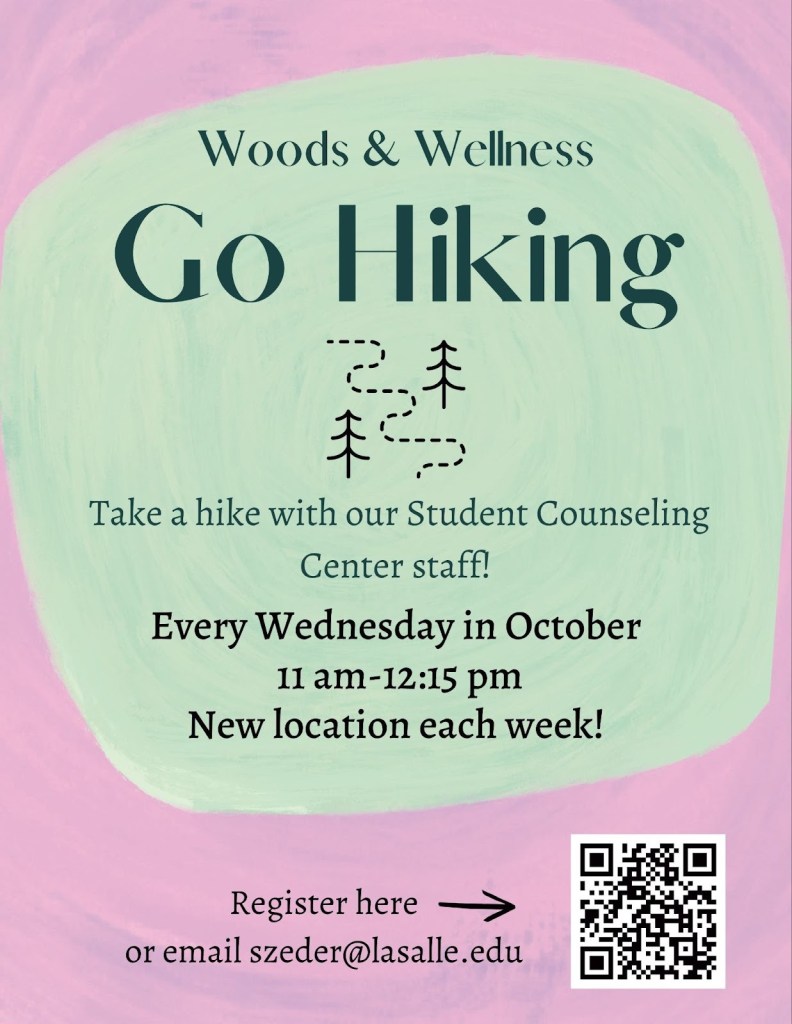
Student counseling is free to La Salle students, along with wellness coaching through the Student Health Center. The Student Counseling Center recently adopted a new program titled “Community Connections,” as well as a “Wood and Wellness” group that meets every Wednesday at 11 a.m. outside the Student Counseling Center to go on nature walks/hikes. See the fliers below for more information:
Flier via La Salle UniversityFlier via La Salle University
The Center of Academic Achievement can assist students with a variety of academic needs from coaching to tutoring, which can make the academic effects of burnout that much more bearable.
Additional Resources, as recommended by Dr. Rogers:
Apps: Insight Timer, Calm and Headspace
Podcasts: 10% Happier, Tara Brach and Mindfulness Mode
“If you’re experiencing this, you’re not alone,” Rogers said, claiming that your mental health is just as important as any other lifelong goal, debunking the “hustle culture” myth one support system at a time.
To contact Dr. Rogers directly for more information on burnout, you can email her at rogerse@lasalle.edu, along with Allison Walter at waltera@lasalle.edu.
Zen Buddhism focuses on harmony between the body, mind and self. In A Temporary Affair: Talks on Awakening and Zen, David Radin discusses the awakening, truth of life and the acceptance of impermanence. Zen Buddhism emphasizes the impermanence of human experience to enlighten the individual about fulfillments.
When you acknowledge that nothing outside of yourself can fulfill you, you “allow yourself a certain freedom—the freedom to just relax in the present moment, to breathe, to smile, and come back to yourself,” says Radin. Radin speaks about visiting a friend who is dying, talking about how nothing one accomplishes in this life can be brought to the next.
According to Radin, the mind “has been trained to compete and struggle to attain something that will give it a feeling of fulfillment; a feeling that we should spend a whole life accomplishing something that is going to provide fulfillment, instead of realizing fulfillment is inane.” The mind controls emotions and ideas of existential meanings. The mind creates pain and needs to be relaxed through meditation. Zazan, or Dhyana, is the central practice of Zen Buddhism, with the goal of reaching spiritual enlightenment.
Meditation is often seen as a connection with the mind when it really focuses on the body. When the body is softened, it allows the body to enter full harmony with breathing. Zazan does not focus on the mind but rather, the breathing. Peace occurs when the individual allows awareness and breathing to connect. Zazan is not the individual attempting to not think, it is the practice of giving up the thoughts lingering around to end up at the purest state.
Meditation is difficult to begin because the stigma is that peace of mind will occur instantly, but it does not. Meditation forces you to confront your mind, which comes with pain, but there is no way to escape it. Radin explains this concept by saying, “the first thing you find when you take up meditation is that you are face to face with your own insanity.” In various religions, people are praying to a Savior asking to be saved from fear and depression because the role of the Savior is to remove the pain that is unbearable. However, in Zen Buddhism, the individual is responsible for saving itself by accepting the mind.
Humans live their lives wanting external accomplishments and recognition, and when they reach enlightenment, it is usually too late. Throughout life, individuals are constantly trying to prove themselves to the external world, but one day everyone will grow old and die. The overarching truth of this is that there is something special within each person that has been there since birth, human consciousness.
Human consciousness dictates thinking causing either destruction or happiness. When the individual learns how their mind works, they can open a door of honesty and potential. When recognizing that everything worked for in this life will disappear, the individual will connect with their inner stability.
You might have heard “Why is therapy important?” more than once, whether that’s in the news or a 5-minute article. One cannot deny its importance to the quality of life and to keeping relationships close and healthy. Many aspects of therapy are there to help those in need– from one-on-one sessions to entire group sessions, there is a session out there ready to hear and help you.
Therapy benefits both emotional and physical wellbeing, as well as providing various coping mechanisms. An example of why therapy is important is talk therapy. According to Healthline, “Talk therapy encourages open and honest dialogue about issues that cause distress. Through your relationship with your therapist, you’ll work to identify and understand how these stressors are impacting your life and develop strategies to manage the symptoms.” This is a good approach for people who find it easier to express their fears and concerns through their own words. It lets them take charge while also being guided into better and healthier coping habits.
This ties into individual therapy where you are given a safe space to speak on all your stressors and solely focus on you. Many social skills can be improved with therapy such as communication skills, feelings of empowerment and healthier life choices that can help you develop more thoughtful insights on life. Not only that, but it can also build communities and long-lasting connections that can last for generations by building each other up. Talk therapy creates a safe environment for emotional expression, meditation promotes mindfulness and cognitive improvement and physical therapy restores movement and reduces pain. All together, therapy supports not only personal growth but also stronger relationships and healthier communities. Regardless of the method, therapy offers accessible and meaningful support that can lead to lasting, positive change in anyone’s life.
Meditation therapy is another wonderful use of therapy. Key benefits of the practice include mindfulness to support mental health. Closing your eyes and listening to your breathing can help keep in touch with what’s most important. Frequent meditation helps improve focus, emotional regulation and resilience to whatever challenges might come your way. Insights from PositivePsychology explain that the science-based practice is a “comprehensive exercise [that] will not only help you cultivate a sense of inner peace throughout your daily life, but will also give you the tools to enhance the mindfulness of your clients, students or employees.” The practice is open to everyone, and over a thousand people worldwide are trying it. Here are three benefits that came out of meditation: “The amygdala changes after two months of meditation training. Desbordes and colleagues (2012) found that there is less activation in this area after learning meditation.” This is interesting as the amygdala is responsible for our emotions, specifically fear, so seeing a decrease after meditation shows a healthy benefit. Number two, “Ramsburg and Youmans (2014) found that meditation improves the retention of information. In their experiments, college students received brief meditation training or rest. Then they listened to a lecture followed by a quiz. Students who received meditation training retained more information. Unaffected variables included mood, relaxation, and class interest.” Memory is important to a lot of people and with the use of meditation, not only can one train their brain to memorize, but they can also make it easier to retain everything that’s being learned more comfortably and efficiently.
Lastly, aside from the mental benefits, therapy can also contribute to physical health. But what is physical therapy? Physical therapy is a type of rehabilitative care focusing on diagnosing, treating both chronic and acute injuries, as well as movement dysfunction. “More specifically, physical therapists are trained to work with people of all ages through the use of prescribed exercise, manual therapy, and patient education.” The practice does not discriminate on age and is open to helping those in need by giving them access to their mobility, as people rely heavily on moving and using their legs. According to the National Institute of Arthritis and Musculoskeletal and Skin Disease, “Treatment of a more severe sports injury may require physical therapy for rehabilitation or fitting for a brace, cast, or splint. A physical therapist can design a plan to help rebuild the injured area’s range of motion and strength. This may include targeted exercises, massage therapy, aquatic therapy, ultrasound or cold and heat therapy to help strengthen muscles and joints and prevent further injury.” This contributes to the lowering of pain in joints and muscles, which also decreases mental distress. Other ways of releasing pain are therapeutic exercises, daily stretching, cold and heat therapy and many more.
To conclude, therapy is not a closed box; it is a journey, and people will end up taking different paths and healing with the right community. Therapy plays a vital role in enhancing overall well-being, that being mentally, emotionally or physically. Whether through talk therapy, meditation or physical therapy, individuals are given the tools to better understand themselves, manage stressors and heal both the mind and body.
Eating is something that people do on a daily basis in their lives. They may eat out at a restaurant or decide to cook a meal at home. Nevertheless, when eating a meal, many people are not mindful of it. Mindful eating is a type of eating that involves being aware of how you are feeling instead of what the food actually is. Mindful eating can be beneficial for people in ways such as digestion, supporting weight management and lessening yo-yo dieting.
Mindful eating is a type of practice. According to The Whole U, the practice entails being completely present and open-minded when eating snacks and meals. It is also a practice that incorporates every sense, emphasizing the importance of paying attention to bodily cues. These cues include hunger and can help people decide how much they need to eat. These cues can also signal how full your stomach is and what foods are appetizing.
One of the benefits of mindful eating includes helping a person’s digestion. According to health.clevelandclinic, enzymes in a person’s mouth are present when people chew and aid in digestion. Mindful eating supports chewing food meticulously and eating it steadily. This causes people to digest food in both an adequate and prompt manner.
Another benefit of mindful eating is supporting weight management. When people listen to their body’s internal indications, they are able to develop healthier food management techniques. Mindful eating helps people to calculate their hunger based on what the body is saying to them instead of calculating hunger based on how many calories you eat. Integrating these eating patterns can help people realize that the food is not as appealing as it appears to the brain.
Moreover, another benefit is lessening what’s called ‘yo-yo’ dieting. According to bite out of life nutrition, diets that are a type of “swift fix” do not work in the long term. Small successes can be found in the short-run, a likely result of diets that restrict the amount of food people consume. A large number of people that diet, however, wind up gaining back the weight they lost. Additionally, this type of eating can be practiced. According to Healthline, people can begin mindful eating through simple measures. One of the ways include eating at a slower pace and not rushing. Another way is by concentrating on the way the food you’re eating makes you feel. People can also ask themselves a series of questions before eating including why they are deciding to eat and if they are actually hungry. People may also sit in an assigned area such as a dining room or kitchen. This can replace sitting in front of your television or desk to eat a meal, which in turn can make the mundane routine of eating more elaborate and thoughtful.
Sleep is something that is a part of everyone’s routine on a daily basis. Some people may sleep more, while others sleep less. Regardless, sleep is the resting of the body and has several benefits that make it imperative for humans to function. These benefits include controlling your blood sugar, lessening inflammation, refining mental function, improving mood and resulting in a stronger athletic performance.
According to Verywellhealth, sleep can benefit your blood sugar and help manage your metabolism. Your metabolism is what the body uses in order to change food into energy. Being deprived of sleep can create issues with a person’s metabolism. One of these issues includes blood sugar levels that are unstable, and this is specifically an issue for people that have diabetes. Inconsistent blood sugar levels can affect a person’s mood, mental function and energy levels.
Additionally, inflammation can be lessened from sleep. A person not getting enough sleep can cause uneven immune system activity to occur, which can cause inflammation as a result. Chronic inflammation can harm bodily structures and can amplify your risk for several health conditions including dementia, ulcers and heart disease.
Likewise, sleep can help refine a person’s mental function. According to Sleepfoundation, sleep can assist with a person’s cognitive thinking and memory. Lacking sleep can impact a person negatively in terms of being able to think clearly, function ideally and make memories. A person’s ability to think recesses after a week of unsatisfactory sleep. People that are deprived of sleep do not perform well in prompt response activities and attention to multiple tasks. An example of this type of activity is driving. An insufficient amount of sleep can affect a person’s judgment as well. A correlation is seen between unsafe behavior and sleeping for less than five hours; therefore, people that are deprived of sleep are at a greater likelihood for making bad decisions.
Moreover, sleep can help improve a person’s athletic performance. Sleep is vital to an athlete’s recovery. The body’s creation of growth hormones is the most prominent at night. These hormones are required in order for the tissue in the body to be fixed. Also, they are a likely aide to muscle growth. Not sleeping can put athletes at risk for a decrease in performance, mood changes and tiredness, which can amplify the risk of injury.
A way to improve your sleep involves the use of technology. Putting aside electronic devices for a period of time before bed can be beneficial. The recommended period of time is 30 minutes. Blue light is released from things like computers, tablets and phones. This light can disturb a hormone called melatonin from being produced, and without this hormone, it is more difficult to fall asleep. Experts in sleep recommend creating a relaxing routine before bed, completing activities such as taking a shower or reading.









 The La Salle Collegian