Philadelphia bleeds while bureaucrats fumble the bandages – Editorial

Editorial

On rising crime in the City of Brotherly Love

The Editorial Board

For this week’s issue, the editorial board at the Collegian wanted to take a break from our regularly scheduled programming — covering issues closely related to the University, its students and its faculty — to discuss a broader topic that encompasses the entire community in which we live, the City of Philadelphia. It is no secret that rising homicides have been a struggle for the City of Brotherly Love for half of the last decade, but, in the last year, the city has reached a boiling point and, in lieu of answers to the problem, justice officials of the city have decided to shift blame.

Rising homicide rates in Philadelphia is an issue that affects all of us, directly or indirectly, no matter what part of the city we live in. A city’s patronage cannot be justified if it is not safe to patronize. How can parents justify sending their children to college in a city with a homicide rate that is up 41 percent from last year? How can businesses justify opening in communities where they are at a substantially greater risk of being subjected to property crime? From a fiscal standpoint, the safety of a city is congruent to economic viability and, in turn, financial stability of its citizens and the infrastructure they use every day. Municipalities need people to be safe and welcome to those who inhabit them; otherwise taxpayers will leave, and the loss of taxpayers hurts the people who cannot afford to leave the most. Now, from a moral standpoint, there is absolutely no justification for such a digression in reducing violent crime. Philadelphians are dying, and we need answers to how that is going to stop before things get worse.

Despite the Philadelphia Police Department making more arrests for illegal possession of firearms and gun violence reaching record highs, Larry Krasner’s DA’s office has overseen a record 48 percent case dismissal or withdrawal rate for illegal possession of firearms, up from 29 percent before he took office. One of Krasner’s hallmark efforts when first taking office centered around ending mass incarceration, but the question we need to ask ourselves as Philadelphians is: Have these policies backfired? We must strongly consider that as a possibility with homicide-related deaths rising from 356 in 2019 to 499 in 2020. That marked a 41 percent increase in homicide deaths, and there is already a 42 percent increase in homicide-related deaths this year compared to January and February of last year.
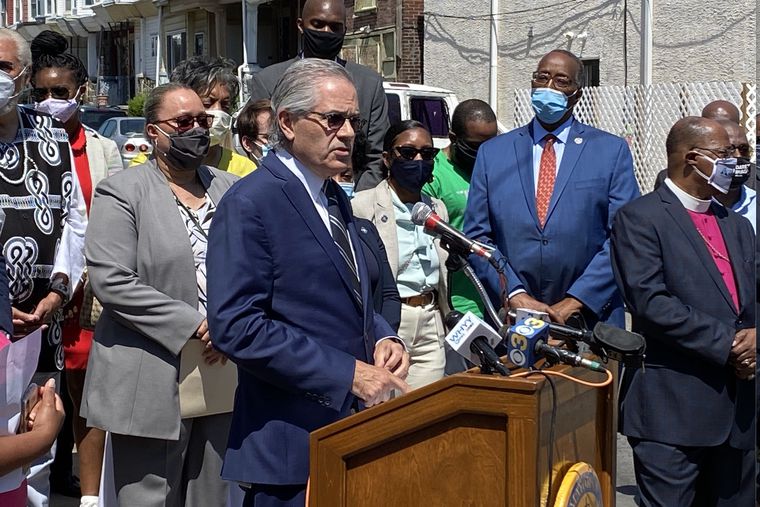
Philadelphia Inquirer
District Attorney Larry Krasner speaks to a crowd about rising gun violence in the city.

PPD Commissioner Danielle Outlaw has spoken at length to news sources about the topic and her statements have hinted at disconnect between stakeholders in the criminal justice department, meaning the police, judiciary and prosecutors, being to blame. On new lines of communication being made between the DA’s office and the PPD, Outlaw made it clear that there are problems in the justice system that need to be identified: “We’ve asked for an open and honest look — if there is something that fell short on the courtside or the DA’s office side — what were those things, and how can we ensure that moving forward maybe in the next few days that it doesn’t happen again?” Outlaw not only hinted at frustration with the other departments, but that communication has been an issue in the past — “This level of communication wasn’t happening but I think it’s important to make sure that we’re not only introspective but there has to be a quality assurance in the review of these cases because we cannot continue to see what we’ve seen.”

Back in August, Krasner defended his office on Fox 29’s Good Day Philadelphia amid criticism stemming from increasing gun violence: “[The Philadelphia Police Department is] making arrests, but let us be honest: When you have a solve rate — when you have what they call a clearance rate, meaning the police have identified the one who they believe is guilty — of 14 percent in July and 9 percent in August, there’s more that we can do together.”

As a Philadelphian, if the sparring match between District Attorney and PPD officials doesn’t anger you, then their reverberations should. Disconnect in our justice department has not only caused an uptick in violent crime, but a degradation of the criminal justice system at the ground level. A source at the Philadelphia Police Department agreed to speak on the morale and effectiveness of the Philadelphia Police Department on the condition of anonymity and what they had to say should upset anyone who is  part of the Philadelphia community. According to the source, morale within the PPD is suffering: 

“The main issue is [officers] do not feel as though they are supported by the district attorney, we arrest plenty of violent offenders but the DA doesn’t prosecute them, and the judicial system does not set proper bail. A lot of the violent offenders we take in committed violent acts while they were awaiting trial for another violent act.”

The perceived lack of support has resulted in the officers becoming reactive to crimes, rather than proactive in stopping them. Our source went on to depict the general mindset among officers at the PPD as one of reluctance as a result of lack of support, “Why should I go out of my way to make a proactive arrest or stop someone with a firearm in the car if no one is going to support that action?” Reluctance in officers to be proactive in investigations has placed more pressure on communities to make themselves safer. 

We’ve seen this firsthand as the mayor’s office of violence prevention has sent officials knocking door-to-door, distributing literature and trying to build up trust between communities to aid in police investigations going forward. Shondell Revell, the executive director of the office and his team, known as the “Violence Disruptors,” were followed by NBC news reporters as they spoke to members of Philadelphia’s high-crime communities: “Resources… You know what I’m sayin [sic]? We’re tryna [sic] stop some of these shootings.”

The editorial board, all members of the Philadelphia community, can say with certainty that our community deserves better than door-to-door pleadings to “stop the shootings.” Our community deserves the right to walk the streets and reside in our homes with peace of mind that a stray bullet won’t make the second we are currently living in our last. The moment we are in right now is a watershed moment for the City of Philadelphia. We have been able to curb gun violence before and, in turn, keep people from dying; we can do it again. The onus cannot entirely be put on us, but we must demand more from bureaucrats, and we must pressure them to get results. Philadelphia is bleeding and, whether it be the police department, the court system or the district attorney’s office — or all of them together — our officials must take accountability to make it stop.


Letters, guest columns and opinion pieces will be considered for publication provided that they meet the editorial standards of The Collegian. All letters must be received by the end of the day Monday to be considered for the current issue. Letters can be submitted via email to abbateb2@lasalle.edu. The Collegian reserves the right to condense or edit submissions. Weekly editorials reflect the views of the editorial staff and are not representative of the university or necessarily the views of the rest of the Collegian’s staff. Columns and cartoons reflect the views of the respective writers and artists.


Quantity over quality in our classrooms – Editorial

Editorial

The Editorial Board

The Editorial Board is old enough to remember a different La Salle — the La Salle most know for its small class sizes and personable professors. It’s what was marketed to us. It’s the mission that was ingrained in us. We are a teaching university, and what sets us apart is our individualized attention to students. Just a few years ago, this was the case. Is the same true today?

The collective experiences of the Editorial Board tell us that this is not the case. What were once intimate class settings are now full Zoom rooms. Professors who were once teaching three classes are now teaching four. Administrative assistants are gone. Adjuncts are scarce. These things add up, and the sum is a reduced quality of education. 

Last week, the Editorial Board brought to your attention the high administrative costs at the University; this week, the Editorial Board shows you one of the side effects of disproportionate spending. While the administration of the University may be growing, the faculty is shrinking. As stated in last week’s editorial, since the pandemic, the University has laid off 53 employees and eliminated 51 vacant staff positions; this decision has translated into greater responsibility for faculty. 

When more responsibility falls on the shoulders of professors, the student’s education suffers. Firstly, professors are unable to dedicate as much time to individual students. In a Zoom class nearing 30, naturally the professor will be unable to engage every student or even notice their presence in the online classroom. The student, on the other hand, suffers from a diffusion of responsibility in a larger classroom. Because of the large class size, there lacks a necessary pressure for students to even pay attention to the class material; if he doesn’t answer the question, someone else will (until no one does). In a smaller class, there is inherently more of a balance, and students are encouraged to take more ownership of the class. Furthermore, with a larger course load, professors are unable to give the same attention to and offer the same support for their courses, because they have to plan twice the content for the courses they are now teaching. Furthermore, not only are large classes becoming a norm, but smaller classes are unable to run due to their lack of profitability. The effect of this restriction is that the curriculum becomes more narrow and students are unable to explore their intellectual interests. 

If we cannot stick to the original plan — small class sizes and professors who know us on a personal basis — so be it. Our identity is changing, and in 10 years, La Salle may no longer “that” university. At the same time, we cannot market ourselves as a school that can offer things it does not. La Salle is facing issues, like low enrollment and stagnant alumni donations. The University is overburdened by debt, so much so, it has been downgraded by credit agencies in recent months. Ultimately, the University has taken some hits and the Board of Directors is clearly working to address them but, instead of bandaging a wound, they are amputating a leg. By expending the budget on things like hiring consultants from McKinsey & Co. and hiring administrative executives at high salaries, they are, in effect, cutting off the lifeblood of La Salle University: its professors and the students they teach.

Correction: In the original article, the Collegian reported, “What were once classes of 15 are now pushing 30. Professors who were once teaching one or two classes are now teaching three.” Most professors in the Arts & Sciences and Business schools were teaching three courses and are now teaching four. Also, most courses were capped at 33 students.


Letters, guest columns and opinion pieces will be considered for publication provided that they meet the editorial standards of The Collegian. All letters must be received by the end of the day Monday to be considered for the current issue. Letters can be submitted via email to abbateb2@lasalle.edu. The Collegian reserves the right to condense or edit submissions. Weekly editorials reflect the views of the editorial staff and are not representative of the university or necessarily the views of the rest of the Collegian’s staff. Columns and cartoons reflect the views of the respective writers and artists.

Too many VPs in the kitchen spoil the broth – Editorial

Editorial

Is “administrative bloat” a problem at the University?

The Editorial Board

Twenty years ago, the executive cabinet at the University looked something like this: president, provost, three VPs and four deans. Today, however, the administration has a much greater fleet: president, three deans, vice president and general counsel, vice president of university advancement, chief of staff, vice president of mission, diversity and inclusion, vice president of enrollment management, marketing and communications, vice president of finance and administration, provost and vice president of academic affairs, vice president of student affairs and enrollment and, most recently, executive vice president. Yes, it’s a mouth full. Twenty years ago, La Salle had roughly the same or slightly more students than it does now. In 20 years, how exactly did we get to this point, and are we better off now or then? Does the big government model for the administration work for La Salle? A large, complex administrative structure at La Salle creates several potential problems for the University. Firstly, it’s a costly operation. Secondly, it cripples the model of shared governance. Thirdly, the model lends itself to the pitfalls of bureaucracy. 

The first issue is that these administrative roles are not just titles; they are big paychecks for the University. Often surpassing $200,000, the salaries of these administrators double (sometimes triple) those of faculty. Since the pandemic, the University has laid off 53 employees and eliminated 51 vacant staff positions; this decision has translated into greater responsibility for faculty. How can it justify this decision while simultaneously creating a new role within the administration? If faculty members can assume greater responsibilities with fewer colleagues and same or decreased pay, the administration should also be able to do so. More than salaries, a larger administration is accompanied by a plethora of administrative costs, such as distinct reports and new rules and regulations. 

Ballooning administrative costs are not a unique problem; they’re a higher education problem. According to a 2017 Forbes article “Bureaucrats And Buildings: The Case For Why College Is So Expensive,” administrative bloat in the past 30 years has resulted in a disproportionately heavy emphasis on administrative costs: “During the 1980-1981 school year, public and private institutions spent $20.7 billion in total on instruction, and $13 billion on academic support, student services and institutional support combined, according to data from the National Center for Educational Statistics. By the 2014-2015 school year, total instructional costs had climbed to $148 billion, while the same grouping of administrative expenses had risen to $122.3 billion…Put another way, administrative spending comprised just 26 percent of total educational spending by American colleges in 1980-1981, while instructional spending comprised 41 percent. Three decades later, the two categories were almost even: administrative spending made up 24 percent of schools’ total expenditures, while instructional spending made up 29 percent.” The top-heavy corporate model is not the most efficient one. A better long-term management model might be to hire fewer top-paid, senior administrators and more administrative assistants whose salaries quarter those of the senior members.

Secondly, a large administration cripples the model of shared governance within the University. A university should rely at least partially on the consultation of its most important and in-touch asset: faculty. With a larger administration, the administration will likely be less dependent on faculty and even deans in decision-making processes. This has already proven to be true, given that the faculty senate was not consulted in the creation of the new executive vice presidency role or the hiring process for said role. Moreover, in recent years, faculty members have been blindsided by administrative decisions countless times, such as the sale of artwork from the art museum and the firing of administrative assistants to name a few. With the administration’s growing control over (specifically) academic policy, the unbalanced power becomes a problem within the University. The disconnect between the administration and the faculty creates an excessive tension that is both counterproductive for the University and conducive to cynicism among faculty (ultimately affecting students). Before adding more decision-makers to the pay-roll, why would the University not tap into its existing resources?

Lastly, the system lends itself to the pitfalls of bureaucracy. One of the ways in which this manifests are the intricate and euphemistic titles. If the university is focusing on “best practices,” “strategy” and whatever other buzzwords are popular in the modern landscape, the student experience is not necessarily better. When a student has a simple request or need, he may be tied up in bureaucratic red tape: contacting multiple offices, abiding by complex rules and regulations, etc. Also, many decisions made within the bureaucracy do not benefit current students, but future students. The issue of a bureaucratic administration is connected with the aforementioned problems as well. The nature bureaucracy lends itself to higher costs as well as increasingly unbalanced power. 

One could argue that, in recent years, the landscape of higher education has greatly changed and that these changes have thus transformed the roles of administrators, perhaps urging schools like La Salle to develop new roles for niches it must address. Is this the case for the creation of the executive vice president role? The justification will be there if the ends justify the means. In other words, the University is financially struggling. It hired a man with budget-balancing experience for a reason. If he can get the University back on track, the University’s hire is an ultimately good decision. It met a need. If not, it worsens the problem. Only time will tell.

Administrators serve a critical rule at universities. Given the current situation of La Salle University and the consensus about trends in administrative spending, however, the Editorial Board is cynical about a growing administration at La Salle. While we believe that the University should get back to the basics in the long-term, we also recognize that the University’s decisions concerning the administration are attempts to address critical needs for La Salle. So for now, much rests on the outcomes of new administrators; if they cannot deliver returns on the investment, La Salle’s got a few more problems on its hand than before. 


Letters, guest columns and opinion pieces will be considered for publication provided that they meet the editorial standards of The Collegian. All letters must be received by the end of the day Monday to be considered for the current issue. Letters can be submitted via email to abbateb2@lasalle.edu. The Collegian reserves the right to condense or edit submissions. Weekly editorials reflect the views of the editorial staff and are not representative of the university or necessarily the views of the rest of the Collegian’s staff. Columns and cartoons reflect the views of the respective writers and artists.

The implications of an administrative exodus: why is everyone jumping ship? – Editorial

Editorial

The Editorial Board

In a democracy, a mass exodus of government officials signals to the world that there is a problem in the system; in an educational institution, the signal is no different. With President Hanycz’s plan to leave La Salle for Xavier and one source’s confirmation that multiple other administrators are following suit, many might be wondering, “Why is everyone in the administration leaving La Salle? Is it money? Is it the Board of Trustees? Is it the pandemic?” No answer is overwhelmingly apparent. We can only say that — in the span of one semester — the president of the school and three of her executive cabinet members are leaving, and there are dangerous implications of this mass move. Ultimately, the administrative exodus is a scary sign for the University; it hints at a deeper problem within the University, in which either the resources are too low or the structure of the administration too flawed to create positive outcomes. 

La Salle University struggles financially as a result of the coronavirus pandemic; this fact is a given in the world of higher education. However, La Salle has long been an institution akin to financial vulnerability, and that insecurity could have been a major factor in the administrators’ decision to leave the University. After all, in June, President Hanycz told The Inquirer that the University would face “a dire financial outlook” if students did not return to campus. Students, in fact, did not return to campus come fall, which brings one to the possible conclusion that such a dire financial outlook has arrived. Since these statements, the University has laid off 53 employees, cut salaries and hours for 48 others and eliminated 51 vacant staff positions. These decisions were made only in recent times. However, it is also important to note that, though there was a brief uptick in 2019, revenue and asset trends have been declining since 2015, according to Cause IQ. These declining trends have signaled deeper financial trouble for the University — trouble that may have been worrisome enough for administrators. If it can and did happen to 53 employees, it could one day happen to four administrators. Even with job security, these administrators could be receiving better offers elsewhere. Two of the departing administrators will assume roles at universities with much greater revenue; the other two will assume roles at private companies.

The departures could be a matter of finances, but they also could be a matter of results. One source speculated that there may be dissatisfaction with the administration among the Board of Trustees. If the Board is unhappy, its members may make a critical decision for the administration. It is interesting to note the recent creation of the executive vice presidency role, given that its objective is entirely outcome-based, focusing on La Salle’s market value and strategy. The resume for this position’s appointee details experience in stabilizing the budget for the Archdiocese of Philadelphia. This hire indicates that the Board saw a greater need for strategy within the University; one could say that the creation of this role was a reaction to the pandemic, but the reality that the role was already filled in October of last year makes that conclusion less clear. 

Is it plausible that all four administrators were simply “ready to make a move” in their careers at the same time? Plausible, but likely not. The evidence suggests that either money or work product motivated these moves. Even so, it may be true that the decisions of these administrators were unrelated. It may be true that the University could find a perfect fit in its hiring process. Yet, it is not about the past or the future. Presently, the reality that four administrators to leave La Salle at the same time is a bad optic for the University: if the higher-ups are jumping ship, are we to say that La Salle is sinking?


Letters, guest columns and opinion pieces will be considered for publication provided that they meet the editorial standards of The Collegian. All letters must be received by the end of the day Monday to be considered for the current issue. Letters can be submitted via email to abbateb2@lasalle.edu. The Collegian reserves the right to condense or edit submissions. Weekly editorials reflect the views of the editorial staff and are not representative of the university or necessarily the views of the rest of the Collegian’s staff. Columns and cartoons reflect the views of the respective writers and artists.

Class of 2021, what does our future hold?

Editorial

Editorial Board

In the past four years, for the graduating class, what we learned about in history class became reality. We were in Philly to see the tides shift in Washington. We were in Philly to mourn the death of classmates. We were in Philly to celebrate the Eagles’ Super Bowl victory. Now, some of us are in Philly to endure a global pandemic. As we reflect on the major historical events which have served as the backdrop to our education, we may be forgetting that we are now entering the second week of our last semester, and for many of us, that’s a terrifying thought.

With less than four months to graduation, the class of 2021 has a great deal on its mind: grad school applications, career prospects and the uncertainty of the future. As a senior, it’s hard not to be bitter about our situation. It’s natural to think we deserved better as a class — to be able to cap our collegiate careers with late nights in the library and warm spring days on the quad. However, this is not the hand we have been dealt. This editorial is not to say that everything is going to be alright; it’s probably not. Rather, it is to say that, even though everything won’t be alright, we’ll handle it. 

In all that we have collectively endured, we have been afforded the opportunity to develop a growth mindset. We can only mourn the loss of our experience for so long before it cripples us. We need to stop asking “Why is this happening to me?” and begin asking “What is this teaching me?” When I reflect on what this experience has taught me, I am called to put myself in the shoes of previous generations of students — students who endured the Vietnam War, 9/11 and the 2008 financial crisis. While those events may have afflicted many students, ultimately, they survived (and often with good jobs) and, despite the circumstances, we will survive too. 

This editorial is not to say that everything is going to be alright; it’s probably not. Rather, it is to say that, even though everything won’t be alright, we’ll handle it. 

The pandemic’s effect on the global economy and job market makes graduation that much more daunting. We can accept that our dream jobs won’t be laying at our doorstep come May, and yet, there’s a certain power in that acceptance. There is power in the ability to accept instability and uncertainty in our lives. With the grit and resilience we have collectively developed, the world, if not now, will one day be our oyster. The spring semester is sure to host a distinct set of challenges, but if there’s one group up for the task, it’s the class of 2021.


Letters, guest columns and opinion pieces will be considered for publication provided that they meet the editorial standards of The Collegian. All letters must be received by the end of the day Monday to be considered for the current issue. Letters can be submitted via email to abbateb2@lasalle.edu. The Collegian reserves the right to condense or edit submissions. Weekly editorials reflect the views of the editorial staff and are not representative of the university or necessarily the views of the rest of the Collegian’s staff. Columns and cartoons reflect the views of the respective writers and artists.