Republicans dominate on Election Day amid high voter turnout

Politics

Cole Welsh, Editor

On Tuesday, Americans went to the polls to cast their ballots in what was already expected to be a high turnout election.

In the most closely watched race of the night, Donald Trump defeated Kamala Harris to become the next president of the United States.

Providing him with the 270 Electoral College votes needed to emerge victorious, Trump won the Rust Belt states of Pennsylvania, Wisconsin and Michigan. Trump also notched decisive victories in the key swing states of Georgia and North Carolina.

At the time of this article’s publication, the swing states of Arizona and Nevada have yet to be called for either candidate, although Trump possesses a sizable lead in both states.

Additionally, Trump became the first Republican presidential candidate to win the popular vote since George Bush’s victory in 2004.

In the battle for the U.S. Senate, Republicans won a handful of races, flipping the chamber to the GOP.

In West Virginia, Republican Governor Jim Justice won the race to replace outgoing Senator Joe Manchin, a centrist Democrat.

In Ohio, Republican businessman Bernie Moreno defeated longtime incumbent Sherrod Brown.

In Montana, Democrat John Tester lost re-election to 38-year-old former Navy SEAL Tim Sheehy.

In Pennsylvania, Republican combat veteran Dave McCormick narrowly defeated three-term incumbent Bob Casey.

For the Democrats, incumbent Senator Tammy Baldwin won reelection to retain her seat in Wisconsin.

The race for Arizona’s Senate open seat has yet to be called, although Democrat Ruben Gallego maintains a small lead over Republican Kari Lake.

Likewise, the Senate matchup in Nevada has also not been called, as incumbent Senator Jacky Rosen maintains a slim lead over Republican challenger Sam Brown.

With a razor-thin margin of victory, Democrat Elissa Slotkin, a current congresswoman and former Central Intelligence Agency analyst, bested Republican Mike Rogers to represent Michigan in the U.S. Senate.

In regard to the other chamber of Congress, it is currently too early to determine which party will win control of the US House, as a plethora of competitive congressional seats have yet to be called.

That being said, Republican victories were not just an occurrence at the federal level.

In Pennsylvania, Republicans won the state attorney general’s race and kept the other two statewide row offices. Dave Sunday, a Navy veteran and the current district attorney of York County, defeated Democrat Eugene DePasquale to become PA’s top prosecutor after running on a tough-on-crime platform. Republicans Tim DeFoor and Stacy Garrity won their reelection contests for auditor general and state treasurer, respectively.

As it pertains to the state legislature in Pennsylvania, Republicans are projected to retain control of the State Senate.

In the contest for PA’s 5th Senatorial District, which covers most of Northeast Philadelphia, 29-year-old Republican Joe Picozzi unseated Democratic incumbent Jimmy Dillon. In doing so, Picozzi will become the first Republican state senator to represent Philadelphia in more than two decades.

State House races in Pennsylvania were no less competitive. Currently, Democrats maintain a one-seat majority in the chamber. Due to several close races having yet to be called, control of the State House could still be won by either party.

While Tuesday was certainly a great night for Republicans up and down the ballot, Americans will get a better idea of the election results once the remainder of the votes in several states are counted. However, it is clear that the GOP’s message resonated with voters, as the party made inroads with voters across all demographics and geographical areas.

2024 Philadelphia general election voter guide

Politics

Cole Welsh, Editor

In less than two weeks, Americans will go to the polls and cast ballots in what is expected to be a high-turnout election.

This general election will be on Nov. 5, 2024. Polls will be open from 7 a.m. to 8 p.m. in Pennsylvania.

While the presidential election has certainly attracted the most attention, contests will also be held for a variety of down-ballot races.

Vote via Wikicommons

In the presidential race, Vice President Kamala Harris will face off against Donald Trump, who previously occupied the White House. Due to the Electoral College system that determines the winner of the election, a small number of swing states will decide the election, with Pennsylvania arguably being the most notable.

In what many see as a battleground race to determine which party controls the U.S. Senate, Democrat Bob Casey, the incumbent, is seeking a fourth term to represent Pennsylvania and is running against Republican Dave McCormick, a businessman and combat veteran.

There are also several statewide races on the ballot.

For the open office of attorney general, Democrat Eugene DePasquale, the former auditor general of Pennsylvania, will face off against Republican Dave Sunday, who currently serves as the district attorney of York County. The incumbent, Michelle Henry, declined to run after being appointed to the position by Governor Josh Shapiro.

In the race for auditor general, incumbent Tim DeFoor, a Republican, is being challenged by State Representative Malcolm Kenyatta, a Democrat.

In yet another statewide race, Republican State Treasurer Stacy Garrity, who served in the US Army Reserve, will face a challenge from Democrat Erin McClelland, a former small business owner from Allegheny County.

There will also be races for Philadelphia’s U.S. House of Representatives seats.

In the race to represent Pennsylvania’s 2nd Congressional District, which covers all of Northeast Philadelphia and the River Wards, incumbent Democrat Brendan Boyle is being challenged by Republican Aaron Bashir, an accountant.

For the 3rd Congressional District, which covers much of Northwest and West Philadelphia, no Republican will appear on the ballot, meaning that incumbent Dwight Evans is virtually guaranteed to win reelection as a Democrat.

For the 5th Congressional District, which contains a sliver of South and Southwest Philadelphia, incumbent Democrat Mary Gay Scanlon will face off against Republican Alfeia Goodwin, a retired Philadelphia police officer.

In regard to Philadelphia’s representation in the PA Senate, incumbent Democrats Nikil Saval (1st District), Sharif Street (3rd District) and Vincent Hughes (7th District) are running unopposed in their general elections.

However, in the 5th District, which contains much of Northeast Philadelphia, candidates from both parties will appear on the ballot in what many expect to be a competitive race. Democrat Jimmy Dillon, the incumbent, will face off against Republican Joe Picozzi, who previously worked on Capitol Hill.

For the PA House, incumbent Democrats Amen Brown, Pat Gallagher, Ed Neilson, MaryLouise Isaacson, Joe Hohenstein, Jason Dawkins, Jose Giral, Malcolm Kenyatta, Ben Waxman, Elizabeth Fiedler, Regina Young, Jordan Harris, Rick Krajewski, Roni Green, Joanna McClinton, Morgan Cephas, Tarik Khan, Keith Harris, Danilo Burgos, Darisha Parker, Chris Rabb, Andre Carroll, Jared Solomon and Anthony Bellmon are all running unopposed.

Republican State Representative Martina White of Northeast Philadelphia will also be unopposed in the election for her district.

However, there is one race in Northeast Philadelphia that is extremely competitive and could even determine which party controls the PA House of Representatives. Democrat Sean Dougherty, a former assistant public defender, is running against Republican Aizaz Gill, who recently managed the successful re-election campaign of Republican Philadelphia City Councilman Brian O’Neill.

With issues such as the economy, illegal immigration, crime and abortion dominating this election, it remains to be seen how Americans, including Philadelphians, will vote in this election. This being said, a handful of races, including that for president, are surely expected to be competitive and may come down to just a small number of votes.

Voter fraud: Fact or fiction in Pennsylvania’s election laws

local politics, Politics

Lilly Geneva Billarrial, Staff Writer

PHILADELPHIA — Is this your first time voting? Have you recently moved to Philadelphia and are unsure of the process? Do you know your rights as a first-time voter?

Safe and secure elections are a fundamental pillar of democracy in the United States. As a swing state, Pennsylvania often finds itself in the national spotlight during presidential elections. For first-time voters, understanding your rights and distinguishing fact from fiction is crucial to ensuring your vote counts.

What is Voter Fraud?

Voter fraud refers to illegal interference with the election process, such as tampering with results, casting fraudulent votes or coercing someone to vote for a particular candidate or party. However, cases of voter fraud are extremely rare. Pennsylvania has strong measures in place to safeguard the integrity of its elections.

How Does Voter Fraud Affect Our Democracy?

“Voter fraud undermines trust in the electoral process,” said Madison Jane Griffin, a member of the Class of 2025. “The principle is one person, one vote, but when fraud occurs, it clouds what should be a positive experience. I also believe it fosters distrust in communities. Voter fraud does happen, but it’s on a much smaller scale than people think. The real danger is the perception of widespread fraud, which puts election workers—many of whom are volunteers—at incredible risk. I’ve witnessed election workers falsely accused of discarding ballots, which is never the case. Voter fraud is real, but the exaggerated view of it is more dangerous.”

First-Time Voters: Know Your Rights in Pennsylvania

According to Pennsylvania’s official website, no state or local government can deny a person the right to vote based on race, ethnicity, or national origin. Your right to vote can only be challenged if a poll worker or observer questions your residency in the precinct. Additionally, it is illegal for anyone to intimidate or coerce you into voting a certain way.

Voter Protections in Pennsylvania

Pennsylvania’s election laws provide specific protections for vulnerable groups:

Language Rights: Under federal law, counties must provide language assistance when a certain percentage of the voting-age population speaks a specific language. Pennsylvania offers voter registration forms in Spanish, Simplified Chinese, Traditional Chinese and Vietnamese.

Disability Rights: Polling places must be ADA-accessible, ensuring that voters with disabilities can cast their ballots independently and privately.

If you encounter issues or suspect voter fraud, report them by calling 1-877-VOTESPA.

Important Note for La Salle Students

Only authorized organizations, such as La Salle Votes and Democracy Matters La Salle Chapter, are allowed to register La Salle students to vote in the upcoming election. Volunteers from these groups will wear red buttons that say “Democracy Matters.” If someone without this button asks for your personal information, do not sign anything. Unauthorized individuals are not permitted on campus for voter registration. If you see any suspicious activity, contact La Salle Public Safety at (215) 951-1300 immediately.

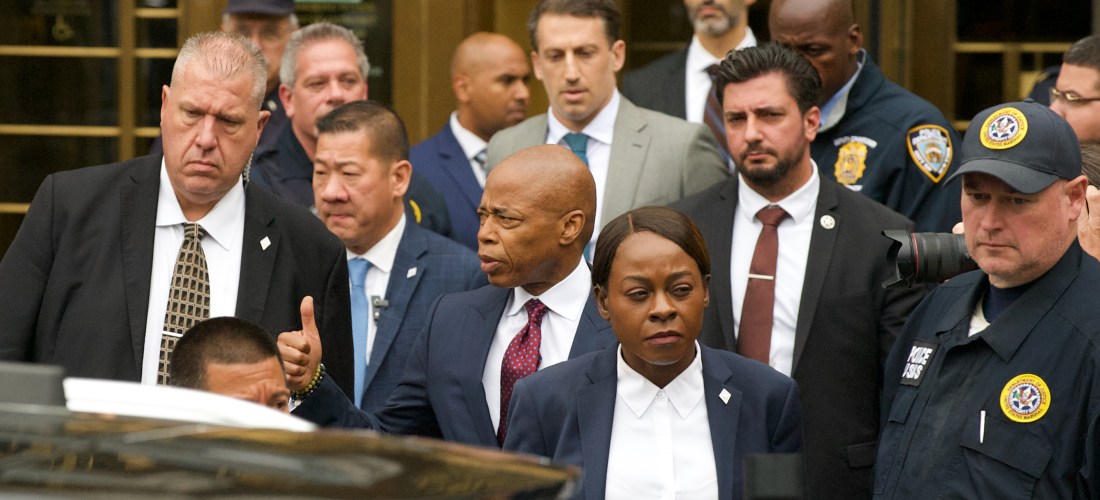
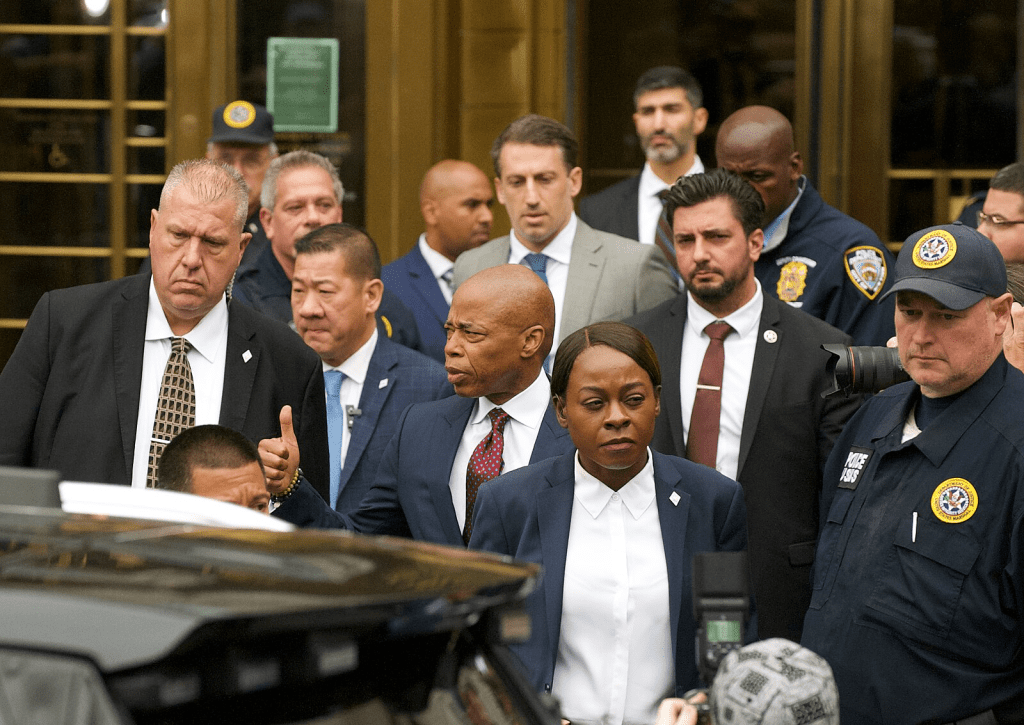
NYC Mayor Eric Adams indicted by Feds in corruption investigation

national politics, Politics

Cole Welsh, Editor

Eric Adams arraignment via WikiCommons

Amid a whirlwind of controversy surrounding City Hall, the mayor of America’s largest city has been indicted by federal prosecutors.

According to the 57-page indictment, New York City Mayor Eric Adams has been charged with a slew of crimes, including bribery, conspiracy and campaign finance violations.

With this historic indictment, Adams becomes the first NYC mayor to be indicted while in office.

US Attorney Damian Williams, who is leading the corruption investigation, alleges that Adams abused his current position, along with his past role as the borough president of Brooklyn, to take bribes and solicit illegal campaign contributions.

In one instance, it is alleged that Adams, in exchange for gifts from Turkish officials, pressured the New York City Fire Department to allow Turkey’s new high-rise consulate building to open, even though the property had yet to pass a required inspection.

Adams is also professed to have accepted donations from straw donors, allowing foreign contributors to illegally funnel their money to his mayoral campaign. In doing so, Adams’ overseas donors circumvented federal laws aimed at preventing foreign influence in elections.

The indictment claims that Adams compounded his gains from the fraudulent contributions by using them to defraud New York City and steal public funds. Through applying for the matching funds program that is intended for donations from NYC residents only, it is believed that Adams’ mayoral campaign illegally received more than $10 million in public funds.

Adams is further alleged to have sought and received other illegal benefits from some of the same co-conspirators who channeled money to his various political campaigns. In particular, one Turkish diplomat purportedly gifted Adams and his associates with free or discounted travel on Turkey’s national airline. In addition, federal prosecutors believe that Adams received, among other things, free hotel rooms, meals and entertainment while in Turkey.

Following the breaking news of the indictment, federal agents executed an early morning raid on Gracie Mansion, the official mayoral residence, that led to the seizure of Adams’ cell phone.

While the indictment may have come as a surprise, the investigation surrounding Adams and his inner circle was no secret.

Two weeks earlier, Adams accepted the resignation of NYPD Commissioner Edward Caban after federal authorities issued a subpoena for his phones.

Caban’s interim replacement, Tom Donlon, had his own residence raided by federal agents after barely a week into the new job.

Tim Pearson, a former NYPD inspector and senior advisor to Adams, also had cell phones seized.

Last year, federal agents raided the home of Adams’ chief fundraiser, Brianna Suggs, seizing several electronic devices, documents and other evidence.

At his arraignment in federal court, Adams pleaded not guilty, vehemently denying any wrongdoing.

However, as Adams faces a sentence of up to 45 years in prison if convicted on all counts, it remains to be seen how these criminal charges will impact next year’s mayoral race, which has already attracted a handful of challengers to Adams’ left and right.

The Vice-Presidential Debate 

national politics, Politics

Jessica Perez-Salinas, Staff Writer 

On Oct. 1, the United States witnessed one of the most astounding achievements in this election. For the first time in this presidential election, two nominees engaged in a civil and mostly calm debate: free from mudslinging and name-calling. Unlike an earlier debate, they did not compare  golf swings. During this debate, the vice-presidential nominees for the Democratic party and the Republican party, JD Vance and Tim Walz, engaged in the first and only vice-presidential debate.  

Hosted by CBS NEWS, the debate lasted around an hour and a half and covered some of the nation’s most pressing issues including healthcare, immigration, the southern border, gun control and more. Viewers were informed of the rules prior to the debate, including the decision not to fact-check candidates’ statements and muting the candidates’ microphones if needed. 

Domestic Policy 

Some of the most pressing issues affecting Americans at home are rising medical costs, gun control and housing. 

On rising healthcare costs and the Affordable Care Act (ACA), Vance was asked about Trump’s plan to replace the ACA and how they would protect people with pre-existing conditions. Vance did not specifically answer what Trump’s new plan would be but stated that Trump helped drive down drug prices during his presidency. He argued that current protections and regulations for people with pre-existing conditions would remain, but the healthcare marketplace would be more accessible. Walz rebutted his argument, stating that Trump had attempted to remove and undermine the ACA during his term and that enrollment in the ACA has increased under the Biden administration. 

On housing, Walz was asked about Harris’ promise to provide up to $25,000 in down payment assistance and build 3 million new homes. Walz argued that the government should provide aid that will help generate wealth through affordable housing and that it would be possible without increasing housing costs. Vance argued that driving down energy prices will help drive down the costs across various sectors including housing costs. He also attributed undocumented immigrants as one of the factors for increasing housing costs. Both nominees vaguely described their proposed tax plans and efforts to help overall increasing economic costs for citizens. The moderators stated that their proposed tax plans could lead to significant blows to the federal budget. 

On gun control, Vance was asked about holding parents responsible for school shootings. Vance stated that most of the gun violence in the United States is committed by illegally purchased firearms, attributing it to Biden and Harris’ open border policy. A report from the Wilson Center found that current trends suggest around 70%-90% of firearms originate in the United States and are moving south. 

On school safety, Vance suggests increasing security in schools and addressing the mental health crisis in the United States. Walz described his experience in meeting the families who have been impacted by school shootings and argued that gun reform is necessary to protect families. During this debate, Vance and Walz engaged in many respectful moments. After Walz brought up his son’s witnessing of a shooting, Vance commented, “I’m sorry about that. Christ have mercy. It is awful.” One of the aspects that has been missing from recent debates is humanization and compassion. Although they fundamentally disagree on various issues, they can acknowledge the impact these issues have on each other. 

Foreign Policy and Climate Change 

On immigration, Vance was asked about Trump’s plan to enact mass deportations and how that would affect undocumented immigrants with children born in the United States. Vance blamed the immigration crisis on Harris’ open border policy, which he claimed has driven the flow of fentanyl in the United States. According to a report by the Cato Institute, 80.2% of fentanyl smuggled into the United States is brought by U.S citizens for U.S citizens, and around 88% of all fentanyl is confiscated at the border. Vance doubled down on Trump’s plan to build the wall and called out the Biden administration’s failure to keep track of migrant children lost at the border. Walz was also asked about the issue of mass deportation but argues that vilifying and dehumanizing immigrants does not solve the issue.  

One of the key moments of this debate was the fact-checking of Vance, which the moderators had established would not happen during this debate. The moderators corrected a false statement in which Vance had reiterated that undocumented migrants in Springfield, Ohio were eating cats and dogs. This statement has been proven false by the Republican governor of Ohio. 

 The moderator stated that “Springfield, Ohio does have a large number of Haitian migrants who have legal status, temporary protected status.” Vance and Walz had their microphones cut off, especially as Vance began to argue with the moderators over immigration policies. 

Walz was asked about his previous statements on being in China on the day of the Tiananmen Square massacre. Walz has stated multiple times that he was there, but multiple reports and media show that he was not in China during that month and did not arrive in Hong Kong until August of that year. CNN posted a clip from a 2019 interview in which he stated this precise claim. After much discussion, Walz agreed that he misspoke. 

Over the past week, the United States was hit by Hurricane Helene which has had a devastating and deadly impact on the areas hit across Florida, Georgia and North Carolina. The severity of hurricanes and other natural disasters will only increase with the continued impact of climate change. Vance was asked about Trump’s plan to reduce climate change to which he argued that the United States has to produce energy at home and invest in domestic industries. Walz suggested mitigation and reducing the impact of climate change. He also called out Trump’s previous claim that “climate change is a hoax”. It is important to note that Vance suggested further investment in natural gas production which has been proven to be a driving factor in climate change. 

The Viewers 
CBS and Politico conducted polls after the debate to determine the winner. Both suggest a tie between both nominees, with CBS News only finding a 1% difference between Vance and Walz, with Vance leading. Among independent voters, Politico found that 58% of those polled favored Walz in the debate versus the 42% that favored Vance. The CBS news poll did find that most people did have a more favorable opinion of Vance after the debate. However, presidential debates and even more so, vice presidential debates have little influence on voter outcomes. Viewers tended to agree with their political alignment with most Democrats siding with Walz and most Republicans siding with Vance. Most viewers found the debate positive and agreed that it focused more on policy rather than personal attacks. Overall, the debate proved to be an important example of how people can engage in civil debates.

Teamsters union declines to make presidential endorsement, bucking Democratic streak

Politics

Cole Welsh, Editor

Last week, one of America’s largest labor unions announced that they would decline to endorse a candidate for president for the first time in nearly three decades.

The International Brotherhood of Teamsters, which represents workers such as truck drivers and freight workers, made the decision after meeting with both major candidates.

“Neither major candidate was able to make serious commitments to our union to ensure the interests of working people are always put before Big Business,” according to a statement released by Teamsters President Sean O’Brien.

The union, which stands at approximately 1.3 million members, solicited input from its membership through straw polling before deciding not to make an endorsement.

According to the union’s leadership, an electronic poll found that almost 60% of rank-and-file members preferred Donald Trump, while 34% supported Kamala Harris. Similarly, a phone poll indicated similar preferences, with 58% supporting Trump and 31% endorsing Harris.

For decades, the Teamsters, like many labor unions, have endorsed Democratic presidential candidates. The union backed Hillary Clinton in 2016 and Joe Biden in 2020. It also supported Barack Obama in both 2008 and 2012.

However, O’Brien has worked to make inroads with the GOP in recent years, speaking at the Republican National Convention in July. The union’s PAC made its first contribution to the Republican National Committee this election cycle since 2006, donating $45,000 before Trump spoke at a Teamsters roundtable.

Their decision not to make an endorsement, along with the released survey results, has created some worry among Democrats that their party is losing its appeal among the working class and union voters.

Since Trump’s victory in 2016, this key constituency has slowly shifted towards the Republican Party, which many attribute to Trump’s support for enacting tariffs on foreign goods and protecting domestic energy production. As seen with Ronald Reagan’s victory in the 1980 presidential election, the GOP’s positions on social issues have also attracted union voters, particularly men.

While many labor unions, such as the United Auto Workers and AFL-CIO, are still throwing their support behind Harris, the Teamsters are not alone in their refusal to back Harris.

The Fraternal Order of Police, which is the nation’s oldest and largest police labor union, recently announced their endorsement of Trump, citing his stances on public safety and border security.

The International Association of Fire Fighters, which endorsed Biden in 2020, has yet to back a presidential candidate in this election.

As working class and union voters are a large voting bloc in the American electorate, particularly in the swing states of the Rust Belt, it remains to be seen how this non-endorsement will impact the general election.

While Trump and other Republicans have certainly improved their standing among union voters, one can only speculate as to which candidate will win over the working class in this election, which is likely to be decided by only a small number of votes.

United Nations General Assembly adopts global AI regulation

Politics

Jessica Perez-Salinas, Writer

How do we manage the expansion and rapid development of artificial intelligence? At what point will our realities become synchronized with artificial intelligence? Nations across the globe are learning about and trying to address these issues everyday. There is no doubt that AI will change our world in unimaginable ways. 

Artificial Intelligence  (AI) is the development of technology that “simulates human learning, comprehension, problem solving, decision making, creativity and autonomy,” according to IBM. We see this in various forms, such as self-driving vehicles or language learning models. It has the potential to transform industries and create a new reality. AI is rapidly transforming our society, becoming a beacon for progress and chaos. It can further developments in the arts, sciences, and civil society with speed and efficiency. However, it can also be a source of destruction as it distorts and manipulates our reality. 

On Sep. 19, the United Nations AI Advisory Board released a report on the need for global governance over AI. The report titled “Governing AI for Humanity” calls for international AI regulation and examines the potential risks and benefits. The report was composed by 39 experts on AI from across the globe, including the UN’s Secretary General’s chief envoy on technology, Amandeep Singh Gill. The report emphasizes the need for intergovernmental cooperation to regulate AI advancements, arguing that “the very nature of the technology itself – transboundary in structure and application – necessitates a global approach.” Most striking is the Board’s suggestion to base the model of AI regulation on international human rights law.

Some of the risks posed by AI include the invasion of privacy and security, environmental damage through carbon emissions, and enabling distrust in democratic institutions through the spread of misinformation. 

Furthermore, the report acknowledges the AI divide, which is the uneven distribution of technology and AI resources, especially in the Global South. The report shows that only seven UN member states form part of non-UN AI initiatives. These seven states also belong to the G7, an intergovernmental organization composed of some of the most advanced democracies and economies. AI can lead to rapid scientific developments, aid economic recovery, and assist in reaching the UN’s Sustainable Development Goals. However, AI achievements are dependent upon a country’s political and economic capabilities. Poor infrastructure, technology and policy can undermine the capabilities of AI, but the possibilities for progress are there. Global governance on AI can help lessen these burdens through the exchange of knowledge and resources. The report also highlights the need for equity and voice in discussions over AI.

AI affects everyone and it is integral that all countries have a voice in how to regulate it. AI advancements are rapidly outpacing the abilities of the UN, even more so than countries in the Global South. The report suggests the formation of an AI Fund accessible to UN member countries, which could also aid in the UN’s other developmental goals. Currently, the UN’s emergency fund and the World Bank’s Digital Development Partnership are possible multilateral options that countries can use to lessen the AI divide. AI can be beneficial for every nation, which is a key goal highlighted in the report. The future of AI depends on the collective interest of all nations to regulate technology greater than a few people can manage. 

Other global initiatives are in the works to combat the need for AI regulation including a bilateral agreement between the U.S and E.U plan to test AI security. 

Other key points in the report include the need for an AI office in the UN Secretariat and bi-annual discussion among all member states to have common ground for AI discussion. The future of AI is still in our hands. Time is of the essence, and we cannot let AI overcome us.

Can we trust political information on TikTok?

Politics

Maya Martin, Editor

The ease and accessibility of social media allow users to obtain news and political information at much faster rates than ever before. Therefore, a common trend, especially for college-aged students, is obtaining political information and news through TikTok.

According to sophomore Patrick Malloy, “I get the majority of my news from TikTok and the news stations on there rather than watching the actual news.”

In a time where young voter turnout is on the rise, TikTok can be a particularly useful tool for political parties and figures to spread their views and persuade social media users.

“Part of this surge in young voter turnout is due to robust voter engagement…TikTok, where over 60 percent of users are Gen Z, was crucial to these efforts. October polling from the Pew Research Center showed that people under 30 are the most likely group to get their news from the app,” stated The Nation.

TikTok offers many benefits to sharing news such as speed, ease and the ability to interact via likes and comments. While any user can post political content on the app, trustworthy news sources and political figures are also present on the app.

“A quick scroll through a user’s algorithmically determined ‘For You’ page could feature videos from the White House, a local Sunrise Movement chapter, and March For Our Lives, mixed in with the latest dance craze or fashion trend,” stated The Nation.

Although it has many benefits, TikTok is commonly looked down upon as a platform in which mis and disinformation can be spread very easily. It is important that TikTok users be aware of potential false information that can be spread and how to combat it.

According to TikTok itself, “Our Community Guidelines prohibit inaccurate, misleading, or false content that may cause significant harm to individuals or society—regardless of the poster’s intent. This includes not only physical harm, but also societal harm, like the undermining of trust in elections or public health initiatives.”

Many voting-aged students are aware of potentially inaccurate information and make sure to keep this in mind while viewing news online.

“As a freshman Poli-Sci major, I realized that I have to choose my news information wisely,” said La Salle student LillyGeneva Billarrial. “Since high school, I have been getting my political information from BBC or NowThis News… I get NowThis from the multiple platforms they are on such as Instagram, TikTok, Facebook and Twitter.”

So, what many young voters and students are asking themselves is can we trust political information on TikTok? The app uses a variety of resources to help deter false information, including using authenticity moderators and teams.

The authenticity moderators “consult a global database of previously fact-checked claims and then route any new, evolving, or borderline claims to our Global Fact-Checking Program for independent evaluation,” according to TikTok’s website.

Although TikTok uses these programs to prevent and remove false information, the process is not completely reliable. There will always be the ability to post and view false information. Even if false content is removed, it can take days to weeks for the content to be caught by the authenticity moderators and deleted from the app.

“Researchers at NewsGuard—a group that tracks online falsehoods—searched TikTok for content about major news topics. They discovered misinformation in nearly 1 in 5 of the videos that the app suggested,” according to Junior Scholastic. “That is why, experts say, you shouldn’t believe everything you see on TikTok.”

2024 Philadelphia Primary Election results

local politics, Politics

Cole Welsh, Staff Writer

Last Tuesday, Democrats and Republicans went to the polls and cast their ballots in Pennsylvania’s primary election.

In addition to those for the highly anticipated presidential election, primary contests were also held for a variety of federal and state races.

For the Democrats, Joe Biden, the incumbent, easily won Pennsylvania with approximately 88% of the vote. US Congressman Dean Phillips, who dropped out of the race in March, earned roughly 6.5% of the vote. Additionally, approximately 60,000 Democrats, which translates to roughly 5.3% of the total vote, chose to cast a write-in vote instead. In the weeks leading up to the election, Uncommitted PA, a coalition of individuals and groups opposed to Biden’s perceived support for Israel in its war against Hamas, urged Democrats to write “uncommitted” as a protest vote.

For the Republicans, Donald Trump, who is hoping to return to the White House, earned approximately 83% of the vote in his primary contest. Former United Nations Ambassador Nikki Haley, who dropped out of the race in March, received approximately 16% of the vote.

In what many see as a battleground race to determine which party controls the US Senate, Democrat Bob Casey, the incumbent, and Republican Dave McCormick each won the nominations for their respective parties and will face each other in November.

At the state level, former PA Auditor General Eugene DePasquale won the Democratic contest to be his party’s nominee for attorney general. DePasquale earned approximately 35% of the vote, with much of his support coming from Central and Western Pennsylvania. Delaware County District Attorney Jack Stollsteimer (who performed well in the suburbs of Philadelphia), received about 20% of the vote. Joe Khan, Keir Bradford-Grey and Jared Solomon each earned less than 17% of the vote statewide but individually did well in Philadelphia.

In the Republican contest for attorney general, York County District Attorney Dave Sunday decisively defeated State Representative Craig Williams by winning every county but one. Sunday earned approximately 70% of the vote and is set to face Democrat DePasquale in the general election.

In another statewide race, Auditor General Tim DeFoor, who is seeking a second term, won the Republican primary election without any opposition. State Representative Malcolm Kenyatta of Philadelphia, who ran with the endorsement of the PA Democratic Party, bested Lehigh County Controller Mark Pinsley with about 64.5% of the vote. DeFoor and Kenyatta will both appear on November’s ballot.

In yet another statewide race, State Treasurer Stacy Garrity, who is seeking a second term, won the Republican primary contest without any opposition. In what many consider to be an upset victory, Erin McClelland, a former small business owner from Allegheny County, defeated State Representative Ryan Bizzarro by a margin of about 8%, despite Bizzarro receiving the PA Democratic Party’s endorsement in the race. Garrity and McClelland will face off on the November ballot.

There were also primary elections on the ballot for Philadelphia’s US House of Representatives seats. In the race to represent Pennsylvania’s 2nd Congressional District, which covers all of Northeast Philadelphia and the River Wards, Democratic incumbent Brendan Boyle and Republican challenger Aaron Bashir were both unopposed in their respective primaries and will face each other in the general election. For the 3rd Congressional District, which covers much of Northwest and West Philadelphia, incumbent Dwight Evans handedly won the Democratic nomination over former Philadelphia Register of Wills Tracey Gordon with about 87% of the vote. With no Republican filing to run in this race, Evans is virtually guaranteed to win another term. For the 5th Congressional District, which contains a sliver of South and Southwest Philadelphia, Democratic incumbent Mary Gay Scanlon and Republican challenger Alfeia Goodwin were both unopposed in their respective primaries and will face each other in November.

In regard to Philadelphia’s representation in the PA Senate, incumbent Democrats Nikil Saval (1st District), Sharif Street (3rd District), and Vincent Hughes (7th District) were all unopposed in their primary contests and will not face Republican challengers in November. However, in the 5th District, which contains much of Northeast Philadelphia, Democratic incumbent Jimmy Dillon and Republican challenger Joe Picozzi were both unopposed in their respective primaries and will face off in the general election.

For the PA House, incumbent Democrats Pat Gallagher, Ed Neilson, Mary Louise Isaacson, Joe Hohenstein, Jason Dawkins, Jose Giral, Ben Waxman, Elizabeth Fiedler, Regina Young, Jordan Harris, Joanna McClinton, Morgan Cephas, Tarik Khan, Donna Bullock, Danilo Burgos, Darisha Parker, Chris Rabb, Jared Solomon and Anthony Bellmon were all unopposed in their primary contests and will not face Republican challengers in November. Similarly, Republican State Representative Martina White of Northeast Philadelphia, who was unopposed in her primary contest, will not have a Democratic challenger in November and is slated to win re-election.

In the 10th Legislative District, which is based in West Philadelphia, Amen Brown, a relatively moderate Democrat who has championed tough-on-crime policies and supported charter schools, narrowly defeated fellow Democrat Cass Green by a margin of about 50 votes. Sajda Blackwell received roughly 20% of the vote. As no Republican is running for the seat, Brown is expected to win the general election in November.

In the 172nd Legislative District, which contains parts of Northeast Philadelphia, Sean Dougherty, a former assistant public defender, defeated incumbent Kevin Boyle to clinch the Democratic nomination for the seat. In the week prior to the election, a warrant was issued for Boyle’s arrest after he allegedly violated a protection from abuse order after contacting his ex-wife. However, on the day before the primary election, Philadelphia District Attorney Larry Krasner said his office withdrew the warrant after law enforcement learned that the protection from abuse order had expired. Earlier this year, Boyle also made headlines after going on a drunken tirade and threatening employees at a local bar. For the Republicans, Aizaz Gill, who recently managed the successful re-election campaign of Republican Philadelphia City Councilman Brian O’Neill, defeated Patrick Gushue with roughly 65% of the vote. In a race that many consider could determine which party controls the chamber, Dougherty and Gill will face each other in what is set to be a competitive general election.

In North Philadelphia’s 181st Legislative District, incumbent Malcolm Kenyatta defeated challengers Lewis Nash and Naderah Griffin in the Democratic contest. In West Philadelphia’s 188th Legislative District, incumbent Rick Krajewski handedly defeated fellow Democrat Tony King. In West Philadelphia’s 190th Legislative District, incumbent Roni Green easily beat James Love Jackson in the Democratic primary for the seat. In the 201st Legislative District, which is based in Northwest Philadelphia, Andre Carroll won the Democratic contest without any opposition to succeed retiring incumbent Stephen Kinsey.

Voters also selected delegates to attend their respective parties’ national convention this summer.

Additionally, the sole question on the ballot passed with almost 67% of the vote. As a result, the Philadelphia Home Rule Charter will be amended to require the municipal government to help registered communization organizations pay the costs of lawsuits.

2024 Philadelphia Primary Election voter guide

Politics, state politics

Cole Welsh, Staff Writer

For all voters who are registered as either Democrats or Republicans, Pennsylvania’s next primary election will be held on April 23, 2024. Polls will be open from 7 a.m. to 8 p.m..

In addition to those for the highly anticipated presidential election, primary contests will also be held for a variety of federal and state races.

For the Democrats, President Joe Biden, the incumbent, has already clinched the 2024 Democratic nomination and became his party’s presumptive nominee for president when he won enough delegates in Georgia. However, US Congressman Dean Phillips, who dropped out of the race in March, will remain on the Democratic ballot.

In a similar fashion, Donald Trump, who previously occupied the White House, has already clinched the 2024 Republican nomination and is his party’s presumptive nominee for president. However, former United Nations Ambassador Nikki Haley, who dropped out of the race in March, will remain on the Republican ballot.

In what many see as a battleground race to determine which party controls the US Senate, Democrat Bob Casey, the incumbent, seeks a fourth term to represent Pennsylvania and is unopposed in his party’s primary election. For the Republicans, Dave McCormick, a businessman and combat veteran, is unopposed in the GOP contest for the seat.

At the state level, there are a plethora of Democrats competing in their party’s primary for attorney general. Specifically, Delaware County District Attorney Jack Stollsteimer, former Pennsylvania Auditor General Eugene DePasquale, former Bucks County Solicitor Joe Khan, former Philadelphia Chief Public Defender Keir Bradford-Grey and State Representative Jared Solomon of Northeast Philadelphia are all running. Due to the competitive and large field of candidates, the Pennsylvania Democratic Party chose not to make an endorsement in this race.

In the Republican contest for attorney general, York County District Attorney Dave Sunday and State Representative Craig Williams of Delaware County will both be on the ballot. While Sunday has been endorsed by the Pennsylvania Republican Party, Williams, who led the impeachment of Philadelphia District Attorney Larry Krasner, has been endorsed by the Pennsylvania House Southwest Caucus.

In another statewide race, Auditor General Tim DeFoor is seeking a second term and is running unopposed in the Republican primary. State Representative Maolcom Kenyatta of Philadelphia, who has secured the endorsement of the Pennsylvania Democratic Party, and Lehigh County Controller Mark Pinsley, will appear on the Democratic primary ballot.

In yet another statewide race, State Treasurer Stacy Garrity, who is seeking a second term, will be the sole Republican candidate on the primary ballot. Ryan Bizzarro, a state representative from Erie County, and Erin McClelland, a former small business owner from Allegheny County, will both appear on the Democratic ballot. In addition to significant support from other elected officials, Bizzarro has secured the endorsement of the Pennsylvania Democratic Party.

There will also be primary elections on the ballot for Philadelphia’s US House of Representatives seats. In the race to represent Pennsylvania’s 2nd Congressional District, which covers all of Northeast Philadelphia and the River Wards, incumbent Brendan Boyle will be unchallenged on the Democratic ballot. Aaron Bashir, an accountant, will be unopposed on the Republican ballot. For the 3rd Congressional District, which covers much of Northwest and West Philadelphia, no Republican has filed to run. However, incumbent Dwight Evans is facing a challenge from former Philadelphia Register of Wills Tracey Gordon for the Democratic nomination. For the 5th Congressional District, which contains a sliver of South and Southwest Philadelphia, incumbent Mary Gay Scanlon is running unopposed on the Democratic ballot. Alfeia Goodwin, a retired Philadelphia police officer, is running unopposed on the Republican side.

In regard to Philadelphia’s representation in the Pennsylvania Senate, incumbent Democrats Nikil Saval (1st District), Sharif Street (3rd District) and Vincent Hughes (7th District) are running unopposed in both the primary and general elections. However, in the 5th District, which contains much of Northeast Philadelphia, candidates from both parties have filed to run. State Senator Jimmy Dillon, the incumbent, will be the sole Democrat on the ballot. Joe Picozzi, who previously worked at the Manhattan Institute, will be on the Republican ballot.

For the Pennsylvania House, incumbent Democrats Pat Gallagher, Ed Neilson, MaryLouise Isaacson, Joe Hohenstein, Jason Dawkins, Jose Giral, Ben Waxman, Elizabeth Fiedler, Regina Young, Jordan Harris, Joanna McClinton, Morgan Cephas, Tarik Khan, Donna Bullock, Danilo Burgos, Darisha Parker, Chris Rabb, Jared Solomon and Anthony Bellmon are all running unopposed in both the primary and general elections. Republican State Representative Martina White of Northeast Philadelphia will also be unopposed in both the primary and general elections for her district.

In the 10th Legislative District, which is based in West Philadelphia, Democrats Sajda Blackwell and Cass Green are challenging incumbent Amen Brown, a political moderate who is supported by the Philadelphia Democratic Party. In the 172nd Legislative District, which contains parts of Northeast Philadelphia, Sean Dougherty, a former assistant public defender, is challenging incumbent Kevin Boyle for the Democratic nomination. Aizaz Gill, who recently managed the successful re-election campaign of Republican Philadelphia City Councilman Brian O’Neill, and Patrick Gushue, a combat veteran, are running on the Republican side. In North Philadelphia’s 181st Legislative District, incumbent Malcolm Kenyatta is being challenged by Lewis Nash and Naderah Griffin in the Democratic contest. In West Philadelphia’s 188th Legislative District, incumbent Rick Krajewski will be joined by fellow Democrat Tony King on the primary ballot. In West Philadelphia’s 190th Legislative District, incumbent Roni Green is being challenged by James Love Jackson in the Democratic primary for the seat. In the 201st Legislative District, which is based in Northwest Philadelphia, only Andre Carroll, who has worked on several political campaigns, will appear on the Democratic primary ballot after incumbent Stephen Kinsey announced his retirement. No Republican has filed to run in this race.

For both the Democratic and Republican primary ballots, voters will also be able to vote for delegates to each party’s national convention this summer.

Additionally, a local ballot question pertaining to Philadelphia’s registered community organizations will be on the ballot. Independent voters, along with those that belong to a minor political party, will be able to vote on this ballot measure as well.