

Sam Klein, Editor
The term “burnout” was first coined in 1974 by clinical psychologist Herbert Freudenberger who borrowed “drug-addict slang” to describe the emotional exhaustion he observed in the East Village of NYC among drug clinic volunteers. Since Freudenberger’s research, the concept of burnout has evolved beyond healthcare and into the everyday lives of people–professionals and students alike, who suffer chronic and severe stress. A “burnout epidemic” is sweeping the nation now more than ever as society encourages a fast-paced, “hustle” culture, prioritizing long hours to achieve success while disregarding intentional self-improvement.
What is Burnout?
Erica Rogers PhD, Assistant Director of the Student Counseling Center at La Salle, defines burnout as chronic and prolonged stress, dividing burnout into three categories: emotional exhaustion, depersonalization and hopelessness.
As a Brown University and City University of New York graduate, Rogers has been working with students for over a decade, as well as providing students at La Salle with necessary burnout-prevention training since 2019. As part of this training, Rogers emphasizes burnout is more than just stress, although the physical symptoms mimic that of anxiety, and instead extends into fatigue and apathy.
Emotional exhaustion, as outlined by Rogers, is the fatigue that comes with chronic stress when an individual is unable to take a break or have a healthy release. This exhaustion then directly leads to depersonalization, the feeling of disconnection from yourself and the things you care strongly about.
“Let’s say you are… [a] therapist. Let’s say you don’t care as much about what people are telling you, you’re not feeling that same kind of compassion,” Rogers says, demonstrating a lack of empathy towards patients in a client-focused, humanity-driven field is an example of what burnout can look like professionally.
After an individual starts to experience apathy, hopelessness begins to kick in; therefore, people might feel a decreased sense of accomplishment, or as Rogers explains “the feeling that nothing that you do makes any difference, [so] why do it anyway?”
What Does Burnout Look Like?
For students, burnout can look like not going to class, failing to do homework or study for exams or generally isolating yourself from interests–whether clubs, organizations or social hangouts.
While large amounts of stress are normal around midterms and finals, it is important to recognize the difference between healthy amounts of stress and burnout, which can be distinguished by an individual’s period of recovery.
“Are you feeling relief from having a break from things going back to normal, or is it… really difficult for you?” La Salle Wellness Initiative Coordinator Allison Walter said, explaining that a few days to catch up on rest and indulging in personal interests post-midterm/finals would be enough for healthy stress levels, however not burnout.
Physical symptoms of burnout can include spiked cortisol, muscle tension, back pain, headaches/migraines and sleeplessness/insomnia. However, many symptoms aren’t as obvious- like increased hopelessness and an inability to “bounce back” after periods of recuperation, which is why it is important to be proactive about burnout and minimize its effects early.
Proactively Combatting Burnout
There are a variety of factors that contribute to burnout such as dysfunctional relationships, overwhelming demand (generally through a large volume of work), lack of control and an overarching feeling of unbearable stress. However, as Walter states, “We are more disconnected than ever.”
“Struggling together can make it [burnout] so much more manageable,” Walter continues, explaining that by connecting with other students, especially those experiencing the same academic and social pressures, the overall impact of burnout is minimized.
Rogers expands upon this idea, as she explains there are various physical, emotional/mental and spiritual connectors that can also help individuals who are struggling with burnout.
Emotionally, Rogers recommends allowing negative thoughts to take up space in your mind instead of exerting excess energy to push them away, visualizing and focusing on self-compassion.
“Imagining that your stressful thoughts are leaves moving down a stream and floating away,” is an example Rogers provided of effective visualization, furthering her idea of self-compassion by encouraging people experiencing burnout to speak to themselves the way they would a loved one.
Physically, Rogers claims it is essential to ask ourselves these questions: How do you treat your body when it’s under stress? Where do you hold the stress? And what are you going to do to release that tension? For some people, getting physical activity through going to the gym or for a walk is helpful, however a mere body scan, box breathing or holding a warm drink can be equally as effective. Not every solution is “one size fits all;” therefore, it’s important to recognize individual techniques that are successful.
Spiritually, one should take time to do things that connect with their personal values to gain a greater perspective and bridge their experience with the intangible. Rogers takes this one step further to encompass random acts of kindness where we ask ourselves relationally, how am I connecting with others?
Walter acknowledges burnout is perceived as “part of the college experience, but it doesn’t have to be.” She elaborates that there are numerous ways to proactively combat burnout including through clear school/social boundaries, saying “no” when necessary, viewing extra-curriculars as quality over quantity and recognizing the vast free resources available to students on La Salle’s campus.
Resources to Combat Burnout
On-campus:
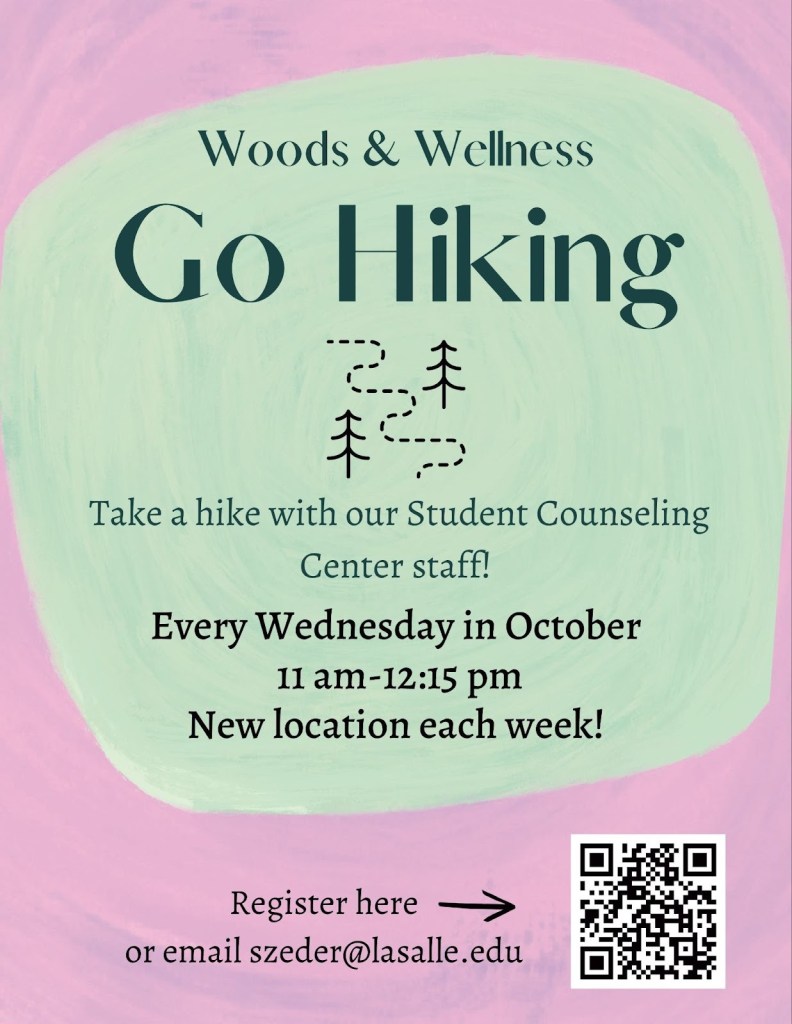
- Student counseling is free to La Salle students, along with wellness coaching through the Student Health Center. The Student Counseling Center recently adopted a new program titled “Community Connections,” as well as a “Wood and Wellness” group that meets every Wednesday at 11 a.m. outside the Student Counseling Center to go on nature walks/hikes. See the fliers below for more information:

- The Center of Academic Achievement can assist students with a variety of academic needs from coaching to tutoring, which can make the academic effects of burnout that much more bearable.
Additional Resources, as recommended by Dr. Rogers:
- Apps: Insight Timer, Calm and Headspace
- Podcasts: 10% Happier, Tara Brach and Mindfulness Mode
“If you’re experiencing this, you’re not alone,” Rogers said, claiming that your mental health is just as important as any other lifelong goal, debunking the “hustle culture” myth one support system at a time.
To contact Dr. Rogers directly for more information on burnout, you can email her at rogerse@lasalle.edu, along with Allison Walter at waltera@lasalle.edu.
 The La Salle Collegian