

Cole Welsh, Editor
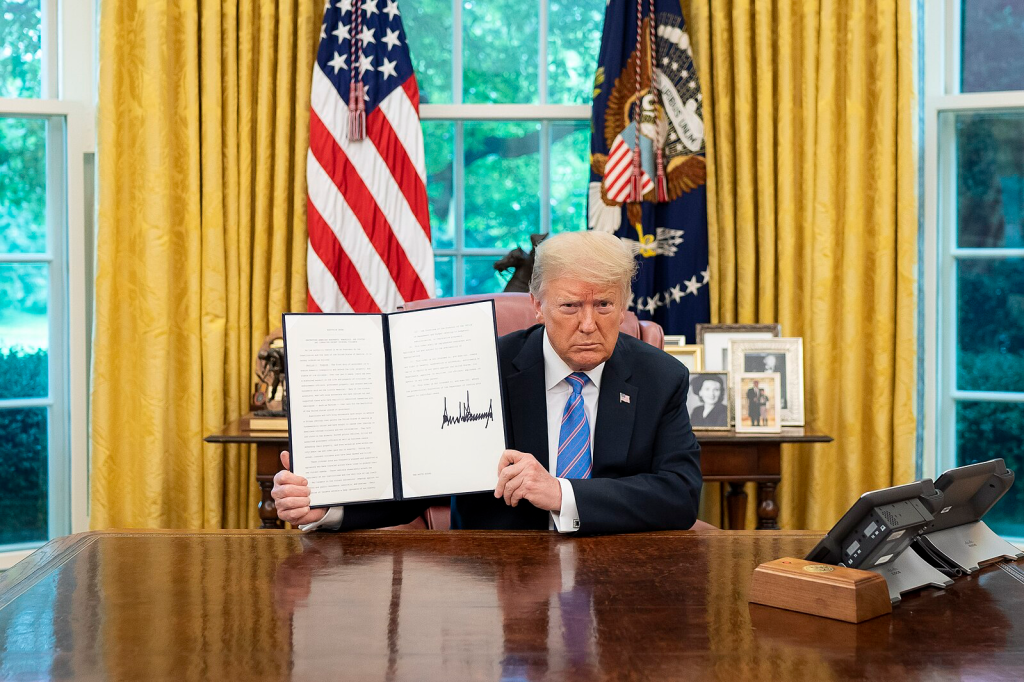
Fulfilling a key campaign promise, President Trump formally designated eight Latin American crime organizations as “foreign terrorist organizations.”
The move, carrying out an executive order signed by Trump on his first day in office, labels Tren de Aragua in Venezuela and La Mara Salvatrucha (MS-13) in El Salvador, among others, as terrorist groups.
Such a designation requires showing that an organization is foreign, engages in terrorist activity and threatens American national security.
The “foreign terrorist organization” label for drug cartels is certainly unconventional, as the designation has traditionally been reserved for groups that use violence for political gains, including the Islamic State and Hezbollah.
While American authorities have previously labeled organizations such as the Taliban and al-Qaeda as “narco-terrorists,” the difference is that these were existing terrorist organizations that used drug profits to fund their activities.
Latin American cartels, which primarily traffic drugs for monetary purposes, have not historically received this designation.
However, the Trump administration, which has taken a hardline approach to the drug epidemic, argues that the international connections and operations of the cartels warrant the designation.
They cite the involvement of these cartels in the illicit drug trade, human trafficking and violent campaigns to extend their territory.
For Trump, these cartels are a top concern, flooding the United States with deadly drugs, violent criminals and vicious gangs.
While Republicans and law enforcement have generally embraced the order, others have criticized the move as potentially harmful to diplomatic and trade relations. In particular, cartels play a key role in the Mexican economy, dealing in not only drug trafficking but also the multibillion-dollar avocado industry.
Regardless, this designation should come as no surprise. Running on a law and order message, Trump has made securing the U.S.- Mexico border one of his chief priorities, vowing to carry out mass deportations and sending active duty troops to the border.
With this label, the cartels have gained new adversaries.
In the past, federal law enforcement, mainly the FBI and the DEA, largely investigated these cartels as part of the War on Drugs. Following Trump’s executive order, these agencies will continue their operations with additional support.
Along with other intelligence agencies, the CIA can now play a role, gathering information in ways law enforcement cannot without fear of prosecution or having to justify their actions in court.
Similarly, the military could also be utilized to neutralize the heavily armed and violent cartels outside of the United States. This could take the form of drone strikes or even the deployment of special operators, although concerns regarding Mexico’s sovereignty might deter such action.
For law enforcement, this order will impact almost every aspect of counter-narcotics policing. From local officers on patrol to state and federal agencies, law enforcement now has additional integrated resources at their fingertips.
With increased cooperation between police, intelligence agencies and the military now a possibility, the War on Drugs has entered what many consider a new stage.
Although exact details still need to be provided by federal officials, this designation potentially transforms America’s rules of engagement with organized drug trafficking, elevating it from a crime to a national security threat.
 The La Salle Collegian