
Peyton Harris, Editor
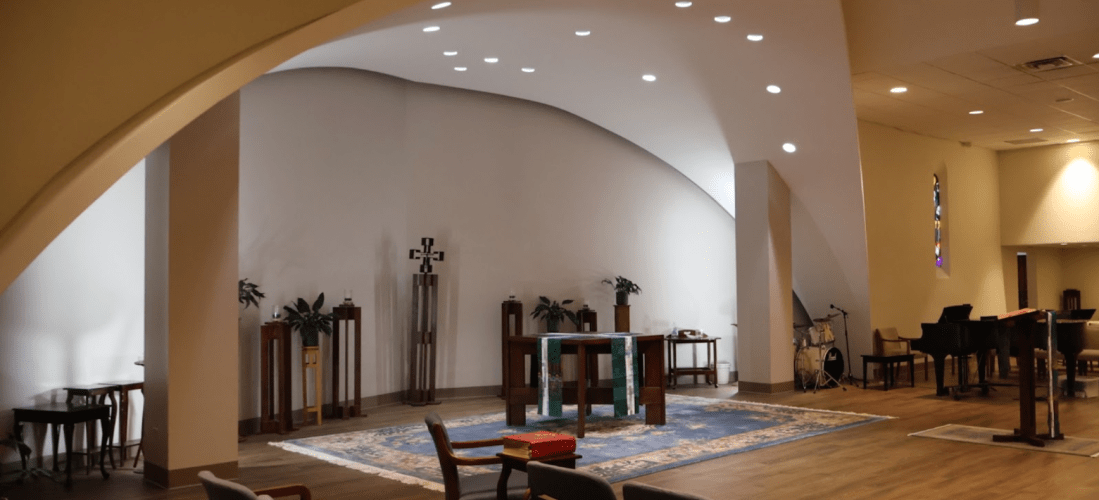
PHILADELPHIA – Situated within the basement of College Hall lies De La Salle Chapel, La Salle University’s home for practicing religion as intended by its Catholic founders. While College Hall was the first building completed on the “new” campus in 1929, the Chapel itself did not come to fruition until 1965. Although the space has been present on campus now for nearly 60 years in its current form, members of the university community see where some changes might be beneficial to sustaining the Chapel for years to come.
One group on campus that utilizes College Hall and the Chapel is the La Salle Christian Fellowship, a group of 30-plus students who meet weekly. The group’s mission is to foster group discussion on faith and Christianity, offering Bible study as well as outreach programs within the local community. Led by La Salle students Abby Griswold and Haylie Doan, the program has seen a boost in membership.
“We are an ecumenical group, meaning we are made up of all different Christian faith traditions,” said Griswold. “The Chapel is a wonderful and welcoming place for all people, whether religious or not.”
Griswold feels that events in the Chapel would benefit from more advertisement and support from the university. “We have plenty of activities that take place in the Chapel, from daily and Sunday Mass, to Adoration, Evensong reflections, [and] Christian Fellowship meetings! If the school could find a way to reach more students with these events, I think people would love to join us more.”
Each week, the Fellowship sets a lesson plan for its Wednesday meetings. While the lessons vary, there is an overall theme of reaching young people, pushing them to discover their faith internally and live as servants of that faith. Recent lessons have been titled, “Discussing our Call to Servanthood,” “What Does it Mean to Live a Balanced Life,” and “Praise. Repentance. Ask. Yield.,” with more planned for the spring semester.
While the Chapel plays host to many gatherings on campus, this is not without complications. Its home, College Hall, is nearing a century on campus. While some changes have been made in other parts of the building, this means that it is not fully compliant with the Americans with Disabilities Act of 1990. This Act of Congress put in place that accommodations should be made for those who are disabled, handicapped or otherwise physically impaired. As the Chapel is in the basement of College Hall – which is only accessible via staircases, there is growing concern from university administration.
“We are inaccessible to anyone that has mobility issues, and that is a frustration of mine,” said Alisa Macksey, La Salle’s Vice President of Mission, Diversity and Inclusion. She discussed conversations with Facilities and other university officials for ways to rectify this issue, but as of now, no solution has been decided. “We’re looking for ways, none of them are things… that’s gonna solve it. All kind of band aids that will make it better.”
Macksey feels that a larger shift within religion and spirituality itself may come into play in years to come. “A lot of people, not just young people, have been turned off to formalized religion because of what I like to call ‘the human flaws of organized religion,’” she said, describing her views on how humans are intrinsically flawed, and may use religion as a medium to convey personal views.
“I think there is a sense of ‘I don’t want to be a part of something like that’, but then I also feel like I’m seeing from students a desire of something like spirituality, of what else is there,” Macksey said. “I’m always trying to think of how we can address that in this space. How can we help foster someone’s spiritual life versus their formalized religion?”
It is important to understand as well that although De La Salle Chapel was built for the purpose of Catholic worship and services, that is no longer its sole purpose. “If someone says, ‘I want to really understand my Jewish faith more or my Muslim faith,’ I want to be able to offer that, but also offer a broad spirituality, so that if people aren’t ready for a formalized religion, we can offer both.”
For Macksey, her goal with the Chapel is to meet students where they are in their theistic journey. “I want to help students to foster some sort of faith [or] spiritual journey, so that they have something else to turn to when things are challenging, when things are hard to explain in some way, at whatever pace they want to go.”
“In my experience, the environment in [the Chapel] is always one that is very inviting. There is always someone there who is willing to have a friendly conversation, help you out with questions, or even just give you space if you need it,” said Doan. “De La Salle Chapel acts as a place to cultivate new relationships and foster a sense of community.”
De La Salle Chapel, though not present in its current form at that time, also possesses historical significance. It was in the then-College Hall Auditorium on February 11, 1958, that Senator John Fitzgerald Kennedy of Massachusetts received an honorary degree from La Salle College, as it was then known. Kennedy, who went on to be the first Catholic elected President of the United States in 1960, delivered remarks at the occasion expressing his personal gratitude.
“A degree from La Salle College means to me something more than a scrap of paper, another in a long collection of degrees customarily heaped upon public figures,” Kennedy said. “The Christian Brothers who today staff this… and other schools throughout the world are indeed the spiritual songs of [St. John Baptist de] La Salle.”
Today, the Christian Brothers are still present on campus, primarily residing in Anselm Hall adjacent to the Chapel. “We’re fortunate here that we have so many Brothers. At my last institution, we only had seven, and here we have 19,” said Macksey. While the Brothers have historically been the primary instructors across the university, faculty today come from across all faiths and backgrounds, with only two of the Brothers actively teaching courses.
“How can we get students to meet them and just hear about their lives, as they’re interested in young people and they like to mentor and teach in a non-classroom setting. How can we facilitate that connection,” said Macksey.
Opportunities for connections in the Chapel that take place weekly are the Mass services, which are offered Monday through Thursday each week at 1pm, as well as Sunday Mass at 5pm. Other special services in observance of Catholic holidays, as well as after certain university-sanctioned events, are also offered. Christian Fellowship also meets each Wednesday at 7pm during the semester.
As De La Salle Chapel enters its sixtieth year, the university has not outlined any special events as of yet to highlight the occasion. University officials look forward to welcoming students, faculty, and the community alike to join in the space for years to come.
Featured images of the De La Salle Chapel via Peyton Harris:


 The La Salle Collegian