

Sean Bradley, Staff
The American robin is a songbird familiar to many and has long been considered a sign of spring. However, contrary to popular belief, most robins in Philadelphia are found here year-round. In this Nature at La Salle article, we’ll learn about a songbird that would be a better harbinger of spring, which is Sayornis phoebe, or more commonly known as the Eastern Phoebe.
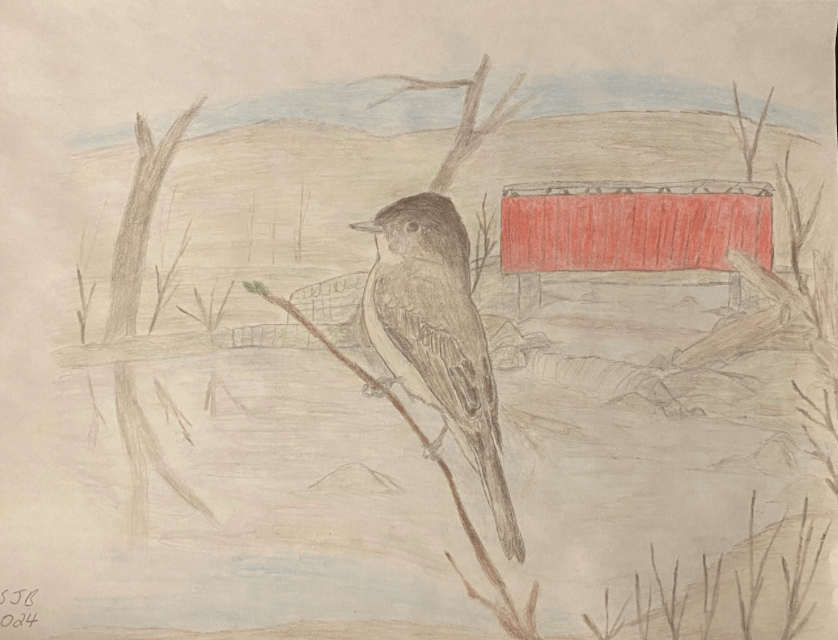
Measuring about five to six inches, weighing less than an ounce, and with a 10 to 11-inch wingspan, the Eastern Phoebe is a rather drab bird. Its plumage on the back and wings is grayish brown, with the wings each having two bars. Its forehead is dark brown, and its bill is black. Its throat is white, and its chest and belly are pale gray but change to faint yellow in the fall. Lastly, its legs and feet are black.
Despite its dull appearance, the Eastern Phoebe is still an interesting bird. For one thing, the species gets its name from its distinct fee-bee song. Found in the tyrant flycatcher family (Tyrannidae), Eastern Phoebes, like all tyrant flycatchers, engage in a flycatching behavior, often perching and waiting patiently for insects to fly by before catching those insects in short flights and returning to the same perch. When perching, they also have a cute habit of wagging their tail up and down. Eastern Phoebes are also quite adaptable and are found in a variety of habitats, including woodland edges, stream sides, and farmlands. Not only do they nest in natural settings, like rock outcrops and streambanks, but they also nest on human structures, like bridges and buildings. They typically nest in areas near water and with woody understory vegetation. The nests are open cups with mud bases and are lined with moss, grass, and animal hair. Females lay two to six eggs, and both parents raise two broods per year. Additionally, unlike most North American birds whose populations have declined, eastern phoebe populations have increased in the last five decades, partly due to their ability to adapt to urban settings.
So, why is the Eastern Phoebe a better sign of spring as opposed to the American robin? Well, unlike robins which are year-round residents in Philadelphia, Eastern Phoebes are migratory. They spend the spring and summer months in the northern United States and southern Canada and migrate south and winter in the southern United States and northern Mexico. Since they’re short-distance migrants, Eastern Phoebes are one of the first migrants to return north, returning as early as March, as well as one of the last migrants to migrate south, leaving as late as November.
Additionally, while robins are omnivorous (feeding on earthworms and fruit), Eastern Phoebes are insectivorous, meaning their diet consists entirely of insects. When insects become less abundant as the weather cools, eastern phoebes migrate to warmer climes where insects are more plentiful.
So, if you see a small, grayish-brown bird perched wagging its tail on a warm day in March, then surely enough spring is here.
 The La Salle Collegian