
Sean Bradley, Staff
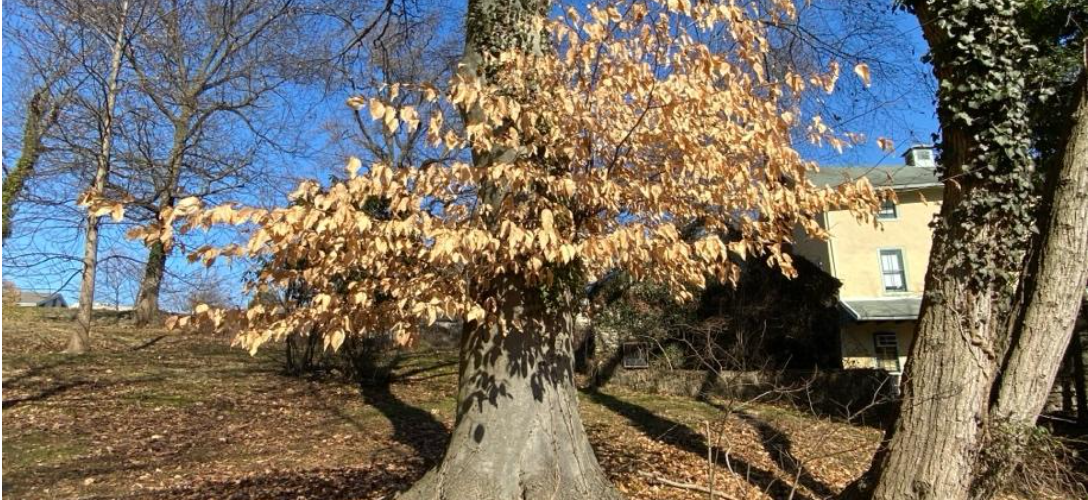
By mid-winter, most deciduous trees have shed their leaves. However, some deciduous trees, like oaks and beeches, will retain their leaves well into winter in a phenomenon known as marcescence. In this Nature at La Salle article, we’ll learn how and why this phenomenon occurs.
The process for trees undergoing marcescence begins in the fall. Beginning in the fall, many deciduous trees create a separation layer between the leaf stem and branch called the abscission layer. For trees that shed their leaves, the abscission layer undergoes completion. Once the abscission layer is formed, nutrients and water are no longer able to be transported to the leaves and thus the leaves fall. Not only does the abscission layer protect the trees from damage as the leaves are shedding, but it also protects the trees from the cold, winter weather. By forming an abscission layer and shedding leaves, trees conserve energy as well as conserve moisture and nutrients within the trunk. The fallen leaves eventually decompose and return nutrients to the trees’ roots to ensure their survival. However, trees with marcescent leaves do not completely form an abscission layer.
While the exact reasons for marcescence are unknown, scientists have a few ideas on why it occurs in some trees. According to a PennState Extension article, trees retain their leaves for these three reasons: protection, food and water. Starting with protection, since marcescence mainly occurs in younger trees and on lower branches, scientists believe the retained leaves help protect new, spring buds from being eaten by animals, like deer. Having marcescent leaves allows the buds to survive and the trees to continue growing. Food is another possibility for why marcescence occurs. Scientists think that marcescent trees keep their leaves until spring, so that they can add more nutrients to the soil for food and growth by shedding their leaves once all the fallen leaves from autumn have decomposed. Lastly, water is another possible reason for why trees experience marcescence. Scientists think that the marcescent leaves help direct precipitation, like snow, to the tree’s base, allowing for water to seep into the roots.
So, the next time you’re outside on a walk on a winter day, you can appreciate and understand the science behind this cool phenomenon.
 The La Salle Collegian