
Sean Bradley, Staff
Last week, the fall foliage was in its prime. Although the colors are beginning to fade away, you still may be wondering what is behind the changing of the leaf colors and why the leaves fall in autumn. This Nature at La Salle article will explore what causes the leaves to change color as well as why the leaves fall in autumn.
There are three factors that affect fall leaf color, including leaf pigment, night length and weather. First, starting with pigment and night length, most leaves are green in summer because they contain a pigment called chlorophyll, which absorbs sunlight to convert into sugars in a process called photosynthesis. But, as the night length increases, the leaves receive less sunlight, resulting in chlorophyll breaking down and yellow, orange and brown pigments called carotenoids being revealed. Also, as the nights get longer, some leaves’ veins, which carry sugars to and from the leaves, close and cell layers form at the leaves’ bases. The sugars then become trapped in the leaves. The clogged veins cause the leaves to produce a red pigment called anthocyanin. Weather also affects fall leaf color, with temperature and moisture being major influences. Regarding temperature, warm, sunny days and cool nights often result in the most colorful foliage. Anthocyanin pigments do particularly well under these conditions. The sugars produced in the leaves during the day become trapped in the leaves at night, resulting in brilliant red foliage. Since carotenoids are found naturally in leaves, yellow, orange and brown foliage occur more consistently. In terms of moisture, warm, wet springs, warm summers and warm, sunny fall days with cool nights often produce the best fall colors. Summer droughts and warmer fall weather result in delayed and duller fall colors.
Additionally, certain leaf colors are associated with particular species. For instance, maples usually have red or orange leaves, whereas oaks have brown leaves. Birches, elms, hickories and tulip-trees have yellow leaves while beeches have tan leaves and dogwoods have purplish-red leaves.
While seeing the leaves change color and fall is a pretty sight, it is also important for the trees’ survival. Unlike evergreen needles, which have protective coatings and cells containing fluids that resist freezing, leaf tissues are tender and thin and lack these sorts of protections. Thus, many deciduous trees drop their leaves to avoid freezing. Lastly, once the leaves settle on the ground, they are still important because they decompose and help form the organic layer of the soil. This process provides nutrients and retains water for the trees to survive. The fallen leaves also provide habitat for small animals, including bees, butterflies, salamanders and earthworms, who hibernate, feed and lay eggs here.
So, the next time you’re outside on a fall day, appreciate the science behind fall foliage. Take a moment to remember the importance of fallen leaves for the trees’ survival and wildlife.
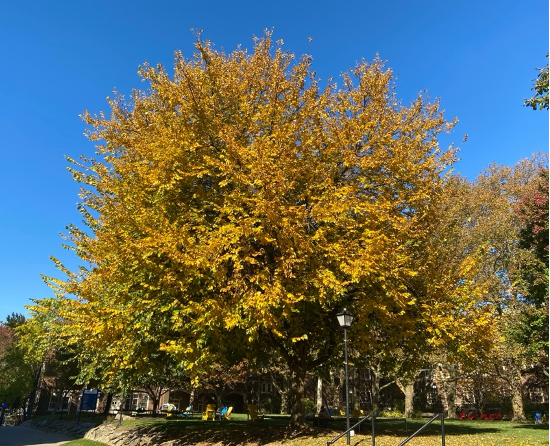
American Elm, via Sean Bradley

Sugar Maple leaf via Sean Bradley

Red Maple via Sean Bradley
 The La Salle Collegian